Author Archive

Voyager, 30 Years On… and On…

Tuesday, August 21st, 2007

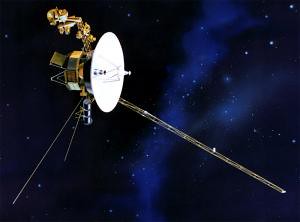
Billions of miles away from earth, way past the edge of our solar system, Voyager 1 is quietly (we assume) celebrating its pearl anniversary this week.
 

Space.com reminds us of the two Voyagers’ origins: 

Voyager 2 launched on Aug. 20, 1977, and Voyager 1 launched on Sept. 5, 1977. Both spacecraft continue to return information from distances more than three times farther away than Pluto, where the sun’s outer heliosphere meets the boundary of interstellar space…

Voyager 1 currently is the farthest human-made object at a distance from the sun of about 9.7 billion miles (15.6 billion kilometers). Voyager 2 is about 7.8 billion miles (12.6 billion kilometers).

Originally designed as a four-year mission to Jupiter and Saturn, the Voyager tours were extended because of their successful achievements and a rare planetary alignment. The two-planet mission eventually became a four-planet grand tour. After completing that extended mission, the two spacecraft began the task of exploring the outer heliosphere.

During their first dozen years of flight, the spacecraft explored Jupiter, Saturn, Uranus, Neptune and their moons. These planets were previously unknown worlds. The Voyagers returned never-before-seen images and scientific data and helped make fundamental discoveries about the outer planets and their moons.

The spacecraft revealed Jupiter’s turbulent atmosphere, which includes dozens of interacting hurricane-like storm systems, and erupting volcanoes on Jupiter’s moon Io. They also showed waves and fine structure in Saturn’s icy rings from the tugs of nearby moons.

 
The NASA Voyager site also contains some amazing facts about the spacecraft, their navigation and observation technologies, and the scientific discoveries that they have made possible.

30 years is a long time, to be sure — but we should enjoy many more anniversaries to come: 

 Barring any serious spacecraft subsystem failures, the Voyagers may survive until the early twenty-first century (~ 2020), when diminishing power and hydrazine levels will prevent further operation. Were it not for these dwindling consumables and the possibility of losing lock on the faint Sun, our tracking antennas could continue to "talk" with the Voyagers for another century or two!
 

Invite2

Monday, August 20th, 2007

Hughes to Buy Gilat?

Wednesday, August 15th, 2007

Globes Online reports on some major movement in the satcom industry:

Gilat Satellite Networks Ltd. (Nasdaq: GILT; TASE) has reputedly received an offer from Hughes Communications Inc. (Nasdaq:HUGH), the company’s US rival. This is not the first time that Hughes has expressed an interest in Gilat; in 2004, the companies were in negotiations for a possible a merger with Hughes Network Systems, which ultimately did not materialize. The failure led to the resignation of Gilat CEO Oren Most. Both Gilat and Hughes Network Systems manufacture very small aperture terminals (VSAT) for satellite communications.

Haaretz.com provides further analysis: 

Gilat has become a hot item. For two years the company’s results have been picking up and now the satellite division of Rupert Murdoch’s Hughes is bidding to buy the Israeli firm for a high $ 12 per share. …

Hughes’ satellite division is Gilat’s arch-rival in the United States. The two are considered leaders in the U.S. satellite communications industry.

Gilat operates in the U.S. through its subsidiary Spacenet, which reported an upswing in business in the second quarter of this year.

Assuming that Gilat’s board of directors decides to accept the offer, the transaction will require approval of the U.S. Federal Trade Commission, which will consider whether a merger of the two companies would negatively impact the market’s customers.

Hughes is controlled by media baron Rupert Murdoch and the Apollo Management fund, one of the investors in York Capital Management, which is Gilat’s largest shareholder with 20.8 percent. 

On Monday, we previewed yesterday’s launch of Hughes’ Spaceway 3 satellite, which expands Hughes’ ability to provide high-speed, two-way communications for Internet, data, voice, video and multimedia applications. The acquisition of Gilat would enable Hughes to increase its provision of such services to Africa and South America, where Gilat is particularly strong (they signed a deal just last month to provide IP and VOIP services to Tanzania).

The end result of the merger would position Hughes to become a major competitor to satellite internet provider WildBlue.

Street Insider first picked up news of the acquisition on Monday, while Asbury Park Press, which is also reporting the deal, cites Israeli tabloid Yedioth Ahronoth.

The offer comes on the heels of solid Q2 results from both Hughes (reporting a 12% revenue increase over Q1)  and Gilat (opens in PDF).

We’ll keep you updated on the details of the acquisition as they become available. To subscribe to the Business Network blog via RSS, click here.

Perseids Light Up The Sky

Wednesday, August 15th, 2007

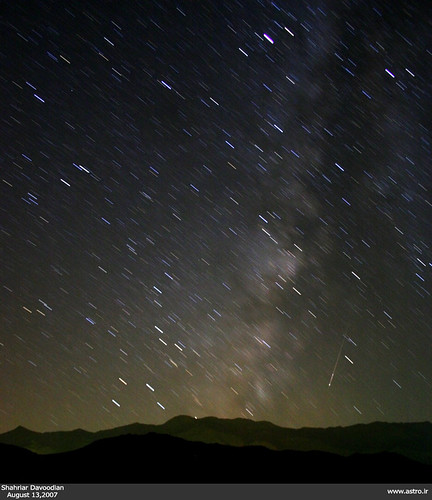
Astronomy buffs throughout the Northern Hemisphere have been staying up late recently to view the Perseids meteor shower, which peaked on August 12th during the new moon.

Spaceweather.com has a fine collection of photographs of the meteor shower. (The photo above is taken from their collection.)  

At its peak Sunday night, the Perseids awed observers with up to 80 meteors per minute visible in a clear sky.

We’ve been fans of the Perseids since the early 1990s, when the comet Swift-Tuttle — the parent body of the Perseid meteor cloud — made its closest pass to earth since Abe Lincoln was president. The proximity of Swift-Tuttle meant that the Perseids were particularly spectacular during our salad days of 1993.

None of us, however, are likely to be around for the comet’s next perihelion passage in August of 2126 (when it may be as bright as Hale-Bopp), but until then the Perseids’ peak — usually August 12th — remains one of the best nights of the year to set up an astronomy date.

Several years ago, Space.com published a great article featuring the Top 10 Perseid Meteor Shower facts. Among them:

 1. Perseid meteoroids (which is what they’re called while in space) are fast. They enter Earth’s atmosphere (and are then called meteors) at roughly 133,200 mph (60 kilometers per second) relative to the planet. Most are the size of sand grains; a few are as big as peas or marbles. Almost none hit the ground, but if one does, it’s called a meteorite.

2. Comet Swift-Tuttle, whose debris creates the Perseids, is the largest object known to make repeated passes near Earth. Its nucleus is about 6 miles (9.7 kilometers) across, roughly equal to the object that wiped out the dinosaurs.

3. Back in the early 1990s, astronomer Brian Marsden calculated that Swift-Tuttle might actually hit Earth on a future pass. More observations quickly eliminated all possibility of a collision. Marsden found, however, that the comet and Earth might experience a cosmic near miss (about a million miles) in 3044.


Check out the complete article (and 7 other interesting facts) here

Arianespace to Lift Hughes, B-Sat Birds Tuesday

Monday, August 13th, 2007

If you remember Papillon, you remember that it’s the story of convicted felon Henri Charrière’s numerous attempts to escape from a penal colony on French Guiana.

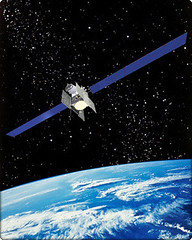
Hopefully, Arianespace will only require one attempt to break free of the surly bonds of earth when they launch their heavy lift mission with the SPACEWAY 3 (artist’s conception at left) and BSAT-3a satellites tomorrow from the Spaceport in French Guiana:

  Arianespace’s third heavy-lift Ariane 5 mission of 2007 has been cleared for its August 14 liftoff following today’s successful launch readiness review, which was performed at the Spaceport in French Guiana.

All is now set for Ariane 5’s transfer on August 13 from its Final Assembly Building to the ELA-3 launch pad, where the final countdown will lead to a liftoff the following day, at the opening of a window runs from 8:44 p.m. to 9:21 p.m. (local time at French Guiana).

SPACEWAY 3 arrived in French Guiana a month ago; it will be operated by the Maryland-based Hughes Network Systems, LLC to provide satellite-delivered broadband services to enterprise, government and consumer users throughout North America. It was built by Boeing:

SPACEWAYTM is Hughes next generation broadband satellite network that will provide high-speed, two-way communications for Internet, data, voice, video and multimedia applications. The initial contract includes three Boeing 702 geostationary satellites built by Boeing Satellite Systems, (BSS) and will operate in the Ka-band spectrum. The first orbital slot is currently planned for 99 degrees west longitude….

The SPACEWAY satellites feature innovative, on-board digital processors, packet switching and spot beam technology. Spot beam technology will enable the satellite to provide services to small terminals, while on-board routers will enable mesh connectivity; users of the system will be able to directly communicate with any other user of the system without requiring connection through a central hub.

The builder of the B-Sat system is Lockheed-Martin, which began building the satellite in 2005: 

Designated BSAT-3a, the 1.8-kW satellite will provide direct broadcast services throughout Japan following its scheduled launch the second quarter of 2007.  Contract terms were not disclosed.  B-SAT previously issued an authorization to proceed to Lockheed Martin for start of satellite design and construction. 

The BSAT-3a communications payload comprises eight 130-W Ku-band channels and will be located at 110 degrees East longitude.  With a design life of more than 13 years, BSAT-3a is based on the award-winning A2100A platform manufactured by Lockheed Martin Commercial Space Systems (LMCSS), Newtown, Pa.  BSAT-3a marks the 12th Lockheed Martin satellite contract awarded in the 1- to 4-kW small-class satellite range and the second in 2005.

B-SAT3a will provide direct television links for the entire Japanese archipelago, and will be operated by Japan’s B-SAT Corporation. The complete launch kit from Arianespace, featuring information on the payload, launch countdown and flight trajectory, can be found in PDF format here.
 

Beer in Space

Thursday, August 9th, 2007

Let’s start by saying that when you’re truly miles away from ordinary — ie, in space — drinking one of these is no swing in the hammock.
We don’t raise this issue because of Endeavor’s successful launch yesterday with Canadian astronaut Dave Williams on board. On shorter missions such as shuttle flights, we side with the teetotalers — astronauts can do without.

And they generally do, with some exceptions. "Small amounts of alcohol were apparently allowed on the Soviet space station Mir, and when Russian astronauts joined the International Space Station, there were some grumblings about the decree that it be dry," according to NewScientistSpace.

And in 1969, "Buzz Aldrin took communion after landing on the Moon, sipping wine from a small chalice. In the Moon’s feeble gravity, he later wrote, the wine swirled like syrup around the cup."

But when you start talking about multi-year voyages to Mars, for example, the question of beer in space — or any carbonated beverage, for that matter — becomes more than just a question at the bottom of your glass. Keeping astronauts on such extended voyages happy is a concern, and while kegstands in zero G aren’t likely to ever appear on the rec schedule, an occasional beer or even soda pop might help astronauts relax during the 2-year haul to Mars.

One of the chief obstacles to consuming carbonated beverages in space, however, is the wet burp:

Unfortunately for thirsty astronauts, beer is poorly suited to space consumption because of the gas it includes. Without gravity to draw liquids to the bottoms of their stomachs, leaving gases at the top, astronauts tend to produce wet burps.

"That’s one of the reasons why we don’t have carbonated beverages on the space menu," NASA spokesperson William Jeffs told New Scientist.

There are also questions about the effects of alcohol in space:

Jeffs says no research has been done on the effects of alcohol in a microgravity environment. But he says: "There may be differences in alcohol absorption and metabolism in space, which makes one suspect that there may be differences in the effects of alcohol in space."

Clark says medications sometimes have unusual effects in space, which "run the gamut from increased to decreased reactions".

At least one study has been done, however, on where astronauts would get their beer when the closest CircleK is a few million miles away:

 Graduate student Kirsten Sterrett at the University of Colorado in the US wrote a thesis on fermentation in space, with support from US beer behemoth Coors. She sent a miniature brewing kit into orbit aboard a space shuttle several years ago and produced a few sips of beer. She later sampled the space brew, but because of chemicals in and near it from her analysis, it didn’t taste great by the time she tried it.

Ok, so maybe even getting beer in space is still a problem. Still, as extended space voyages become a reality in the future, expect the question of drinks in space to come up — though hopefully not in the form of a wet burp.

The Bourne Satellites

Monday, August 6th, 2007

We haven’t yet seen The Bourne Ultimatum, but at least some of us here at Really Rocket Science are counting the hours until we can sit in the darkness with our bucket of buttered popcorn and soda for the final installment of the series, loosely based on the Robert Ludlum novels.   

This is work-related, we tell ourselves, because of the extensive use of satcom in the film to drive the plot, which centers around rogue baddies in the intelligence community tapping into video surveillance networks (think of our Slingbox webcam on steroids) to track the film’s hero:

The plot goes something like this: London journalist Simon Ross (Paddy Considine) has stumbled onto a hyper-secret CIA black op code named Blackbriar.

It’s so sensitive the whisper of it on Ross’ cellphone sends sinister surveillance technology abuzz an ocean away in midtown Manhattan.

There, the Blackbriar leak may as well be a blot of blood in shark-infested waters, sparking the attention and ire of a Bush-league spook (David Strathairn) and Pam Landry (Joan Allen), the honourable but tough-as-nails CIA bureaucrat from 2004’s Supremacy who, in the last moments of that film, told Bourne his birth name.

Thing is, that still hasn’t happened yet — Ultimatum actually kicks off in Moscow following Bourne’s confession to a young Russian girl whose parents he murdered. Still racked by flashbacks to his vicious past — more replete with post-9/11 imagery than ever before — Bourne’s search for his identity leads him to Ross and, consequently, to Strathairn’s thinly-veiled Republican stooge.

From here, Greengrass piggybacks jaw-dropping set piece upon jaw-dropping set piece. When the ever-resourceful Bourne sets up a meet with Ross at London’s Waterloo Station, he puppeteers the reporter through corridors and crowds to evade a rapidly-constricting network of operatives and video surveillance cameras linked via satellite to Strathairn’s hi-tech hub.

Here’s the trailer:

And here’s the breathless review (one of many) from the Winnipeg Sun

Go ahead and ascribe an adjective — breathtaking, heart-stopping, head-spinning — the fact is no stream-of-consciousness thesaurusizing (pulse-pounding, nerve-rattling, spellbinding) does justice to the experience of this fastest, fiercest Bourne yet….

The best action movie of the summer? Try of a generation.

Director Paul Greengrass hasn’t manufactured a sequel — he’s written code for a template all future Bonds, Ryans and whoever-the-hell-else will have to match or stumble and die trying.

Given that the film brought in more than $70 million in its opening weekend, we suspect we’re not the only fans anxious to get into the theater this week.  What of you? Have you seen the film? What did you think of the director’s use of satcom technology as an integral part of the film?

DIY Friday: Lemon Battery!

Friday, August 3rd, 2007

We’ve had some nifty DIY Friday projects since the series began: projects that are truly luxury items (the card-dealing robot and the beer-launching fridge); projects that improve upon the latest in tech gadgetry (the slingbox webcam and tivo on your phone); and projects that allow you to save a few bucks on your latest consumer technology upgrade (such as building your own HDTV antenna).

Most of these projects, we readily admit, require some basis of knowledge in electronics and science. Which has us thinking: where and when did we get excited by the realization that a little bit of creativity, some spare time and a sodder gun could create hours of enjoyment?

For ourselves, that answer goes back to 4th grade, and some of those basic science experiments that, while not particularly useful in an commercial sense, revealed to us that the world of science — and indeed the world itself — was full of wonder.

With that in mind, we present to you a DIY Friday project that truly brings us back to our roots: your very own lemon battery!

Th folks at ScienceOnline produced this fine video. It’s mesmerizing in the unique way that only elementary-school documentaries are. Enjoy it — and, if you have kids, consider doing today’s DIY Friday project with them. You may just unlock a world of wonder.

Rolling Out the Big Gun

Monday, July 30th, 2007

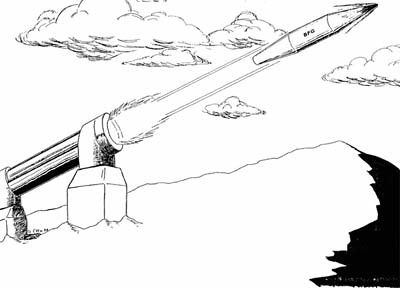
If you ever read Jules Verne’s From the Earth to the Moon, you’ll recall that it’s the story of three wealthy members of a gun club who build a huge cannon and shoot themselves to the moon.

In writing the novel, Verne did a number of calculations to determine how a space gun would work. Although his figures proved to be surprisingly accurate, space guns have since been ruled as a means of manned space flight because the accelerating forces (up to 2,000 Gs!) are too powerful for any living thing to survive.

But now, a group of graduate students and academics hopes to use a similar concept to launch low-cost satellites into orbit.


Space Review reports: 

Ben Joseph, a 25-year-old aerospace engineering graduate of MIT, and a team of students and professors are resurrecting [the space gun idea… with] a radically new kind of impulsive launch technology known as the “ram accelerator.”

Joseph and his colleagues have formed a company called Ballistic Flight Group, with the goal of commercializing the space gun launch concept for satellites:

A typical artillery weapon uses a large explosive force at the base of a gun to propel a shell down a rifled metal tube, which is angled to provide the projectile with its trajectory.

In the space gun launcher being promoted by BFG this cannon type of firing is merely the first step in the process. The main step is the ram accelerator, a technology invented and developed by faculty and staff at the University of Washington in Seattle, where Ben Joseph studied as an undergraduate. After a pre-launcher gun (e.g., light gas or gunpowder propelled) accelerates the projectile up to speeds of over 500 meters per second, the projectile enters the ram accelerator by passing through a breakable diaphragm and entering another tube, this one filled with a more volatile propellant, such as oxygen and methane. Because the projectile enters this second tube at supersonic speeds, it interacts with the tube wall to produce a ramjet–like effect inside the barrel. This ramjet effect forces the projectile to combust the fuel behind it, increasing its acceleration through the tube. The projectile exits the barrel with a muzzle velocity of around 8 kilometers per second. An upper stage rocket would circularize the trajectory of the payload (approximately one third of the projectile’s 2,000-kilogram mass) to a low Earth orbit of around 800 kilometers….

So that’s the technology, as envisioned. What about the cost? 

What makes the ram accelerator so appealing is its economic potential. BFG estimates that the accelerator could be built for an estimated $157 million, a price tag that includes the launch tube and its supports, the pre-launcher gun for initial acceleration, and propellant handling system for the oxygen, hydrogen, and methane gases for the ram accelerator portion of the launch system. This price tag is astonishingly low—cheaper than some expendable rockets—and it could be fired hundreds or thousands of times. Depending on the gun’s final muzzle velocity, prices for payloads could drop to nearly $500 per kilogram, a drastic reduction from current market prices…

During Joseph’s presentation on the commerce track of the International Space Development Conference, he concentrated on the most obvious markets for the ram accelerator: commercial satellite launches. BFG has taken particular interest in the Iridium and Globalstar constellations, which were financial failures but technically viable. Those satellites are nearing the end of their service life, and the ram accelerator would reduce the costs launching new satellites to nearly one tenth of their projected value. At those prices, a large LEO constellation becomes financially competitive with a high-bandwidth satellite chain in geosynchronous orbit. This does not change the economics of human spaceflight, but it does represent the order-of-magnitude cost improvement NASA and the private sector has sought for over 20 years.

Whether a space gun or BFG’s efforts can deliver on the dream of low(er) cost satellite launches remains to be seen. We’ll keep you posted. 


Darpa Goes “Deep Green”

Tuesday, July 24th, 2007

When it comes to battlefield planning and execution, a crystal ball would certainly make a field commander’s life a whole lot easier.

That’s exactly what DARPA — the research and development arm of the Department of Defense — hopes to create (sort of) with the "Deep Green" program.


DARPA describes the requirements for Deep Green in its call for ideas (PDF here):

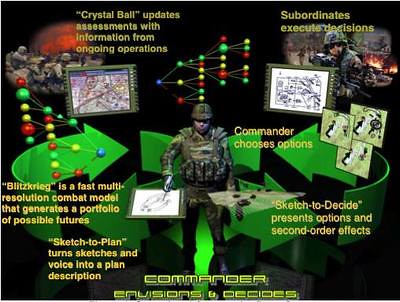
Deep Green will build a battle command decision support system that interleaves anticipatory planning with adaptive execution. Deep Green must be capable of addressing the full spectrum of joint and combined arms capabilities available to the modular brigade commander, drastically increasing the option and future space. This will allow the commander to think ahead, identify when a plan is going awry, and help develop alternatives “ahead of real time.” The commander (and his support staff) is involved in essentially two major asynchronous functions: generating options and making decisions. The goal of this program is to create a commander-driven system to assist the commander and his support staff in generating options or Courses of Action (COAs).

Wired explains further: 

Deep Green has a half-dozen different interlocking components, including a "Sketch to Plan" program that reads a commander’s doodles, listens to his words, and then "accurately induces" a plan, "fill[ing] in missing details."  That allows an officer "to specify an option at a coarse level, then move on to the next cognitive task."  A related program, "Sketch to Decide" allows a commander to "see the future" by producing a "comic strip" to represent his possible options in a given situation.  That may "sound exotic," the Agency notes.  But "since the 1970s (and perhaps earlier), there have been novels and game books in which the reader is asked to make a decision and then is directed to a different page or paragraph, depending on the choice made."

To make these warzone versions of choose-your-own-adventure novels, Darpa proposes two pieces of software. "Blitzkrieg" will quickly model sets of alternatives, while "Crystal Ball" will take information currently coming into a headquarters to figure out which scenarios are the most likely to happen, and which plans are likely to work best.    Crystal Ball will use this estimate to nominate to the commander futures at which he/she should focus some planning effort to build additional options/branches.  Crystal Ball will identify the trajectory of the operation in time to allow the commander to generate options before they are needed.

 So why the name Deep Green? The Register snarkily explains:

The colour presumably alludes to the fact that – at least to start with – the robocommand package is intended to help US Army bird colonels handle their "modular brigade" battle groups. If the project were a British Army one, the project might be known as "Deep Brown" (Or there again, maybe not). As Deep Blue is already taken, future versions for the other US services will presumably be known as Deep Periwinkle (air force) and Actually Deep Blue (navy).

The R&D timeline is slated for just three short years, though that estimate is made without the benefit of a crystal ball, we presume.