Author Archive

Astronauts Toss Junk Overboard from ISS

Monday, July 23rd, 2007

At 6:24 am EDT this morning, two International Space Station crew members — Astronaut Clay Anderson and cosmonaut and station commander Fyodor Yurchikhin — stepped from the Quest Airlock to take out the trash.

Specifically, they had to get rid of a refrigerator-size ammonia reservoir and a supporting brace.

The Houston Chronicle explains:

After months of deliberation, NASA decided to throw away the coolant tank and a 218-pound brace. Normally, the no-longer-needed pieces of hardware would have been returned to Earth aboard a space shuttle.

However, NASA is planning only 12 to 14 more assembly and supply missions to the 210-mile-high orbital outpost before it retires the shuttle fleet in 2010. There won’t be enough room to bring the ammonia tank and the brace back, space agency officials said earlier this month.

The brace was occupying external stowage space on the station that will be needed to hold a new gyroscope that is awaiting launch aboard the shuttle Endeavour early next month.

But wait — we’ve written before about the dangers that space junk poses to satellites and the ISS. So how will the ISS avoid smacking into a 1,400 pound ammonia coolant tank? 

Late today, NASA plans to raise the altitude of the space station by several miles to lower the risk of a catastrophic collision with the space station. The two objects will be tracked by military radar so the operators of other spacecraft can be notified of a potential collision.

Even in a zero-G environment, of course, trash can be unwieldy. That’s why Cosmonaut Oleg Kotov stayed in the U.S. laboratory Destiny to operate the Canadarm2 and help the two spacewalkers with the morning chores:

Canadarm 2 is a larger and more sophisticated version of the robotic arm built for the space shuttle. Fully extended, the arm is nearly 18 metres long, three metres longer than the shuttle’s arm, and can handle loads up to 116 tonnes.

The new arm also has a hand on either end so one can latch onto the space station while the other end reaches out and picks up things that it needs. Then it can let go and grab on somewhere else.

The real talent in the new design is in its ability to move around where the astronauts most need the robot arm. The Canadarm 2 can crawl along the body of the space station on its two hands, end over end like an inchworm. The outside of the station has a number of sockets where the arm can plug in. As well, the arm can be fixed to a work platform that moves on rails from one end of the station to the other.

For all that sophistication, however, we are sad to report that the Canadarm2 still cannot open a can of beer. (See video.)

Video of this morning’s spacewalk can be seen here. Also check out this news report on astronaut Clay Anderson, who brought a football with him to the ISS in honor of his Nebraska roots.

Cleveland Art Festival Utilizes IPTV for Digital Film Fest

Thursday, July 19th, 2007

Hello Cleveland!

Tonight marks the kickoff of the three-day Open Student Television Network (OSTN) / Internet 2 Film Festival, which is being run as part of the Ingenuity Festival at Cleveland State University.

OSTN features the only 24/7 worldwide IPTV channel devoted exclusively to student programming, and boasts 41 million subscribers at 4,500 universities in 36 countries. Internet 2 is a higher education research consortium delivering advanced networking capabilities to its members. And the Ingenuity Festival is 4 days of cool creativity — including "opera, theater, ballet, step dancing, breakdancing, contemporary dance," and "cutting-edge, art-and-technology collaborations and integrations" — in Cleveland’s Playhouse Square.

But here at Really Rocket Science, we’re particularly intrigued by the IPTV delivery of the OSTN/Internet 2 Film Festival:

The collaboration between the Open Student Television Network and Internet2 create the perfect mesh for the Ingenuity Festival, combining both technology and media in the ultimate medium – a premiere channel for student produced work. The Internet2 network acts as a backbone for the OSTN channel’s delivery to colleges and universities all over the country, and allows the channel to deliver streaming NTSC quality video through fiber. The OSTN Channel is available to Cleveland State University, Case Western Reserve University, John Carroll University, the University of Akron and other surrounding Intenet2 member schools.

The organizers have used IP at every stage of the festival:

The student directors and producers will use Internet2 technologies to both submit and screen their films, the organizers said. A variety of media formats will be showcased, including short films, documentaries and student television shows.

Digital programming from diverse sources will be shown, including the work of students the University of Southern California, Brown University, Duke University, Oberlin College, John Carroll University, and the University of Akron.

Not in Cleveland? No worries. Each night of the festival (which lasts from 7-9 pm Eastern) is being webcast (schedule here). You can check out the films being shown here. We’re impressed by the high quality of the submissions, with Feedback Fred (pictured above) of particular note — there’s something about it that perfectly captures the vibe of the Berlin art scene as we remember it  from a visit  to Germany nearly 18 years ago.


Slim and Sleek in Your New Spacesuit

Wednesday, July 18th, 2007

Back in March, we wrote about the efforts of scientists to build the next generation of spacesuits, and their goal of halving the 300-lb weight of current spacesuits and increasing mobility.

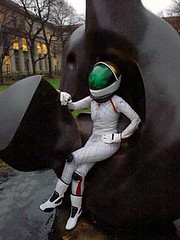
Now, however, Dava Newman, a professor of aeronautics and astronautics and engineering systems at MIT, has a new "Biosuit" design that not only meets those requirements — but adds the all-important element of style.

 MIT News explains:

Newman is working on a sleek, advanced suit designed to allow superior mobility when humans eventually reach Mars or return to the moon. Her spandex and nylon BioSuit is not your grandfather’s spacesuit–think more Spiderman, less John Glenn….

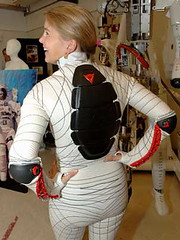
Newman’s prototype suit is a revolutionary departure from the traditional model. Instead of using gas pressurization, which exerts a force on the astronaut’s body to protect it from the vacuum of space, the suit relies on mechanical counter-pressure, which involves wrapping tight layers of material around the body. The trick is to make a suit that is skintight but stretches with the body, allowing freedom of movement.

Over the past 40 years, spacesuits have gotten progressively heavier, and they now weigh in at about 300 pounds. That bulk — much of which is due to multiple layers and the life support system coupled with the gas-pressurization — severely constrains astronauts’ movements. About 70 to 80 percent of the energy they exert while wearing the suit goes towards simply working against the suit to bend it.

Working in a three hundred pound suit is only possible in a low-gravity environment. But if humans ever step foot on Mars, they’ll need lighter suits such as the one designed by Newman:

Key to their design is the pattern of lines on the suit, which correspond to lines of non-extension (lines on the skin that don’t extend when you move your leg). Those lines provide a stiff "skeleton" of structural support, while providing maximal mobility….

The suits could also help astronauts stay fit during the six-month journey to Mars. Studies have shown that astronauts lose up to 40 percent of their muscle strength in space, but the new outfits could be designed to offer varying resistance levels, allowing the astronauts to exercise against the suits during a long flight to Mars.

Perhaps most amazing is the Biosuit’s safety aspect:

[I]f a traditional spacesuit is punctured by a tiny meteorite or other object, the astronaut must return to the space station or home base immediately, before life-threatening decompression occurs. With the BioSuit, a small, isolated puncture can be wrapped much like a bandage, and the rest of the suit will be unaffected.

To get a full perspective of the complex requirements that must be met for a spacesuit to function safely in the hostile environment of space, check out this entry from Wikipedia. 


Who’ll Own Dow Jones?

Tuesday, July 10th, 2007

Talk about the rapidly-shifting media landscape! For the last several days, the press has been abuzz with conflicting reports about the fate of Dow Jones and its true content-producing prize, the Wall Street Journal.

Interestingly, a major satcom player has stepped into the scene of this high-stakes business drama.

A few days ago London’s Business Online claimed an exclusive scoop, handing the prize to Rupert Murdoch:

 Rupert Murdoch has succeeded with his $5 billion bid for Dow Jones, owners of the Wall Street Journal, according to sources acting for the Dow Jones board. Negotiations on price and matters of principle have been completed, though some details remain to be resolved. None is regarded by either side as a deal-breaker.

The Dow board is confident that the terms of the deal will be accepted  by the Bancroft family, which controls a majority of voting shares in Dow Jones, over the next few working days. A formal announcement is expected next week.

On Friday afternoon London time, Dow Jones, reacting to the first posting of this story, issued a statement saying that it was "incorrect". When The Business contacted Dow’s corporate affairs, however, it refused to elaborate on the record.

While it’s only Tuesday, and news confirming the scoop could come at any moment, Forbes reported yesterday that Dow Jones may be holding out for a White Knight

Dow Jones, in talks to be acquired by News Corp., is holding onto hopes that it can avoid Rupert Murdoch’s grasp. The Wall Street Journal publisher was to meet Monday with a supermarket baron who has been looking to buy a major newspaper.

Dow Jones (nyse: DJ news people ) board members were scheduled to sit down with billionaire Ron Burkle. Last month, the Dow Jones union approached Burkle about a possible bid. The union, which represents over 2,000 employees, has opposed a $5 billion, $60-per-share offer from News Corp. (nyse: NWS news people ) saying that Murdoch could meddle with the media company’s editorial products and hurt its journalistic integrity.

But perhaps the White Knight will come from the stars or — in an ironic twist — from a consortium that includes a Web 2.0 guru who got famously rich from (you guessed it) Rubert Murdoch himself:

EchoStar Communications is part of an investor group, led by MySpace cofounder Brad Greenspan, which is looking to buy part of Dow Jones, The Wall Street Journal reported Monday.

Greenspan brought together of group of investors that are looking to purchase part of Dow Jones at $60 per share and to invest another $250 million, offering an alternative to Rupert Murdoch’s $5 billion offer for the financial-news company.

Greenspan’s group “would include the participation” of EchoStar, according to The Journal. EchoStar declined to comment to the paper.

Looking to invest in Dow Jones would be the latest in a series of unusual investment moves on the part of EchoStar, the nation’s second-largest direct-broadcast satellite provider. Earlier this year, Charlie Ergen’s company reportedly made a failed $2.13 billion bid for ION Media Networks, which owns 60 TV stations and runs a broadcast network. ION ultimately accepted a tender offer from NBC Universal and Citadel Investment Group.

And just last month, EchoStar teamed up with its satellite rival, DirecTV, to make a bid for Intelsat, the world’s biggest provider of fixed-satellite services. But BC Partners won in that auction, acquiring a majority stake in Intelsat for $5 billion.

Now, for those who haven’t been closely following the plot: NewsCorp bought MySpace, making Brad Greenspan a rich man. EchoStar chief  executive Charlie Ergen and Murdoch were previously locked in a years-long battle for No. 1 satellite-TV operator DirecTV, which Murdoch’s  News Corp. eventually acquired. Now EchoStar and Greenspan appear to be going head to head with Murdoch in a bid to grab one of global media’s premier content properties.

What’s at stake in this ongoing competition between Ergen and Murdoch to build their respective satellite and content empires? News Corp. wants to launch Fox Business Channel, so having Dow Jones would give them a competitive advantage over CNBC. Considering how quickly Fox News became competitive with CNN, or how quickly MySpace added value to NewsCorp’s media portfolio, it’s not an overstatement to say that the final results of this bidding war will reverbate for years to come.

And so the convergence continues….

A Tour de France First: HD

Monday, July 9th, 2007

The 2007 Tour de France kicked off on Saturday from London, England — and Stage One, which ended in Canterbury, has already featured some high drama.


London mayor Ken Livingstone wrote about the course of the race prior to the Grand Depart, and the standings so far can be found here. But race fans have no doubt already heard about Robbie McEwan’s incredible comeback from a crash early in the race. As one fan writes:

McEwen crashes 20km from the finish line and is out of the race due to the furious pace being set at the front of the peleton by teams such as Quick-Step, Milram, Credit Agricole and Lampre. He is somehow brought back into the peleton with just a few kilometers remaining by his teammates despite the best efforts of the sprinter teams to make sure he stays out of contention. He then works his way through the entire Tour de France field in the space of a couple of miles and, despite all the exertions and a wrist injury, appears in the last 200 metres to blow all the other sprinters away. One of the most historic non-mountain stage wins in the Tour de France.

Here’s the video on YouTube:

Fans outside of England wouldn’t know about McEwan’s comeback without satcom, of course, and this year marks the first time that le tour is being broadcast in HD, thanks to a suite of satcom services being provided by Globecast:

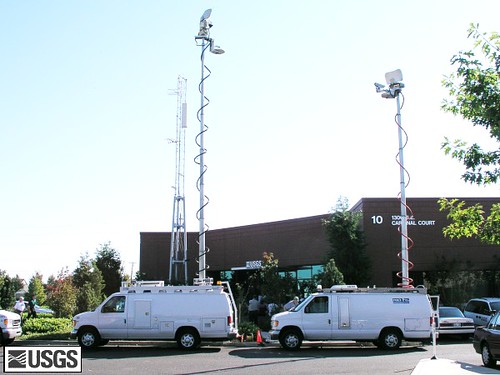
GlobeCast will supply French broadcaster France Televisions and the European Broadcasting Union (EBU) with satellite and microwave transmissions to provide complete HD coverage of the race. GlobeCast will be deploying up to eight SNG (satellite news gathering) and mobile microwave units at each stage of the race, supported by 30 technical professionals. That includes coverage of the race’s start in London, England–a first for the Tour–where GlobeCast recently launched a full-service broadcast and playout center.

GlobeCast mobile units stationed at various points along the course will transmit footage shot via motorcycle and helicopter by SFP (Société Française de Production) back to France Televisions’ production trucks at the finish line. GlobeCast will provide unilateral satellite contribution feeds to the channel’s master control room in Paris, and its mobile units will distribute the official world feed of the Tour de France to rights holders throughout the world on behalf of the EBU.

The overall communications solution provided to the Tour by France Telecom, which now markets all its services under the Orange brand, includes 1,500 temporary telephone lines to be deployed every day in the technical and press areas; high-speed Internet access in those areas; an upgraded mobile network over the entire course to ensure optimum coverage, mostly in 3G or 3G+; and a team of 50 technicians. The team will be mobilized around the clock, with support from 330 regional colleagues at each stage, and will handle the transport, assembly, operation and supervision of the necessary infrastructures and systems for five specific areas: stage finish line, organization headquarters, intermediate points, press room and stage departure village.

If you want to see the excitement of the tour in even higher definition than HD (or at least on a bigger screen), be sure to check out Wired to Win, an IMAX film about the Tour de France that  is now making its way to select cities.

DIY Friday: High-Powered Mountainbike Light

Friday, July 6th, 2007

Summer’s got you in the mood for some adventure, and the mountain bike in the garage is calling you to get outdoors and blaze some new trails with your handheld GPS.  But the weather forecast is for hot. Heiß. Caliente. If only you could mountain bike after dark, you think….

Which brings us to this week’s DIY Friday project: a high powered LED headlight for your mountain bike helmet.


The folks over at Singletrack provide the instructions, and a list of materials you’ll need:

  • A 7.2v 1400mAh Ni-Cad battery 
  • A 150mA trickle charger
  • Some 2 core mains cable
  • A White luxeon star V LED 
  • A collimating lens
  • A 22mm pipe cli
  • A AMD heatsink
  • Some thermal paste
  • A re-usable zip-tie
  • Some small zip ties and electrical tape
  • A DPDT sub-min toggle switch
  • A 1 Ohm resistor and a 0.47 Ohm one, both rated at 3W

Singletrack provides a list of suppliers for the above materials in the UK; a little bit of Googling (DIY style) should turn up suppliers for our U.S. readers. (Tools required consist solely of a junior hacksaw, a file, some glue and a soldering iron.)

Still need more illumination than the light that is now attached to your helmet? Race Day Nutrition provides the plans for a bike light (that you can attach to the handlebars) using three 3W Luxeon LEDs.


For additional ideas — more illumination, as it were — check out the DIY LED Bike Lighting Guide, which makes the case for LED over halogen for a variety of factors, from more acceptable battery drain to lighter weight and less heat.

Now get pedaling. 

DirecTV Satellite Launch Friday at 8:50 pm EDT

Thursday, July 5th, 2007

DirecTV customers have been promised 100 HD channels by September — and the delivery of that promise is riding on a rocket that launches tomorrow night.

The Proton Breeze M launch vehicle will lift off from Pad 39 at the Baikonur Cosmodrome, Kazakhstan, with the DIRECT 10 satellite on board. According to the International Launch Services (ILS) website, "this will be the debut of the Enhanced Proton Breeze M, which is capable of launching spacecraft over 6,000 kg into Geosynchronous Transfer Orbit (GTO)."

The payload is the Boeing-built Direct 10 satellite:

DIRECTV’s next-generation satellite features state-of-the-art antenna and payload subsystem that will provide customers with unparalleled national and local HDTV (High Definition Television) service. The powerful 131-transponder payload integrates 32 active and 12 spare TWTAs at Ka-band for national service and 55 active and 15 spare TWTAs for spot beams. The payload is powered by a gallium arsenide solar array that spans more than 48 meters. DIRECTV 10 will receive and transmit programming throughout the United States with two large Ka-band reflectors, each measuring 2.8 meters in diameter, and nine other Ka-band reflectors.

ILS is running a launch blog, where the most recent entry chronicles the rocket’s journey out to Pad 39 on Tuesday:

The rather uneventful train trip out to the pad could be watched from various points around Area 95 and drew the biggest crowd of onlookers we have seen out here so far. Everyone who wanted to attend was permitted on the pad deck to watch the incredible sight as the assembled ILV rolled horizontally into position next to the flame bucket. Then it was hydraulically rotated to its vertical launch position.

Talk about a photo opportunity. Pictures, videos, Russian and Americans alike… everyone tried to capture it in as many ways as they could. One of the favorite pictures to take is to pose as if one hand is pushing the rocket to vertical. It never really DOES look like one person is doing the lifting, but it is a tradition to try and get that shot to commemorate this exciting day.

The launch will be webcast live here. Also be sure to check out this photo gallery

DIY Friday: Slingbox Traffic Webcam!

Friday, June 22nd, 2007

Earlier this month we wrote about an innovative blogger using Slingbox and Tivo to deliver Tivo to a mobile phone.

Now, Slingbox is making its second appearance in a month in our DIY Friday series with your very own DIY Traffic Webcam!

A TV news station in San Francisco figured it out

The news operations director at CBS 5, Don Sharp, devised a way to replace more than 20 of its cameras affixed to the tops of local bridges, freeways and buildings that use microwave technology to relay video back to the station with smaller cameras combined with a Slingbox Pro and a high-speed wireless EVDO card, at 800 kilobits per second.

Normally, news stations have to pay $25,000 for cameras to monitor traffic and weather, in addition to the cost of maintaining the units and renting the space for them. Compare that to a smaller camera for $500, a $300 Slingbox and $60 per month for each data card and it could potentially change the way broadcast TV news does business. That’s especially true if someday all live shots were done with a small portable camera and Slingbox, since that could eliminate the need for gas-guzzling microwave trucks normally needed to broadcast breaking events.

Be sure to check out the great webcam shots of San Fran, transmitted via Slingbox, here.

So what do you think? Could this really send these guys the way of the dinosaurs?


To the Asteroid Belt!

Thursday, June 21st, 2007

NASA has scheduled a news briefing for next Tuesday, June 26, at 2 p.m. EDT.

The purpose of the news briefing is to preview the July 7 launch of the asteroid belt-bound Dawn mission.

Named "Dawn" because it is designed to study objects dating from the dawn of the solar system, Dawn will launch aboard a Delta II rocket from Cape Canaveral, Fla:

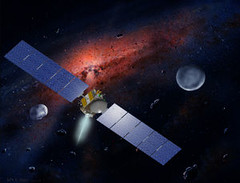
[The mission] will send the Dawn spacecraft, a robotic space probe, to the asteroid belt. Dawn will orbit and examine the two most massive members of the asteroid belt, the dwarf planet Ceres and the asteroid Vesta. Dawn will be the first spacecraft to enter into orbit around two different planetary bodies other than the Earth and Moon, and the first to visit the largest asteroid….

The mission’s goal is to characterize the conditions and processes of the solar system‘s earliest epoch by investigating in detail two of the largest protoplanets remaining intact since their formation. Ceres and Vesta have many contrasting characteristics that are thought to have resulted from them forming in two different regions of the early solar system; Ceres is theorized to have experienced a "cool and wet" formation that may have left it with subsurface water, and Vesta is theorized to have experienced a "hot and dry" formation that resulted in a differentiated interior and surface vulcanism.

To cruise from Earth to its targets it will use three DS1 heritage Xenon ion thrusters (firing only one at a time) to take it in a long outward spiral.

Images from the Hubble Space Telescope, such as the ones below, are being used by astronomers to help plan the mission:


 Of particular note is that this Dawn almost never arrived:

The mission originally was approved in December 2001 and was set for launch in June 2006. Technical problems and other difficulties delayed the projected launch date to July 2007 and pushed the cost from its original estimate of $373 million to $446 million. The decision to cancel Dawn was made March 2, 2006, after about $257 million already had been spent. An additional expenditure of about $14 million would have been required to terminate the project.

The reinstatement resulted from a review process that is part of new management procedures established by NASA Administrator Michael Griffin.

The briefing will air live on NASA Television and be streamed on the agency’s Internet homepage at www.nasa.gov.

The Tribe of Google Earth

Tuesday, June 19th, 2007

Google is harnessing the power of satellite imagery to help the people of Amazon.

No, not that Amazon — this one:


The San Francisco Chronicle explains how Amazon Chief Almir Surui reached out to Google for help in ending violent clashes between loggers and miners and members of the Surui tribe: 

During his visit to the Bay Area late last month, Almir, the first Surui to graduate from college, asked the folks at Google Earth for high-quality satellite imagery that would allow the tribe to monitor loggers and miners, who have no legal right to operate on the tribe’s 600,000-acre reserve about 1,600 miles northwest of Rio de Janeiro.

His plea fell on receptive ears with company officials in Mountain View, who are now at work on a plan to let the Surui use Google’s technology to raise awareness of their plight by working with satellite providers to vastly improve image resolution.

"The Amazon rain forest and its indigenous peoples are disappearing rapidly, which has serious consequences both locally and globally," said Google Earth spokeswoman Megan Quinn. "This project can raise global awareness of the Surui people’s struggle to preserve their land and culture by reaching more than 200 million Google Earth users around the world."

Google Earth has already been used to track disappearing gorillas, the humanitarian crisis in Darfur, and the results of mountaintop removal coal mining in Appalachia. 

This isn’t the first convergence of high technology and the Amazon basin, of course. Last September, we wrote about Intel’s efforts to build a digital city in the Amazon; and the One Laptop Per Child initiative (supported by SES-Americom) promises to bring the power of computers and internet communications to people living in remote locations throughout the world.