Author Archive

Surfing at East Java

Friday, November 2nd, 2007

Surfing at East Java. This brings two things to mind – boarding off the coast of Indonesia and surfing the Internet at a trendy coffee shop. But what if you want to surf the Internet in Indonesia. Well, its not so easy.

Indonesia is a developing nation consisting of 17,508 islands, making it the world’s largest archipelagic state. Indonesia also happens to be the fourth most populous country in the world. So how do you connect all these Islands and people? With SAT-GE:

SAT-GE, a provider of unique C and Ku-band satellite coverage stretching across the Pacific Ocean Region from coast-to-coast, today announced the provision of satellite capacity across Eastern Indonesia for PT Telkom, the leading incumbent telecommunications operator in Indonesia.

Using multiple transponders on the GE-23 satellite, PT Telkom are able to rapidly extend their GSM/CDMA network and other services over Eastern Indonesia, providing connectivity deep into Papua, Maluku and Sulawesi.

GE-23 was chosen as the best satellite for the job, with a prime position over Papua, it delivers a unique coverage of Eastern Indonesia and its power capability is ideal for high bandwidth trunking and backhaul.

“With a subscriber base growing at double digits month-on-month, we needed a combination of bandwidth, coverage and rapid deployment. Satellite was the ideal solution for our expansion in Eastern Indonesia, and GE-23 meets our needs,” said Mr Dani Indra Widjanarko – Satellite General Manager.

“It has been a pleasure to work with SAT-GE; their responsiveness and the higher power capability of GE-23 opens many opportunities for us for Eastern Indonesia.”

Andrew Jordan, General Manager of SAT-GE, commented: “We are delighted to be able to assist PT Telkom in their pursuit of growth and the roll-out of communications across Indonesia. GE-23 supports voice, video and data applications and PT Telkom has chosen a platform that will be able to grow with their objectives and aspirations.”

About PT-Telkom:

PT Telekomunikasi Indonesia Tbk (TELKOM) is the largest full information and communications (InfoComm) service and network provider in Indonesia. TELKOM (here after referred to also as the Company) provide fixed wirelines, fixed wireless, cellular as well as data & Internet and network interconnection services, both directly and through its associate companies and subsidiaries.

As of December 31, 2006, the number of TELKOM subscribers reached 48.5 million, consisting of 8.7 million fixed wireline and 4.2 million fixed wireless subscribers and 35.6 million cellular subscribers. TELKOM’s subscriber growth of 30.73% in 2006 increased the Company’s operating income in 2006 by 23% compared to that of 2005.

DIY Friday: Office Firewall

Friday, November 2nd, 2007

Focus. It can be tough to get “in the zone” at work. AIM windows popping, email alerts, Really Rocket Science RSS feeds — is there ever a break for work?

Forget about server-side firewalls — its time for an office firewall:

The recipe is pretty simple: turn off your programs, put AIM on away, don’t open a browser, and tell your co-workers to bugg-off.

But some of this is just a little ridiculous:

If interruption by your manager or co-workers is a big problem, work out a way that you can signal you’re available to chat or that you’re super-involved at the moment at your desk. A dishwasher “dishes are clean, dishes are dirty” flippy sign comes to mind, or a mailbox flag type device. Make an agreement with others that when the “sock’s on the door,” you won’t stop by asking if they want to get coffee or what they thought of last night’s Lost.

While some of this is just genius:

A couple of programmers I know who worked at a frenetic office used to schedule a 2 hour long meeting together in a conference room a couple of times a week, where they’d go with their laptops to code in peace.

But maybe we need more dramatic change. Designer Marcus Curran developed an office “pod”:

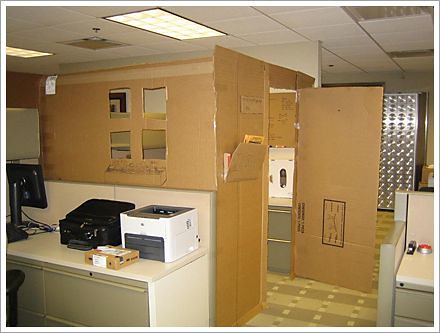
If your manager isn’t going to sign-off on that price-tag, just turn to cardboard:

Or, best of all, don’t go to the office at all. The new trend may be telepresence:

It’s IvanAnywhere, a robot Bowman uses to interact with his colleagues in Waterloo from his home office 1,350 kilometres away.

“Robot” is a bit of a stretch, actually. IvanAnywhere is basically a coat rack on wheels with attached speakers, camera and touch-screen computer.

The computer screen displays a live shot of Bowman’s face from his living room in Nova Scotia.

But in the three months since IvanAnywhere first went online, he has become such a normal part of the third floor at iAnywhere that co-workers barely even notice they’re talking to a machine rather than to Bowman’s human form.

“We are all so used to Ivan, they don’t even give it a second thought,” says Glenn Paulley, Bowman’s boss and the originator of the IvanAnywhere idea.

When Bowman has a question for a colleague, he doesn’t pick up the phone; he uses his joystick to drive his doppelganger to the team member’s office.

If Paulley needs Bowman’s time on a software issue, he calls IvanAnywhere to his office, just as he would with any other employee.

Bowman uses IvanAnywhere to take part in meetings, even giving presentations with the help of a projector.

Every once in a while, he’ll motor to the floor’s lounge area to look out the window and chat with passersby, much as he would if he were in Waterloo.

Fast-track Road Trip

Tuesday, October 30th, 2007

Cross-country road trips serve as a right of passage — one of the few memorable and transformational experiences that almost anyone can do (we’re not talking about hiking the Appalachian Trail here). It can be a remarkable experience: have a pint at a rural dive-bar, detour on the historic Route 66, spend the night at a college dormitory, eat breakfast at truck-stops, and, most importantly, just enjoy the ride. So, what’s the rush?

Roy’s memoir, The Driver: My Dangerous Pursuit of Speed and Truth in the Outlaw Racing World, will hit bookstores this week, serving dual purposes. For one, its narrative proffers the backstory to Team Polizei, the Teutonic-themed guise Roy derived for the Gumball rally in 2003. Perhaps more important, at least for automotive information junkies, is the formal declaration it’ll issue. And this is it: Roy and co-driver Dave Maher last year raced from New York City to Santa Monica Pier – a total of 2,795 miles across 13 states — in a 2000 BMW M5, arriving after 31 hours, 4 minutes on the road. If accepted by the community of rally cohorts who scrutinize such matters, that time will best all other such records of lore, the most recent clocked this past May, when rivals Richard Rawlings and Dennis Collins claimed a time of 31 hours, 59 minutes from New York City to Redondo Beach, California in a black Ferrari 550. It also dramatically undercuts the celebrated record of 32 hours, 7 minutes set by David Diem and Doug Turner, winners of the 1983 US Express.

The New York Times has more, including a photo:

The message came across the police scanner in October 2006 as Alexander Roy was driving his 2000 BMW M5 west on Interstate 44 in Oklahoma: “I have a report of a blue BMW speeding, weaving in and out of traffic and driving recklessly. Be advised.”

Roy said he heard it shortly after he and his co-driver, David Maher, had been exceeding 150 miles an hour. As Maher scanned the prairie through binoculars for a place to hide, the car’s radar detectors lighted up. They decided to exit the highway and feign a bathroom break while a support team in a Cessna overhead searched for the speed trap that would inevitably materialize.

Having temporarily escaped, Roy eased back onto the highway. As he approached two state police vehicles waiting on the median, he ducked to the right of a tractor-trailer in a move he called “the cross-country racer’s ideal police line-of-sight blocking position.”

You can check out a detailed “driveplan” here. They made a total of only five fuel stops, thanks to a reserve fuel tank, as part of the gear.

The gear is all bought and loaded. Twenty packs of Nat Sherman Classic Light cigarettes, check. Breath mints, check. Glucose and guarana, Visine and riboflavin, Gatorade and Red Bull, mail-order porta-pissoir bags of quick-hardening gel, check.

Randolph highway patrol sunglasses, 20-gallon reserve fuel tank, Tasco 8 x 40 binoculars fitted with a Kenyon KS-2 gyro stabilizer, military spec Steiner 7 x 50 binoculars, Hummer H1-style bumper-mounted L-3 Raytheon NightDriver thermal camera and LCD dashboard screens, front-and-rear-mounted sensors for a Valentine One radar/laser detector, flush bumper-mount Blinder M40 laser jammers, redundant Garmin StreetPilot 2650 GPS units, preprogrammed Uniden police radio scanners, ceiling-mount Uniden CB radio with high-gain whip antenna. Check. Check. Check.

The car’s modifications:

So, this isn’t just an average road-trip on speed. In fact, Roy and his team were breaking a record originally set back in 1971. Still, I’d still prefer my lazy journey and lots of Fast Food breaks.

Arctic Russian Telecom

Wednesday, October 24th, 2007


Gilat’s SkyEdge Networks will be expanding their satellite-Internet services in the Russian-arctic North.

Gilat Satellite Networks Ltd. (Nasdaq:GILT) today announced that North-West Telecom, one of Russia’s largest telecommunications companies, is expanding its Gilat SkyEdge satellite network to bring telephony and broadband Internet services to a growing number of remote communities in North Western Russia.

North-West Telecom originally deployed a SkyEdge VSAT network earlier this year to serve several hundred sites in the Arkhangelsk region. The network expansion will serve many more sites in the Murmansk, Karelia, Komi and Vologda regions and will comprise hundreds of SkyEdge Pro VSATs and more than 60 SkyEdge Gateways that provide high-speed mesh trunking and IP connectivity.

North-West Telecom’s deployment of the SkyEdge VSAT network fulfills a Universal Service Obligation (USO) to meet the modern telecommunications requirements of rural communities. The network is operated by Russia’s leading satellite service provider, Global-Teleport, which will use its SkyEdge satellite hub station based near Moscow. Gilat has been working closely with Global-Teleport to develop several major communications networks in Russia.

“This is the third major USO project that we are deploying based on Gilat’s SkyEdge product. Combined, those projects span Russia. The expansion of the North-West Telecom project reflects the successful completion of the first phase this year," said Alexey Ostapchuk, General Manager of Global-Teleport. “Gilat’s effective combination of leading-edge technology, seamless integration to our existing network, and global experience in USO projects have opened new opportunities for us in the Russian telecom market," he added.

Arie Rozichner, Gilat’s Regional Vice President, Eurasia, said, “A contributing facet of our success in Russia has been our local office that provides the support that our customers require. North-West Telecom’s decision to expand its network with SkyEdge means that our VSATs will continue to help improve the quality of life for citizens in North Western Russia’s rural areas.”

Gilat’s SkyEdge is a satellite communications system that delivers high-quality voice, broadband data and video services over a powerful unified system. SkyEdge represents Gilat’s extensive knowledge base and field-proven product offering, acquired through two decades of experience. SkyEdge’s flexible architecture and efficient space segment utilization make it an ideal platform for operators and service providers.

For an idea of just how "out-there" these provinces are, check out this map. Murmansk, for example, is well above the arctic circle, home port to Atomflot, the world’s only fleet of nuclear-powered ice breakers, and an important Russian naval base. The average January low in nearby Arkhangelsk? Try two degrees farenheit.

To their credit, NW Telecom has been able to brave the cold now for a while: they are celebrating their five-year anniversary by exhibiting at InfoCom-2007 in Moscow, which opened today.

Laser-linked Military Satellites — TSAT

Wednesday, October 24th, 2007


Wouldn’t it be great if our enemies stretched dark fiber across the battlefields, if Baghdad linked T1’s to our bases, if an entire fiber optic network was in place—ready for use—before an invasion.

Think again. As our military becomes increasingly relient on network infratructure to share information, to operate weaponry, to plot strategy, it cannot rely on the local library’s free wi-fi. The solution: satellites, of course. Enter the Transformation Communications Satellite System (TSAT)

As video communications is integrated into robots, soldiers, and UAVs, and network-centric warfare becomes the organizing principle of American warfighting, front-line demands for bandwidth are rising sharply. The Transformation Communications Satellite (TSAT) System is part of a larger effort by the US military to address this need.

The final price tag on the entire TSAT program is expected to reach $14-18 billion through 2016, which includes the satellites, the ground operations system, the satellite operations center and the cost of operations and maintenance. By mid-2007, the U.S. Air Force will either decide to build the TSAT system on its current schedule and launch in 2013-2016, or postpone TSAT, take stopgap measures and add Advanced Extremely High Frequency (AEHF) satellites 4 & 5 to the three slated for launch from 2009-2012.

Lockheed Martin and Boeing have won a total of $514 million each in risk reduction contracts for the TSAT SS satellite system, in hopes of making that Plan B unnecessary. The bids are in, and both teams await a decision. TSAT’s $2 billion TMOS ground-based network operations contract is already underway.

The TSAT constellation of satellites, receivers, and infrastructure has seen a recent resurgence of news coverage, and its central role in next-generation US military infrastructure makes it worthy of in-depth treatment. Yet its survival is not assured by any means. Outside events and incremental competitors could spell its end just as they spelled the end of Motorola’s infamous Iridium service.

The report details all aspects of the program, from its background to future challenges.

TSAT promises higher speeds as it uses a new generation of laser-linked satellites. Some prefer more established technologies but at a huge cost — speed:

The AEHF [Advanced Extremely High Frequency] program is running over cost and schedule, but it incorporates more mature technologies. TSAT promises dramatically greater bandwidth and processing capabilities and is considered integral to DOD’s efforts to network all of its weapon systems, but there is much less certainty as to how much the system will cost or when it can be delivered because critical technologies are less mature. Ultimately, the question facing the Transformational Communications Office is whether the TSAT program can successfully integrate leading-edge technologies in time to provide its advertised capabilities, or whether AEHF satellites with just 1/20 the bandwidth capacity represent a safer bet that is guaranteed to deliver something to a bandwidth-starved military.

The reality of space programs is harsh, and unbending. They cannot use the standard ‘fly, fix, fly…’ development approach because the vehicle is placed in orbit. Which means the Air Force has just one shot to be successful. This changes one’s risk calculus, and one’s systems engineering overhead and methodologies as well.

[…]

The bottom line remains. Mature technologies are less risky over the short term, but they limit innovation and may lack enough "upside" to meet longer-term needs. As an earlier DID article noted, if the goal of the current set of satellite systems is bleeding edge dominance for reasons of planning or policy, then given the requirements of space launches, the GAO’s findings throughout the TSAT program are what one would expect as the price for having that capability potential.

The greatest threat to the project may not be technology or feasibility — but an inability to defend against external threats. Last January, China succesfully test-destroyed a satellite using an anti-satellite missle. This raises a lot of questions, as Aviation Week reports:

Finally, Wynne said the United States cannot afford the "exchange ratio" of building and deploying multibillion dollar "Battlestar Galactica" satellites that can be destroyed by $100 million antisatellite (ASAT) missiles. In the debate over trying to harden or duplicate space-based capabilities after China’s ASAT test in January, Wynne suggested putting up "enough" assets to beat an enemy but apparently not trying to guarantee an insecure realm.

The Man From Hughes

Monday, October 22nd, 2007

We’ve discussed HughesNet at length here at ReallyRocketScience — their ability to expand high-speed Internet access to rural America, to remote villages in Brazil, to Middle-eastern networks, to name a few.

The man behind the plan? Pradman P. Kaul. On Saturday he was interviewed by the New York Times:

Q. It seems that Americans communicate more via high-speed cable and digital subscriber telephone lines than via satellites, suggesting that satellites have not lived up to their promise. Do you agree?

A. No, each technology has its place, and its advantages in terms of applications and when it’s used. Clearly, significantly more bits of data are transmitted on cable and DSL than satellite, but what satellites do well is broadcast and multicast applications, as in the case of DirecTV and EchoStar broadcasting television. They have close to 30 million subscribers. In almost every country in the world, direct-to-home television is going great guns.

A second thing satellites are very good at is, once you put a bit up on a satellite it reaches anywhere in the region that the satellite is serving. There is no place in North America that you can’t reach. The ubiquitous coverage that satellites offer is a major advantage. For broadband Internet access capabilities, there are probably 15 million households in the United States who don’t get it and will not get it for a long time. So satellites play a great role in bridging the digital divide.

Q. Why aren’t cable and telephone companies making a stronger effort to reach all Americans?

A. It’s an economic issue. The cost of running a piece of wire or a piece of optic fiber is high, and it requires a density of subscribers to give them an economic return on the investment. In rural areas, the economics just don’t pay out. With satellites, it doesn’t cost any more to reach the one guy sitting on top of the mountain in the state of Washington than it does the guy in downtown Manhattan.

Q. Can you offer as fast and as robust communications as the cable and telephone companies?

A. The service is robust and in some cases offers a higher level of reliability than you get from cable and DSL. In terms of speed, that’s an economic issue. We just launched a new satellite called Spaceway 3 that will be in service in the United States by January of next year. The speeds that satellite offers can match any speed that is available terrestrially. The question is what you charge for it?

Perhaps most interesting is the deployment of satellite Internet in suburbs:

Q. What is the divide between those who have access to high-speed communications versus those who don’t? Is it an urban-rural split?

A. It’s actually rural and suburban where people don’t have it. It amazes me sometimes when I look at it. Even in major Washington, D.C., suburbs, which is our neighborhood, there are big pockets where you can’t get DSL or cable.

Mr. Kaul received his undergraduate degree from George Washington University and a Masters in electrical engineering from UC-Berkely. His bio is available here.

International News Explosion

Monday, October 22nd, 2007

When you check into a hotel room anywhere in the world, chances are you will have CNN-International. The network launched in 1985, brining 24-hour news programming in English to every corner of the earth, currently reaching 200 million households and hotel rooms in over 200 countries.

Outside of BBC, there wasn’t much competition. Now, it appears a 24-hour news channel explosion is underway:

CNN may have started it all, but international 24-hour television news is rapidly expanding as a bevy of nations are kicking off their own 24-hour multilanguage services, in what observers describe as a global battle of egos and ideas.

The TV news explosion has been most pronounced in the Muslim world, where, until 1996, broadcasts were strictly controlled by the state. Al Jazeera broke that mold, sending its signal out by satellite first throughout the region.

Al Jazeera is now broadcast regularly across the globe. Financed by the emir of Qatar, a nominal U.S. ally, Al Jazeera now has an English-language service and a robust Web site, and reaches an estimated 50 million people.

Here’s a run-down and some of what they’re discussing today:

Al-jazeera: "Mid-East expert admits: No proof of Iran nukes"

CNN International: "Brazilian Grand Prix: And so it ends"

BBC: "Chinese party unveils new leaders"

CCTV (China): "Moon orbiter, Chang’e I, sets to take off" (Sound familiar?)

And it’s not just ad revenue that some of these stations are seeking. There can be a real propoganda edge:

The success of Al Jazeera, abetted by the rapid expansion of communications satellites, was not lost on others — in particular, Iran.

Last July, Iran’s PressTV began English-language satellite broadcasts; Iranian officials said the global broadcasting effort is to counter the pro-Western bias of more established outlets.

"We are the target of global media war, and there is hardly any media delivering on its commitment," Iranian President Mahmoud Ahmadinejad said in a widely covered address marking the station’s launch. "The media are used by the domineering powers to occupy lands and people’s hearts."

In addition to Iran; France, Russia, and China have all joined the international news club — led by CNN and the BBC — in recent months and years.

Increasingly these new global networks have an anti-American edge. Earlier this year, the insurgent Islamic Army of Iraq went on the air with Al Zawraa — thanks in part to a cooperative Egypt that gave it satellite access.

Perhaps the most virulently anti-American outlet is Venezuela’s Telesur network. Launched In 2005 by Venezuelan dictator Hugo Chavez, the network has been assiduously signing deals to have the station carried on cable carriers throughout Latin America. Telesur’s coverage promotes a left-wing bent. Recently Telesur was advertising a special documentary on Che Guevara, the communist guerilla.

Others think its all about good old-fashioned ego:

But Stephen Hess, media expert and senior fellow at the Brookings Institution, tells NewsMax that propaganda is generally not the driving force behind these networks. His explanation for the explosion in global television news: "Ego. National ego visited through heads of state."

"I felt that particularly when I looked at the French plans. They want to play with the big nations. This is one way that you get there. You’re almost pushing your way in.

"Hey, what is France’s place in the world today," Hess says. "If we were recreating the Security Council of the United Nations and limiting it to the same people, would France be one of those countries?"

The new France 24 network, with a stated goal of matching CNN, BBC, and Al-Jazeera, launched its service last December. The network broadcasts in French and English, and has found cable and satellite carriers to take it to Europe, the Middle East, Africa, and the Washington D.C. area. As of Oct. 1, it was offering a trilingual Web site in English, French, and Arabic.

"This channel will not be anti-American," network chief Alain de Pouzilhac told The Washington Post upon its launch. "But this channel has to discover international news with French eyes, like CNN discovers international news with American eyes."

NOTE: While we debate the credibility of some of these new networks (Are they anti-American or just releasing an alternative, albeit reasonable perspective?), NewsMax (the source of this post) often receives a similar debate as to its fairness. Many consider the outlet to have a conservative bent.


DIY Friday: IPTV

Friday, October 19th, 2007

Do you want to create and deliver IPTV content? It may not be as expensive or complicated as you’d expect.

You don’t need a professional studio or a souped-up computer running thousands of dollars of software. Just go open-source:

The ‘Open Source IPTV Production Suite’ is an ensemble of high-level animation, 3D, compositing and editing tools that are available as free, open source GPL applications. However, this is not a direct attempt to duplicate the production tools found in Apple’s Final Cut Studio. It’s an attempt to create a fully functional, professional software suite that is capable of generating high end VFX and 3D animation like those found in Shake and Motion and Maya. Don’t be fooled, just because the software is open source doesn’t mean that it isn’t of professional grade.

This production suite "recipe" links to a variety of programs, from GIMP, an open-source Photoshop clone, to Jahshaka a video editing platform, to Audacity, a audio editor. All of these component are free and open-source (meaning that there is a community constantly improving the product).

So, you’ve created the content, now what do you do with it?

Besides the potential of video over the Internet, thousands of schools, businesses, and churches regularly use their own video networks internally.

But until recently, running video and audio over such a network was tough to pull off. Why? RF-modulated analog video, a common solution that’s still in wide use, can be expensive to set up and technically challenging to maintain. It also suffers from limited, VHS-level resolution. And what about two-way interactivity? Forget it. Many such installations simply make use of another analog technology — a telephone line — to return audio.

But over the last decade, the introduction of MPEG-based hardware (MPEG-1 became a standard in 1992) slowly started to solve the problem of delivering good-quality video over closed networks that a business might use, for example, to deliver training. Buyers of MPEG-based systems, however, still faced outlays for gear including servers, encoders, and decoders to send video to computer screens and television sets.

NAB 2000 changed all that. “At the show, you saw the first practical, dedicated AV hardware that employed IP technology,” says Joe Mendonca, director for streaming and video over IP solutions at North Haven, Conn.-based HB Communications. “This dramatically changed the way we could move audio and video over a network, simplifying installation and making it easy for our customers to use.”

What changed? Although streaming video over the Internet was possible via a new generation of PC cards, the actual video and audio compression was still very compute intensive, making realtime use impractical and production-time-consuming. But by the end of the ’90s, improved technology such as DSP chipsets had enabled realtime compression of video and audio signals.

Combining that compute power with TCP/IP (the technology behind data transmission over the Internet) means that video and audio can be just as flexible in their distribution as anything else that goes over the Internet.

There are further benefits. Since IP gear can use the same Ethernet networks that already exist in many of today’s businesses, schools, and other institutional settings, there’s a built-in distribution network. That networking technology is far cheaper and easier to deploy and manage than single-use cabling such as the coax used by RF-based video distribution systems.

In addition to giving some encouragement (and history), the above article also details some hardware and software solutions for IPTV network delivery, mainly VBrick and Winnov.

Also, Ruckus Wirless provides a wirless option worth considering.

HD via IPTV

Friday, October 19th, 2007

Many IPTV systems use MPEG-2 video. But what if we want to upgrade to HDTV? It is not always an easy transition.

Enter IP-PRIME:

Entone, Inc., an innovator of IPTV home connectivity solutions, today announced the launch of HD NOW™, a solution that enables IPTV service operators to rapidly and cost-effectively deploy high-definition (HD) services alongside their existing MPEG-2, IPTV infrastructure.

HD NOW is a fully-integrated HD MPEG-4 solution that complements existing MPEG-2 IPTV headend infrastructures, without the high costs of building out an MPEG-4 headend. HD NOW enables operators to offer HD as a premium service and creates a smooth transition path to additional revenue-generating services enabled by HD content. In addition to Entone’s Hydra IP Video Gateway, HD NOW utilizes SES AMERICOM’s HD-4 technology and includes options for best-in-class middleware and content security systems.

“Operators need to remain competitive as consumers demand more HD content. HD NOW minimizes the risks associated with complex technical build-outs, and provides a cost-effective, ‘out–of-the-box’ solution for delivering HD content,” comments Bill Squadron, President of SES Americom’s IP-PRIME® group.

HD NOW is ready for rapid deployment. And using Entone’s Hydra IP Video Gateway eliminates the need for a set-top box at each TV. Investors are impressed: Jim Jones, managing director of Scale Ventures, cited “Entone Technologies’ ability to distribute high-definition video signals to multiple television sets throughout the home as a rare and valuable capability.”

Both IP-PRIME and Entone’s Hydra gateway will be on display at next week’s Telco TV show in Atlanta. Check it out.

China to hit the moon?

Wednesday, October 17th, 2007


We’ve discussed China’s space ambitions before (here and here), including Tom Delay’s over-the-top (if not ridiculous) assertion that the U.S. is losing a 21st "Space Race" with China.

And now it appears that China plans to "hit" the moon.

Gasp. Don’t worry — our Eastern "space race competitor" is not bombing the moon:

Chang’e I, China’s first lunar probe satellite will hit the moon to end its one-year orbital tour as part of the research mission, said Professor Xiao Naiyuan from the Department of Astronomy of Nanjing University in a scientific lecture held on October 6, according to a report by Nanjing Daily on October 8. The launch day of the satellite is yet to be determined.

The satellite is expected to shoot high-resolution photos when crashing into the moon, said Xiao.

I can’t wait to see the photos from that. The launch is in its final stages:

Chinese researchers and technicians are making final preparations for the launch of the country’s first moon orbiter.

Zhang Qingwei, minister in charge of the Commission of Science, Technology and Industry for National Defense, says his team has nearly finished pre-launch tests.

The rocket and orbiter have been transported to the launch site and will blast off at the end of October. The mission has three main goals: to map three-dimensional images of the lunar surface, analyze dust on the moon, and study the space environment between the Earth and the moon. The minister says the next mission will be to launch a moon vehicle, and then safely return it to Earth.

A video of the orbiter is available here.

And if you want to see the launch in-person, you better be a Chinese national and line-up for your tickets now:

China is offering 2,000 tickets to view the launch of the country’s first lunar mission, the Chang’e 1 probe satellite, a company said Friday.

Only Chinese nationals are allowed to buy the tickets, priced at 800 yuan (107 dollars) each, Yang Pei, a spokeswoman for the ticket agency, Chengdu Chang’e Benyue Co. Ltd., told AFP.

Viewers can choose from three viewing points, with two located 2.5 kilometres (1.6 miles) away from the launch site and one four kilometres away, according to Friday’s Shanghai Morning Post.