Author Archive

The Rockies are in. Will Frontier be watching?

Tuesday, October 16th, 2007

With the Colorado Rockies making an improbable run to the World Series (winning 21 of their last 22 games), their home-town airline is scrambling to get the games, in-flight:

Denver-based Frontier Airlines apparently hopes it can get in on some of the hoopla surrounding the first-ever World Series appearance by the Colorado Rockies, who are also based in Denver. Frontier is negotiating with DirecTV for the rights to show the World Series games aboard its flights, The Denver Post reports. Frontier already has satellite TV access on its flights, but the Fox network –- which has the World Series rights -– is not part of Frontier’s in-flight programming contract, according to The Associated Press.

While this looks more like a PR-stunt than an honest service upgrade, it is amazing how much customers appreciate in-flight satellite television. Take JetBlue — the first airline to install Satellite TV: despite a number of embarrasing delays, tarmac-waiting-marathons, and no legacy-airline perks (like the occasional first-class upgrade), JetBlue still ranks at or near the top in most customer surveys.

JetBlue, by the way, already offers Fox programming on its DirecTV lineup.

Let’s hope the players stay warm and the flights are on time. It could be a cold, windy, maybe even snowy series in Denver and either Boston or Cleveland.

Steel WAN

Monday, October 15th, 2007

Steel giant, ArcelorMittal has signed a massive contract with BT to serve its wide area network needs worldwide. ComputerWorldUK has the details:

ArcelorMittal has signed a £13.9m global network services agreement with BT covering its wide area network services at 700 sites spread across 40 countries worldwide.

The deal forms part of the steel giant’s IT consolidation and standardisation strategy, which was put in place after the merger of Arcelor and Mittal towards the end of 2006.

The contract gives BT first and last refusal for any additional sites to be added to the network. It also paves the way for BT and ArcelorMittal to work together to deliver other forms of networked IT, such as VoIP and local area network services.

Under the deal, BT will install a "highly resilient" IP network to connect ArcelorMittal’s sites across the world. The network should be a key enabler for the firm’s global IT plan to optimise its production capability by moving work orders more efficiently around the world. It is also being touted as enabling global shared services for functions like HR.

According to EFY, the contract "comprises WAN-services such as MPLS (multi-protocol label switching), VSAT (very small aperture terminal), xDSL (digital subscriber line) and IPsec, a suite of protocols for securing Internet Protocol (IP) communications." This may lead to BT’s deployment of VoIP and LAN services for ArcelorMittal, as well.

For a company that isn’t very well known by an average Joe, ArcelorMittal is HUGE: It’s the world’s largest steel company, with 320,000 employees in more than 60 countries. Its 2006 revenues exceeded $88 billion. Not surprisingly, its IT needs are similarly large — its IT annual budget is £355.

Without even a dose of modesty, ArcelorMittal has a video series covering the 2006 merger of Arcelor and Mittal Steel (or as they put it, "the creation of one of the greatest companies in the world.").

This climb in the steel market hasn’t been an overnight surge. ArcelorMittal started out as Societe Anonyme des Hauts Fourneaux et Forge de Dudelange in Luxembourg in 1882 — that’s 22 years before U.S. Steel formed.

Also with a base in Luxembourg is SES, which may end up playing a roll in providing satcom capacity for this contract.


Rugby Fever

Monday, October 15th, 2007

This might be a stretch topic for this blog, but after Saturday’s game I just can’t stop thinking about Rugby. England had an improbable win over France on Saturday to reach the finals:

Even though it was achieved by five points this time, the England rugby team’s victory over France in Saturday’s semi-final was every bit as racked with nerve-shredding tension as last weekend’s two-point scramble over Australia.

By the end, there was barely enough energy left in the collective spirit to wander out into the street outside the pub and salute the triumph with a verse of Jerusalem. And if everyone was as drained as this just by watching, imagine how the players must have felt.

Actually, they must have felt wonderful. Exhausted, but vindicated; there can be no better combination for the sportsman than knowing that all that effort has reward.

Never in English sporting history can there have been a turnaround like theirs: a month ago, in defeat by South Africa, they were dismissed as hopeless and hapless, now they are mean and magnificent. Their self-belief has apparently been forged from tungsten.

The highlights:

I’m not the only person that is excited. ThisLondon describes the scene in England as the “The Great Ticket Scrum.” Tickets are going for “between £1,000 and £4,000 each – up to 13 times their face value.” The Eurostar train to Paris is sold-out and hotels rooms for Saturday’s final (the few that remain) are “advertised at between four and ten times their usual rates.”

Do you have the fever, yet? If yes — and if you don’t want to enter the ticket-scrum or rely on YouTube highlights, you better explore your pay-per-view options for Saturday’s final against South Africa. Dish Network and DirecTV will both offer the game for $25 and $30, respectively. iN DEMAND is offering the game for Cable subscribers. The fees will depend on you local provider.

Normally, European rugby games can be seen on Setanta Sports, a small but rapidly growing network. For this most-epic of games, Setanta will only be offering a tape-delayed broadcast on its network, plus a live pay-per-view web-stream. Setanta has an interesting story:

Setanta Sports was formed due to the football passion of its co-founders Michael O’Rourke and Leonard Ryan. Living in London and frustrated at the lack of live coverage in London of the Ireland v Holland World Cup clash in 1990, the two negotiated broadcasting rights and put the event on in Ealing. A thousand like-minded fans turned up and Setanta Sports was born. The word ‘Setanta’ is taken from one of Ireland’s great heroes, ‘Cúchulainn’, which means the ‘hound of Cullan’. As a child, this great hero’s name was ‘Setanta’ meaning ‘the little’. He was given the name Cúchulainn when he killed the fearsome watchdog of the smith Cullan, by hitting a sliotar (the small ball used in hurling) down the animal’s throat. Having killed the watchdog, he undertook to guard Cullan’s house in place of the hound.

With all this buzz, these broadcasters are cashing in. According to Jim McDonald, head of broadcast at MPG, the media planning agency, ITV (the network airing the games in London) has already boosted its income by about £2m.

“As for the final itself, I should think we are looking at £5m-£6m potentially in the additional value of the air time. ITV’s predictions were very conservative and were based on the England team only reaching as far as the quarter finals.”

Enjoy the game.

IPoS in Brazil

Wednesday, October 3rd, 2007

Last year, we wrote about Intel’s Digital Villages program, and its first deployment — connecting the isolated, Brazilian island city of Paratins using long-range wireless technology. Since then, Intel has implemented similar programs in Baramati, India and the Guangdong Province in China. Intel chairman, Craig Barrett visits them all (and writes about the trips).

While WiMAX and other long-range wireless solutions are effective in connecting locations throughout remote areas in Brazil (like Paratins), many of these broadband deployments require Internet Protocol over Satellite (IPoS). HughesNet is in Brazil doing just that:

Hughes Network Systems, LLC (Hughes), the world’s leading provider of broadband satellite solutions and services, announced today that its Brazilian operating subsidiary has implemented the region’s first DVB-S2/IPoS satellite hub. HughesNet(R) customers are now being activated on this hub, which is operating with the most efficient implementation of the DVB-S2/IPoS air interface standard including the ACM (Adaptive Coding and Modulation) feature. The DVB-S2/IPoS standard is the world’s leading broadband satellite standard approved by the TIA in North America, and ETSI and ITU in Europe.

Customers will receive higher system availability and greater throughput for a given antenna size as a result of the enhanced system capabilities derived from the DVB-S2/IPoS standard. The new Hughes HN System optimizes link performance, even in networks with geographically diverse locations and in high rain areas, by adjusting error-correcting codes and modulation dynamically based on signal quality feedback from HN remote terminals. The greatly improved Low Density Parity Check (LDPC) error correcting codes, combined with the adaptability features, make the Hughes solution the most efficient DVB-S2/IPoS platform on the market today.

"Our new HN System, based on DVB-S2/IPoS, takes our broadband satellite operation in Brazil to the next level," said Delio Morais, president of Hughes Network Systems Americas. "Along with higher speeds, it means significantly improved bandwidth allocation and operational efficiency." Morais estimates that by year end more than 1,500 customer sites will be receiving HughesNet service through the new DVB-S2/IPoS with ACM hub.

Today, HughesNet completed the rollout of this service in the state of Amazonas, including the installation of more than 200 HN terminals. The state’s board of education is using the capabilities to deliver educational programs for the "On-Site Middle School with Technology Mediation" project:

In early August, the Educational Media Center of Amazonas was opened in Manaus at the State Education Board. Specially trained teachers of different disciplines deliver their classes, which are transmitted in real-time to the Hughes-operated NOC (network operations center) and then broadcast to students in rural communities in 42 municipalities via two-way satellite technology. Organized as an interactive IPTV system, students report to the teachers in Manaus, ask questions, and receive real-time feedback, assisted by 260 on-site teachers. Utilizing the HughesNet two-way satellite service, student-teacher interaction is achieved as though they were physically present at the same location.

Every classroom features a technology kit that includes a Hughes HN broadband satellite terminal, multimedia PC, LCD TV, laser printer, and a special battery in case of power outages.

Morais continued, "The greatest challenge for Hughes was in accessing the rural communities in Amazonas to install the satellite equipment. But it was overshadowed by the importance of bringing education to the teenagers and adults in more than 200 communities in Amazonas who will benefit from this project."

In addition to these government rollouts, there are many local Brazilian resellers already making this HughesNet service available to households and businesses in Brazil.

HughesNet utilization of DVB-S2 industry standards and the Adaptive Coding Modulation (ACM) feature (which we discussed last week), can yield higher throughputs and up to 50% more efficient bandwidth utilization over the DVB-S specification.

HughesNet DCB-S2 standard is leading the way in IPoS but its next generation, SPACEWAY, set to launch North American commercial service in early 2008, will be even more impressive. The main difference:

The IPoS standard is for traditional bent pipe satellites. SPACEWAY is a brand new type of satellite in which the satellite itself is an integral part of the network and therefore the air interface is quite different. However, in HNS’ standardization work, we have continued along the SI-SAP path, facilitating the application and value added service migration from IPoS to SPACEWAY platforms.

Hunting with Satphones

Wednesday, October 3rd, 2007

Signal fires, 100-mile treks to civilization, stone messages arranged on a beach — these are the makings of a great wilderness survival movie. You know how it goes: a turboprop plane drops off a mid-life-crisis sufferer and his kid in northern, remote Canada, with instructions to pick-up in two weeks. Something goes horribly wrong—an animal attack, storm, disease, alien invasion, whatever— and the team is forced to reach safety or survive until the plane returns.

But these plot lines may be a thing of the past. From a recent bear-hunting journal:

Wallace got off two shots from his .375 H&H Browning A-bolt rifle — a loaner from Lanning.

Even the guides couldn’t believe the size.

“You could tell it was big at 150 yards,” Wallace said about the distance that he shot. “But when we got down there, we just stood around for awhile looking at each other and wondering ‘what the heck have we done?’ It was just a huge, just a huge bear.

“Both of the guys had guided for years, and they both said ‘that’s the biggest bear.’ They said it was just a monster.”

Starting at about 6:30 p.m., the foursome packed the hide — an estimated 130 pounds of bearskin — and skull back to camp.

“They looked at the animal and figured it was about a 1,000-pound bear, easily,” Wallace said.

Back in camp, the call back to the lodge was a tough sell.

“They got on the satellite phone and said ‘hey, come and get us,’ ” Wallace recalled, then added with a chuckle, “they thought that we wanted to move, but we said ‘no, we got them both.’ And they didn’t believe us.”

Sat-phones have become so convenient for these types of expeditions that they are standard equipment for many outfitters. Even Greenpeace’s Papua New Guinea project is using satellite phones for emergencies and to, yes, submit their daily blog entries:

Our electricity is produced using three separate sets of solar panels. During the day, the panels charge car which in turn provide power to charge laptops, GPS devices, satellite phones, cameras and the lights we use in the �office� while writing blogs at night. On cloudy and rainy days, we are extra-careful not to waste our valuable energy.

One of the satellite phones is based at the camp at all times. It is our connection to the outside world and necessary for emergencies. Calls are very expensive so I don’t phone home. Once a day we check e-mails via satellite phone and send out our weblog entries.

Maybe Really Rocket Science could spring for a blogging-sat-phone. I’d like to make my entries from the South Pacific too.

USPS’s SatCom

Monday, October 1st, 2007

Today, Verizon Business announced it has signed a new contract with the U.S. Postal Service to provide a satellite data and voice services for about 5,000 sites "where wireline or wireless access is unavailable or too costly."

The network, formally known as a VSAT (very small aperture terminal) satellite system, will provide point-to-point communications for about 5,000 Postal Service sites in the continental United States, Hawaii, Alaska and Puerto Rico, and backup connectivity for a number of larger USPS sites. In addition, Verizon Business will provide more than 20 mobile satellite communications kits for the U.S. Postal Inspection Service’s incident response vehicles. Verizon Business is providing the service in conjunction with Spacenet, a satellite network services company.

Verizon Business is deploying the Postal Service’s satellite network under a new two-year contract valued at $25 million and known as ORB-IT (outerspace radio broadcast information technology). The contract also has an option for three two-year extensions.

"Verizon Business continues to work with the Postal Service to provide communications and network services to help it move the mail and process packages more efficiently and cost effectively," said Susan Zeleniak, vice president for Verizon Federal, an organization within Verizon Business dedicated to serving federal government customers. "Verizon Business has earned its position as one of the top communications providers to the federal government by working closely with government agencies to plan and execute effective strategies to help keep their operations running smoothly in the face of changing conditions – either manmade or natural."

Verizon Business and Spacenet will provide both full-time broadband satellite data services as well as on-demand connectivity for on-the-go communications. The network will provide high-performance converged communications capabilities including simultaneous support for high-quality voice, video and broadband data.

The network will support a wide range of customer applications including video relay service (VRS) for deaf and hard-of-hearing USPS employees, multicast file delivery, real-time video broadcasting, routine data transport, and voice-over-Internet-protocol (VoIP) services. This new satellite network will provide primary connectivity for smaller, more rural USPS facilities that have a limited support staff. As the Postal Services rolls out new applications – and eventually point-of-sale (POS) terminals in areas where POS is not currently available – the new VSAT service can easily scale to meet the demands for more bandwidth.

In addition to expanding rural connectivity, mobile VSAT kits will be positioned around the country for immediate deployment to sites that lose their standard wired or wireless connection.

This isn’t USPS’s first use of backup satellite deployments using Verizon (formerly MCI). The relationship actually goes back to 1997, when a plan was established to set-up 7,000 VSAT units by 1999 using Spacenet and MCI. This was a good move, as the 9/11 attacks tested USPS’s backup capabilites:

Using VSATs as a backup for terrestrial systems is a proven and reliable solution. Nowhere was this truer than the September 11 2001 attack on the world trade centers in New York. The USPS offices in New York went almost immediately back on line after USPS pointed its existing VSAT network towards New York. When frame relay went down, a satellite connection took over.

While FedEx and UPS are usually ahead of the technology curve on most fronts, this Verizon announcement is just one more improvement in USPS’s already effective emergency communications strategy. Again, this proved true on 9/11:

Bob Otto, vice president of IT at the U.S. Postal Service (USPS) in Washington, says he could see the smoke from his office after the aircraft struck the Pentagon on Sept. 11. "We then evacuated our computer center of our Washington facility and set it up for remote management from our Raleigh [N.C.] disaster center and immediately instructed our data centers in California and Minnesota to begin backing up to Raleigh," Otto says.

Then Otto’s group learned that the New York attacks had knocked out the frame-relay links connecting facilities in New York to the postal service’s wide-area network. So the USPS pointed its VSAT satellite system toward New York, and the city’s post offices were almost immediately back on the network.

It was all part of the plan, says Larry Wills, manager of distributed computing for the USPS. While frame-relay land lines are the primary network connection to thousands of post offices across the U.S., the USPS has 11,000 VSAT installations nationwide, Wills says. The VSAT services are provided by SpaceNet Inc. in McLean, Va.

Generally, the switch-over is automatic: When frame relay goes down, a satellite connection takes over. Wills says post offices generally don’t even know when it has happened.


DIY Friday: Place-shifting

Friday, September 28th, 2007

Heard about Sling Media recently? They were recently acquired by EchoStar. Their product is really cool – stream video content, including live and recorded TV (in HD too!), to your laptop or cell phone anywhere you can get an internet connection. You buy a "Slingbox" – any one of three models – and it connects to your TV, Computer, DVD Player, etc… and allows you to access it over the internet.

This place-shifting functionality is starting to catch on. Microsoft recently announced the addition of functionality to Windows Media Center PCs allowing users to view TV schedules, manage recordings and view some content – although it does not appear to offer full streaming of all content like SlingBox.

Don’t have a Sling Box or a Windows Media Center PC? Well, you can do all of this now with your existing PC and some free software from the internet (this one is Windows only – OSX and Linux users will have to wait for another DIY post). The key is a cool piece of software called "Orb" (get it here). "Orb" runs on your PC and keeps a (configurable) record of your music, photos and videos. It "creates a secure media portal to your home PC" that you can access from any computer, cell phone or PDA connected to the internet. (More from the info page here)

Even better, Orb has a detailed guide for creating and installing widgets on computers, start pages and blogs – so you can show your favorite media to your friends and keep up to date with your latest content. You can even view your Orb content on your Wii, as this YouTube video shows. For that matter, you can also you your Wii and Orb to view your Webcam.

Orb is a really cool piece of software – and it’s hard to believe so much useful functionality is free! Definitely check this out.

And one last thing. We also liked the Slingbox alternative described by "wasteotime" on Instructables.com. Read the whole article for specific details, but it basically involves routing the audio from your radio or TV into your computer, then calling your computer via Skype to listen into the audio in real time. Compared to Slingbox and Orb, it’s only a realistic alternative for a very limited use case. But our favorite part of this is how you change the channel – just call someone at the house and have them do it!

So now your content can follow you wherever you go. Start watching!


Satcom gibberish or industry standard?

Wednesday, September 26th, 2007

To officially become a rocket scientist, you have to pass a single, very simple test — you need to understand what "broadband satellite terminals compliant with the DVB-S2/IPoS air interface standard, including the Adaptive Coding Modulation (ACM) feature" are.

Just kidding, but it is complicated. Today, Hughes Network Systems announced the that it has shipped more than 300,000 of the devices. What makes these broadband satellite terminals different? Let’s break it down:

IPoS specifies a “Satellite Independent Service Access Point” (SI-SAP), which creates a well defined interface between the satellite-dependent functions and the application layers, thereby enabling an open-service delivery platform. Its first version was approved by the world’s major standards organizations in 2005: the Telecommunications Industry Association (TIA) in North America, and ETSI and ITU (International Telecommunications Union) in Europe.

In December 2006, ETSI further approved the Internet Protocol over Satellite.v2 (IPoS.v2) air interface standard, which incorporates the DVB-S2 industry standard including ACM (Adaptive Coding and Modulation). Link performance is continually optimized even during high rain conditions by adjusting error-correcting codes and modulation dynamically, based on signal quality feedback from remote terminals.

With the addition of DVB-S2 including the ACM feature, IPoS-compliant networks yield higher throughputs and up to 50 % more efficient bandwidth utilization over the DVB-S specification.The unique Hughes implementation of the ACM feature means the combination of coding and modulation of the outbound channel can be configured for each remote terminal, so that the Hughes system is able to transmit data at the optimum efficiency for each terminal. This ability to custom design the outbound link per terminal enables an operator typically to realize an additional 50 percent throughput over the DVB-S specification.

One prominent deployment worth mentioning is Kuwait-based, Gulfsat, which runs a large Middle-East communications network:

Mustafa Murad, chief operating officer at Gulfsat, said, “We are very pleased to be using the Hughes broadband satellite platform to provide our new, two-way residential Internet service and to have the first DVB-S2 NOC serving the residential market in the Gulf region.” Mr. Murad added , “One of the key factors in selecting Hughes was their proven experience with over 170,000 DVB-S2/ACM capable terminals shipped worldwide as of February 2007. The Hugh es implementation of DVB-S2 allows us to provide a very efficient and cost-effective service to our customers with improved satellite Internet browsing and download performance at a level that traditional landline service cannot match.”

Gulfsat has one of the largest satellite antenna farms in the region, reaching ten satellites, in total.


Next stop: the asteroid belt

Wednesday, September 26th, 2007

We’re one day until launch. NASA’s newest mission, a 3-billion mile, 8-year journey, will explore the asteroid-belt. The mission’s chief engineer, Marc Rayman, sure knows how to build the excitement: "In my view, we’re going to be visiting some of the last unexplored worlds in the inner solar system."

"Dawn" will, appropriately, launch just after sunrise tomorrow morning. That is, if the forecast of rain holds off.

USA Today has the mission details:

Dawn will travel to the two biggest bodies in the asteroid belt between Mars and Jupiter — rocky Vesta and icy Ceres from the planet-forming period of the solar system.

Ceres is so big — as wide as Texas — that it’s been reclassified a dwarf planet. The spacecraft will spend a year orbiting Vesta, about the length of Arizona, from 2011 to 2012, then fly to Ceres and circle there in 2015.

Dawn’s three science instruments — a camera, infrared spectrometer, and gamma ray and neutron detector — will explore Vesta and Ceres from varying altitudes.

[…]

Because Vesta and Ceres are so different, researchers want to compare their evolutionary paths.

No one has ever attempted before to send a spacecraft to two celestial bodies and orbit both of them. It’s possible now because of the revolutionary ion engines that will propel Dawn through the cosmos.

Dawn is equipped with three ion-propulsion thrusters. Xenon gas will be bombarded with electrons, and the resulting ions will be accelerated out into space, gently shoving the spacecraft forward at increasingly higher speeds.

"It really does emit this cool blue glow like in the science fiction movies," Rayman said.

NASA tested an ion engine aboard its Deep Space 1 craft, which was launched in 1998. Ion engines have been used on only about five dozen spacecraft, mostly commercial satellites.

Dawn also has two massive solar wings, nearly 65 feet from tip to tip, to generate power as it ventures farther from the sun. Ceres is about three times farther from the sun than Earth.

You can watch the launch live on NASA TV — available on web stream. The "pregame show" begins at 5:15am. The main event will begin sometime between 7:20am and 7:49am:

Dawn’s Sept. 27 launch window is 7:20 to 7:49 a.m. Eastern Daylight Time (4:20 to 4:49 a.m. Pacific Daylight Time). At the moment of liftoff, the Delta II’s first-stage main engine along with six of its nine solid-fuel boosters will ignite. The remaining three solids are ignited in flight following the burnout of the first six. The first-stage main engine will burn for 4.4 minutes. The second stage will deposit Dawn in a 185-kilometer-high (100-nautical-mile) circular parking orbit in just under nine minutes. At about 56 minutes after launch, the rocket’s third and final stage will ignite for approximately 87 seconds. When the third stage burns out, actuators and push-off springs on the launch vehicle will separate the spacecraft from the third stage.

Alaska Airlines – another first?

Tuesday, September 18th, 2007

If you’d ask a group of passengers if cell-phone calls should be allowed on flights, you would receive instant protest. No one wants to sit next to a chatterbox teenager or, worse, an angry business man with a bluetooth for a five hour flight. You ask about WiFi, however, and you would receive instant excitment. Emails, surfing, news, chatting — Americans want to be connected.

As the airline biz gets increasingly competitive, is inflight Internet access the next competitive edge? Alaska Airlines thinks so:

Alaska Airlines today announced it plans to launch inflight wireless Internet service next year based on Row 44’s satellite-based broadband connectivity solution. Alaska made the announcement in Toronto at the 28th Annual World Airline Entertainment Association Conference and Exhibition. The airline will test Row 44’s system on a next-generation Boeing 737 aircraft in spring 2008 and, based on the trial’s outcome, plans to equip its 114-aircraft fleet.

The technology will provide customers with a unique entertainment and business network at 35,000 feet. Passengers with Wi-Fi-enabled devices, such as laptop computers, PDAs, smartphones and portable gaming systems, will have high-speed access to the Internet, e-mail, virtual private networks and stored inflight entertainment content.

“Bringing broadband Internet access to the skies is one of the most important things we can do to enhance the experience of both business and leisure customers,” said Steve Jarvis, Alaska Airlines’ vice president of sales, marketing and customer experience. “We’re moving ahead with testing and ultimately plan to bring wireless broadband to our whole fleet.”

Unlike air-to-ground services, Row 44’s satellite-based system is designed to function over land, water and across international borders, enabling service throughout Alaska’s route system in Alaska, the Lower 48 states, Hawaii, Canada and Mexico.

Customers connect to the system through wireless hotspots installed inside the aircraft cabin. A light-weight radome mounted on top of the aircraft houses an antenna, which receives and transmits signals through the Ku-band satellite system.

Alaska plans to become the first US airline with such connectivity, although American and Virgin America are planning similar services through an air-to-ground platform provided by AirCell. Row 44’s system will rely on high-earth-orbit satellites, providing continuous coverage in remote areas and over water (it is Alaska Airlines, after all). Both systems can be easily installed in short sessions, lessening the aircraft down-time.

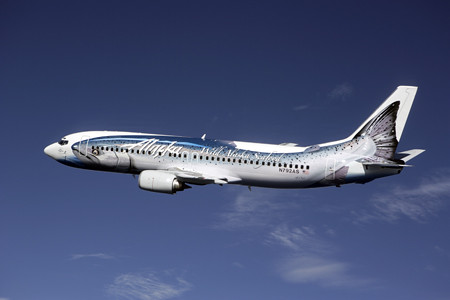
Alaska has a history of innovation. They were the first North American airline to offer online ticketing (1995) and online check-in (1999). Oh, and they paint salmon on some of their planes. Cool.

If history is our guide, similar in-flight Internet platforms will be picked up by other carriers in short-order. The WSJ (subcription-only) mentions that Southwest is considering the service. And the always active rumor-mill at Airliners.net is predicting a big JetBlue announcement in October (inflight Internet, perhaps?).