Author Archive

Sealand – a communications hub?

Monday, September 17th, 2007

We’ve discussed a lot of important deployments of satellite Internet — developing nations, rural areas, and mobile platforms, to name a few. Let’s not forget about MicroNations:
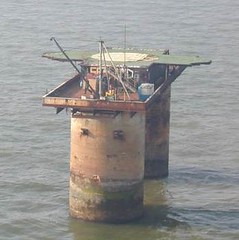
Sealand, a tiny ex-British military base used during WWII, sits just off the Southeast coast of England. Since the tiny platform has only a population of 20, no connections to mainland England, and, um, questionable international status, how does Sealand get wired?

From SatNews:

The Principality of Sealand has received a multi-million dollar investment opportunity from a Russian investment group to fund the launch of a new communications satellite. So states the official newspaper of the country, the Sealand News. Such a project would give the independent micro-nation total worldwide Internet freedom plus internationally un-restricted Internet broadcasting, all from the former military fortress/artificial island located six miles off the coast of Britain.

It’s no secret why Sealand would be an attractive communications hub — no taxes, no censorship, no restrictions. For example, Sealand will soon be launching an online casino, promising 100% tax-free winnings. There has also been talk of using Sealand as a hub for media download services.

Pirate Radio is on the list too. Sealand’s own newspaper has the details:

A new Pirate Radio Station is supposed to set up shop in Sealand.

History repeats itself as a group of young radio DJs are negotiating with the Principality over using the former British anti-aircraft platform as the location for their new “Free Radio Sealand”.

Plans are to use the facilities of HavenCo, the internet hosting company with its datacenter located in Sealand, to launch an international internet radio station as well as a terrestrial and digital radio station.

“We’re going to bring back Pirate Radio big time,” said Stuart Turner (21), also known as Lord Stuart of Sealand, a former Virgin Radio DJ. “We’re going back to the roots of Radio Essex when listening to the radio was actually a way of life!”

The Principality of Sealand used to be a Pirate Radio station in the early Sixties: During the summer of 1965 Roy Bates entered the Pirate Radio business and set up his own radio station at Knock John Tower, a former WW2 British naval defence platform in the Thames estuary.

An original wartime radio beacon was converted for use as the broadcasting transmitter and regular broadcasts commerced on 7 November 1965. The enormously popular Radio Essex, later renamed BBMS (Britain’s Better Music Station) was the first Pirate Radio Station to provide 24/7 entertainment and shaped the face of Sixties pop culture as we remember it.

After being convicted of violating British broadcasting law, Roy Bates moved his radio station to Roughs Tower. 2 years later Bates turned Roughs Tower into the Principality of Sealand and became HRH Prince Roy of Sealand!
KAGUYA Launches

Monday, September 17th, 2007

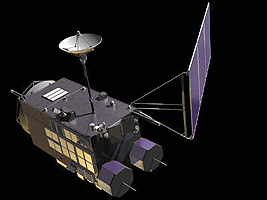
In June, we discussed the naming of Japan’s new lunar study — what many consider the most sophisticated lunar exploration mission in the post-Apollo Era. It is also Japan’s first major lunar mission. Last Friday morning, the spacecraft launched from Tanegashima island, 600 miles south-west of Tokyo, aboard an H-2A solid-fuel rocket:

ScienceDaily has the project details:

The mission of the SELenological and ENgineering Explorer “KAGUYA” (SELENE), Japan’s first large lunar explorer, is being keenly anticipated by many countries.

The major objectives of the mission are to understand the Moon’s origin and evolution, and to observe the moon in various ways in order to utilize it in the future. The lunar missions that have been conducted so far have gathered a large amount of information on the Moon, but the mysteries of its origin and evolution have been left unsolved.

KAGUYA will investigate the entire moon in order to obtain information on its elemental and mineralogical composition, its geography, its surface and sub-surface structure, the remnant of its magnetic field, and its gravity field. The results are expected to lead to a better overall understanding of the Moon’s evolution.

At the same time, the observation equipment installed on the orbiting satellite will observe plasma, the electromagnetic field and high-energy particles. The data obtained in this way will be of great scientific importance for exploring the possibility of using the moon for human endeavors.

KAGUYA consists of the Main Orbiter and two small satellites (Relay Satellite and VRAD Satellite). The Main Orbiter will reach the vicinity of the Moon. Once it has reached the Moon, it will be placed into a peripolar orbit at an altitude of 100 km. The Relay Satellite will be placed in an elliptic orbit at an apogee of 2400 km, and will relay communications between the Main Orbiter and the ground station. The VRAD Satellite will play a significant role in measuring the gravitational field around the Moon. The Main Orbiter will be employed for about one year and will observe the entire Moon.

Is this the start of an Asian Space Race? The Guardian sees some evidence:

While Jaxa officials play down talk of a space race with China, the mission is a major step towards the goal of building a manned station on the moon by 2025, and a sign of renewed regional interest in lunar exploration. China is to send its Chang’e-1 probe to the moon this year to construct 3-D images of the moon’s surface and analyse its dust. India is expected to launch an unmanned lunar orbiter next year.

Google’s X-Prize

Friday, September 14th, 2007

My senior year of High School I read the newly released book Longitude, which detailed the scientific quest for an accurate and durable method for determining longitude at sea. The prize: the equivalent of 12 million in today’s currency. I couldn’t help wonder why our scientific innovation wasn’t promoted in the same way. Sure, government and university grants are great for scientific progress but so is a little healthy competition and the prospect of massive wealth.

Imagine my excitment when I read about the X-Prize, announced at about the same time as the publication of Longitude. In 2004, the X Prize awarded its first prize of $10 million to Burt Rutan and Paul Allen for developing the first non-government, reusable manned spacecraft that was launced into space twice within two weeks.

The X-Prize Foundation lives, offering prizes for a number of contests from genome sequencing technology to building a 100-mpg vehicle.

Now, Google is getting into the game. The Google Lunar X-Prize will offer $20 million to the first team that constructs autonomous rovers that can land on the moon, travel at least three-tenths of a mile, and send video, images and data back to Earth. Google is running the project in conjunction with the X-Prize foundation. MSNBC has the details:

The first team to succeed would win $20 million – that is, if the job is done by 2012. After that, the prize drops to $15 million, and if no one is successful by the end of 2014, the money could be withdrawn. If a second team succeeds before the deadline, $5 million would be given as a runner-up prize. Another $5 million would be reserved for bonus tasks – for example, roving for longer distances, taking pictures of old lunar spacecraft, finding water ice or surviving the long lunar night.

The imagery and other data beamed back from the moon would be shared with the world via the Google Lunar X Prize’s Web site.

“By working with the Google team, we look forward to bringing this historic private space race into every home and classroom,” Peter Diamandis, chairman and chief executive officer of the California-based X Prize Foundation, said in a prepared statement. “We hope to ignite the imagination of children around the world.”

Watch the promotional video, find an extremely wealthy sponsor and some rocket scientists, then get to work, folks.

Nothing like reverting to early 18th Century contests to solve the technological challenges of the 21st Century and beyond.

DIY Friday: Burning Man

Friday, September 14th, 2007

When you think of Burning Man, a six-day festival held in the middle of the Black Rock Desert in Nevada, you think of eccentric art—sculptures, paintings, artistic contraptions of all kind. Burning Man hits the limits of self-expression. Even more amazing, though, is Burning Man’s commitment to self-reliance. As one essayist puts it:

You’re here to survive. What happens to your brain and body when exposed to 107 degree heat, moisture wicking off your body and dehydrating you within minutes? You know and watch yourself. You drink water constantly and piss clear. You’ll want to reconsider drinking that alcohol (or taking those other substances) you brought with you — the mind-altering experience of Burning Man is its own drug. You slather yourself in sunblock before the sun’s rays turn up full blast. You bring enough food, water, and shelter because the elements of the new planet are harsh, and you will find no vending.

You’re here to create. Since nobody at Burning Man is a spectator, you’re here to build your own new world. You’ve built an egg for shelter, a suit made of light sticks, a car that looks like a shark’s fin. You’ve covered yourself in silver, you’re wearing a straw hat and a string of pearls, or maybe a skirt for the first time. You’re broadcasting Radio Free Burning Man — or another radio station.

But when 50,000 people descend onto a spot in the desert, they need energy — no matter how environmentally-conscious they may be. Enter solar power — there is plenty of that in the desert.

These folks may not be rocket scientists, but they sure have engineering prowess. While some shows, like the Control Burn fire act, use 650 gallons of fuel a night, there is some carbon-free entertainment out there. More demonstrated free energy, thanks to a trebuchet:

This year’s event was held August 27th through September 3rd, drawing almost 50,000 people around the theme “Green Man” (environment). Responding to this inspiration, Cooling Man is a project aiming to make “Black Rock City” carbon-neutral through carbon-offset purchases and energy reduction. For just a six-day event, it is pretty fascinating how much of a civilization is created.

Next year we will look into what sort of sat-coms they have — no landlines available in Black Rock City, I imagine.

Blog Wild

Monday, September 10th, 2007

WildBlue was named Euroconsult’s 2007 Broadband Satellite System Operator of the Year during the 11th World Summit for Satellite Financing in Paris, France. WildBlue provides high-speed Internet access via satellite to homes and small businesses in communities not currently served, or underserved, by other high speed providers. From their press release:

The Broadband Satellite System Operator of the Year award is based on a performance analysis of satellite market players, selected by a jury composed of representatives from Satellite Finance, Space News and from Euroconsult’s analyst team. In selecting the award recipients, the jury reviews each operator’s performance in relation to a number of benchmarks, including: subscribers at year-end 2006 and 2006 subscription growth; penetration of the estimated addressable market at year-end 2006; and strategic decisions and innovative offerings of 2007. WildBlue received the award yesterday during a ceremony held at the Hotel Westin in Paris.

But who is Euroconsult?

Since its creation, the company has become a worldwide reference for research and advice at each step of the value chain in the satellite industry including satellite manufacturers, satellite operators, satellite service providers, launch and services equipment, space agencies, TV platforms & channels as well as bankers, investors and insurers.

A forum on this award dished mixed-reactions. One user notes that the survey did not include—duh—customers! And some of these customers don’t seem too happy — suffering from frequent timeouts, slow speeds, and questionable customer support. Some express their anger on YouTube:


Others however, realize where the satellite broadband industry is — in its infancy, expanding, and still adapting to customer demands. HughesNet (the primary WildBlue alternative) is rising but doesn’t appear to be out-performing WildBlue in value or speed. As one forum particpant puts it: “I wasn’t happy with the spike in latency, but at the end of the day no one else is working any harder to provide this customer with a better alternative, at least not today.”

Phoenix – so far, so good

Monday, September 10th, 2007

The Phoenix Mars Lander has passed its first in-flight check. The collaborative project, part of NASA’s Mars Scout class, is headed by the Universtiy of Arizona but includes efforts by Lockheed-Martin and The Max Planck Institute. The mars lander, slated to explore the arctic region of mars, analyzing samples of soil and ice, launched on August 4th and is expected to land on May 25, 2008. Last week, it received its first in-flight report, including a photo taken from its robotic arm camera:

The Robotic Arm Camera took an image of the Robotic Arm scoop using its red LED (Light-Emitting Diode) lamp. Human eyes see this image only in shades of gray, so the picture has been enhanced in false color to better represent what the camera sees.

Images from the Robotic Arm Camera, one of five imaging instruments on the lander, will be the only pictures taken and returned to Earth until Phoenix approaches and lands on Mars on May 25, 2008. Additional images will be taken by the Robotic Arm Camera later in the cruise stage.

The Robotic Arm Camera check was one of a series of instrument tests being completed as Phoenix cruises toward the red planet. Phoenix was about 57 million miles from Earth when the image was sent back. It is traveling at 76,000 miles per hour in relation to the sun.

On Mars, the Robotic Arm will dig trenches, scoop up soil and water-ice samples and deliver them to several instruments on the lander’s deck for chemical and geological analysis.

The Robotic Arm Camera, built by the UA and Max Planck Institute, is attached to the Robotic Arm just above the scoop and will provide close-up, full-color images of the Martian surface, prospective soil and water-ice samples, samples collected in the scoop before delivery to the lander’s science deck, and of the floor and side walls of the trenches.

While the photo doesn’t look like much, it provides welcome relief to the project team. From the project’s excellent blog:

At the moment all we have to look at is the scoop on RA that we’ll use to dig into the surface of Mars. Although we see numbers flow back during these health checks, a picture is something very tangible. It tells us in an image what it takes pages of numbers to understand. We see a sharp focus, the lights are on, the multitude of commands executed properly, the data pipe that the images stream down all work, After all RAC is a camera, all the work is to have an instrument that takes images and the result is we get a picture here on Earth from tens of millions of miles from home. Makes me confident we’ll get back pictures after we land on Mars.

I find this very comforting. Not only have we endured launch, deep cold of space, but we also survived the Van Allen Radiation Belts that surrounds the Earth (some 1500 rems / year compared to 0.04 here on earth). We’ve prepared for this and we’d prepared well. It certainly is exciting to see our hearty little friend is healthy so far from Earth on her extraterrestrial journey to her new home on Mars.

The same in-flight check returned the lander’s cruising temperature (a touch colder than a Wisconsin winter):

So far all looks well on the spacecraft and the instruments are at a balmy -30° C with some places near 0°C. The RAC at a comfortable -15°C!So much for the interplanetary weather report.

Meanwhile, the weather on Mars isn’t much better. Earlier this summer, a global dust storm swept the red planet creating a sky-darkening dust clout, nearly killing NASA’s solar-dependent exploration rovers. The rovers, Spirit and Opportunity, have worked 40 months more than their original 3-month goal. Along the way, they’ve survived a lot:

"These rovers are tough. They faced dusty winds, power starvation and other challenges — and survived. Now they are back to doing groundbreaking field work on Mars. These spacecraft are amazing," said Alan Stern, associate administrator of NASA’s Science Mission Directorate, Washington.

Let’s hope the Phoenix has similar longevity. So far, so good.

DIY Friday: Military Satellite Hacking

Friday, September 7th, 2007

Relax. We are not designing instructions on how to take-down U.S. military satellites. But the U.S. Space Countermeasures Hands On Program (Space CHOP, for short) is trying to do just that — using store bought, DIY gear to disrupt or take-down U.S. military satellites. The goal: if we can discover our own vulnerabilities first, we can protect ourselves from the real enemies. Popular Mechanics chronicles Space CHOP’s activities:

Space CHOP was formed in 1999, and one of its earliest experiments used a UHF generator and a small amplifier purchased from an electronics store. The team pieced together an antenna out of copper wire, PVC piping and other easily obtained materials. (The Air Force won’t elaborate on Space CHOP hardware or targets.) By aiming the antenna at the sky and turning on just a few milliwatts of power, the team showed it could block signals from a military communications satellite.

"We demonstrated that a few unsophisticated guys with a few thousand dollars’ worth of equipment could interfere with a seriously sophisticated satellite system," says John Holbrook, Space CHOP’s program manager. "If we had turned on full power, we would’ve knocked [the system] out."

And it is not just DIY, technological experimentation. This team uses good, old-fashioned intelligence and face-to-face investigating:

More often than not, the Space CHOP team doesn’t need any equipment to uncover a vulnerability. They scour the Internet for potentially damaging information. They case out Air Force bases. Or, posing as graduate students, they pump defense contractors and military officers for information until they’ve figured out a way to take down a satellite or its link on the ground.

As the author of this Popular Mechanics article, Noah Shachtman, notes on his blog, this is not a fantasy threat. From the AP:

The Bush administration warned Wednesday against threats by terrorist groups and other nations against U.S. commercial and military satellites, and discounted the need for a treaty aimed at preventing an arms race in space.

Undersecretary of State Robert G. Joseph also reasserted U.S. policy that it has a right to use force against hostile nations or terror groups that might try to attack American satellites or ground installations that support space programs. President Bush adopted a new U.S. space policy earlier this year.

"We reserve the right to defend ourselves against hostile attacks and interference with our space assets," Joseph said in prepared remarks to the George C. Marshall Institute.

Joseph, the senior arms control official at the State Department, said nations cannot all be counted on to use space purely for peaceful purposes.

"A number of countries are exploring and acquiring capabilities to counter, attack, and defeat U.S. space systems," Joseph said

He also said terrorists "understand our vulnerabilities and have targeted our economy in the past, as they did on 9/11." He said terrorists and enemy states might view the U.S. space program as "a highly lucrative target," while sophisticated technologies could improve their ability to interfere with U.S. space systems and services.

Not a member of Space CHOP but still want to hack satellites? Try grabbing free satellite signals.

iCar?

Thursday, September 6th, 2007

Like many people, the iPhone shook my perspective on technology. It’s no longer about the best laptop, best mp3 player, or best phone. It’s about technological fusion — forging devices that can do it all.

So, why not an iCar? While you can’t carry it in your front pocket, there is no reason you don’t want your car to have the best technological capabilites. A radio is no longer good enough (a sad realization for a ’94 Geo Prism driver). CNET has all the nerd-gossip:

Apple and Volkswagen are reported to be in talks about an "iCar" or car integration system, according to reports from German magazine Capital and the Associated Press.

Apple CEO Steve Jobs and Audi Chairman Martin Winterkorn, who heads the Audi brand group that includes Volkswagen, met recently in California to discuss ideas, but no concrete plans, a Volkswagen representative told the Associated Press.

"We wouldn’t comment on rumors and speculation," said Tom Neumyar, senior manager for iPod and iTunes at Apple.

Volkswagen of America would neither confirm nor deny the reports.

While its currently all speculation, just imagine the possibilities: navigation system, iTunes synching, integrated touchscreens, chatting among back-seat passengers, integrated bluetooth, etc.. LAPTOP Magazine details some more wishlist items (some not-so-serious):

Dashboard on the Dashboard
We can’t wait to slip into our silver, leather-interior car and control everything–from the air conditioning to the gears–via a strictly touch-sensitive dashboard that’s void of any buttons or control wheels. Our fingers will manipulate everything on the panel with simple finger strokes and taps. In keeping with Apple’s current Mac OS X Dashboard, we’re demanding customizable Widgets with everything from Google Maps to current gas prices.

Click Wheel As Steering Wheel
It’s going to take some getting used to, or even a retake of your driver’s test, but replacing the olden-day steering wheel with an iPod-like Click Wheel will make it easier to turn the corner; you’ll merely have to slide your hand over the touch-sensitive plastic wheel. Bonus: A simple push of the center button emits a loud honk that sounds like a Leopard purr.
[…]

Smart Playlists
Using live traffic updates, your music playlists will be automatically generated by the amount of congestion. When you’re about to enter areas with heavy traffic, you’ll be soothed by the mellowest tracks in your collection. When all that’s in front of you is open highway, the bounciest and raciest pop and punk tracks will move to the top of the list. Your iCar will even customize your library based on where you are. If you’re cruising down the Jersey Turnpike, for example, you’ll hear Lynyrd Skynyrd’s "That Smell" blaring through the Apple Hi-Fi sound system.

AirPort Antennas
Pull into the garage and you’ll be able to download iTunes movies over the air to the backseat monitors for the kids to watch, or sync videos, photos, and music with your Apple TV. We’re also excited about the possibility of swapping playlists with other iCar owners via Wi-Fi while you’re at a stoplight-provided they have DRM-free tracks.

Critical to this dream iBeetle (or iPassat) will be Internet-access. What will this iPhone iCar do without the requisite AT&T signal? Perhaps Qualcomm’s Omnivision Mobile Platform can be integrated. Using OmniTracs and OmniExpress, this mobile platform can connect one’s vehicle through satellite and wireless networks.

A Geo driver can dream, right?

On an even lighter note, imagine Microsoft’s retaliation, as one CNET reader jokes:

God help us if Microsoft attempts anything similar. Considering the hackability of their operating system, we’d be in HUGE trouble…

Great Photoshop contest on Fark.com, like this "Zune Buggy:"

DIY Friday: Greenhouse

Friday, August 31st, 2007

Labor Day weekend is not my favorite time of the year. The extended weekend and numerous BBQ’s (solar or traditional) are nice. But the lingering sense of disappointment kills me — no more swimming pools, no more long summer nights, no more backyard gardening. Yes, even rocket scientists enjoy these things.

This week’s DIY edition will explore bringing summer inside — it’s time to build a greenhouse. If you’re like me, enjoying fresh veggies for only two months a year, just doesn’t seem right. BuildEazy.com has the plan. You might not finish it over the long-weekend but you should beat the first freeze. If it seems too complicated, consider buying a kit

DIY TV, delivered on DirecTV channel 220 or Dish Network channel 111, has a similar story up about one man’s custom greenhouse:

The temperature outside was close to zero Fahrenheit, but inside Jay Stanton’s greenhouse it was close to tropical. This winter day stood as a testament to Jay’s thoughtful planning and design, which took nearly four years of research. “I talked to a lot of experts,” explains Jay. “I went to an agricultural college and did a field trip to Longwood Gardens, and asked a lot of questions.”

Once you have something constructed (hopefully in less than four years), try making your greenhouse passive-solar:


New Satcom in Texas

Friday, August 31st, 2007

ND SatCom is moving to Plano:

ND SatCom Inc., a supplier of satellite-based broadband VSAT, broadcast, government and defense communication network and ground station solutions company, U.S. headquarters has moved into a Plano facility. The state-of-the-art, 23,000 square foot facility will house design, integration and testing of both fixed and mobile satellite earth terminals.

"Today is a milestone in ND Sat-Com Inc.’s history. The more spacious office, customer training and integration facilities are an excellent foundation for the company’s future development in the America’s satellite communications industry and for servicing our customers more efficiently. The attractive package that the City of Plano offered us for this new business location supports us in our progress," said Chris Morris, president & CEO, Americas.

But ND SatCom’s services extend beyond Plano — well beyond Texas. Earlier this year, the company implemented Bulgaria’s first satellite-based telemedicine network. Of all the global sat providers, why did Bulgaria look to ND?

Tzvetelina Dimitrova, CEO of Interactive Technologies, explains why the company chose ND SatCom for this specific project: "ND SatCom’s SkyWAN® is a platform which supports the wide range of applications such as video conferencing, IP video and VoIP needed in this project. Due to its allocation on demand scheme, SkyWAN® offers our end customer an optimized and dynamic bandwidth usage." Dieter Dreizler, Director Sales of ND SatCom, says: "ND SatCom’s SkyWAN® technology supports the network’s performance and offers unique redundancy features. Effectiveness and reliability are key factors in telemedicine communication. Given that parts of Bulgaria are earthquake endangered regions and terrestrial lines might fail, satellite communication is the best solution for providing independent and consistent telemedicine services."