Author Archive

Dropping the SpookSat

Tuesday, August 7th, 2007

If you don’t like that headline, try The Register’s leader: "Cheesed-off spooks give up on duff spy-sat."

Reuters explains:

The National Reconnaissance Office has deemed an experimental U.S. spy satellite a total loss and will allow it to slowly drop from orbit and burn up in the atmosphere, two defense officials told Reuters this week.

The classified L-21, built by Lockheed Martin Corp at a cost of hundreds of millions of dollars, was launched on December 14 but has been out of touch since reaching its low-earth orbit, put by satellite watchers at about 220 miles above the earth.

It will now gradually fall out of orbit over the coming decades, said the officials, who asked not to be named. At some later date, it will burn up as it enters the earth’s atmosphere, posing no danger to people below, they said.

We discussed these technology failures earlier in June. Now that the L-21 is a loss, what’s next?

Meanwhile, the Pentagon will likely now have to test aspects of new technologies that were on the L-21 by piggybacking them onto other satellites over the next four to five years, the officials said.

For instance, the military could put the new sensors aboard TacSat 3, the latest in a series of smaller satellites, when it launches later this year.

The NRO could still try to build a new spacecraft to test the technology, but it would take several years to get the funding for such a satellite and build it, one official said.

The U.S. may be lagging behind in this technology race:

The two officials declined to identify what exactly the experimental Lockheed satellite was meant to test, but said its failure was troubling, given that other countries were rapidly plowing ahead with development and launch of new capabilities, especially in the area of synthetic aperture radars.

Synthetic aperture radars offer high-resolution and can pierce darkness and thick clouds to identify targets, even peering below the surface of the ground or peeking into foliage that might obstruct the view of photo-based sensors.

One official said Germany in June launched TerraSAR-X, a sophisticated new satellite armed with a synthetic aperture radar that analysts say marks the start of a new level of quality in the mapping of the earth.

Canada is also working on this technology.

Ukraine Announces New Space Program

Thursday, August 2nd, 2007

Politically, Ukraine is somewhat at a cross-roads, being pulled in one direction by its Russian-Soviet past and in the other direction by its Western EU-NATO neighbors. The 2004 "Orange revolution," which discarded the Kremlin’s favoured candidate, may have been the turning point.

Ukraine’s space program reflects Russia’s declining influence. First it was Ukraine’s agreement to participate in EU’s Galileo System (a system similar to GPS), not joining Russia’s developing Glonass system.

Now, Ukraine has announced an ambitious new 4-year independent space program. An English translation of a Ukranian news report explains:

The Cabinet of Ministers today at the session has affirmed the national target scientific and technical space program of Ukraine for 2008-2012. General Director of National space agency Yuriy Alekseev told journalists.

According to him, financing of the State program amounts UAH 1,5 milliard.

According to the program, in particular, Ukraine should launch two satellites of remote sensing of the Earth, to create a satellite of connection and to participate in tenders of satellites creation for the other countries.

“The satellite has been already made for Egypt, and in autumn it can be given to the customer,” Alekseev noted.

Also, according to Alekseev, the program foresees the training of Ukrainian specialists at the European space enterprises, “UNIAN” reports.

Russia’s WPS news agency (subscription only) has more on the satellites:

Two of the satellites are intended for remote Earth probing and the third is a communication satellite. General Director of the National Space Agency, Yury Alexeev, announced this after approval of the draft space program of the country for the next five years at a meeting of the government. The document makes provisions for active international cooperation including cooperation with Russia, European Union and the US. The costs of the program exceed $400 million and state financing will account for about $300 million of this amount.

Sirius/XM Merger Update

Tuesday, July 31st, 2007

It has been while since we’ve discussed the XM-Sirius merger announced in February. For two companies that had combined losses nearing two billion last year, they are understandably anxious for action.

Whether you favor the merger or not, there has been progress. On the most recent XM earnings call, it was noted that four out of every five comments filed with the Federal Communications Commission (FCC) were in favor of the merger. Twice elaborates:

XM chairman Gary Parsons said that overall the company “feels pretty good” that the merger will pass regulatory hurdles. “We didn’t go to great lengths to generate [public comments to the FCC] and it was 4 to 1 for the merger. And a strong constituency of groups who felt underserved by radio came out positively for this and that’s pretty impactful. And the announcement of the various pricing plans is by any measure a bold and pioneering move” that will add support for the merger, he added.

Sirius adds their take in today’s second-quarter report (link):

"Momentum for the pending merger with XM continues to build," said CEO Mel Karmazin. "Support from our customers, suppliers and other groups representing a diverse cross-section of Americans clearly demonstrates the public interest benefits and enhanced competition that will come from the merger. We continue to work with the [Federal Communications Commission] and the [Department of Justice] to make the case that the merger offers more choices, including a la carte offerings, and lower prices for subscribers, and we continue to expect that the merger will be completed by year-end."

Recognizing this momentum, XM’s CEO, Hugh Panero, has announced he will leave XM, apparently to make room for the merged company:

Noting that Sirius CEO Mel Karmazin would lead the proposed merged Sirius/XM, and that Nate Davis, XM, president and COO had taken over much of the day-to-day operations at XM, he added, “My role was to do strategy and work with bigger partners and I’ve helped with the merger. I felt the merger had progressed and was hitting a number of milestones … And understanding there would be one CEO at the end of it, I felt it was time to move on.”

The 10-year XM veteran told analysts, “When I first came to XM it was merely a PowerPoint presentation and many were skeptical that anyone would pay for radio,” Panero said, noting that now satellite radio has 14 million subscribers.

The companies also laid out their plans for future subscription plans, mimicking content tiers offered by cable and satellite television providers:

Satellite radio providers Sirius and XM said Monday they could offer a variety of subscription packages that cost as much as 46% less than current plans if their merger is approved.

In a bid to allay concerns among lawmakers that their merger would raise prices and limit programming choices, the companies announced several new packages that they say offer subscribers more choice than they can individually.

Under one package, customers could pick 50 channels on either Washington-based XM Satellite Radio Holdings Inc.’s or New York-based Sirius Satellite Radio Inc.’s systems for $6.99 a month. Additional channels could be added for 25 cents apiece. Currently, subscribers of either system pay about $13 a month for more than 100 stations.

"We need to build the subscription business base of satellite radio to strengthen our business and better leverage our high fixed costs," Sirius Chief Executive Mel Karmazin said in Washington. "We are confident that a lower price point [and] more programming choices will help us do just that."

DIY Friday: Installing a Satellite Dish

Friday, July 27th, 2007

On Monday, YouTube took over the Democratic Debate. Today, YouTube takes over DIY-Friday. Thank you, user generated content.

The first video explains how to mount a satellite dish using a simple satellite signal meter available for $15 bucks here.

A more detailed installation guide (although some of the connectors are a bit out-dated):

Not working right? Call a professional or just blow it up:

GSM Satellite Backhaul

Thursday, July 26th, 2007

Remote regions and developing nations are seeing a massive expansion in their GSM networks. Nigeria, for example, has only 1.25 million landline phones, but more than 30 million mobile subscribers. This presents a number of challenges: foremost, how do you expand a network to remote places that lack the infrastructure for conventional GSM networks?
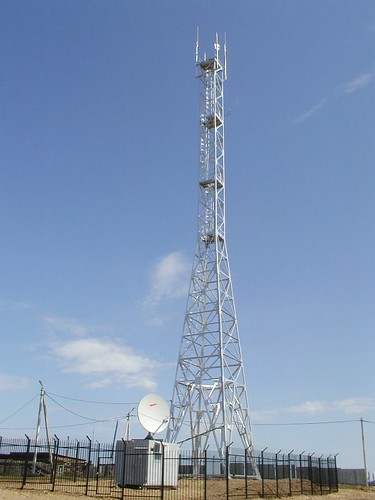
The solution: satellites, of course! In Papua New Guinea, SES NEW SKIES signed a contract with the national telecom company, Telikom Papua New Guinea, to provide GSM backhaul services using its NSS-5 spacecraft. Details from Cellular-News:

The NSS-5 satellite capacity will allow Telikom PNG to expand its GSM services into new regions and provide telephone services over mountainous terrain by providing GSM backhaul between a large number of sites around the country back to the capital Port Moresby.

States Scott Sprague, Senior Vice President Global Sales of SES NEW SKIES: "The ubiquitous coverage of the NSS-5 satellite allows Telikom Papua New Guinea to significantly increase its GSM service area across the rugged geography of Papua New Guinea. SES NEW SKIES is proud to assist the country’s premier telecommunications provider to offer vital communications services to widespread, mainly rural populations and across terrains that make it difficult to develop even basic transportation infrastructures."

Remote deployment is only one use of satellite backhaul services. As satellite modem manufacturer Radyne expains, two other uses could prove critical: temporary installations during disaster recovery (when the broadband infrastructure has been damaged) and when a rapid deployment is required.

Communications technology giant Cisco hasn’t ignored this developing industry (abbreviations in description have been expanded):

At the cell site, GSM traffic is compressed and aggregated with [Universal Mobile Telecommunications Service (UMTS)] traffic by the [mobile wireless router]. The result is lower bandwidth aggregated traffic that is routed to the satellite modem and transmitted to the other side. Depending on actual T1/E1 link utilization for both GSM and UMTS, Cisco RAN Optimization can reduce the bandwidth required on the satellite link up to 50 percent, providing significant savings in [operating expenses].

DIY Fridays: Portable Satellite Radio

Friday, July 20th, 2007

Satellite radio is becoming somewhat commonplace while traveling: its a good move if you drive in rural places, many car rental companies offer XM or Sirius standard or as an upgrade, car dealerships throw in satellite radios as promotions, and even airlines are offering satellite content.

It’s even starting to show up in homes, with home receivers and antennas being stacked right next to amps, cd-players, and turntables.

But while iPod’s seem to be taking over, you rarely see someone sporting portable satellite radio. Why not enjoy Bluegrass Junction, XM Cafe, or Sirius Classic Soul in between car-trips and living room lounging? Of course, you could purchase a device, but that wouldn’t be any fun.

Make has the instructions (subscription only):

The basic prescription is to mount a Terk XMicro antenna on headphones and connect to a Delphi roady. There are a few complicated steps:

Modifying the antenna: You need to alter the antenna by…

removing the pink plastic connector shroud. I used a small screwdriver to get between the white and pink plastic and gently extracted the white plastic looking piece. Then I heat-shrank a "strain relief" over the top of the connector and the exposed wire from breaking. This rubber "shrinky dink" tubing will contract tightly over the wires once you apply heat from a hair dryer to it.

Create a power supply: Connect a battery-pack with five AA batteries to the Delphi using a RadioShack Adaptaplug "Type B" tip. This should generate six to nine volts.

Turning it on:

Using the power button to turn the unit on will turn on the display’s LEDs, eating up battery power. Instead, input the sequence "232" into the keypad and then push in the scroll wheel on the side.

Enjoy the tunes!


I want my Big Ten Network

Tuesday, July 17th, 2007

Higher taxes, decreased services, increased crime, atrocious construction—these are the issues that make city residents furious. But last December, absent these circumstances, I’ve never seen more rage in my pleasant home town of Madison, WI. Why? The Green Bay Packers were playing on the NFL Network and the local cable companies refused to carry the network. Listen to the radio or squeeze into an over-packed neighborhood bar — this was a decision Madisonians didn’t want to have to make.

This is a scenario that could play out again in Midwest sports towns, with the launch of the Big Ten Network (BTN) in August. BTN will air 35+ football games, 105+ Men’s basketball games, and 55+ Women’s basketball games a year, in addition to other sports and academic programming. The network currently has national agreements in place with DirecTV and AT&T but many cable operators are still holding-out. This includes Comcast, which responded to BTN sharply:

Indiana basketball fans don’t want to watch Iowa volleyball, but the Big Ten wants everyone to pay for their new network.

Now, BTN is turning to the grassroots to get Comcast and other providers to pay-up (link):

To get the Big Ten Network, Penn State fans should visit www.BigTenNetwork.com and enter your zip code, which will then provide a link to the cable providers in your area, as well as DirecTV and Dish Network, to make a request for them to carry the Big Ten Network.

Back to Madison, WI: cable-subscribing Badger fans are set to be in-the-dark when it comes to the BTN. And, while a lot of reader are outraged at Charter (the dominant local provider), one man is equally ticked-off at the Big Ten:

Commissioner Jim Delany needs to get real about charging Wisconsin fans millions of dollars to watch his new Big Ten Network — the second most expensive national cable channel in the country — which will air what sports columnists are now calling "fifth tier" sporting events such as nonconference tune-up football games and university swim meets.

In order to salvage the BTN into a profit-making venture, Delany says that he will try to migrate to his network many games from the ABC and ESPN networks, thus asking consumers to pay premium fees for many of the games they used to be able to see for free.

But moving the games to the expensive new channel could reduce revenues to our schools and dramatically hurt recruiting efforts. Many high school stars who don’t live in Big Ten states could be effectively shut out of viewing Big Ten games.

To be selfish: as a DC resident with the prospect of getting more Big Ten games out-of-market, I’ll be the first to say: I want my MTV Big Ten Network.


DIY Friday: Camcorders

Friday, July 13th, 2007

If the thought of taking home-movies on a low-quality, cheap video recorder makes you squeamish or, better yet, embarrasing your family with a clunky, odd-ball camera makes you smile, try building your own camcorder.

The Chaos Blog took-on the project and left us with some pretty good instructions.

1) Capturing
The core of the project is a standard CCD surveillance camera.

These goodies comes in all shapes and sizes. I recommend a monochrome with 480 tv-lines or more. Colour cameras are quite expensive especially if you’d want 3CCD, and it’s very hard to control the colours of your recordings, if you don’t know what you’re doing. You should never choose a higher value than 0.5 lux when it comes to light sensitivity. If you stick to this you’ll always be able to shoot video indoor with just a few lamps turned on.

2) The optics
The Chaos blogger recommends standard SLR optics from your 35mm camera. They are cheaper than camcorder optics and you probably already own a few different focal lengths. Purchase a C-mount lens adapter (specific to your SLR lens brand) or build the adapter yourself.

3) Storage/Recording

For storage/recording I have used a SONY Digital8 recorder. They are easy to come by and relatively cheap on e-bay. The really cool thing about these recorders is that you can record both from an analogue video source or digital (firewire) video source. So if your standards get higher you can always buy a security camera with a Firewire output. And the quality of these recorders are superb though they are aren’t that young. No doubt this is a pro video tool and with lots and lots of option settings.

A number of readers also recommended using a cheap Aiptek MPVR. A more expensive Archos AV500 Mobile DVR would also do the trick.

4) Microphone & Pre-Amp
Any compact microphone with a built-in pre-amp should work.

5) Viewfinder

Since decent viewfinders that you can actually use for this project are very hard and expencive to come by, I’ve chosen to use a LCD-screen instead. Luckily, I already had one that was as “made for the job” all ready with a hotshoe build on, so it would be easy to mount.

6) Batteries

Since both the recorder and viewfinder-screen carry their own battery pack, the only thing I had to supply with power was the security-camera (12v dc) done with 8 1,5v AA batteries. A lot of security cameras can even take aprox. +-3, but for the safety of your camera it may be a good idea to put a “current controller” between the camera and the battery pack.

7) Mount
This is where you have to be very creative. Unless you have a perfect contraption laying around (the Chaos blogger used “an old Velbon monopod and other bits”), you will need to sort through your garbage stack and hardware store. I’d even consider using wood, which would make your DIY-camcorder even more ridiculous looking (and, thus, better).

Still not satisfied? Try building these:

Underwater Camera

Nightvision Camera

Excellent instructions on building a nightvision camera from a disposable CVS video camera are available here.

Satellite Robots

Thursday, July 12th, 2007

With the new Transformers film now in theaters, it is only fitting to discuss robots. The San Diego Union-Tribune takes-up machines based on nature:

“The Wright brothers learned how to control (a plane’s) direction by watching hawks in flight,” he said. “They figured out that turning a plane had to do with changing wing surfaces, though not the way hawks did it.

“That’s an important distinction. The Wright brothers drew inspiration from biology, but they didn’t exactly copy it.”

Robotic designs based upon natural organisms are as diverse as the animal world itself. There are devices in the works that mimic caterpillars, spiders, dogs and octopuses. Their goals and purposes are equally varied, from new medical treatments to space labor to being a soldier’s best friend.

The satellite business took note:

In January, a pair of small robots developed by European and Japanese scientists took their first steps in space – not steps, actually, since the robots lacked legs, but the feat was still a giant leap for robotkind.

During the brief suborbital flight Jan. 22, a rocket launched from Japan released a satellite that, in turn, deployed three daughter satellites. These three pulled out a 360-square-yard triangular net with the mother satellite at its center.

From the mother satellite, two palm-sized robots then crawled onto the net like spiders moving across a web. To avoid drifting off in zero-gravity, the spiderbots were equipped with a series of wheels that gripped both sides of the netting.

The experiment did not last very long. One spiderbot stalled after just five seconds of movement; the other after 30 seconds.

Engineers say the problem was likely knots in the net. But they contend the experiment was a conceptual success. They say the technology may ultimately revolutionize the satellite industry because large, costly antennas and solar panels could be launched from small, inexpensive rockets, then assembled in space by tiny robots.

What was the design inspiration?

Bernhard Putz, responsible for their design took advantage of the experience gained during several years of very successful robot soccer games. The viennese team regularily ends up in the final of European and World championships and is renouned for its innovative and robust designs. (link)

Fireworks

Tuesday, July 3rd, 2007

In honor of our Nation’s birthday tomorrow, I bring you "space fireworks" — or the best space can do to mimic illegal fireworks:

From the Hubble Telescope: