Author Archive

Solar-powered, City-wide WiFi

Monday, July 2nd, 2007

Expanding on Friday’s DIY post about solar-powered WiFi extenders, St. Louis Park, MN is implementing a solar-powered, city-wide wireless network (link):

Unlike any other community wireless system in the nation, the St. Louis Park Wi-Fi network is powered by the sun.

ParkWiFi will provide wireless Internet coverage across all 10 square miles of the city, using about 400 wireless access points. Each access point will have a battery to supply electric power and a solar panel to keep the battery charged. Several miles of fiber optic cable will tie it all into a network.

Unlike non-solar projects in Madison, WI and Philadelphia, ParkWiFi will not primarily use existing utility poles (likely because of solar-panel placement) — a move that caused some contention:

Council members and city staff grew concerned after beginning installation of the poles in mid-April and receiving feedback about the locations and aesthetics of the solar equipment and poles. It is also clear that many people believed that the equipment would be installed on existing utility poles as was done during the pilot project. The pilot project did not include the use of solar power technology. Hearing the concerns, especially about the location of poles, staff stopped installation of the poles and brought the discussion before the council.

In some cases, pole color and height were changed and mid-size lot placement were moved to property boundaries and alleys. But, "Council also directed staff to not compromise on performance of the system while finding new locations."

The project is a private – public partnership between the City of St. Louis Park (which will own the network), Unplugged Cities (which will operate and maintain the network and provide subscriber services), and ARINC (which will build the network).

The city challenged proposal responders to be creative. ARINC delivered:

The novel solar approach eliminates the need for the City to pay the local electric company monthly fees for per-pole attachments and electricity usage, a projected savings of $200,000 to $250,000 over the course of the five-year project. Service to the existing pilot areas will continue as ARINC completes the phased build out citywide. It is anticipated service to most of St. Louis Park will be completed by fall, except for some residential units in the largest buildings and some commercial buildings.

DIY Friday: Solar-powered WiFi Extender

Friday, June 29th, 2007

WiFi is meant to be liberating. Drop the cords, forget the desktop computer, and just work or surf from your couch, kitchen, or backyard—that is, if the signal will reach beyond your walls. To solve this—and to avoid having to lay a wire down the middle of your backyard—build a solar-powered extender/repeater.

Popular Science lays out the formula:

It uses a Linksys Wi-Fi range expander ($100; linksys.com) modified with an omnidirectional 9dBi antenna ($58; pacwireless.com). To avoid unsightly extension cords in the flower bed, I added a lead-acid battery ($22; radioshack.com) and a 10-watt solar panel ($119; sundancesolar.com) to charge it.

Wire the Antenna
1. Open the expander by removing its rubber feet and the screws underneath them.
2. Remove the brown and blue power plugs and the brown power-supply board.
3. Desolder the existing antenna and replace it with an antenna mount.

Add the Battery
4. Install a fuse holder and a 10-amp fuse near the negative terminal of the battery.
5. Connect the negative lines, and separately the positive lines, from the cigarette-lighter socket, solar panel and battery.

Attach the Panel
6. Solder red and black leads from the circuit board to the DC-to-DC converter, and plug the converter into the lighter socket.
7. Stuff everything into a weatherproof box and mount it at head height, with the solar panel at a 45-degree angle.

If you want to extend the range beyond 200-300 feet, try using a directional antenna to broadcast the signal towards a specific area (your outdoor patio, perhaps), or add another extender/repeater.

Meraki, an intriguing company that develops hardware and software for community networks, recently announced it will be selling a product similar to this DIY-contraption.

Priced at just $99, Meraki Outdoor can send a signal up to 700 feet. Paired with Meraki’s existing indoor $49 Mini, the Meraki Outdoor repeater can power access for dozens of households sharing one high speed connection. Meraki Outdoor can be easily installed on a wall or even a pole outside the house. It marks another step forward in Meraki’s efforts to change the economics of Wi-Fi access, driving the cost per household of high speed connections to $1 to $2 a month.

Adding the Meraki Solar accessory kit will allow the repeater to broadcast a signal without being connected to any electrical source, making it an ideal solution for any community, even emerging markets where electricity is scant or unreliable. Once connected, Meraki Solar’s power usage can be distributed throughout the day and managed by the Meraki Dashboard service ensuring the repeater is powered during peak usage times. The Meraki Dashboard is a web-hosted management tool designed to make monitoring, configuring, and monetizing a Meraki Network easy and is included with all Meraki products for no additional charge. The solar kit includes a solar panel, battery pack and an outdoor Ethernet cable.

The Meraki Outdoor repeater is for sale on their website. The solar kit is not yet available (so you’ll have to stick with PopSci’s DIY instructions, for now).

The most obvious use of this technology would be for a small neighborhood to purchase a T-1 and distribute it around the neighborhood using a series of repeaters. In the past, this would require a high-level of network engineering (optimal routing paths, back-up routes, various nodes, complex software, etc.). These new products simplify the task.

As the software becomes simpler and the hardware more compact and durable, the implications of this technology could be far reaching. In places with unreliable power service and scarce network engineers (think the Developing World), this technology could be especially useful, extending access to broadband and lowering costs. Green Wifi is doing this, distributing out-of-the-box, solar-powered, WiFi routers and repeaters.

Trees

Thursday, June 28th, 2007

Those pesky trees. Let’s say you are finally willing to make the satellite leap, when your installer gives you the bad news: the trees are in the way. Or even worse, let’s say you install a dish, only to have it blocked a year later as your tree-line skyrockets.

It’s a big problem and there isn’t a clear answer. Let’s start by addressing a few common comments on this subject’s many forums (here, here, and here).

I installed my dish in February, it worked fine in my wooded lot, but now I’ve completely lost my signal.

The problem could be, believe it or not, leaves. One woman in Illinois experienced this: "“As the trees started getting leaves on them, we’d get those little squares [on the TV screen]. Then it just kept telling us it’s acquiring a signal.” The installer apparently received a strong signal with the trees obstructing and assured the couple there wouldn’t be a problem. He didn’t consider the leaves come Spring.

My neighbor’s dish is blocked by branches, but his signal is perfect. Why me?

While the provider may have something to do with this, it could be simply a result of geometry. Most cheap, compact dishes are actually offset, so the line perpendicular to the dish’s face is not the actual direction of the signal. See the attached diagram (hat-tip to Aris):

My south-facing roof is completely blocked by trees. What do I do?

Your dish does not necessarily need to face south. Check with your provider and a professional installer. Also, consider a ground placement if there is enough open-space.

Before placing a dish, spend a considerable amount of time surveying your property, ideally with a satellite professional. And do not underestimate the growth of trees. It would be wise to identify your trees and research their maximum height and growth-rates. A Princeton American Elm, for example, can grow three to six feet per year during early development (AmericanElm.com). You can always trim your trees but this could be a costly affair—and don’t count on your local government to trim road-side trees to improve your tv reception.

But, as one reader points out, don’t just resign and let the trees win. Be creative.

So, if you do live in a place that is surrounded with trees and blocking the southern sky, don’t give up because there’s always something that can work out. I honestly didn’t think we stood a chance. But you can make it happen…so don’t give up.

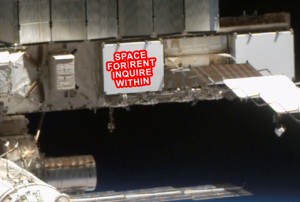
FREE Room for Rent on Space Station in 2010. Must pay for moving expenses.

Tuesday, June 26th, 2007

Reply to: [email protected]

Date: 2007-06-26, 10:04AM EDT

If you are looking for a microgravity labratory, this place is PERFECT for you. I’m now focusing more on exploration-related activites and have some extra space I can share. I prefer government agencies (are you from the National Institutes of Health?) but am willing to accept a private business.

The room should be available until at least 2015, although some think it can hold-together until 2022.

The move could be a bit tricky. My spacecraft fleet goes out-of-service in 2010. You will need to build or borrow a space-craft to get here.


Location: Space
it’s NOT ok to contact this poster with services or other commercial interests
PostingID: 360874


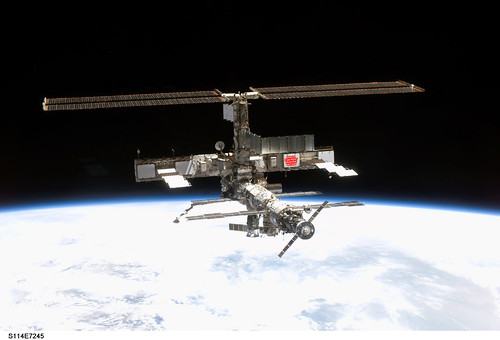
Yes, the International Space Station is for rent. From NewsDay:

For the past two years, much of the science at the space station has been oriented toward returning astronauts to the moon, and even going on to Mars.

“We didn’t need the entire capacity of the space station to do exploration-related research,” said Mark Uhran, NASA’s assistant associate administrator of the space station. “So the capacity that was freed up after we restructured our program is now available to other agencies or private sector companies.”

The space station’s first section was launched in 1998 and it has been inhabited continuously since 2000 by Russian, U.S. and European crew mates. By 2009, the station’s three-member crew is expected to grow to six people.

The station was designed to last until at least 2015, but managers now believe it could operate as late as 2022.

“What probably drives the life is … probably how much the space station is utilized,” said Bill Gerstenmaier, NASA’s associate administrator for space operations.

Once it is completed, it will cost about $1.5 billion a year to run the space station. About half the space station’s U.S. section would be available for the use by outsiders, who wouldn’t have to pay a fee for its use.

NASA’s plans to open up the space station to outsiders, though, depend on whether private companies build spaceships that could travel to the outpost as a replacement for the grounded shuttles after 2010. NASA has given $500 million in seed money to two private companies to build spacecraft and has signed agreements with others.

Remembering Roswell

Monday, June 25th, 2007

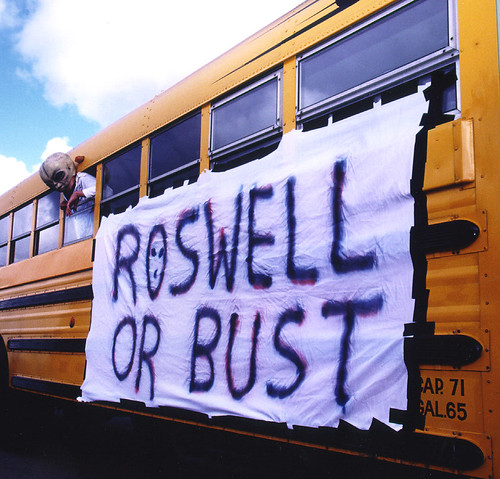
Rancher W.W. "Mack" Brazel woke-up early one morning after a night of intense storms to check-on his ranch, about 70 miles North of Roswell, NM, and clean-up some debris. What he found started more than 60 years of intense discussion. Conspiracy or cover-up, the debate continues.

We all know the story: Mack couldn’t explain the debris, called the local Sheriff but didn’t make too much of the incident. He told the Roswell Daily Record that he and his son saw a "large area of bright wreckage made up of rubber strips, tinfoil, a rather tough paper and sticks." The Sheriff called the local Air Field who sent military officers. The U.S. military first said it was a flying saucer, then backtracked and said it was a weather balloon. Was this flip-flop a cover-up or simply a communications blunder?

A crowd, mostly of the "cover-up" opinion, will gather in Roswell in early July to "celebrate" (if that’s the right word) the 60th anniversary of this landmark event in UFO history. City officials expect the Roswell Festival could attract 50,000 people to the area, which has developed into a sort-of theme park for flying saucers and aliens, complete with a museum, gift shop, "Alien Zone," and, soon, a roller-coaster.

While the UFO theories didn’t resonate in the reality-based population until Roswell (1947), people were writing about flying saucers much earlier in the century. From claims of "Deros," a race of freaks living under the Earth’s crust, to stories of spaceship kidnappings, pseudo-Science journals tapped into the imaginations of thousands of Americans, from creative teenagers to paranoid-schizophrenics. For many, Roswell confirmed their dreams/conspiracies/nightmares.

No, I do not believe aliens are stalking humans or that the Roswell debris was anything but a downed weather balloon. But I still appreciate what the Roswell incident contributed to American culture. Without sounding too cheesy, it forced all Americans (not just the Paranoid) to consider the limits of our planet and space. It forced Americans to think big, to explore our solar system, to look up at the stars and consider our possibilities. Perhaps—just maybe—we wouldn’t have had the will to land on the moon had it not been for the collective imagination brought on by Roswell. I have little doubt that Roswell spawned generations of space-enthusiasts, scientists, and astronomers that continue to innovate and explore—much of which we discuss here on ReallyRocketScience.

KAGUYA!

Tuesday, June 12th, 2007

Last December, I blogged about satellite-naming being the new new creative gold prize of astronomy —or, as I wrote then, the "new UGG boots of the space agencies" (what was I thinking writing that?). The Japan Aerospace Exploration Agency (JAXA) was planning the launch of their new lunar orbiter (formerly called SELENE), advertised as the the biggest lunar exploration project since the Apollo Project. Who wouldn’t want to name that?

A winner has been chosen! KAGUYA. As LiveScience explains, the name is from an ancient Japanese tale “Taketori Monogatari” – the tale of the Bamboo-Cutter which involves Princess Kaguya, the Moon Princess." (To be clear, KAGUYA is not named after the genetically modified mouse born in 2004 from two parents of the same sex.)

As Space.com explains, the project is perhaps the world’s most extensive current study of the moon (and there are many projects):

SELENE consists of a main orbiting satellite located at about 100km altitude, and two small satellites (Relay Satellite and VRAD Satellite) in polar orbit. The orbiters will carry instruments for scientific investigation of the Moon, on the Moon, and from the Moon.

JAXA claims that SELENE will be the most sophisticated lunar exploration mission in the post-Apollo Era. According to the agency, SELENE will observe the distribution of the elements and minerals on the surface, the surface and sub-surface structure, the gravity field, the remnant of the magnetic field, and the environment of energetic particles and plasma of the Moon. The scientific data will also be used for exploring the possibilities of the future utilization of the Moon. JAXA will also establish the basic technologies for future Moon exploration: lunar polar orbit insertion, 3-axis attitude control and thermal control in lunar orbit. In addition, SELENE will take pictures and movies of Earth-rise from the Moon horizon.

Too bad "Spektor" wasn’t chosen.

Europe Jumping Into Space Tourism Race

Monday, June 11th, 2007

A decade ago, space tourism was just a dream, even for the richest of the rich. In 2001, Dennis Tito became the first space tourist, paying more than $20 million. Since then, a number of multi-millionaire and billionaires have made the journey on Russia’s Soyuz spacecraft. (The program is booked-up until 2009.) Now, space tourism might be possible for even six-figure savings accounts.

Looking to cash-in on the new desire for out-of-this-world travel, an explosion of commercial space tourism is underway. Most of the proposed programs propose suborbital flights, which still provide a traveler with a view of the earth’s curvature and a short period of weightlessness, without the danger and expense of full re-entry. Single tickets are expected to sell for $200 to $300 thousand dollars.

While a half-dozen companies are already developing plans (including RocketPlane and PlanetSpace), Virgin Galactic appears to be the most established. Galactic draws together the only company to actually put a privately developed craft into outerspace (California-based Scaled Composites) with the financial and marketing genius of British Billionaire, Richard Branson. The company will launch its “flights” as early as late-2009 from California’s Mojave Spaceport until New Mexico’s Spaceport America is complete (making Virgin Galactic essentially an American enterprise). Watch Virgin’s promotional simulation (very cool):

Now, Europe is expected to jump into the game with an announcement at this week’s Paris Air Show. From the London Times:

EUROPE is to enter manned space travel for the first time, almost half a century after the first cosmonaut orbited the Earth.

EADS Astrium, Europe’s biggest builder of satellites and rockets, is this week expected to announce plans to carry tourists into space. The firm is due to unveil plans at the Paris air show for a spacecraft that will carry tourists out of the atmosphere for a brief ride at 3,000mph before ferrying them back to Earth.

Europe stood on the sidelines during the space race between America and Russia in the cold war, largely because of the vast cost. The first human space flight carried Yuri Gagarin, the Soviet cosmonaut, once round the Earth in 1961, and in 1969 Neil Armstrong became the first person to set foot on the moon.

Europe’s programme, conducted through the European Space Agency, has confined itself to unmanned probes, such as the Giotto mission of 1986, which explored the tail of Halley’s comet. However, European astronauts, including the Britons Helen Sharman and Michael Foale, have flown on Russian and Nasa missions.

A spokesman for EADS Astrium said: “We are going to reveal a space tourism project next week for the Paris air show.” The scheme is thought to be the first step in a plan to take space tourists into orbit and even to dock at a “space hotel”.

DIY Friday: Build a backyard wind turbine

Friday, June 8th, 2007

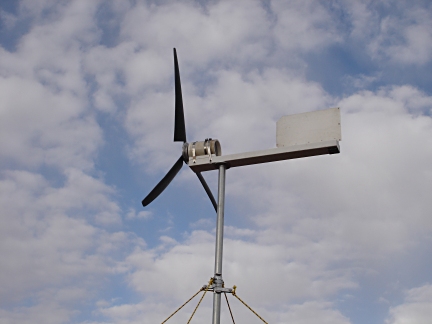
This may not be too useful if you live in a New York City loft, but if you have a large property in a windy location, try generating some eco-energy. Of course, you could buy one — but that wouldn’t be any fun. This tutorial was "generated" after an astronomer bought a remote property without electricity — but with lots of wind:

I started by Googling for information on home-built wind turbines. There are a lot of them out there in an amazing variety of designs and complexities. All of them had five things in common though:

  1. A generator
  2. Blades
  3. A mounting that keeps it turned into the wind
  4. A tower to get it up into the wind
  5. Batteries and an electronic control system

I reduced the project to just five little systems. If attacked one at a time, the project didn’t seem too terribly difficult.

Step one — find a generator: A popular option is to adapt an old computer tape drive motor — Amatek PM motors appear to be the best option.

Check out ebay to purchase. As for the required technical specs:

When used as generators, motors generally have to be driven far faster than their rated speed to produce anything near their rated voltage. So what you are looking for is a motor that is rated for high DC voltage, low rpms and high current. Steer away from low voltage and/or high rpm motors. You want a motor that will put out over 12 Volts at a fairly low rpm, and a useful level of current. So a motor rated for say 325 rpm at 30 Volts when used as a generator, could be expected to produce 12+ volts at some reasonably low rpm. On the other hand, a motor rated at 7200 rpm at 24 volts probably won’t produce 12+ volts as a generator until it is spinning many thousands of rpm, which is way too fast for a wind turbine. So shop for motors accordingly.

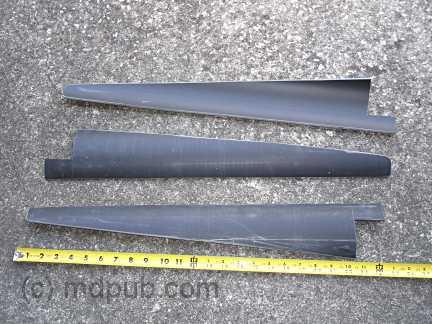
Step two — construct blades: Our astronomer DIY’er cut sections out of PVC pipe. He quartered a 24inch long, 6inch pipe (resulting in four blades — 3 for the turbine, with one spare), then shaped and sanded the blades.


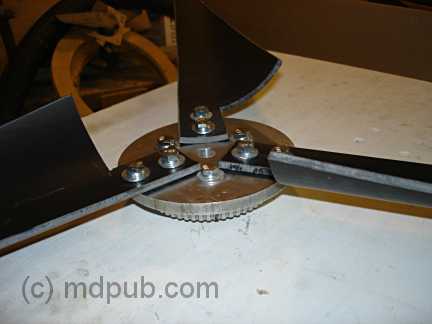
Step three — connect the blades to a hub: Find a metal disc that can attach to the motor. Drill 6 holes on the perimeter (two for each blade). One option is to connect two discs together: one that will connect the blades, one that will connect to the motor (which is what our astronomer friend did).

Step four — mount the turbine using wood or piping connect the motor/blade apparatus to a base. Notice in the picture a sheet-metal "tail" that keeps the turbine directed towards the wind. The turbine should be mounted on a sturdy pipe, secured by guy-lines. Ideally, the power cord will run through the piping to the ground.


Step five — connect the electronics:

A wind power system consists of the wind turbine, one or more batteries to store power produced by the turbine, a blocking diode to prevent power from the batteries being wasted spinning the motor/generator, a secondary load to dump power from the turbine into when the batteries are fully charged, and a charge controller to run everything.

A lot of controllers are available on ebay or you can build your own (instructions are available here).


Need more details or want to build a larger, more elaborate design? Considering buying detailed plans here.

And if your own website isn’t "renewable" enough, you can always get "Web Hosting As Nature Intended". This company uses solar panels to power their servers (check out a webcam here). We’ll have to look into it here at ReallyRocketScience.


Robert Berry to be honored with Lifetime Achievement Award

Monday, June 4th, 2007

This Wednesday, at the ISCe 2007 Conference in San Diego, Robert E. Berry – former systems fellow and chairman of Ford Aerospace and SS/L – will be given a Lifetime Achievement Award.

More about Berry from the press release announcing the award:

"Berry led SS/L and its predecessor, Ford Aerospace, from 1977 to 2000 and, with his willingness to push innovative concepts, was responsible for some of the world’s most advanced communications and meteorological satellite projects for defense, civil, and commercial applications. He cultivated the international market for U.S.-based satellite manufacturing, and under his leadership, SS/L developed the technologies that have put the company at the forefront in providing high-power satellites for direct-to-home television, satellite radio, broadband Internet and international fixed satellite services."

During Berry’s tenure at Ford Aerospace, his team built many satellites for IntelSat, including the notable IntelSat 5 and IntelSat 7 series. After Ford Aerospace was sold to Loral in 1990, Berry led SS/L in developing the FS-1300, which was a very advanced and reliable satellite that in some cases exceeded its design life of 10 – 15 years.

More from the press release:

"Berry was instrumental in providing three generations of satellite platforms to Intelsat, helping the intergovernmental consortium provide fixed satellite services to more than 149 countries, territories, and dependencies. He initiated and managed Ford Aerospace’s participation on the Milstar industry team and advocated multi-mission satellite systems, with SS/L providing military communication payloads for commercial satellites for France, Japan, Spain and Australia. Currently at SS/L, he consults with both government and commercial interests to explore new applications arising from combining satellite, wireless, and fibered transmission."

The ISCe 2007 conference takes place this week, June 5th – 7th, in San Diego. Besides honoring Robert Berry, the conference is hosting a number of other impressive speakers and sure-to-be engaging talks. Check out the speaker list here.

In a related note, Berry’s company Ford Aerospace is also where Linda Hudson, currently of BAE Systems, got her start. She was the first woman manager at Ford, overseeing the quality assurance division. After making a name for herself as an executive at Ford, she eventually became the first female vice president at General Dynamics and now, as the president of BAE’s land and armaments division, has made a significant impact in the defense industry with BAE’s recent $4.1 billion purchase of Armor Holdings. London newspaper The Times calls her "the most powerful woman in the American defence industry" (link).

Recently, Hudson travelled to London to host a BAE leadership conference. She must have made quite an impression, as one British observer noted that "she talked a lot of sense – without the jingoism and rubbish you normally hear from American defence experts" (link).


DIY Friday: TiVo on your mobile phone

Friday, June 1st, 2007

Picture it: you’re at a baseball game and are fighting with your buddy about whether or not the last hit was fair or foul. The away team’s manager is screaming at the ump and the home team isn’t showing the replay on the scoreboard to avoid controversy. You are stuck guessing — and your honor is on the line.

The solution: pull out your mobile phone, connect to your home’s TiVo, rewind the recording, then force your friend to buy you a beer for getting the call wrong. It’s possible!

An innovative blogger pulled off a very useful mashup by connecting his PPC-6700 mobile phone to a Slingbox, and the Slingbox to his TiVo. A Slingbox is a TV streaming device that enables viewers to remotely view content.

After connecting your TiVo to the Slingbox, download the appropriate player for your mobile phone. Currently there are versions for Windows Mobile 2003, Windows Mobile Version 5.0 for Smartphone, and Palm OS.

While many users find the ability to easily record shows to be most important, I’m intrigued by the convenience of having vast amounts of mobile content. The screen size on the 6700 or the Q is not much different than on an iPod and this mashup avoids hard drive space limitations and the trouble of having to download content, then add it to the iPod. By streaming from your TiVo, you are guaranteed a steady selection of fresh media—both live and recorded.

From early user reviews, the quality appears to be more-than-sufficient. Here is a video from a Motorola Q (skip to 3:30 to watch the Chappelle Show):

Don’t have a Slingbox or TiVo but still want to stream TV on your phone? Try a free service called Orb. While it let’s your home computer be a hub that streams all types of media—music, photos, and videos—to any Internet-connected device, its tv feature may be most useful. Simply connect your tv or set-top box to your computer’s tv tuner card (instructions on buying one are here), then install Orb’s free software. Your computer becomes a server distributing your tv’s content. Orb includes DVR technology, allowing you to (like the TiVo mashup) remotely record programming.

Enjoy the game!