Author Archive

DIY Friday: Build Your Own HDTV Antenna

Friday, November 3rd, 2006

Sure, you just spent $10,000 on a sweet Plasma HDTV Monitor and another $400 on a kick a$$ receiver, but that doesn’t mean you have to break the bank buying a super-expensive HDTV antenna, does it?
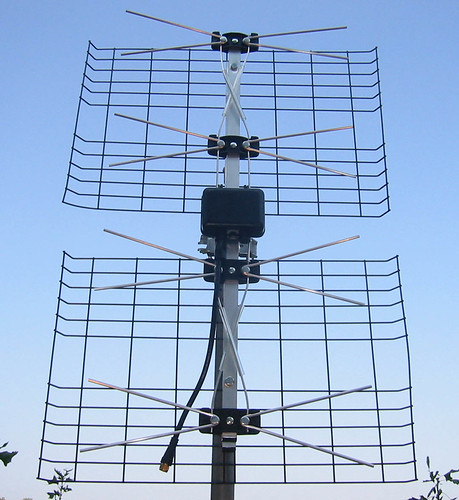
Not at all, according to pitman2 over in the Lumenlab 2.1 ("Saving the World from Bad TV") forums, who posted instructions on how to build your very own HD antenna using cardboard, a few hangers, and something called a UHF Matching Transformer. While its not entirely a MacGyver-esque construction (no saliva and papertowel tubes required), it seems to do the job.

"In my un-scientific tests this antenna seems to hold it’s own against the DB2 as an indoor antenna . In outdoor tests it performed almost as well as the DB2. Although I wouldn’t use this one outdoors, being card board and having a solid reflector. One good gust of wind and it’ll fly away. But there is no reason why you can’t build one with higher quality materials to be used outside. Like a cooling rack for a reflector so that it doesn’t catch the wind."

What’s that you say? You haven’t shelled out yet for a new HDTV monitor and receiver yet? You’re waiting for the price of your next generation television to drop below the price of the house your grandparents bought in 1956? Oh, well, have no fear, we hear at RRS have you covered too. Actually, Popular Mechanics has the information, but we’ll link to their how-to on turning your PC into a lean, mean HDTV viewing machine and you can thank us later.

One word of warning on the last bit though: While turning your PC into an HDTV and building your own antenna maybe cheap, explaining to your significant other why you have to watch television under the phosphorescent glow of your computer monitor while coaxial cable from the antenna on the roof dangle overhead… well, that’s priceless.


Cuba Funding the Internet?

Thursday, November 2nd, 2006

According to government official in its Commission of Electronic Commerce, Juan Fernandez, Cuba is funding the Internet. While this may seem a little bit surprising, coming from a country whose widely known for limiting citizen access to the ‘net and censoring any access a citizen does find, the problem is a little complicated:

"Once the underdeveloped countries have undertaken this tremendous effort and sacrifice to create the minimum conditions for them to be able to connect up to the Internet, then they find themselves confronted with a situation whereby they have to pay for the connection up to the Internet at the same level as the developed countries, even though this might also be a channel used by users in the developed countries.

Which means that you can have technical means whereby you can do away with this paradox. And these poor countries seem to be financing (the) Internet by this system."

The only problem with making this argument, Wired’s Declan McCullagh points out, was that representatives from industry and researchers responsible for hooking Latin American countries up to the net were at the UN Internet Governance Forum during which Fernandez posed his argument and could respond, citing instead Cuba’s telecommunications monopoly and censorship policies as the source of the island nation’s struggle to pay for its Internet connection. Bill Woodcock, research director for the non-profit Packet Clearing House, stepped up and noted these challenges:

"Remember that the Internet is an end-to-end model. Zero percent of Cubans are connected to the Internet. The Cuban government operates an incumbent phone company, which maintains a Web cache. Cubans who wish to use the Internet browse the government Web cache. They do not have unrestricted access to the Internet.

And the question about whether there is an inequality in Cuban access to the global Internet, ask yourself whether a Cuban Internet service provider would face any challenges in connecting to a network in the United States or in Europe. And the answer is that, no, these are unregulated markets. They would face exactly the same costs as anyone anywhere else in the world."

The ultimate bit of irony? The UN Summit that this is all taking place at, opened by UN Secretary General Kofi Annan, is occurring at a hotel in Athens that — get this — doesn’t have working Internet. Ooops…

NASA Looking to Invest in the Future

Wednesday, November 1st, 2006

According the Washington Post, NASA is getting into the ventura capital biz with a new firm, Red Planet Capital, aimed at investing in start-ups developing emerging technologies that might someday prove useful to NASA. (NASA Watch, of course, had the story in February)

Peter Banks, an organizer and manager of the Red Planet project noted:

"We will invest with others in companies making products that aren’t being made elsewhere and that NASA might be able to use. We don’t really expect the companies to be making products that can be used as is on the moon, or in other low-gravity environments. NASA would do the adapting once the technology is developed."

While this is the first time the "federal government has started a venture capital fund for civilian purposes", its not the first time its utilized the venture capital model of investment for the purposes of government technology development. In fact, the present administrator of NASA, Michael D. Griffin, former president of the CIA-sponsored venture fund, In-Q-Tel, which was very successful in delivering technologies to the Agency… some 130 at last count.

Still, the plan is not without its critics already, some of whom wonder how the federal government can really make it in the cutthroat world of venture capital investing. Blogger Rick Rickertsen doubted, in particular, the usefulness of setting up an investment fund, when present VCs would be more than willing to tell the government what technologies are worth investing in:

"The U.S. has the largest, smartest, best funded venture capital industry on the planet (of Earth). There are hundreds of firms with brilliant technologists investing billions of dollars per year in leading technologies of all types — including private space exploration, which will hopefully put NASA out of business. Why on earth does NASA think they need to add to that? It is truly crazy and beyond wasteful. If NASA wanted a window on technology for the Federal Government, all they needed to do was write a letter to all VCs thought the National Venture Capital Association (Cost: about $200) and all of these good patriots would have sent them every promising business plan in their files. Then they would have had a REAL window on technology."

While Rickertsen may have a point, the success of In-Q-Tel and the fact that Red Planet Capital would basically do just what he requested (asking other VCs to send it the "best" business plans in their files) and then evaluate the quality of those business plans, makes me think that his argument might be a little naive. Oh sure, I imagine VC would be more than willing to send the Feds some pretty slick business plans, spending the next few nights dreaming while federal dollar signs danced over their heads, but to think that they’d do so out of the goodness of their hearts… well, that’s just dumb.

Satellite-Linked Heineken?

Monday, October 30th, 2006

Well, it looks like the party might soon be over for the generations of euro-tripping backpackers who’ve snuck a few bottles of French wine into Germany or bottle of the illicit green stuff from central europe into Ole’ Blighty… shucks!

Our good friends at vnunet are reporting that Heineken Brewery (makers of Dutch delight drunk around the world), in association with IBM, international shipping company Safmarine, Vrije Universiteit Amsterdam (University of Amsterdam), and customs agencies in the US, UK, and the Netherlands, are beginning a program to track cargo container shipments of Heineken beer from Europe to the United States using satellite and cellular technology.

Called the "Beer Living Lab," the main goal of the project is to create a paperless documentation trail using IBM technology to provide real-time visibility of the product and interoperability through wireless sensors linked to its WebSphere platform.

According to IBM project Manager, Steffan Reidy, the results of this research effort could be used to improve customs processes around the world:

"[It’s] the first step in building the ‘Intranet of Trade’, which will help to substantially improve efficiency and security in the global supply chain."

Or, as Vnunet reported:

"Once accepted and implemented widely, paperless trade will support initiatives that will eliminate most inspections on arrival, thus significantly speeding up ocean freight shipments and improving the profit margins for shippers."

While this might mean it might be a little harder to sneak some booze across the border (especially if and when the technology is combined with RFID tagging of shipped spirits), the potential savings that could be passed down to consumers and improved port security probably evens things out a bit.

Want even more information about the Beer Living Lab? Think about taking a brief sojourn to Amsterdam in the next few days… the lab seems to be having a workshop on the technology on Thursday.

Space Station Unloads Supply Ship; Microsoftie to be next Space Tourist

Friday, October 27th, 2006

With the safe arrival of Anousheh Ansari, the first female space tourist, as we reported a few weeks ago, life continues to be interesting aboard the International Space Station. Today, the Space Stations residents were finally able to open the hatch leading to an unmanned supply shipped that docked with the station 24-hours before. As CBS News reports:

"The Progress M-58 cargo ship, carrying supplies to the station’s three-man crew, docked at the station Thursday at 6:28 p.m. Moscow time (10:28 a.m. EDT) on autopilot, as planned.

Mission Control could not confirm, however, that its antenna had folded as required for the craft to clamp securely on the station although later it announced that it had solved the glitch."

Fortunately, Mission control reports, the crew, which was never in danger of being without food or oxygen, has opened the cargo ship and begun unloading supplies.

In other ISS related news, the billionaire who helped create Microsoft Excel and Word, Charles Simonyi, is supposedly set to be the next space tourist according to the Seattle Post Intelligencer. Simonyi is currently set to join the Space Station crew for eight days (during a ten day mission) aboard a Russian Soyuz spacecraft set to launch on March 9,2007.

Everyone will, of course, be able to follow Simonyi on his travels through his blog at charlesinspace.com.

Galactic Hit-n-Run

Thursday, October 26th, 2006

While I’m not really certain what this all means, it has lead to some really amazing images and movies.

Astronomers have new evidence that the Andromeda spiral galaxy was involved in a violent head-on collision with the neighboring dwarf galaxy Messier 32 (M32) more than 200 million years ago. This infrared photograph taken with NASA’s Spitzer Space Telescope revealed a never-before-seen dust ring deep within the Andromeda galaxy (highlighted by the inset). When combined with a previously observed outer ring, the presence of both dust rings suggests that M32 plunged through the disk of Andromeda along Andromeda’s polar axis approximately 210 million years ago.

Check-out a high resolution image of the collision (2.1 MB) and a great simulation of the collision.

According to a press release connected to the images, the findings may be important for the clues they might provide about our own galaxies’ future. Similar to collision pictured above,

"Astronomers have predicted that Andromeda and the Milky Way will collide in approximately 5 to 10 billion years. That collision will erase the separate identities of each galaxy, leaving a single elliptical galaxy in their place."

At least we’re not going to be around for that one, right? 🙂

Presenting the Sun… in STEREO

Wednesday, October 25th, 2006


NASA’s STEREO Mission is set to launch this evening at 8:53 PM EST and things seem to be going well, according to the mission website:

"The STEREO mission is about to begin. Safely installed atop a Boeing Delta II rocket, the twin spacecraft are ready for launch Wednesday at 8:38 p.m. EDT. The vehicle’s second stage was loaded with storable propellants on Monday. The launch weather forecast remains favorable, with virtually no concerns. High pressure behind a passing front has brought pleasant conditions for the next two days. There is still only a 5% chance of weather violating launch constraints, due to possible development of thick clouds."

The launch blog will start reporting the happenings starting two hours before the launch (around 7pm EST).

The STEREO (Solar TErrestrial RElations Observatory) Mission, for those who don’t already know, intends to use stereoscopic 3D vision to construct a complete picture of a sun and the nature of solar flares. In addition to helping us know a great deal more about the world’s most important star, the mission should help us learn how we can best protect future astronauts from the dangerous effects of solar flares.

X-Prize Cup Follow Up: No Winners in Space Elevator Competition

Tuesday, October 24th, 2006

Looks like there were no winners in the X Prize Cup’s space elevator cup competition this past weekend in Las Cruces, NM. The competition, which  we wrote about last week, put twenty teams against one another in two categories, climbing and tether strength. According to an article on earthtimes.org:

Although none of the teams were declared winners, the University of Saskatchewan Team (USST) was just two seconds short of winning the prize, as they managed to climb 200-foot- high carbon fiber ribbon in two seconds over the time allotted to them.

While there weren’t any winners, this year teams did far better than they have previously, according to Ben Shelef, an executive at the Spaceward Foundation that sponsored the competition. Shelef reminded those interested interested in the competition that:

"For year one, we attracted seven teams and didn’t climb the tether. This year we had four teams make it up to the top, and one came very close to claiming the prize. We didn’t want to make the competition too easy and we can’t make it too hard, so it looks like we are walking the line."

Interested in taking a stab at the challenge during next year’s cup? Looks like you might have an even greater incentive to succeed: Shelef announced that the prize money from this year’s competition will rollover to next year’s, leaving the climbing and tether strength competitions with a combined purse of $500,000.

Even if it means having to take the stairs this year, building the (space) elevator next year has become even sweeter…

X-Prize Cup Tournament This Friday & Saturday in New Mexico

Wednesday, October 18th, 2006

For readers that haven’t established weekend plans just yet, you might want to consider a quick jaunt out to La Cruces, NM where the Wirefly X-Prize Cup will be taking place this coming Friday and Saturday (Oct. 20 & 21).

The main event of the weekend will, of course, be the $2.5 million in Prize competitions that will being going on throughout the exposition.

The Northrop Grumman Lunar Lander and Vertical Lander Challenge will probably be on of the most watched events, but the Spaceward Foundation‘s Space Elevator Challenge may be among its most technically interesting. In the Space Elevator Games, teams will be competing for two, separate $200,000 prizes, one for who builds the best climber (a machine capable of traveling up and down a tether ribbon, with powering being beamed to a transmitter on the device) and the team that builds the strongest tether (first competing against other teams and then by proving that its tether is 50% stronger than the off-the-shelf variety.

While we’ve written about the space elevator competition in the past, Really Rocket Science readers will also have a leg-up on other attendees in terms of other events going on at the space exposition. Also taking place during the fair will be the unveiling of the Rocket Racing League’s X-Racer (written about at RRS here) and meet and greet with the world’s first space tourist, Anousheh Ansari (written about on RRS just a few weeks ago).

Stay tuned to Really Rocket Science for all the information coming out of New Mexico in the next few days. While we won’t be there, we’re going to stick to this story in the days ahead.

PRC to Broadcast Folk Tunes from Moon, Raises Concerns

Friday, October 6th, 2006

Chinese news service, Xinhua, reports that government officials in the PRC have announced what songs will be broadcast back to earth from the country’s first lunar-probing during next year’s Mid-Autumn Festival. According to the Commission of Science, Technology and Industry for NationalPRC Flag Defense, the organization in charge of the lunar project:

"Most of the songs [will be] Chinese folk songs. The song [that] got [the] most votes was [the] folk song ‘My Wonderful Home Town’, followed by ‘I Love China’, ‘Singing Praises of Motherland’ and 27 others."

In other Chinese space-related news, the U.S.A. Today reported yesterday that U.S. defense officials are concerned tests China has been conducting of ground-based laser devices capable of jamming U.S. spy satellites over their country. Given the amount of money the U.S. has poured into developing satellites for intelligence gathering purposes, defense analyst with the Lexington Institute Loren Thompson suggests we have cause for concern:

"Space is a much bigger part of our military posture than it used to be, so any effort by the Chinese or anybody else to jam our satellites is potentially a big deal."

While these new devices merely jam the satellite signal over PRC territory, some are saying that it might be possible to disable satellites using lasers in the future… certainly something the U.S. is going to have to consider in spy satellite construction in the future.