DIY Friday: Launch Your Own Satellite
Friday, December 1st, 2006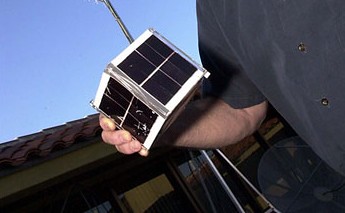 Got a spare $80,000 and a dream of putting your own satellite into space?
Well, you’ve come to the right place. A recent article from News.com showcases the exciting CubeSat program, based at Stanford and California Polytechnic State University, San Luis Obispo, which allows students and companies from a around the world to launch tiny satellites for cut-rate prices without the bureaucratic and logistical hurdles they might experience if they tried to launch them on their own.
For around $40,000 for development and $40,000 for launch, the CubeSat program has put dozens of one kilogram, ten-centimeter cubed satellites 240-360 miles up in the heavens. Says one of the program’s principle founders Prof. Bob Twiggs:
"I kind of look at this as the Apple II. The ordinary person can get something into space. We don’t know what the ultimate use is, but look what happened to the Internet.”
So what are these mini satellites doing other than helping schools and individuals claim their own chunk of Space? Well, Stanford launch a three-cubed CubeSat in 2003, called QuakeSat, which monitors the seismic energy released over faults which could be used to predict earthquakes… a useful device if there ever was one for quake-prone California.
Students around the world have been using the CubeSat program to gain a working knowledge of spacecraft design that they might not otherwise have the opportunity to engage in. University students in Columbia and Romania are currently in the process of putting together their own CubeSat, as are high school students at San Jose’s Independence High.
While no word is out yet about how you could go about building your own CubeSat with the declining price of space technology, here’s $5 saying you’ll find a CubeSat in a box of Cracker Jacks in the next twenty years.
 While you may not normally turn to Really Rocket Science for book recommendations, we’ve always believed that even the best engineers (and enthusiasts) could use a little literature in their life. Still, if you’re going to indulge in the good stuff, its always a good idea to start with some work that has some applicability to your every day life, which is why we’re recommending a work written by a French playwright chronicle the afterlife of the 20th century’s most preeminent scientist… errr… ummm… Well, now that I think about it, it probably isn’t even close to applicable to your everyday life, but it does sound pretty cool, right?
 my excellent map reading skills, knowledge of the compass rose, and keen sense of direction, I’m also pretty good at announcing where we should be turning, staying straight, or getting off the highway — oh my god, you just missed that exit. How could you have missed it? — just a few seconds before the necessary maneuver.
 should the ice caps melt and, as