Author Archive

I didn’t write this! Sounds more like Dickens

Thursday, January 11th, 2007

While some might say it reminds them of a game of "Spot the Looney," there seems to be some confusion across the pond about whether or not the U.K. is going to venture to the moon or not.

According to the BBC, the UK’s astronomy funding agency, the PParc, is planning on taking the country’s first mission to the moon by 2010. The proposed craft, named Moonlight, would be designed to orbit the satellite and shoot four "suitcase-sized darts containing various instrumentation into the lunar surface.
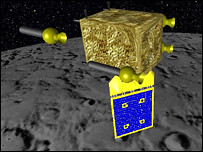
"The darts could carry a small suite of instruments, such as seismometers to listen for ‘Moonquakes’. Analysing these tremors would give scientists new insight into the make-up of the lunar interior.

According to Dr Andrew Coates, of the Mullard Space Science Lab and who has contributed to the concept study, the impactors would represent the first time there had been a detailed study of the Moon’s sub-surface."

Another proposed designed, code-named Moonraker, would be designed to land on the surface of the moon.

"Its scientific goal would be to study the lunar surface, perhaps at the poles or in the giant impact crater that resides on the far side of the Moon. It might also provide useful information for space agencies searching for suitable sites for eventual human habitation."

Cool ideas, so what’s the problem? Well, it turns out key British Science officials are saying that its pretty unlikely that the UK is going to go it alone on a project of this magnitude.

According to science blog Physorg.com, David Parker, director of space science at the British National Space Centre (BNSC), the plans the BBC reported on are the "’most unlikely outcome’ of Britain’s space plans."

D’Oh!

Consumer Electronics Everywhere: Updates from CES & Macworld

Wednesday, January 10th, 2007

Yesterday was a huge day (probably the biggest of 2007… just 9 days in) for the announcement and release of Consumer Electronics, as we teased yesterday, at CES and Macworld Conference & Expo.

Of course, Apple takes the cake with three of the biggest announcements of the day:

The release of Apple TV which brings iTunes Store purchased music, television shows, and movies (over 350, now including many from the Paramount vault) to the big screen via your wired or wireless network.

The introduction of the iPhone, a product which will foreseeably revolutionize the mobile phone market. WIth over 200 individual patents to its name, when its released in June, the iPhone will be the most technology advanced mobile phone on the market featuring a full blown operating system, multiple wireless connection technologies (Quad-band GSM, EDGE, 802.11b/g, & Bluetooth 2.0 w/ EDR), and a huge 3.5-inch screen that utilize new multi-touch display technology.

The announcement that the company would know be known as Apple, Inc. rather than Apple Computers, Inc. While meaningless to most techies, the name change is akin to Apple screaming, "Bring it on" to consumer electronic juggernauts such as Sony, Motorola, or Nokia, representing its transition to a consumer electronics company and a willingness to take on a new industry.

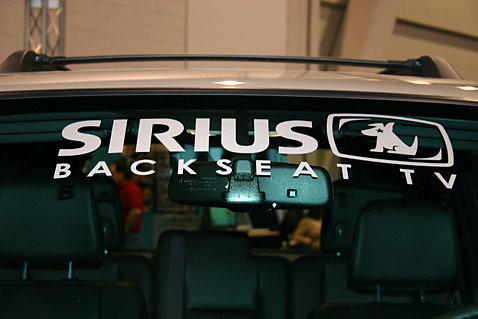
Back at CES, Satellite Radio company Sirius announced, according to Sat Radio blog Orbitcast, that Dodge will be offering Sirius Backseat Television in some 2008 models. With multiple zones, Orbitcast notes, the Dodge set-up allows the driver to listen to the raunchiest bits of Howard Stern while the kids watch Spongebob. Coolness!


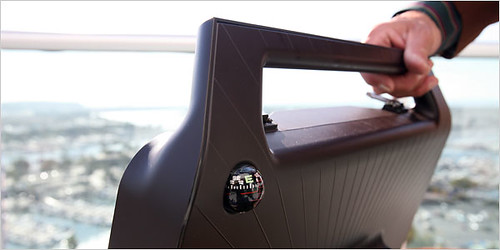
For those looking to watch TV themselves, The New York Times featured an article Monday about another major announcement from DirectTV, Sat-Go, which allows you to watch satellite TV anywhere. With an interesting genesis, partially invented by the man who produced CHiPS and The New Hollywood Squares, its a product that sure to be a huge hit in the right markets, even if there have been less elegant solutions in the past.

DIY Satellite Radio Merger

Wednesday, January 3rd, 2007

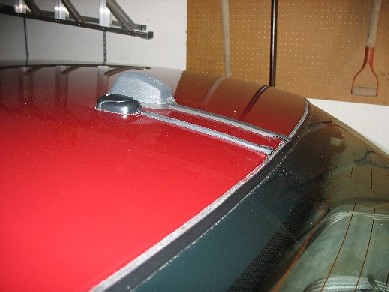
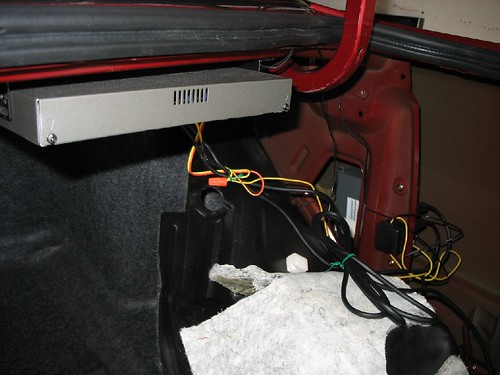
While the NYTimes confirmed rumors that the two were headed towards mergers-ville Monday, some hackers over in the XM fan forums have been discussing a joining of Sirius and XM that even the FTC can’t shut down. As with most two headed consumer electronic beats, the rig requires ignoring manufacturer claims that the doing so is impossible and leaving a mess of cables and random boxes in your trunk.


Hey, who said you needed to put groceries in there anyway.

[Adding XM to Sirrus]

RRS Over The Holidays: See You in ’07

Friday, December 22nd, 2006

ReallyRocketScience is going to be taking a bit of a break over the Holidays, but we’ll see you all back here bright and early on Tuesday, January 2nd, nursing our lingering hangovers, and still wondering what happened the evening before last.

 In all seriousness, whatever you celebrate (and even if you’re celebrating nothing in particular), best wishes to you and yours for a happy and safe holiday season.  See you in 2007!

DIY Friday: Car Laptop Desk and a Flash Diffuser (Holiday Edition)

Friday, December 22nd, 2006

With just three shopping days left before the big day, many of us are trying to frantically figure out how we’re going to get all our work done before the end of 2006, while simultaneously hitting the malls getting gifts of all 27 nieces and nephews that we all of the sudden have.


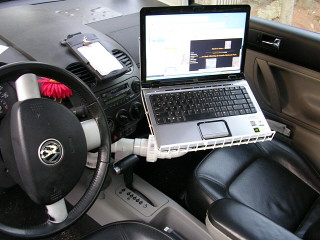
While you’re probably better off not turning to ReallyRocketScience for gift giving suggestions (Hint: Your girlfriend really isn’t going to love that "Build Your Own" Rocketry Kit as much as you think she is), we will direct you to site that will show you how to "build your own", cup-holder-based laptop desk for your car. Sure, checking your email while you’re hunting for that great parking space might lead to one or two fender benders or incidences of road rage, but, hey, at least you’ll be able to make sure your boss thinks you’re still at your desk.


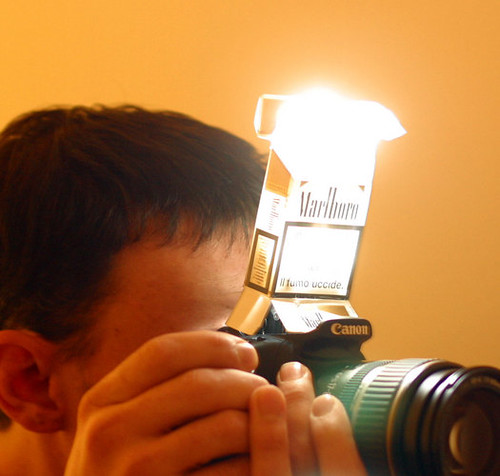
For those of you that have the shopping done, but are planning to photograph the christmas morning festivities only to find out that you didn’t get the flash diffuser you wanted from Santa, here’s a site where you can figure out how to make your own. Just one word of caution: While the resulting diffuser may be good for your evening photos, the cigarettes it takes to make it are bad for your health and, in the long term, far more expensive than the priciest diffuser you can buy.

Yoga? In Space?

Monday, December 18th, 2006

Let it never be said that you don’t get all the angles on space travel and rocketry here on the Really Rocket Science blog. Oh sure, I could tell you about Japan’s launch this afternoon of the country’s largest satellite ever, but you’d much rather know about Yoga’s history in space, right? I thought so.

In any event, I came across this interesting story on the history of Yoga in America published in a recent issue of the Columbia Journalism Review from one of my favorite news/article blog, Arts & Letters Daily. While most of the article, obviously didn’t have much to do with what we talk about here on RRS, it turns out that Yoga has interesting relationship with space travel. For example, at the height of the Cold War Space Race, there was a fair amount of concern about India’s ties to the Soviet Union’s space program. In the 1950s,

"Prime Minister Jawaharlal Nehru of India, obviously prompted by cold-war worries, denied reports that his nation would supply the Soviet Union with yogis to help cosmonauts breathe easier in outer space."

While yogi’s might have never made it to Mother Russia, Yoga did make it into outer-space (and on a Russian mission, no less) when Rakesh Sharma, who some have recently rumored is being considered for a second trip into space, became the first Indian in space in 1984. During the spring flight aboard the Soviet Soyuz T-11, Sharma often did a somewhat elaborate series of zero-gravity Yoga exercises, marking the first extraterrestrial practice of the asanas (postures). Ever since, there has been great interest in the potential benefits in stress relief, breathing, and circulation Yoga could bring to space travel in the future.

Moral of the story? If you’re thinking about hoping a trip on the Virgin Galactic-1 or one of the other opportunities for space travel that might come afterwards, maybe you should start thinking about picking up a matt and heading off to your your local Yoga center while you wait.

DIY Friday: Build an Air Laser

Friday, December 15th, 2006


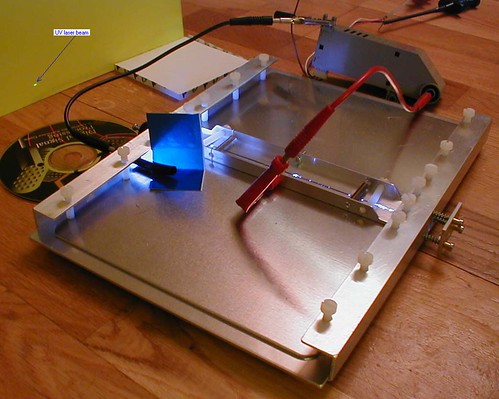
Ever dream of blasting your friends (or your enemies) with really freakin’ cool laser gun when you were kid? Well, it might not be the gun, but the MAKE blog points to a really cool how-two guide for building your own Air Laser. That’s right, "Laser" (insert Dr. Evil air quotes) technology for $10 and none of the crazy stuff that requires a government license and HAZMAT signage.

We describe a very simple laser: no special gas, no chemical products, no vacuum and no glass work! This Nitrogen laser uses normal air at atmospheric pressure. All you need is some metal parts and an about 10 kV 1 mA adjustable High tension DC source.

Dig it! Oh, and if you dig our DIY feature and haven’t checked out the MAKE blog or the quarterly magazine of the same name, do yourself a favor and take a look. You won’t regret it.


NASA has the BEST WEEK EVER! Oh, and wins a Nobel Prize…

Monday, December 11th, 2006

Sure, shuttle disasters and budget cuts have left a chip on its’ shoulder, but many are arguing that NASA has had, in the words of that timeless Vh1 show, the best week ever! Between the surprisingly successful shuttle launch, the announcement of the agency’s plan to return to the moon, and now a Nobel prize, the AP explains, NASA is having a week better than the one you spent in Cabo with Heidi Klum.
The Nobel, of course, went to John C. Mather whose study of cosmic background radiation works to confirm much of the big bang theory. From the Nobel Committee:

"This year the Physics Prize is awarded for work that looks back into the infancy of the Universe and attempts to gain some understanding of the origin of galaxies and stars. It is based on measurements made with the help of the COBE satellite launched by NASA in 1989.

The COBE results provided increased support for the Big Bang scenario for the origin of the Universe, as this is the only scenario that predicts the kind of cosmic microwave background radiation measured by COBE. These measurements also marked the inception of cosmology as a precise science. It was not long before it was followed up, for instance by the WMAP satellite, which yielded even clearer images of the background radiation. Very soon the European Planck satellite will be launched in order to study the radiation in even greater detail."

Take a look at some of the photos tied to the announcement (rhetorical question: are all nobel prize-winning physicists not photogenic or does the Nobel prize committee actually seek out individuals who look odd in front of the lens?) and Mather’s acceptance speech.


DIY Friday: Satellite Monitoring for Next to Nothing

Friday, December 8th, 2006

Any satellite geek with a lick of imagination has imagined what it might be like to work at one of the dozens of American intelligence organizations utilizing top-secret government satellites and communicating and transmitting information around the world. It sounds like a sweet deal: a nifty chair, your own spot in the control room, all space-news you can eat — how could it not be awesome?

Well, if you’re anything like me, you’re probably forgetting that making satellite monitoring your job would mean, well, making it your job. All of a sudden, the vision of a job among the stars crashes to reality and, before you know it, that position playing with satellites becomes just another 9-to-5 with the requisite paper pusing, confused middle mangers, and brown-bag lunches on synergy.

So what’s a geek to do?

Easy. Make satellite monitoring your hobby. Today’s DIY Friday link brings us to steettech.com and shows us how with a couple antennas, a radio scanner, and short-wave tuner anyone can make their own mission control.

Sure, it might not set you up with a sweet government 401K, but at least a DIY Sat Monitoring rig means you don’t have to seek congressional approval to amp up your transmitter, right?

When the Moon Hits Your Eye and you… ask who is “Tye”?

Monday, December 4th, 2006

It seems like satellites with room for names of supporters is the new UGG boots of the space agencies — everyone’s gotta have them. But, as a savvy consumer, you know you’re better off shopping around. I mean, sure you could have your name on MIT & GeorgiaTech satellite, as we suggested a couple of weeks ago, or you could get your name on Japan’s new lunar orbiter, SELENE.

Here’s the whole story, in only the slightest "All your bases are belong to us" english:

"The Japan Aerospace Exploration Agency (JAXA) plans to launch the lunar orbiter ‘SELENE’ on a H-IIA Launch Vehicle from Tanegashima Space Center in the summer of 2007.

The SELENE is an artificial satellite that aims to collect closely featured scientific data on “The formation of the moon and its transitional history up to today,” which is the biggest lunar exploration project since the Apollo Project.

JAXA will accept from the public names and messages to deliver to the moon aboard the SELENE. Please send us your wishful messages."

The real question: If getting your name blasted into space on a satellite is the new in thing, which one is Brangelina going to choose?