Archive for the ‘Around the Blogs’ Category

Yoga? In Space?

Monday, December 18th, 2006

Let it never be said that you don’t get all the angles on space travel and rocketry here on the Really Rocket Science blog. Oh sure, I could tell you about Japan’s launch this afternoon of the country’s largest satellite ever, but you’d much rather know about Yoga’s history in space, right? I thought so.

In any event, I came across this interesting story on the history of Yoga in America published in a recent issue of the Columbia Journalism Review from one of my favorite news/article blog, Arts & Letters Daily. While most of the article, obviously didn’t have much to do with what we talk about here on RRS, it turns out that Yoga has interesting relationship with space travel. For example, at the height of the Cold War Space Race, there was a fair amount of concern about India’s ties to the Soviet Union’s space program. In the 1950s,

"Prime Minister Jawaharlal Nehru of India, obviously prompted by cold-war worries, denied reports that his nation would supply the Soviet Union with yogis to help cosmonauts breathe easier in outer space."

While yogi’s might have never made it to Mother Russia, Yoga did make it into outer-space (and on a Russian mission, no less) when Rakesh Sharma, who some have recently rumored is being considered for a second trip into space, became the first Indian in space in 1984. During the spring flight aboard the Soviet Soyuz T-11, Sharma often did a somewhat elaborate series of zero-gravity Yoga exercises, marking the first extraterrestrial practice of the asanas (postures). Ever since, there has been great interest in the potential benefits in stress relief, breathing, and circulation Yoga could bring to space travel in the future.

Moral of the story? If you’re thinking about hoping a trip on the Virgin Galactic-1 or one of the other opportunities for space travel that might come afterwards, maybe you should start thinking about picking up a matt and heading off to your your local Yoga center while you wait.

Behind the Scenes on the Shuttle Night Launch

Tuesday, December 12th, 2006

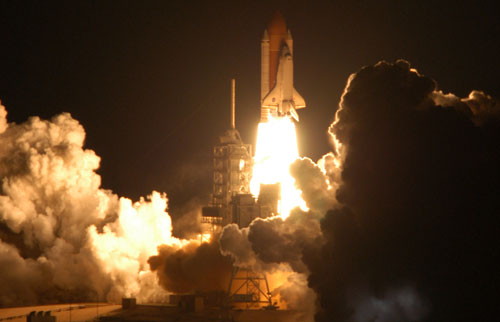
After a delay due to weather, the Saturday night launch of the Space Shuttle Discovery marked the first shuttle night launch in more than four years.
The Discovery mission involves more than NASA, however: Playing a key role in analyzing the weather and the launch itself was the Air Force’s 45th Space Wing out of Patrick Air Force base in Florida.

Air Force Link provides a unique behind-the-scenes look into the role of the 45th Space Wing in Discovery’s launch:

Several units across the 45th SW played vital roles such as helping validate the pad after the shuttle rolled out, final ordnance installation, providing weather forecasts, organizing and training Department of Defense contingency response forces and media relations.

The wing also provided eastern range support with a vast network of radar, telemetry, meteorological, optical and communications instrumentation that helped facilitate a safe, picture-perfect launch….

Another of the ways the 45th SW supported this mission was monitoring restricted airspace near Kennedy Space Center and helping keep it clear during the launch window.

Staff Sgt. Adam Greer, of the wing’s 1st Range Operations Squadron, served as an aerospace control officer. He closely monitored a radar scope and had the capability to facilitate contacting pilots who strayed into the restricted airspace, if necessary, during the mission.

Sergeant Greer remembers watching space shuttle launches as a kid. He said it’s surreal that he is part of the launch team now.

"The fact that I played a role in space exploration by helping launch a mission to the International Space Station is something that will stay with me forever," he said.

The STS-116 mission is the 33rd for Discovery and the 117th space shuttle flight. During the planned12-day mission, the crew will continue construction on the International Space Station, rewiring the orbiting laboratory and adding a segment to its integrated truss structure. 

Click here for more information on the 45th Space Wing at Patrick AFB.

Saturday Night Shuttle Launch

Monday, December 11th, 2006

Gorgeous launch. I’ll be watching this mission on NASA TV


Ariane 5 Launches AMC-18 and Wildblue-1

Friday, December 8th, 2006


Watched the launch live via satellite from French Guiana. A little cloudy, but still pretty cool. They may can it for viewing here.

Hope tomorrow’s STS-116 launch from Florida is clearer.

According to Arianespace:

Dans la nuit du vendredi 8 au samedi 9 décembre 2006, Arianespace a mis en orbite de transfert géostationnaire deux satellites pour deux opérateurs privés américains : WildBlue-1 pour WildBlue Communications et AMC-18 pour SES Americom.

Trentième lancement d’Ariane 5, seizième succès d’affilée

Ce nouveau succès du lanceur Ariane 5, le cinquième en 2006, confirme que l’offre de Service & Solutions d’Arianespace est la référence la mieux adaptée aux besoins des opérateurs, qu’ils soient privés ou institutionnels.

Au cours de ces 12 derniers mois, Arianespace aura mis en orbite douze satellites de télécommunications et une expérience technologique.

Aujourd’hui, Ariane 5 est le seul lanceur opéérationnel disponible sur le marché commercial capable de lancer simultanément deux charges utiles.

Au service de deux clients américains prestigieux

Le choix d’Arianespace par un nouvel opérateur du secteur des télécommunications spatiales américains et par le plus grand opérateur de services par satellites aux Etats-Unis, illustre la reconnaissance d’un service de lancement de qualité.

C’est en utilisant les capacités du satellite Anik F2 de Telesat, lancé par Ariane 5 en juillet 2004, que la société WildBlue Communications, basée dans le Colorado, a lancé son activité Internet. WildBlue-1 permettra à WildBlue Communications d’élargir son offre en large bande à destination des utilisateurs privés et des petites entreprises dans les zones où l’offre terrestre est actuellement inexistante.

Le satellite AMC-18 est le vingt-cinquième satellite confié au lanceur européen par le groupe SES Global (Euronext Paris et Bourse du Luxembourg : SESG), le plus grand opérateur privé de satellites au monde. Le satellite AMC-18 sera exploité par SES Americom, premier fournisseur de services par satellite aux Etats-Unis, qui exploite une flotte de 18 satellites en orbite, fournissant principalement ses services sur l’ensemble du continent américain. En tant que membre de la famille SES Global, SES Americom est aujourd’hui à même de fournir des solutions de télécommunication de bout en bout dans toutes les régions du globe.

A Rocket Science Finish to 2006

Thursday, December 7th, 2006

If the weather cooperates, tonight’s launch of the Space Shuttle Discovery could kick off a "rocket finish" to 2006.

At least nine satellite or shuttle launches are scheduled between now and December 31st.


NASA reports from the launch pad at Kennedy Space Center

All systems onboard the space shuttle are functioning normally this morning, but there’s a 60 percent chance of weather prohibiting a liftoff at 9:35 p.m. EST. A cold front moving through the area is expected to bring with it a lingering blanket of clouds and isolated light rain. The team will press on with the countdown for now, in case the weather cooperates after all.

Starting shortly after 9:00 a.m., Discovery’s orange external tank will begin loading 500,000 gallons of liquid oxygen and hydrogen. This process, called "tanking," takes about three hours to complete. The propellant levels in the tank will be continuously "topped off" until the final minutes of the countdown.

Across the space center, in the Operations and Checkout Building’s crew quarters, the astronauts are scheduled to wake up just as tanking is getting under way. After breakfast, a weather briefing and suiting up, they’ll board the silver Astrovan and leave for the launch pad amid the cheers of Kennedy employees.

The STS-116 mission is the 33rd for Discovery and the 117th space shuttle flight. During the 12-day mission, the crew will continue construction on the International Space Station, rewiring the orbiting laboratory and adding a segment to its integrated truss structure.

But will the weather cooperate? "The forecast has trended for the worse right now," says Kathy Winters, the shuttle’s weather officer.

The weather in French Guiana looks a bit better for tomorrow’s planned launch of Arianespace’s final Ariane 5 mission of the year,  which will lift SES-Americom’s AMC-18 satellite. That launch can be seen live in North America beginning at 4:45 pm EDT.

Moon Base Alpha

Monday, December 4th, 2006


NASA unveiled plans for building a base on the Moon today:

NASA Deputy Administrator Shana Dale, who is guiding the long-term strategy development effort among 14 of the world’s space agencies, said, "This strategy will enable interested nations to leverage their capabilities and financial and technical contributions, making optimum use of globally available knowledge and resources to help energize a coordinated effort that will propel us into this new age of discovery and exploration."

The Global Exploration Strategy focuses on two overarching issues: Why we are returning to the moon and what we plan to do when we get there. The strategy includes a comprehensive set of the reasons for embarking upon human and robotic exploration of the moon. NASA’s proposed lunar architecture focuses on a third issue: How humans might accomplish the mission of exploring the moon.

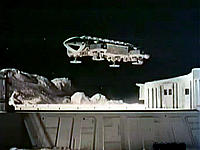
I can’t help it: every time somebody mentions going to the Moon, I think of the British sci-fi show from the 70’s, SPACE:1999. You can still buy the videos on Amazon.

It begins with the Lunar Reconnaissance Orbiter in 2008. This is going to be a pretty cool mission.

Delta Launch From The Cape

Wednesday, November 15th, 2006

Watch a Delta II launch the GPS Block 2R military navigation satellite on Thursday, 16 November. Live feed from the Kennedy Space Center

Here’s the latest from Spaceflight Now:

WEDNESDAY, NOVEMBER 15, 2006
2230 GMT (5:30 p.m. EST)

Preparations continue for tomorrow’s launch of the Boeing Delta 2 rocket carrying a replacement satellite for the Global Positioning System, but bad weather at Cape Canaveral is threatening to delay the liftoff. Launch will be possible between 2:17 and 2:30 p.m. EST (1917-1930 GMT).

A cold front will be sliding through Central Florida on Thursday, and Air Force forecasters expect the Cape to feel the brunt of the stormy weather between 3 and 11 a.m. A severe weather watch has been issued.

Gradual clearing is predicted later in the day, but rain, lingering thunderstorms and thick clouds still pose a high concern for the mid-afternoon launch. There is a 70 percent chance that conditions will be unacceptable at liftoff time.

Mission managers will meet before dawn to assess the latest weather outlook and determine if it’s safe to retract the mobile service tower from around the rocket at pad 17A. Winds cannot exceed 39 knots for the move, plus officials must be confident of no hazardous weather looming on the horizon that could harm the rocket while it stands exposed on the pad for the final hours of the countdown.

Tower rollback is targeted to occur around 6 a.m. The retraction could be postponed a couple of hours without impacting the launch time.

Air Force officials say their strategy, assuming weather is safe enough to retract the tower, will be pressing forward with the launch opportunity. An early decision to scrub is unlikely unless the launch time forecast gives absolutely no hope of allowable conditions, they said. As of right now, there is that 30 percent chance that the storms will clear in time.

The outlook for Friday is beautiful, forecasters say.


Arabsat Launches Today

Wednesday, November 8th, 2006
ILS is launching the BADR-4 satellite today from Baikonur at 19:40 GMT. Watch it live or tune your satellite receivers to…
In North America:
IA-6 @ 93 West
C-band, analog/NTSC
Transponder 14, 3980H
In Europe & Asia:
NSS-7 @ 338 East
Ku-band, digital/PAL
Transponder: WHL4/EUH3,Channel-1, 11,098.9H
Symbol Rate: 6.1113 Msps
FEC: 3/4
In Africa & Asia:
BADR-C (formerly Arabsat 2C) @ 26 East
Ku-band, digital/PAL
Transponder: C21, 4,120H
Symbol Rate: 27.5 Msps
FEC: 3/4

We like their blog.


BIG Airplane Lands in Cayenne

Tuesday, November 7th, 2006

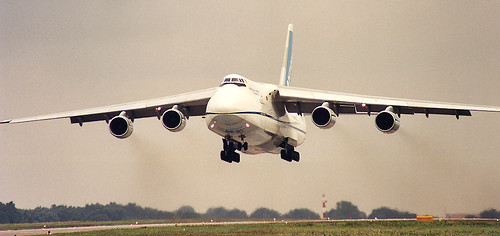
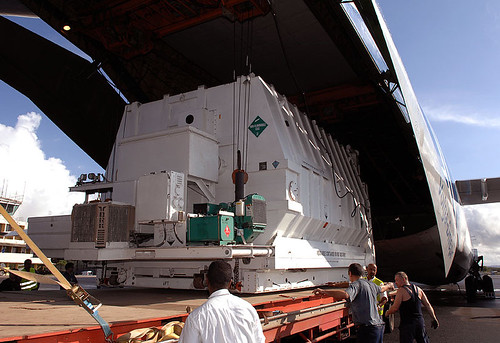
What is THAT? Is it the Big Kahuna landing for Election Day in Florida? No, that’s an Antonov 124 delivering the AMC-18 satellite at Cayenne’s Rochambeau International Airport. The satellite, scheduled for launch in December, is now being transferred to Europe’s Spaceport.

DMSP-17 Launched

Sunday, November 5th, 2006

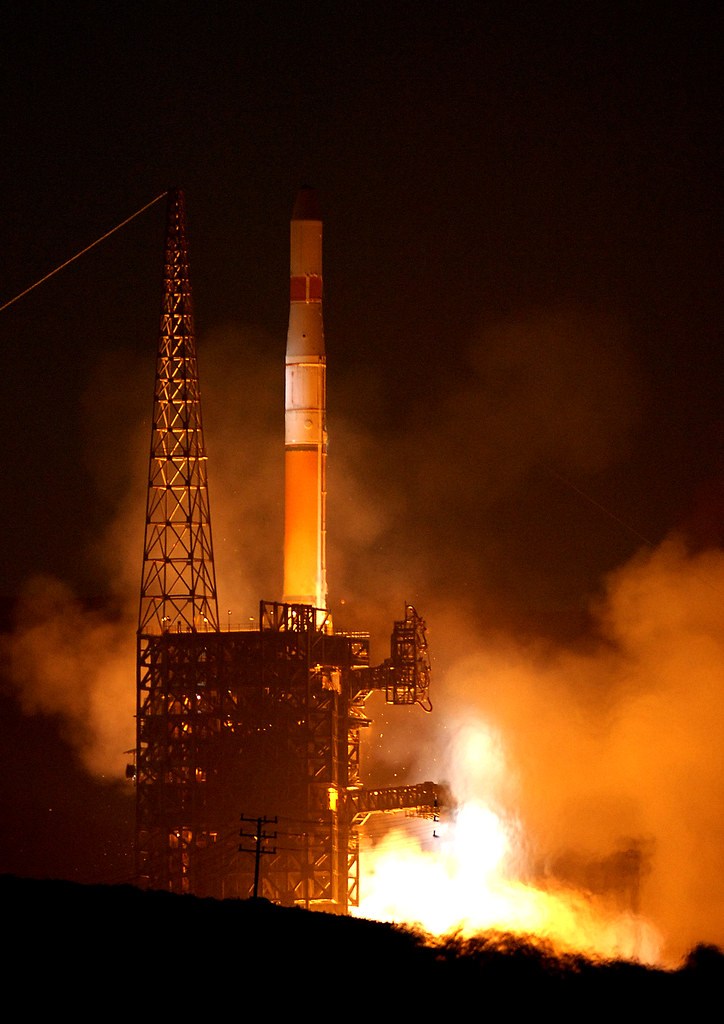
A Delta IV rocket launches at 5:53 a.m. on Nov. 4 from Vandenberg’s Space Launch Complex-6. The rocket carried a Defense Meteorological Satellite Program satellite in to space. The satellite will transition into a polar earth orbit to provide weather forcasts for servicemembers on battlefields around the world. (U.S. Air Force photo/Joe Davila)