Archive for the ‘Around the Blogs’ Category

XM-4 Satellite Sea-Launched

Monday, October 30th, 2006


The XM-4 satellite was successfully launched on Monday:

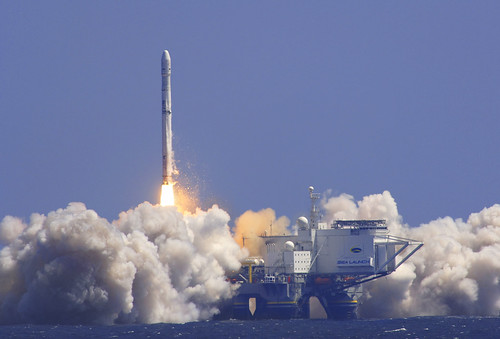
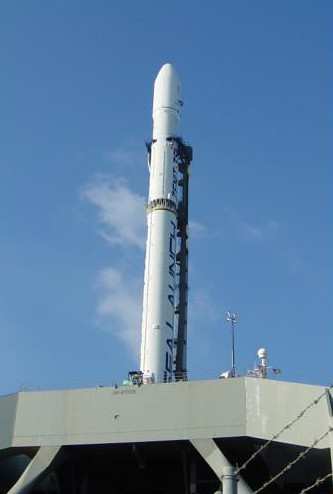
A Zenit-3SL vehicle lifted off at 3:49 pm Pacific Standard Time (23:49 GMT) from the Odyssey Launch Platform, positioned at 154 degrees West Longitude in the equatorial Pacific. All systems performed nominally throughout the flight. The Block DM upper stage inserted the 5,193 kg (11,448 lbs.) spacecraft into geosynchronous transfer orbit, on its way to final orbital position of 115 degrees West Longitude. A ground station at Hartebeesthoek, near Pretoria, South Africa, acquired the first signal from the satellite in orbit.

I think you’ll enjoy the video.

Space Station Unloads Supply Ship; Microsoftie to be next Space Tourist

Friday, October 27th, 2006

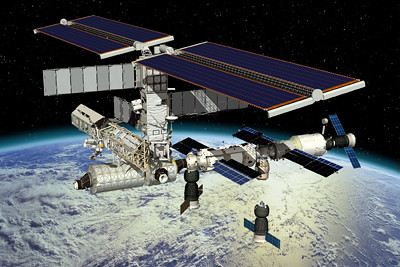
With the safe arrival of Anousheh Ansari, the first female space tourist, as we reported a few weeks ago, life continues to be interesting aboard the International Space Station. Today, the Space Stations residents were finally able to open the hatch leading to an unmanned supply shipped that docked with the station 24-hours before. As CBS News reports:

"The Progress M-58 cargo ship, carrying supplies to the station’s three-man crew, docked at the station Thursday at 6:28 p.m. Moscow time (10:28 a.m. EDT) on autopilot, as planned.

Mission Control could not confirm, however, that its antenna had folded as required for the craft to clamp securely on the station although later it announced that it had solved the glitch."

Fortunately, Mission control reports, the crew, which was never in danger of being without food or oxygen, has opened the cargo ship and begun unloading supplies.

In other ISS related news, the billionaire who helped create Microsoft Excel and Word, Charles Simonyi, is supposedly set to be the next space tourist according to the Seattle Post Intelligencer. Simonyi is currently set to join the Space Station crew for eight days (during a ten day mission) aboard a Russian Soyuz spacecraft set to launch on March 9,2007.

Everyone will, of course, be able to follow Simonyi on his travels through his blog at charlesinspace.com.

XM-4 Ready to Join Rock and Roll Satellites

Thursday, October 26th, 2006


Sea Launch is now preparing for the launch of the XM-4 satellite on 26 October 2006, at 23:49 GMT. Here’s the feed from their webcam:

Live broadcast of the launch will be available in North America via the AMC-3 satellite’s Ku-band payload, transponder 18. The satellite is located at 87 degrees West Longitude. Here are the particulars:
          
Downlink Frequency:   12064  Mhz Vertical
DIGITAL PARAMETERS:      4:2:0      FEC:  3 / 4      Symbol Rate: 6.1113
Audios:    Audio channel 1 / Audio channel 2 = Program Mix ( English)
Standard:    525 NTSC

Transmission test begins at 23:00 GMT, with the live transmission beginning at 23:35. Launch window opens at 23:49 and closes 00:57 on 27 October 2006.

Or you can watch the webcast.

Cargo for ISS

Tuesday, October 24th, 2006

Via MosNews.com

An unmanned Russian cargo ship carrying 2.76 U.S. tons of supplies, equipment and gifts blasted off Monday en route to the international space station, a space official quoted by AP said.

The Progress M-58 mounted atop a Soyuz-U booster rocket lifted off at 5:41 p.m. from the Baikonur cosmodrome in Kazakhstan and entered orbit about 10 minutes later, Federal Space Agency spokesman Valery Lyndin said.

The ship was scheduled to reach the orbiting station Thursday evening, delivering fresh fruit and vegetables, compact discs and DVDs and other gifts to the station’s current crew — cosmonaut
Mikhail Tyurin, U.S. astronaut Michael Lopez-Alegria and German astronaut Thomas Reiter.

Also included in the shipment, according to Itar-Tass, will be equipment for repairing a Russian-built Elektron oxygen generator, which overheated last month, spreading burnt-rubber smell and leaking potassium hydroxide.

While the incident forced the crew to don masks and gloves in the first emergency ever declared aboard the 8-year-old orbiting outpost, Russian and U.S. space officials downplayed it, saying crew members’ lives were never in any danger.

Lunar Lander XPrize

Monday, October 23rd, 2006


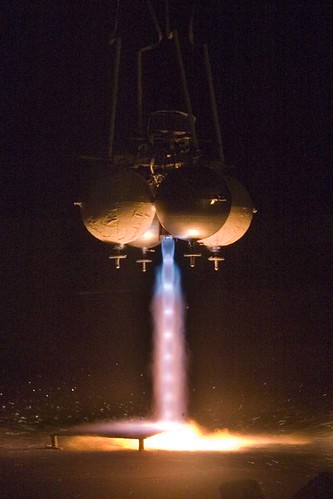
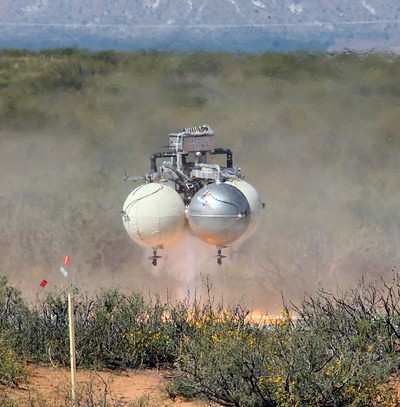
Armadillo Aerospace’s  lunar lander impressed quite a few people at the XPrize Cup in Las Cruces this weekend. Aero-News Net gives this account:

 …the final flight on Saturday, the one that would have earned Armadillo the first tier prize, was frustrated when minor damage done in the previous landing caused a series of events that initiated an inflight abort when the vehicle banked too aggressively shortly after liftoff, and the vehicle went down, damaging itself beyond the ability to fly again.


RRL Announces Winner of Naming Contest; First X-Racer Unveiled

Friday, October 20th, 2006

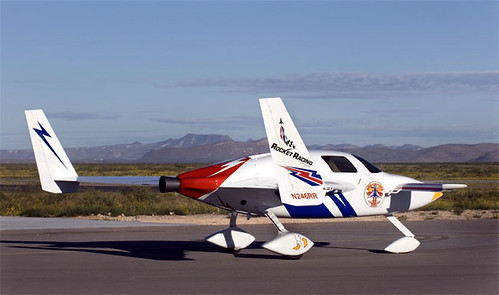
Following up on Spektor’s post on Wednesday about the Wirefly X-Prize Cup (which begins today in Las Cruces, New Mexico), Space.com reports that the first first Mark-1 X-Racer will be known as the Thunderhawk:


 Unveiling the Thunderhawk [image] today at the Wirefly X Prize Cup, RRL officials said that the moniker beat out names like Banshee and Sky Warrior in an online contest that generated more than 2,000 submissions from fans around the planet.

The world headquarters of the Rocket Racing League is based here. The RRL aims to debut its first NASCAR-style races in late Fall 2007 – a first-of-its-kind aerospace sports and entertainment league formed by X Prize founder Peter Diamandis and Granger Whitelaw, a two-time Indy 500 champion team partner….

The fan submitting the winning name is Michael Higgins of New Market, Maryland. He’s an engineer and manager working in the composite pressure vessel industry serving life-support and aerospace/defense applications.

Higgins outlined today how he came up with the Thunderhawk moniker.

“The aircraft, with its rocket propulsion, combines thunderous sound with brilliant flame and light. So I worked up several names focused on thunder and light, and tried to connect those with a bird of prey,” he explained. 

Higgins said he expected the RRL races will put rocket propulsion technology in front of thousands of people through thrilling events. 

“They should generate public interest in rockets and space, much like the famous air races of the 1920s and 1930s did during the golden era of aviation,” Higgins said.

The contest began January 30 and attracted over 2,000 submissions. The top 1,000 names were whittled down to ten semi-finalists by a panel of RRL judges. Fans then were able to vote for their favorite name from the top ten on AOL. 

Nearly 20,000 votes were cast via AOL, selecting Thunderhawk the most popular name.

The live webcast from events at the Wirefly X-Prize Cup is now up; Really Rocket Scientists like us (who couldn’t attend in person) will be glued to the webcast and news coming out of Las Cruces today and tomorrow. (On-demand video from the event can be found here.)

Soyuz Launches MetOp

Friday, October 20th, 2006

The MetOp satellite was finally launched into polar orbit on 19 October 2006 on a Soyuz rocket:

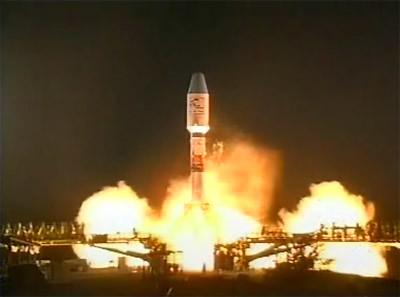
The Soyuz 2-1a, an enhanced version of the Soyuz launcher, lifted off from the Baikonur Cosmodrome in Kazakhstan right on schedule at 10:28 p.m. local time (04:28 p.m. UTC, 06:28 p.m. in Paris). It is the 1,714th launch of a rocket from the Soyuz family.

Starsem and its Russian partners confirmed that the Fregat orbital stage accurately injected Eumetsat’s MetOp-A satellite into its Sun-Synchronous Orbit (SSO). The Fregat upper stage was ignited twice to place MetOp-A into orbit 1 hour, 8 minutes after lift-off.

The MetOp-A satellite will provide more precise details about atmospheric temperature and moisture profiles, invaluable for weather forecasting and climate monitoring. The MetOp program was jointly established by the European Organisation for the Exploitation of Meteorological Satellites (EUMETSAT) and the European Space Agency (ESA). Their main partners in this co-operative venture are the Centre National d’Etudes Spatiales (CNES) in France and the United States National Oceanic and Atmospheric Administration (NOAA).

For this flight, Starsem used the upgraded Soyuz 2-1a, flown with the new ST fairing. The 2-1a configuration features improved navigation accuracy and control capability provided by a digital control system. The 2-1a configuration also enables Starsem to introduce the ST payload fairing with an external diameter of 4.1 meters and a length of 11.4 meters.

This latest successful launch by Soyuz reflects the industrial capabilities of the Samara Space Center (TsSKB-Progress) and the skills of all the operating teams, working under the authority of the Russian Federal Space Agency (Roscosmos).

Starsem is responsible for the international marketing and operation of Soyuz launchers. Its shareholders are Arianespace, EADS, Roscosmos and the Samara Space Center.

Check out the launch highlights.


MetOp Launches Today at 2:28 pm EDT

Tuesday, October 17th, 2006


The BBC reports on Europe’s first polar-orbit satellite:

Europe is set to launch its most sophisticated weather and climate satellite to date.

The MetOp spacecraft will be lofted into its 850km-high polar orbit by a Soyuz-Fregat vehicle from Kazakhstan.

The platform should improve forecasting globally, and give scientists detailed data they can use to refine models describing how Earth’s systems work.

Metop has eight instruments to gather a range of data about the planet’s atmospheric and surface conditions….

Metop is a joint project of the European Space Agency (Esa) and Eumetsat, the intergovernmental organisation charged by European member states with operating a series of orbiting weather observatories….

The new platform weighs more than four tonnes and measures almost 18m (60ft) with its solar wing unfurled.

The Eumetsat website will feature a stream broadcasting the launch live. For more information on the satellite, visit the ESA Portal, or click here for a cool animated video explaining the satellite and its mission.

Nice Launch: Ariane 5 ECA

Monday, October 16th, 2006

Mission réussie pour Ariane 5 ECA
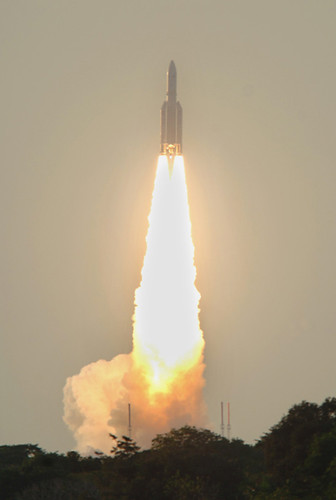
Dans la nuit du vendredi 13 au samedi 14 octobre 2006, Arianespace a mis en orbite de transfert géostationnaire le satellite DIRECTV 9S pour l’opérateur américain DIRECTV et le satellite OPTUS D1 pour l’opérateur australien OPTUS. Grâce au plateau ASAP 5, le lancement emportait également le réflecteur expérimental LDREX-2 pour l’agence spatiale japonaise JAXA.

Arianespace placed two satellites into geostationary transfer orbit: DIRECTV 9S for the U.S. operator DIRECTV Inc., and OPTUS D1 for the Australian operator OPTUS. The Ariane 5 ECA launcher was also fitted with the ASAP 5 platform, allowing it to deploy the LDREX-2 experimental reflector for the Japanese space agency JAXA.

Provisional parameters at injection of the cryogenic upper stage (ESC-A) were:
Perigee: 249.4 km for a target of 249.5 km (±3)
Apogee: 35,940 km for a target of 35,946 km (±160)
Inclination: 6.98 º for a target of 7.0 degrees (±0.06º)

DIRECTV 9S was built by Space Systems/Loral in Palo Alto, California, and will be positioned at 101 degrees West. Weighing approximately 5,530 kg at liftoff, DIRECTV 9S is fitted with 52 high-power Ku-band transponders and 2 Ka-band transponders. It will provide direct TV broadcasts using digital compression technology. DIRECTV 9S will give American TV viewers a greater choice of broadcast services, while prefiguring tomorrow’s multibeam satellites for multimedia applications. Design life is about 15 years.

OPTUS D1 was integrated by American manufacturer Orbital Sciences Corporation in Dulles, Virginia, based on a Star-2 platform. OPTUS D1 will weigh about 2,300 kg at launch. Positioned at 160 degrees East, it will provide direct TV broadcasts, Internet links, voice and data services for Australia and New Zealand. Its design life is 15 years.

LDREX-2 (Large-scale Deployable Reflector Experiment 2), launched on behalf of the Japan Aerospace Exploration Agency (JAXA), is a small-sized partial model representing the large deployable antenna to be used on the ETS-8 technology satellite, which will be launched in December 2006.
Arianespace to Launch DirecTV Satellite Tomorrow

Thursday, October 12th, 2006

Among those who aren’t suspicious of undertaking major endeavors on Friday the 13th, you can include both Arianespace and DirecTV.

The Ariane 5ECA rocket is scheduled to launch tomorrow afternoon between 4:56 and 5:56 pm, U.S. Eastern time. The launch will take place from the ESA spaceport in Kourou, French Guiana.

The launch will service three customers and deploy three satellites: DirecTV’s 9S, Optus’ Optus D1, and JAXA’s LDREX-2.  

The 9S satellite "will be capable of providing up to 54 transponders for high-quality local and national digital video service broadcast into 27 beams. In an alternate configuration, the satellite will be capable of providing up to 44 transponders broadcast into 30 beams."

Want to know what to expect from the launch, second by second? Check out Spaceflight Now’s cool launch cue card