Archive for the ‘Around the Blogs’ Category

Mach 23 Will Set You Free

Tuesday, October 3rd, 2006

The U.S. Air Force Office of Scientific Research thinks it’s possible, and a company in California wants to prove it: a large electromagnetic ring will be able to launch small satellites into space. Discovery Channel Canada gives us the scoop:
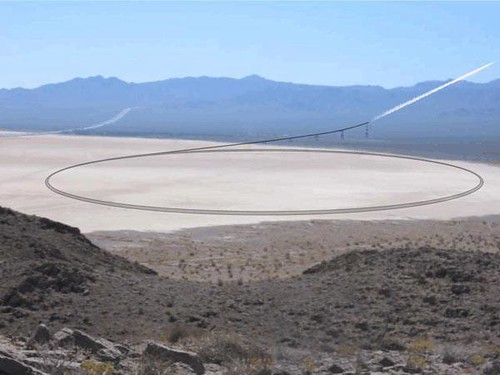
A large circular metal track could accelerate objects to supersonic speed using electromagnets and spit them out into space, says a report from the U.S. air force’s Office of Scientific research.

Tagged as the Launch Ring by its inventing company, Launch Point Technologies, the track would be several kilometers in diameter. Similar to trains that hover on electromagnetic tracks, a sled would hover over the ring and be propelled forward using powerful magnets.

According to the company, a satellite protected by an eggshell-like capsule could sit atop the sled and slowly accelerate over a matter of hours to a supersonic 10 km/sec. Then a small explosion could detach the capsule from the sled and it would hurtle into a side tunnel.

From there, it would shoot up a ramp and through the atmosphere into outer space. Traveling at a 23 times the speed of sound, the capsule would experience forces 2,000 times that of normal gravity on Earth.

A rocket strapped on the capsule would correct the trajectory so that it correctly aligned itself in orbit.

The Goleta California company has received funding to begin a two-year study within several weeks. Boosters of the ring hope to one day use it for thousands of launches a year, at a fraction of today’s cost of putting things in space.

Humans could never withstand the forces exerted during the ring’s launch process. Under existing technological limitations, it could only be used to propel supplies to be used by humans on a long-term mission in outer space, or to put satellites into orbit.

The Air Force also suggests it could be used for military purposes, quickly launching weapons around the world.

For more details, try NewScientist.com.


Japanese Launch Sun Microscope

Tuesday, September 26th, 2006

On Saturday, the Japanese Aerospace Exploration Agency (JAXA) successfully launched  the M-V Launch Vehicle No. 7 (M-V-7) at 6:36 a.m. Japan Standard Time from the Uchinoura Space Center.

Within an hour, JAXA started receiving signals from the rocket’s satellite payload —  the SOLAR-B, a sun observation "microscrope" nicknamed "Hinode" ("sunrise") by JAXA engineers.

The BBC has more
on the SOLAR-B and its mission of studying solar flares, which "release the equivalent of tens of millions of hydrogen bombs in just a few minutes:"

 The probe will attempt to find out more about the magnetic fields thought to power solar flares, and try to identify the trigger that sets them off.

The ultimate goal for scientists is to use the new insights to make better forecasts of the Sun’s behaviour.

Flares can hurl radiation and super-fast particles in the direction of the Earth, disrupting radio signals, frying satellite electronics, and damaging the health of astronauts….

Solar-B is expected to transform our understanding [of solar flares].

It carries three instruments: a Solar Optical Telescope (SOT), an X-ray Telescope and an Extreme Ultraviolet Imaging Spectrometer.

They will make continuous, simultaneous observations of specific solar features, to observe how changes in the magnetic field at the Sun’s surface can spread through the layers of the solar atmosphere to produce, ultimately, a flare.

"Solar-B acts essentially like a microscope, probing the fine details of what the magnetic field is doing as it builds up to a flare," said mission scientist Professor Louise Harra, from the Mullard Space Science Laboratory, UCL, UK.

"What we don’t know is what triggers a flare; we don’t understand the physics of that phase at all. Solar-B will show us how tangled the field is, and how the field lines collide to produce all that energy."

In October, NASA will contribute to the growing understanding of solar flares when it launches its Stereo mission – twin spacecraft that will make 3D observations of the sun.

Better understanding of solar flares is critical, as John Davis, Solar-B project scientist at Nasa’s Marshall Center, told the BBC.

"The information that Solar-B will provide is significant for understanding and forecasting of solar disturbances, which can interfere with satellite communications, electric power transmission grids, and threaten the safety of astronauts travelling beyond the safety of the Earth’s magnetic field," he said.

(Video of the M-V-7 launch can be found here (in the right hand column).) 

Launch Day Monday — Delta II: Good; SpaceLoft XL1: Almost.

Tuesday, September 26th, 2006
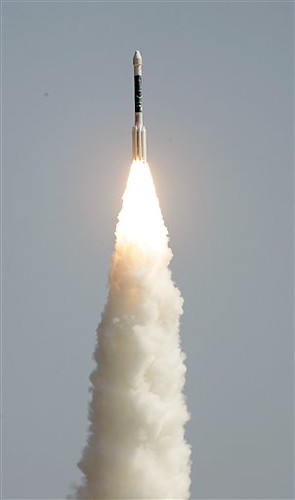
Watched the Delta II launch a GPS payload yesterday, live on HD-Net. Gorgeous launch on a beautiful day at Cape Canaveral Air Force Station in Florida. Seeing it in HDTV does make a difference.

Boeing’s workhouse did its job:

The Delta II rocket carrying the GPS IIR-15 (M) spacecraft lifted off from Space Launch Complex 17A at Cape Canaveral Air Force Station, Fla., at 2:50 p.m. EDT, Sept. 24. Following a nominal 68-minute flight, the rocket deployed the satellite to a transfer orbit.

The Boeing Delta II 7925-9.5 configuration vehicle used for today’s mission featured a Boeing first stage booster powered by a Pratt & Whitney Rocketdyne RS-27A main engine and nine Alliant Techsystems (ATK) solid rocket boosters. An Aerojet AJ10-118K engine powered the storable propellant restartable second stage. A Thiokol Star-48B solid rocket motor propelled the third stage prior to spacecraft deployment. The rocket also flew with a nine-and-a-half-foot-diameter Boeing payload fairing.

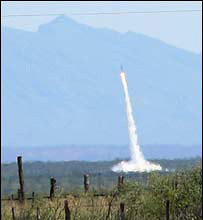
Monday’s other launch event, at Spaceport America in New Mexico, did not do as well. The SpaceLoft XL1 rocket failed at around 40,000 feet, eliciting this gem of a quote from launch logistical coordinator Tracey Larson:

"If it was easy, everyone would be doing it."

Optus Satellite Fueled for Launch in October

Monday, September 25th, 2006

Seems the next Ariane 5 launch is now scheduled for 12 October 2006.

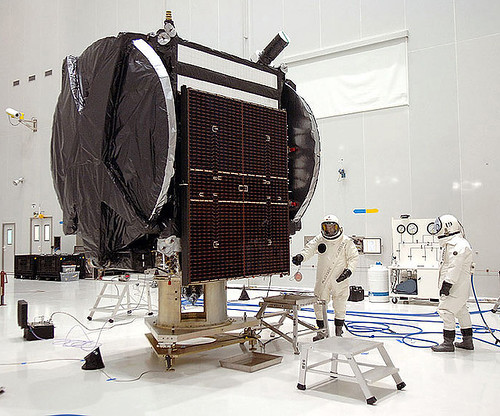
Here’s one of the rocket’s "passengers" being fueled. Evidently, rocket science is still a dangerous business…

Second Team Added to Rocket Racing League Roster

Tuesday, September 19th, 2006

Alan Boyle over at the CosmicLog reports that a second team has joined the Rocket Racing League, the relatively new association charged with organizing and promoting the emerging sport of rocket racing, and, thus may soon be ready for actual competition. Yesteraday, the Bridenstine Rocket Racing Team, which is named after its leader Navy Lt. James Bridenstine, announced that it would be challenging the world first (and, previously, only) rocket racing team, the Leading Edge.

RRL President and CEO Granger Whitelaw thinks that the new teams might have some natural competition.

"Given the air force credentials of our first team, Leading Edge, and the navy aviation experience of this second team under Jim Bridenstine, we expect a good-natured competition as the Rocket Racing League prepares for its official launch in late 2007."

So when can we expect the RRL to ramp up to full gear? While the official word (as we see above) is late 2007, some are saying it could be even earlier. Boyle reports that the Mark1 X-Racers that are going to be used in the competition are still in development, early, usable, and expensive (the final crafts will cost about $1.2 million) prototypes could be hitting the scene within the next four five months. Those looking for an even earlier preview might keep an eye on the X Prize Cup, where the league is planning to show some of their wares next month.

First Female Space Tourist Readies for Monday Launch

Friday, September 15th, 2006

American entrepreneur Anousheh Ansari is set to become the world’s first female space tourist on Monday when she departs the Baikonur cosmodrome in Kazakhstan on a Russian Soyuz rocket as part of Virginia-based Space Adventures plan to bring ordinary (if wealthy) tourists to the stars. 
The AP provides details: 

After months of preparation at Moscow’s Star City training centre and a payment of some 25 million dollars (20 million euros), Ansari is due to spend 10 days on board the ISS, fast becoming the world’s most exclusive resort.

After Ansari, Michael Lopez-Alegria of the United States and Mikhail Tyurin of Russia have adapted to weightlessness, the Soyuz TMA-9 capsule will dock at the ISS on Wednesday.

Ansari, a 40-year-old engineer who made her millions in the US telecoms sector, is planning to take pictures, shoot film and write an Internet travel blog during her stay.

Space.com notes that Ansari is no stranger to space flight:

Ansari’s family made a multimillion-dollar contribution to back the Ansari X Prize, a $10 million suborbital competition for privately-developed, reusable spacecraft. A team led by veteran aerospace designer Burt Rutan and backed by millionaire Paul Allen won the contest in 2004 when their piloted SpaceShipOne vehicle launched into suborbital space twice in two weeks.

Together with her husband Hamid and brother-in-law Amir, Ansari also co-founded the Dallas-based company Prodea to develop the Explorer line of air-launched suborbital vehicles under a partnership with Space Adventures.

Explorer spaceport plans in the United Arab Emirates and Singapore are moving ahead in anticipation of the spacecraft’s development.

Space.com also offers a great interview with Ansari.

We’ll have more coverage of the launch and, of course, Ansari’s blog, on Monday.
 

China to Launch New Communications Satellite in October

Thursday, September 14th, 2006

We wrote last month about the Chinese launch of their seed-breeding satellite.

Now the Chinese hope to breed lots of new channels for millions of people with the launch of its SinoSat 2 satellite at the end of October:

A Chinese Chang Zheng (Long March) 3B carrier rocket is scheduled to launch the SinoSat 2 (a.k.a. Xinnuo 2), satellite… from Launch Complex 2 at the Xichang Satellite Launch Centre. According to Sun Laiyan, administrator of the China National Space Administration, the Xinnuo 2 large-capacity communications satellite, with an anti-jamming system, will provide direct television broadcasting services to the Chinese mainland, as well as Hong Kong, Macao and Taiwan. On Monday, August 4, the satellite left the production facility after receiving its final checks by the Commission of Science, Technology and Industry for National Defence. Xinnuo 2 is based on the Dongfanghong 4 platform and has been designed to work with the ChinaSat 9 satellite in the same orbit, to provide communications services to the Chinese mainland. The ChinaSat 9 satellite is based on the Spacebus 4000 C1 platform and will be positioned at 92.2 degrees east. The Xinnuo 2 satellite, which has taken China six years to develop, is designed to have a lifespan of 15 years, and operated in geosynchronous orbit at 110.5 deg E. China has managed to launch 70 satellites since the 1970’s, of which, currently only 20 are still in service today.

China Daily has additonal information on how the Chinasat 9 and Sinosat 2 satellites will improve television coverage in local areas; the Asia-Pacific Broadcasting Union notes that the new satellite will provide up to 300 million mainland households with "access to cable-quality TV services that have so far been restricted to China’s more urban areas."

The launch of SinoSat 9 comes just in time a new cultural great leap forward in China, as January, 2007 will bring the introduction of a Chinese version of America’s Next Top Model to Chinese television.

(The photo above shows the areas of coverage for the new satellite.)

Japan Launches New Spy Satellite

Monday, September 11th, 2006

Japan, seeking to reduce its dependence on the United States and other countries for its foreign intelligence capabilities, launched its third spy satellite into orbit today aboard an H2-A rocket, the BBC reports:

Japan has two spy satellites already in orbit. Two others were lost when a rocket failed in November 2003.

Japan began its intelligence-gathering satellite programme following North Korea’s test launch of a long-range missile that flew over Japan in 1998.

This launch follows a series of missile tests by Pyongyang in July, which included a new weapon, the Taepodong-2, which is potentially capable of hitting parts of the United States.

The Japan Times provides more detail on the need for the satellite in a preview article published on Saturday:

The satellite will likely focus mainly on North Korea, particularly its ballistic missile sites. Tokyo considers the missiles one of the main threats to the country.

But since Japan’s spy satellites are inferior to those of the U.S. military, and even some newer commercial satellites, government officials say Japan must keep developing its own surveillance technology to ensure it has an independent source of intelligence.

"We have been far behind the U.S. To put it bluntly, the gap is like the one between a kindergartner and a college student," said Yoshio Omori, former head of the Cabinet Intelligence and Research Office, an intelligence-gathering body that reports directly to the prime minister.

"Without independent information-gathering capability, Japan will be a blind follower (of other countries)," Omori warned.

Lockheed Pulls Out of Russian J.V.

Friday, September 8th, 2006

As reported in this morning’s Kommersant (Коммерсантъ):

The Lockheed Martin Corp. announced yesterday that it will withdraw from the Russian-American joint venture that markets Russian Proton rockets. The company cited the rising prices being demanded by the rockets maker, the Khrunichev State Space Research Center, and a number of unfulfilled obligations of the center, as the motivation for its decision. In the 11 years of its existence, the International Launch Services sold 37 Proton rockets for a total of $2.5 billion.

Lockheed Martin said yesterday that Space Transport Inc., a company registered in the Virgin Islands, would be the purchaser of its shares in ILS as well as Lockheed Khrunichev Energia International. A source in the Russian space industry said that Space Transport was being launched as a temporary holder of the assets Lockheed is selling. Eventually, those assets will be bought by Khrunichev, apparently with Vneshtorgbank acting as creditor. The value of the deal was estimated by the source as about $150 million. He added that the ILS would remain as a company registered in the United States and would also market Khrunichev’s new Angara rocket in the future. Lockheed Martin will sell its Atlas rockets through its Lockheed Martin Commercial Launch Services.

ILS has 11 open contracts for launches with a value of $500 million. At the center, they told Kommersant yesterday that they expect orders to increase. Analysts also predict that the industry will have a healthy growth rate in the next several years. Vitaly Davydov, deputy head of Roscosmos, the Russian space agency, predicted recently that Russian rockets account for 40 percent of the world market. Roscosmos press secretary Igor Panarin commented to Kommersant yesterday that “Lockheed Martin’s decision will not affect Russian interests in launch services in the least. On the contrary, it will strengthen bilateral relations between Russia and the U.S. in the space field.” Khrunichev press secretary Alexander Bobrenev concurred, saying that “The Russian side will continue marketing the Proton and Angara carrier rockets. We are capable of meeting our obligations to our clients.”

A Lockheed Martin spokesman told Kommersant that that ending its partnership with Khrunichev was a purely business decision and does not affect its joint ventures with other Russian enterprises, such as Energomash. “Our collaboration with them [Khrunichev] was very fruitful and we still have projects that we will possibly work on jointly in the future,” the spokesman said.

Kommersant has learned that Lockheed informed Khrunichev of its intentions to pull out of the joint business in May. The official explanation for the move is a change in Lockheed’s marketing strategy. “After analyzing conditions on the world market, we decided to concentrate on launches of satellites with masses of 4.5-6.5 tons,” ILS president Dr. Mark Albrecht said in June. In essence, that means that Lockheed has decided to leave the commercial market in favor of more profitable state orders. Boeing made the same decision in 2003. Of the 11 Proton launches in the last three years only five of them were heavier then 4.5 tons.

Another source at Lockheed said that the company disagreed with Khrunichev’s decision to raise the price of the rockets by 15 percent, to $45-50 million each, to pay for the services of an intermediary to conclude contracts with ILS. ILS also received 15 percent of every contract. Another source of contention was $68 million that Lockheed paid in 1999 under an agreement to market the new Angara rocket. The first launch of that rocket was to take place in 2003, but now plans call for the first launch in 2010. “Lockheed Martin will consider its investment in the purchase of the marketing rights to the Angara and include them in the cost of its package in ILS and LKEI,” a source said.

Atlantis to Launch Tomorrow at 12:29 pm EDT

Tuesday, September 5th, 2006

The Space Shuttle Atlantis is set to (finally) lift off tomorrow, Tuesday, September 6th at 12:29 pm EDT. NASA’s launch blog should begin coverage of the event around 6:30 am tomorrow.

Weather has twice delayed the start of STS-115. Lightning at Kennedy Space Center on August 25th delayed the previously-scheduled launch, and then the Atlantis crew had to wait out the passing of Tropical Storm Ernesto.

The launch of STS-115 will make history when it carries Heidemarie Stefanyshyn-Piper, the first Ukrainian-American into space. (Be sure to check out her biography or this interview.)

As always, we’ll bring you updates on the launch of the Shuttle as the countdown begins.