Archive for the ‘Around the Blogs’ Category

Rocketplane Kistler and SpaceX to Test in S. Australia

Wednesday, August 23rd, 2006
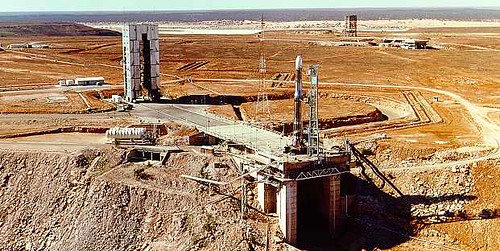
 

Australian Broadcasting Corporation reports that RocketPlane Kistler and SpaceX are trying to gain the right to test rockets at the Australian Defense Department site in Woomera, South Australia. Attracted by the size (about as large as England) and remoteness of the location, the Kistler and SpaceX hope to use the site to do test launches of the rockets NASA International Space Station.

Military history buffs will remember the Woomera Prohibited Area (WPA) as the largest land-based testing range in the world and the site of much of Australia and the U.K.’s nuclear (and otherwise) missile testing throughout the cold war. The WPA, which is still in use today for weapons testing, was also the location of many of European Launcher Development Organization (ELDO)‘s EUROPA rocket launches (one waiting to be launched is seen above) and NASA’s Island Lagoon Deep Space Tracking Station throughout the 1960s.

In addition to being a site with a great history, Woomera seems to have some good site-seeing opportunities and be just as beautiful as much of the rest of the Outback.

Mugunghwa ho ga uhjea balsa hesamnida (Koreasat Launched)

Tuesday, August 22nd, 2006

Sea Launch launched the Koreasat 5 satellite last night from a converted oil platform in the Pacific Ocean, 1500 miles south of Hawaii. Named after the Korean national flower, Mugunghwa, the satellite will be replacing Koreasat 2. Incidently, the number 4 was skipped when naming this satelite (4 is a very unlucky number in Korea; its pronunciation is similar to the pronunciation of the Chinese character for Death). The satellite itself has a very interesting payload.


Koreasat-5 to Launch Tonight

Monday, August 21st, 2006

As we reported last week, SeaLaunch is set to lift the Koreasat-5 communications satellite from its launch facility in the Pacific this evening.


The Korea Times reports: 

KT, South Korea’s largest fixedline and broadband operator, said Monday that it will send its fourth commercial satellite into orbit from the Pacific Ocean this week, marking the nation’s first satellite launch from the open sea.

The Koreasat-5 will be launched at 12:27 p.m. Tuesday [8:27 p.m. U.S. Pacific time on Monday evening] from an area south of Hawaii. The launch will be controlled by an assembly and command ship and a launch platform ship, KT said.

The satellite will replace the Koreasat-2 satellite in providing wireless communications and broadcasting services, the company said.

Unlike previous KT satellites that helped telecommunications in local areas, the Koreasat- 5 will cover other Asian countries, including Japan, China, the Philippines and Taiwan.

The satellite will start its service after four months of testing, it added.

 The SeaLaunch Mission page can be found here.

Real Russian Rocket Report

Tuesday, August 15th, 2006

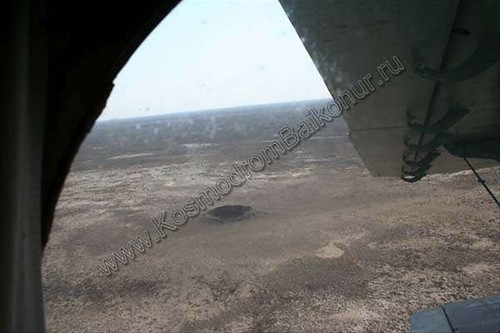
Last month’s Dnepr rocket crash in Kazakhstan, which destroyed Montana’s first satellite, blasted a crater 165 feet wide and 50 feet deep. Fortunately, there were no injuries or fatalities in the vast arid steppes near the Uzbek border. What about the environmental damage? Keep in mind most rocket fuel is considered "nasty stuff." According to NBC News space analyst James Oberg, this launch failure’s aftermath is reminiscent of old habits:

Last month’s crash of a Russian Dnepr space booster with 100 tons of toxic rocket propellant poisoned a small corner of the empty steppes in Central Asia — but may have left a wider legacy of bitterness that will impact Russian space activities for years to come.

And whatever the actual cause of the rocket’s embarrassing failure, the poisonous consequences could have been largely avoided if Moscow space officials hadn’t reverted to almost Soviet-style cover-ups and hollow reassurances about the accident.


I found Mr. Oberg’s piece on this topic, featured recently on the MSNBC site, superbly written, accurate and insightful.

Feeling adventurous? Try reading the original report, in Russian, from 31 July 2006. At least you’ll understand the pictures, and the gist of the English translation (scroll down for both).


Arianespace Successfully Launches Twin Satellite Payload; Koreasat 5 to Lift via Sea Launch Next Week

Monday, August 14th, 2006

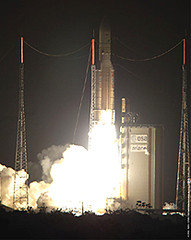
Arianspace’s Friday evening launch of a twin satellite payload, which Spektor previewed last week, was a success. From the mission update:

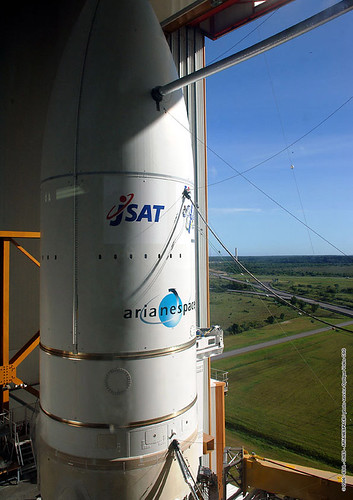
After an on-time lift-off at 7:15 p.m. from Europe’s Spaceport in French Guiana, the heavy-lift Ariane 5 delivered Japan’s JCSAT-10 telecommunications spacecraft and the European Syracuse 3B secure military relay platform into an accurate geostationary transfer orbit.

Tonight’s flight was Ariane 5’s 28th mission, and marked its 14th consecutive success – underscoring the launcher’s maturity. JCSAT-10 was installed in the upper payload position on Ariane 5, and was released approximately 27 min. into the mission. This was followed some 5 minutes later by the separation of Syracuse 3B, which occupied the lower slot in the payload "stack." 

A series of photographs from the launch can be seen here

In other commercial satellite launch news, Sea Launch will be lifting the Koreasat 5 communications satellite on the evening of August 21st. Sea Launch has provided a nice graphical display of the satellite launche’s profile and groundtrack here.

As always, we’ll have more updates on the launch as it approaches. 

ArianneSpace To Launch Two Satellites Tonight

Friday, August 11th, 2006

European commercial space transportation company Arianespace is launching not one but two satellites into orbit this evening. From Europe’s space center, the Guiana Spaceport in Kourou, French Guiana, Arianespace’s Ariane-5ECA will take to the skies for its 28th time, marking the 172nd mission for the Ariane fleet, at some time between 6:15 pm and 7:52 pm EST. The launch can be watched starting 20 minutes before launch time, at Arianspace’s Video Corner.

The Ariane-5ECA is 50.5 meters tall and will weigh in at about 780 tons at lift off, requiring over 400 tons of fuel to ramp the beast up to over 2900 pounds of fource to lift-off.

The payload, a Japanese television (JCSAT-10) and French military communications (SYRACUSE 3B) satellites, is expected to be in operation for between 15 and 12 years, respectively.

For those looking for even more information, download the launch kit in English or French and you’ll have more data on this evening’s than you ever thought you wanted.

Blast from the Past: Hotbird 8

Monday, August 7th, 2006

We’ve got another rocket launch for you. This time it’s one from the more recent past. The HOT BIRD 8 broadcast satellite was place into orbit on Friday via a Proton Breeze M launch vehicle, and we’ve got the video.

We’ve also got a blog post from the HOT BIRD 8 team describing the launch.

We are thrilled to have a successful return to flight for Proton M Breeze M. After a long and sleepless night, 9 hours, 11 minutes, and 20 seconds after lift-off, spacecraft separation was confirmed and the HOT BIRD 8 SC was acquired by the Eutelsat ground stations. The Eutelsat team started the process of opening the solar arrays and beginning health checks of the SC, before flying her to her final destination. After having been up all night, we headed back to the hotels to catch a quick nap and freshen up before the post-launch festivities.

See the press release for more information.

Launching the Coke/Mentos Rocket

Thursday, August 3rd, 2006

Being rocket scientists and all, we couldn’t help but be fascinated by the latest craze lighting up the blogosphere: instructions and videos on how to combine Mentos with Diet Coke to create and launch your own home-made bottle rocket.

This particular launch  is one of the top videos on YouTube, with nearly half a million viewings in the past six weeks:

An explanation on how it’s done can be seen here:

Of course, being rocket scientists (and, for some of us, parents as well) we must provide a caveat– bottlerockets are inherently dangerous, no matter how they’re constructed. We direct you to Newton’s Second Law of Motion for further explanation.


We Got Your Rocket Scientsts Right Here

Wednesday, August 2nd, 2006

Here’s an interesting tidbit. Here in DC, I’m surrounded by rocket scientists. OK, not surrounded but it turns out the metro-DC area is home to a large percentage of the rocket scientist population. Higher than most cities, I bet.

The latest issue of The Washingtonian pulls some data from the Greater Washington Initiative’s latest regional report, which puts the percentage of rocket scientists in the area at 32% of the population. (12% of the nation’s physicists).

Rocket Scientists in DC

Impressive. But that’s only about a third of the country’s rocket scientists. Where are the rest of them? Where are most of them?


Blast from the Past: Titan IV

Tuesday, August 1st, 2006

Titan IV

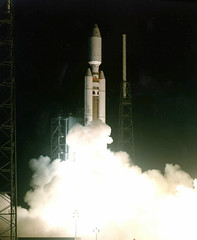
We reached into our video archives and pulled out two rocket launches to show you. Titan IV is the largest unmanned space booster used by the U.S. Air Force to carry payloads as big as the ones the space shuttle carries.

On September 8, 2003, Communications Concepts, Inc. broadcast the launch of the massive Titan IV as it blasted off the launch pad at Cape Canaveral Launch Complex 40. The day’s payload was a satellite for the National Reconnaissance Office. The model rocket was the Titan IV-B, the final model of the now retired Titan program, which was the largest, most powerful, heavy-lift expendable launch vehicle in the United States at the time. This mammoth rocket was as tall as a 20-story building and, with the solid rocket boosters and fuel, weighed about 940,000 kilograms (2 million pounds). In the video, you can see the sheer power of the Titan as the shot, captured from a remote camera less than 500 feet from the launch pad, fills with white just after liftoff.