Archive for the ‘Around the Blogs’ Category

Russian Rocket Crash Destroys Montana’s First Satellite

Friday, July 28th, 2006

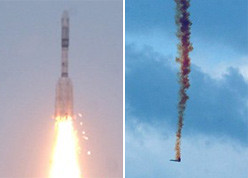
Launching rockets into space has become so common and frequent that we tend to forget that space flight is an inherently risky business. As the old adage about general aviation goes, it’s safe– but extremely unforgiving. When things go wrong, they tend to go wrong spectacularly, and the result can be years and years of work lost, as students at Montana State University learned this week when the Russian rocket carrying Montana’s first satellite crashed in Kazakhstan:

At 100 feet tall and 15 feet across, the Dnepr missile was to carry 18 satellites into orbit. Nearly 200 students, faculty, and members of the public gathered at the Engineering and Physical Sciences building on the campus of Montana State University to cheer the launch from Baikonur Cosmodrome as it was relayed by live video.

However, 13 minutes after the launch, a much-anticipated signal from the rocket had not been received. About two hours later, a space news Website posted a story that the rocket had crashed….

The rocket carried MEROPE, Montana EaRth Orbiting Pico-Explorer, which was the culmination of five years of work and waiting by more than 100 MSU students….

MEROPE was a specific satellite design known as a CubeSat. CubeSats are shaped like a cube 10 centimeters (4 inches) on a side and weigh 1 kilogram (2.2 pounds). They were envisioned as student satellites that could be designed, built, tested and launched in the time it takes a student to earn a four-year undergraduate degree.

Undergraduates from physics, electrical engineering, computer science, mechanical engineering, art, business, even geology and microbiology, worked on the project through MSU’s Space Science and Engineering Lab. …

Over its four-month lifetime, MEROPE was to take measurements of the Van Allen Radiation Belt, a donut shaped band of super-charged particles that can kill astronauts and destroy satellites. The belt’s radiation levels and its shape are constantly changing. MEROPE’s monitoring was to contribute to the understanding of "space weather," Larsen said.

As Bill Hiscock, head of MSU’s physics department, points out, 95% of the work done by the students took place simply in getting the satellite to the launch pad. So, although the satellite was lost, the educational value of the project for tomorrow’s engineers and scientists was not.

Russia’s Federal Space Agency says a first stage engine shutdown caused the crash.

The Birds and The Bees Meets the Mile High Club

Monday, July 24th, 2006

Biology and space flight have been closely intertwined ever since the Soviets first launched Laika into orbit in November of 1957. The unique environment of space presents an incredible laboratory environment for biologists to study biological processes, and literally thousands of experiments have been undertaken in the last 50 years.

Now the Chinese government, following in Mendel’s footsteps, is taking genetic and biological research in space one step further — launching the country’s first seed satellite — specifically designed for seed breeding– this coming September:

Shijian-8 is expected to carry at least 2,000 varieties of plant seeds in nine categories, including grains, cash crops and forage plants, as well as seeds of fungi and molecular biomaterials that have been sequenced.

Sun Laiyan, chief of the China National Space Administration, said the "seed satellite" will enable scientists to try and cultivate high-yield and high-quality plant varieties.

Exposed to special environment such as cosmic radiation and micro-gravity, some seeds will mutate to such an extent that they may produce much higher yield and improved quality, said Sun.

Space experts said 40 per cent of mutated space seeds can be used in space breeding experiments.

Since 1987, nine Chinese satellites and several of China’s six Shenzhou spacecraft have carried seeds for experiments and a number of new species of plant seeds have been bred in space, but never before has the country launched a satellite exclusively for seed breeding.

Space-bred seeds are big business:

Liu Luxiang, director of the Centre for Space Breeding under the Chinese Academy of Agricultural Sciences, said that between 2001 and 2004, space-bred rice and wheat varieties developed by his centre had been planted in about 566,600 hectares, producing an additional 340,000 tons of grain.

Experiments have shown that the vitamin content of vegetables grown from space seeds is 281.5 per cent of that of ordinary vegetables; and microelements of ferrum, zinc and carotene are also higher than normal.

The planting of space tomatoes and green peppers in Southwest China’s Sichuan Province, which started in 1999, has raised average yield by 10 to 20 per cent, with the fruits bigger and of better quality, according to earlier newspaper reports.

Space tomatoes! But are they organic?


ISRO Launch Failure

Monday, July 17th, 2006

The sense of relief felt by many following Discovery’s successful completion of its mission today is a reminder that spaceflight is a complicated and sometimes dangerous business.
Another reminder came just last week, when the launch of India’s Geosynchronous Satellite Launch Vehicle GSLV-F02 ended in dramatic failure on July 10th, destroying "India’s newest communications satellite and the nation’s largest rocket,"" according to SpaceFlightNow

"ISRO officials were forced to destruct the GSLV F02 to prevent populated areas from being hit by the rocket debris falling from the sky," reports domain-B

You can see a video of the launch failure here. Details of the rocket’s satellite payload can be found here and here. IBN has the summary of the disaster:

Seconds after a perfect takeoff, the 49-metre-long launch vehicle, deviated from its trajectory and plunged into the Bay of Bengal.

The three-stage 414-tonne launch vehicle of the ISRO, which lifted off from Satish Dhawan Space Centre on Monday evening, started under-performing right from the start and veered off its path after travelling a few kilometres into the sky….

GSLV-F02 was carrying a 2,168-kg INSAT-4C, the latest satellite of the Indian National Satellite System series, aimed at augmenting the Direct-To-Home television services, facilitate video picture transmission, digital satellite news gathering and provide VSAT connectivity to National Informatics Centre.

Perhaps the worst news of the day: neither the rocket nor the satellite were insured


More on Bigelow, Genesis

Thursday, July 13th, 2006

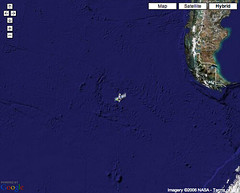
Via Space Pragmatism, here are not one but two interviews with Robert Bigelow, the man responsible for yesterday’s launch of an experimental inflatable spacecraft. There’s also a pretty neat Google Maps site for tracking Genesis in orbit.

Tracking Genesis

Monday Morning Videos

Monday, July 10th, 2006

Here’s a couple of videos to get your Monday started with a bang. Via Mars Blog, here’s a NASA video of the STS-121 solid rocket booster separating from the space shuttle. (Can’t view the video? Check out the Flickr photoset of the view from earth.)

Also, a little late for the 4th of July but fun to watch nonetheless, here’s a YouTube video of 30,000 bottle rockets launched in 2 minutes.

How to Deliver Goods to the International Space Station

Friday, July 7th, 2006

After performing a backflip to allow crewmembers of the International Space Station to inspect its belly (and to provide cool images for space fans everywhere), Discovery docked with the ISS yesterday.

The big item on the mission agenda today? Moving supplies

The astronauts moved a huge cargo container, nicknamed Leonardo, onto the space station by robotic arm. Among the goodies awaiting the space station crew were a new stationary bicycle for exercise, an oxygen generator that will eventually allow the space station to support six inhabitants, a machine that cools the station’s cabin air and a lab freezer for scientific samples…

For the first time in three years, the international space station had three crew members. European Space Agency astronaut Thomas Reiter joined Pavel Vingogradov and Jeff Williams, who marked their 100th day at the space station Friday.

The shuttle isn’t the only means of delivering supplies to the ISS, of course. Earlier this week, the European Space Agency announced the successful completion of acoustic testing on "Jules Verne," the first Automated Transfer Vehicle: 

The ATV, an unmanned vehicle that will deliver supplies to the International Space Station (ISS), will be put into orbit by the European Ariane-5 launcher. Acoustic testing is vital to ensure the ATV can withstand the vibrations caused by the extreme noise levels generated during launch.


Weekend Roundup

Wednesday, July 5th, 2006

We hope everyone enjoyed the long holiday weekend.

The big non-event of the weekend was the expected near-miss between 2004 XP14 and Earth on Monday:

A large asteroid hurtled harmlessly past the Earth early Monday at a distance of about 269,000 miles – slightly farther away than the moon.

Residents with telescopes in the United States and Canada had the best view of 2004 XP14, which appeared as a streaking dot in the northern sky.

Astronomers tracking the space rock’s path since its discovery in 2004 had determined that it would pose no risk to Earth during the encounter nor in the next 100 years. Judging by its brightness, 2004 XP14 was estimated to be a quarter-mile to a half-mile wide.

An asteroid that size, if it smashed into Earth, would probably cause regional destruction. Scientists have said it would take a mile-wide or larger asteroid to cause widespread devastation that could threaten civilization. 

The big event that finally happened– on July 4th, no less–  was the successful launch of space shuttle Discovery yesterday:

The liftoff, right on schedule at 2:38 p.m., was the start of a 13-day flight that is the first in a year for the diminished shuttle fleet as NASA continues its efforts to resume more frequent human spaceflight.

The Discovery is to rendezvous on Thursday with the International Space Station, where it is carrying equipment, supplies and a fresh astronaut for the station’s crew.

But this is also considered the second and final test flight for the shuttle fleet since the loss of the Columbia and its seven astronauts in 2003, and the Discovery’s ascent was scrutinized for the kind of liftoff debris that caused that disaster.

At 2 minutes 53 seconds into the flight, an onboard camera showed numerous pieces of debris appearing to fall away from the external fuel tank. They fluttered away and did not appear to strike the shuttle, carrying a crew of seven.

N. Wayne Hale Jr., NASA’s shuttle program chief, said the pieces had fallen "after the time we are concerned about," after the air becomes so thin that debris usually floats harmlessly away.

A piece of debris that broke off later in the ascent did appear to strike the midbody of the orbiter, NASA officials said. But they added that it probably did not do any damage.

In all, officials said, insulating foam broke away from five spots on the external fuel tank and a solid rocket booster, some with several pieces of foam.

We’ll be bringing you updates of the space shuttle’s 13-day mission over the next two weeks. 


Mitex Launches Successfully

Friday, June 23rd, 2006

UPI files the report:

The Delta II rocket launched Wednesday at Cape Canaveral carried a pair of small satellites for the U.S. Defense Advanced Research Projects Agency (DARPA) Micro-Satellite Technology Experiment. The program looks into new spacecraft technologies that could be applied to future military space projects.

Boeing and its crew of subcontractors reported Thursday that the Delta II in its 7925-9.5 configuration performed flawlessly with the payload deploying some 30 minutes after launch in geostationary orbit more than 22,000 miles above the equator….

The rocket was equipped with nine GEM-40 solid-fuel booster rockets that augmented liftoff thrust to 850,000 pounds to which another 450,000 pounds was added three minutes downrange.


Mitex Launch Today

Thursday, June 22nd, 2006

The New Scientist reports:

The US military is preparing to launch two technology demonstration satellites on Wednesday, collectively known as the Micro-satellite Technology Experiment (Mitex).

The craft will launch aboard a Delta II rocket from Cape Canaveral Air Force Station, Florida, US. The launch window lasts from 1734 to 2134 EDT (2134 to 0134 GMT on 22 June).

The micro-satellites will test a range of technologies for the Defense Advanced Research Projects Agency (DARPA), the US Air Force and the US Navy. These include avionics, advanced communications, fuels that spontaneously ignite on contact, solar cells and new software. No further details of the technologies are available.

DARPA is interested in investigating the capabilities of small satellites, says DARPA spokesperson Jan Walker. One particular focus of the mission is reducing the mass of equipment by using lightweight materials….

he technologies could have been tested with a single satellite, but because the demonstrator mission has few back-up systems and little pre-flight testing, DARPA decided to split the payload in two to maximise their chances of success.

It’s not just small satellites being tested:

The mission will also be the first flight test of an experimental rocket upper stage for the US Naval Research Laboratory. The upper stage will lift the satellites on the final leg of their journey into geosynchronous orbit.

Some of stage’s new features include: lightweight titanium propellant tanks with internal propellant management devices; novel attitude control thrusters; and solar cells with three semi-conducting layers to more efficiently convert sunlight into electricity.

 A larger version of the Mitex launch components diagram can be found here.


Taepodong Tease

Tuesday, June 20th, 2006

While the U.S. is in the midst of a major naval exercise in the Pacific, near Guam, North Korea has reportedly fueled up a Taepodong missile and is ready to light the fuse.

Among the three U.S. aircraft carrier groups, 30 warships, 280 aircraft and 22,000 soldiers taking part in the naval exercises is the USS John McCain. The exercises, "Valiant Shield 2006," marks the first time a Chinese delegation is observing.

Now is not the best time to test an ICBM over the Pacific. You know Japan is not happy about it and has made it known. They’re still upset about the 1998 missile test.

As reported by the AP:

This is an Orbview-3 satellite image provided by GeoEye showing the Taepodong missile launch complex in North Korea, called Musudan-ri, in May 2006. North Korea referred to its missile program Monday, June 19, 2006 in its official media for the first time since it apparently began preparations for a test launch, as a U.S. official confirmed the North has completed fueling a missile that is poised to fire.