Archive for the ‘Around the Blogs’ Category

KazSat-1 Satellite Launched

Tuesday, June 20th, 2006

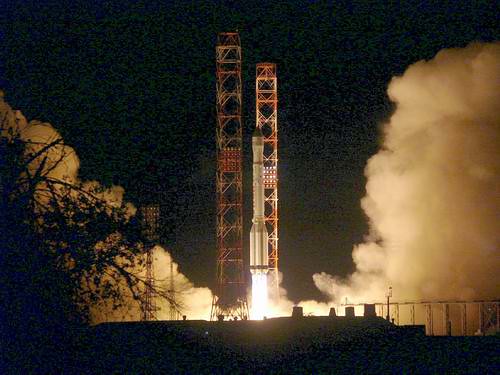
Kazakhstan launched its first communications satellite on 18 June

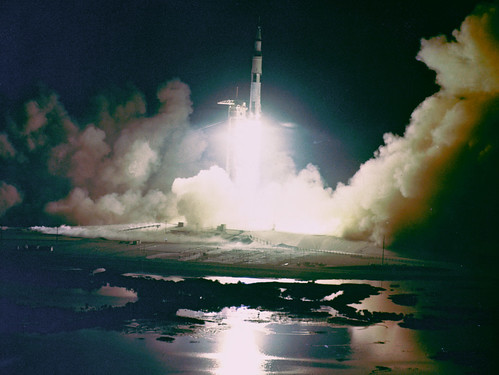
KazSat-1 Launch

2006 from the Baikonur Cosmodrome. The launch was personally seen by Kazakh president Nursultan Nazarbayev, who invited 18 leaders from media and communications in Russian and Kazakhstan.

The satellite’s advantages will provide for greater communications autonomy and security for the vast Kazakh steppes and new industrial development in the entire region.

The Great Kazoo

Contrary to some rumors among the space cadets, they did not adopt Kazoo from The Flintstones as their mascot.


Spaceports Abound

Friday, June 16th, 2006

Do you know the way to your friendly neighborhood spaceport? Yeah, me neither. If you’re like me you probably had to first ask “what’s a spaceport?”. Well, the commercial space travel industry is heating up and spaceport — where commercial spacecraft launch, I guess — are popping up all over the place. And if you live in Oklahoma, there may be a spaceport coming to your neighborhood.

Oklahoma Spaceport

The Federal Aviation Administration has given its OK for commercial spaceflight operations at Oklahoma’s spaceport, a former military air base that is expected to begin hosting test flights of a new suborbital spacecraft next year.

“We are the planet’s newest gateway to space,” Bill Khourie, executive director of the Oklahoma Space Development Authority, told MSNBC.com after the FAA’s announcement on Tuesday.

The launch site operator license, issued Monday, gives Oklahoma an edge in the nascent space tourism industry — a market also being targeted by California, New Mexico, Florida and even Wisconsin, as well as Singapore and the United Arab Emirates. However, the FAA’s Office of Commercial Space Transportation would have to issue separate licenses to companies wishing to operate from Oklahoma.

With the Oklahoma spaceport scheduled to start an extensive test site schedule in 2007, one already operating in the Mojave, and activity picking up at the New Mexico site, I have jut one question. Is living near a spaceport anything like living near an airport?

Rest in Space

Tuesday, June 13th, 2006

Humans have long imagined the stars as the place where loved ones reside after their deaths. Now the spiritual metaphor can become reality, thanks to a Japanese firm’s plans to give people a boost to heaven:

A venture business here is offering people the chance to get closer to space by launching a personal satellite business allowing customers to send ashes or photos of loved ones up into orbit for as long as 30 years.

The service is being provided by Yokohama-based firm Astro Research. The satellites are cube-shaped, measuring 25 cm to a side, inside which the memorabilia can be stored.

The satellites will be launched into space from overseas, and will orbit the earth at an altitude of between 600 and 800 kilometers for about 30 years. For several years customers will able to confirm their positions by radio….

But there is a catch — the price tag of the service is 100 million yen. For most people, that will make the cost of sending their memories into outer space astronomical. 

Sort of brings a whole new meaning to the notion that the deceased are looking down on you, now doesn’t it? 


Launch-a-Rama!

Thursday, June 8th, 2006

Five– count ’em, five— satellite launches are set to take place from Baikonur Cosmodrome over a two week period this month.

As always, we’ll bring you more coverage as the birds get ready to fly. 

Spacewalk Success

Friday, June 2nd, 2006

Looks like the spacewalk we blogged about yesterday went off without a hitch. Almost.

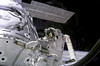
ISS SpacwalkThe spacewalk took 6 1/2-hours, longer than expected, but nowhere near the record of eight hours and 56 minutes set in 2001.

"OK. We’re going out," Russian commander Pavel Vinogradov said at 6:48 p.m. EDT Thursday as he and U.S. flight engineer Jeff Williams exited the Russian side of the station in their bulky suits while the outpost soared more than 220 miles above Earth.

Vinogradov attached himself to the end of a boom that can extend to 50 feet and Williams maneuvered him to an area on the station where the Russian commander installed a new vent for a broken oxygen-generation system. At one point, the spacewalkers were bathed in a golden glow from a sunset over the Pacific Ocean. After the sun passed, the temperature got chilly.

"My feet are like ice," Williams joked in Russian when asked if he was cold. A Russian flight controller responded, "We need to put brandy into the system instead of water." 

No word on the brandy, but there was a pretty cool droid on board the ISS.

Student Scientists to go to Rocket Launch

Thursday, June 1st, 2006

A couple of fifth grade students are going to see thier first rocket launch, and it’s a happy story of the internet community coming together to help a couple of fifth-graders who may be the next generation of rocket scientists

Here’s your chance to help do just that. Two fifth grade students from Indiana, Cameron Wade and Billy Shannon, both 11 years old, have an experiment that will launch onboard a suborbital NASA rocket. It’s part of a partnership between their school and NASA. The problem is, the grant they have doesn’t cover their own travel to Virginia to see the rocket launch!

They still want to go, of course. The trip will cost $3000, and they’re still $1000 from their goal.

And their experiment sounds pretty interesting. 

Young Rocket ScientistsTheir experiment is already in Virginia, waiting to be loaded onto the rocket. The students placed nuts and bolts screwed together in tiny bottles to see whether the vibrations from the rocket will break them apart.

They also sent up plant seeds, which they will plant this summer along with seeds that haven’t been airborne to see whether there is a difference in growth.

“They’re learning how to follow an experiment through,” Ghaffarian said. “They’re learning how to change the variables and see what happens, and it’s cool because … it makes it much more exciting than if you just buy a couple seeds and plant them.”

The nuts and bolts tie in with a unit the class did on robots and cars. The seeds work with lessons on extreme environments. Everyone in Ghaffarian’s third- through fifth-grade multiage class wrote essays that were judged by the school’s office staff on why they should be chosen for the Virginia field trip.

The good news? In less than a day, the money was raised

I am incredibly pleased and proud to announce that after just a few hours, BABloggers have donated more than $1000 to help the two fifth-graders and their teacher fly to Virginia to see their rocket launch!

… I just talked to Pamela Ghaffarian, the teacher, on the phone, and she was thrilled with how wonderful people have been to send her this money. She told me the two students, Cameron Wade and Billy Shannon, are really excited about the trip. I know they’re happy now, but wait until they actually see the launch! Even though it’s a small rocket, it’ll be really dramatic, and they’ll have the time of their lives.

And it might also inspire them to keep aiming high. Here’s to the science blogging community for coming together so quickly to help these students out!
Spacewalk On, Caddy Off

Thursday, June 1st, 2006

I wrote earlier about the amount of debris in outerspace. Well, there’s one bit of debris that we won’t be adding to what’s already up there. 

Thursday’s 5 1/2-hour spacewalk by the Russian and U.S. occupants of the International Space Station will not include the previously announced attempt to hit a radio transmitting golf ball into Earth orbit, The New York Times reported Wednesday. 

The publicity stunt involved the payment of an undisclosed amount of money to Russia from a Canadian golf company. Russian officials did not explain the reason for the postponement.

In place of the golf shot, the astronauts will replace a malfunctioning camera on the U.S. side of the ISS. 

The spacewalk, sans golf clubs, is on for 6:40pm.

Via Marsblog.  

Where There’s No Smoke, There’s Rockets?

Thursday, May 18th, 2006

Quick. What’s the best part about a rocket launch, any rocket launch? If you ask me, it’s seeing something like this.

Right? So, would someone please explain to me what’s the point of a smokeless rocket launch?

James Woodward, a history professor at California State University in Fullerton, presented his research into Mach-Lorentz thrusters Wednesday at the Future in Review conference here. Mach-Lorentz thrusters (MLTs), assuming they can be scaled up from lab tests, could provide a new source of propulsion that "puts out thrust without blowing stuff out the tailpipe," Woodward said.

MLTs are based on Mach’s principle, which suggests that all particles in the universe have an effect on each other, and the work of Hendrik Lorentz, who conducted research into the movement of charged particles in a magnetic field. Woodward has constructed an engine that takes advantage of the fact that objects produce energy when their mass changes slightly, he said.

Woodward used capacitors to change the mass of an object and then applied a current to that mass. That produces a small amount of thrust. Increasing the voltage and frequency of the current increases the strength of the thrust, to the point where the engine could be used to adjust the orbit of a satellite, or push a rocket into space.

Is there a downside to "blowing stuff out the tailpipe"? Is there an upside to not doing so?


Slinging into Space

Friday, May 12th, 2006

Are rockets déclassé when it comes to launching stuff into space?

Well, not really. Nothing can quite compare to the countdown to launch and the rumble as the rocket lifts off from the pad.

But in the future, rockets might not be the only way of lifting things into the Clarke Orbit and beyond. 


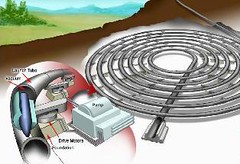
We’ve written before about the space elevator; the picture above depicts another method being explored by scientists and engineers — a giant slingshot:

What if we could throw something so hard, it would wind up in space? At NASA’s behest, Ed Schmidt and Mark Bundy of the Army Research Lab are looking at ways of firing projectiles into orbit.

The notion has a very long pedigree. Back in 1687 when Isaac Newton first came up with the theory of gravity he also introduced the concept of an orbital cannon which could fire a cannonball so fast that it would never come down. The first serious attempt to shoot into space was the High Altitude Research Program (HARP) carried out in the US in the 60’s…. HARP used a modified 16-inch naval gun to loft projectiles to the incredible altitude of 112 miles before being cancelled in 1967.

The ARL study looks at more sophisticated approaches than your basic cannon, including a blast wave accelerator, and electro-magnetic rail gun, and an EM coil gun. But the wildest idea may be the Slingatron: a giant, hypervelocity, rapid-fire slingshot. The machine would spin a projectile faster and faster through a spiral-shaped tube, building up increasing amounts of centripetal force along the way – just like a discus-thrower, spinning himself around before a toss, or like a latter-day King David, winding up his weapon before he whacks Goliath.

Personally, we think slingshots are dangerous– you could poke out your brother’s eye, as Mom used to warn– but cannons look pretty cool:


And engineers for a relaunched HARP project could easily be found in the autumn in Montana, at the Annual World Championship Punkin Chunkin.

Then again, slingin’ a punkin would be pretty cool, too. 


U.S., India Team Up for the Moon

Tuesday, May 9th, 2006

"Indian and U.S. space agencies Tuesday signed an agreement to put two U.S.-made scientific instruments on board of Chandrayaan-I, India’s first unmanned moon explorer, in 2008, Indo-Asian News Service reported:

NASA will put one mini synthetic aperture radar (Mini SAR) and moon mineralogy mapper (M3) on board of Chandrayaan-I, according to the agreement.

"The objective of SAR is to detect water in the permanently shadowed areas of lunar polar regions, while M3 will map the minerals on the lunar surface and study its characterization," [Indian Space Research Organization (ISRO) chairperson G. Madhavan] Nair said.

Chandrayaan-I will be launched from the Satish Dhawan Space Centre (SDSC) at Sriharikota in southeast India’s Andhra Pradesh, by an advanced polar satellite launch vehicle (PSLV), into a 240-24,000 km earth orbit and placed subsequently in a 100-km polar orbit around the moon, with its own propulsion system.