Archive for the ‘Around the Blogs’ Category

DIY Friday: Crayons taking flight

Friday, May 5th, 2006

It’s not everyday you get to launch a Crayon. Trailer Trash Aerospace (what a name…) gives us the lowdown on how they made this happen:

The crayon came from our "need" for a cheep 4" rocket to test our 54 mm motors, at $6 for the airframe and nose cone the cheep part is covered! It has proven to be very sturdy by landing several times with the laundry still safely tucked in the airframe! The drawback is due to the plastic tail cone, they are somewhat labor intensive to build. Only a couple of pictures were taken of the build, when we make an another one we will shoot more!


So what would you call it if you get all the colors in a Crayola box up in the air at the same time? 


Weather Satellites Launch After Weather Delays

Monday, May 1st, 2006

Seventh time’s the charm, right?


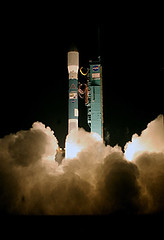
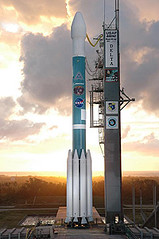
After six tries over eight days, NASA launched a Delta 2 rocket Friday and a pair of satellites that will give planet Earth its newest health checkup by examining the secrets of clouds.

The 12-story-tall rocket built by Boeing rumbled off Space Launch Complex-2 at 3:02 a.m. into foggy skies at Vandenberg Air Force Base.

The approximately $515 million mission placed two satellites into orbit: CloudSat and CALIPSO (Cloud-Aerosol Lidar and Infrared Pathfinder Satellite Observations). About 90 minutes later, officials confirmed that the satellites had arrived in space.

“With the successful launch of CloudSat and CALIPSO we take a giant step forward in our ability to study the global atmosphere," said David Winker, CALIPSO principal investigator from NASA’s Langley Research Center, Va. "In the years to come, we expect these missions to spark many new insights into the workings of Earth’s climate and improve our abilities to forecast weather and predict climate change."

 We wrote about the launch in anticipation on the 20th of April; Rocco kept us updated in the comment threads ("CloudSat can’t launch because of clouds. Go figure."); but now the wait is over, and you can view Friday’s successful launch here.

Good Job: Atlas V Rocket Launches ASTRA Satellite

Thursday, April 20th, 2006

This afternoon’s launch was a complete success.

Lift-off occurred at 4:27 p.m. EDT and initial contact with the satellite, called acquisition of signal, was confirmed at 5:43 p.m. EDT from a satellite tracking station in Uralla, Australia.

Atlas V launches from The Cape

Some really nice photos are on the SpaceFlightNow.com site. 

The video footage is impressive.

Atlas V Rocket to Launch ASTRA 1KR Today

Thursday, April 20th, 2006

ASTRA’s newest satellite will be launched into geosynchronous orbit and will become part of a system that provides television reception to 107 million households in Europe. Launch window opens at 4:27 p.m. EDT (20:27 GMT), and remains opens until 7:16 p.m. (23:16 GMT). Watch the launch live via webcast from launch complex 41 at the Cape Canaveral Air Force Station in Florida. Broadcast begins at 4:05 p.m. (20:05 GMT). Here’s how you can receive it directly via satellite:
 
In North America, AMC-4, transponder 17, C-band analog, 101 degrees West, downlink frequency 4040 MHz (vertical).

In Europe, on ASTRA, transponder 116 on ASTRA 1G at 19.2E with following reception parameters: downlink frequency: 12669.50 MHz / downlink polarization: vertical / transponder transmission rate: 22 MB/s QPSK FEC 5/6; Service name: ASTRA VISION 3

Test signals begin about 3:45 p.m. EDT (19:45 GMT).

If you are not able to watch it, then you can follow it via live text updates.

CloudSat and Calipso to Blast Off Early Friday AM

Thursday, April 20th, 2006

A Delta II rocket will launch a pair of atmospheric research satellites for NASA early Friday morning.


The AP gives a summary: 

A Delta 2 rocket carrying the CloudSat and Calipso satellites will blast off shortly after 3 a.m. Friday [from Vandenberg Airforce Base.]

CloudSat and Calipso are equipped with instruments to study the formation of clouds and microscopic airborne particles called aerosols in unprecedented detail.

Observations from the satellites should help scientists improve weather and climate forecasts.

CloudSat and Calipso are managed by NASA’s Jet Propulsion Laboratory in Pasadena.

Live launch coverage on the web (for all you night owls and early risers) is available here. Also be sure to check out the NASA website for more information about CloudSat and Calipso.

Space Junk

Wednesday, April 19th, 2006

No, I don’t mean the song by Devo. But there’s gonna be some more junk up there, do you need to get one of those hats the band used to wear back in the day, on the off chance that some of that junk finds it’s way back down here? Apparently the FCC ruled that U.S.-licensed satellites launched after March 22, 2002 have to go into disposal orbit when they’ve beamed down their last signal. The latest is the Spacenet 4 satellite, which was launched in 1985.

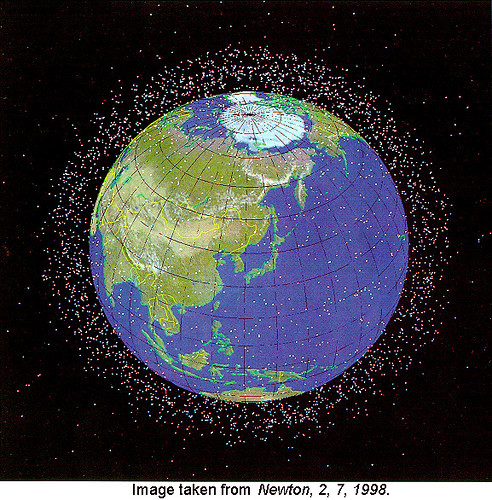
I’ve blogged about the satellite graveyard before, and apparently we’ve left a lot of stuff up there in the past 25 years or so; more than 9,000 man-made objects, which can break into little pieces and cause problems for current space missions. It looks something like this.

Space Junk

I’ve also blogged before about how stuff gets knocked around up there. And it’s not all that unusual for some of it to fall to earth. It can land in your garden, or even on you. Don’t believe me? Ask Devo

She was walking all alone
Down the street in the alley
Her name was sally
She never saw it
When she was hit by space junk

At least now we know why they wore these. 

Space Helmet

Either wear a helmet or practice catching the stuff

I’ll enjoy the latter for now. In the meantime can someone tell me, now that this stuff is up there what are the chances it’s gonna stay up there?

NASA Working on Antimatter Rocket for Missions to Mars

Monday, April 17th, 2006


Is science fiction destined to become just science

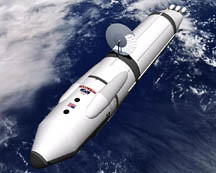
Most self-respecting starships in science fiction stories use antimatter as fuel for a good reason – it’s the most potent fuel known. While tons of chemical fuel are needed to propel a human mission to Mars, just tens of milligrams of antimatter will do (a milligram is about one-thousandth the weight of a piece of the original M&M candy)….

The NASA Institute for Advanced Concepts (NIAC) is funding a team of researchers working on a new design for an antimatter-powered spaceship that avoids this nasty side effect by producing gamma rays with much lower energy….

When antimatter meets matter, both annihilate in a flash of energy. This complete conversion to energy is what makes antimatter so powerful. Even the nuclear reactions that power atomic bombs come in a distant second, with only about three percent of their mass converted to energy.

Antimatter rockets have significant advantages over nuclear-powered spacecraft, including improved safety, efficiency and speed:

The Reference Mission spacecraft would take astronauts to Mars in about 180 days. "Our advanced designs, like the gas core and the ablative engine concepts, could take astronauts to Mars in half that time, and perhaps even in as little as 45 days," said Kirby Meyer, an engineer with Positronics Research on the study.

Advanced engines do this by running hot, which increases their efficiency or "specific impulse" (Isp). Isp is the "miles per gallon" of rocketry: the higher the Isp, the faster you can go before you use up your fuel supply. The best chemical rockets, like NASA’s Space Shuttle main engine, max out at around 450 seconds, which means a pound of fuel will produce a pound of thrust for 450 seconds. A nuclear or positron reactor can make over 900 seconds. The ablative engine, which slowly vaporizes itself to produce thrust, could go as high as 5,000 seconds.

Although one of the drawbacks to antimatter rockets is its high cost of development, we wonder if that can’t be mitigated by passing the hat around to the millions of science-fiction fans around the world, who have dreamed of anti-matter-powered rockers for years.

(Via Rawstory.) 


COSMIC Launch

Monday, April 17th, 2006

COSMIC— the Constellation Observing System for Meteorology, Ionosphere and Climate– was successfully launched from Vandenberg Air Force Base in California on Friday night. The AP reports:


Six weather satellites successfully reached orbit and were ready to begin their five-year mission to track hurricanes, monitor climate change and study space weather, it was announced Saturday.

"Ground stations have received signals from all six satellites," according to an update on the Web site for the project’s manager, University Corporation for Atmospheric Research in Boulder, Colo.

The satellites were launched on a rocket booster Friday evening from this Central Coast base. They were placed into orbit about 500 miles above Earth, where they separated to form a chain.

The satellites will take about 2,500 daily measurements by using global positioning receivers to track radio signals passing through the atmosphere, scientists said.

The information gathered will be used to enhance research and improve weather forecasting. Scientists hope the data will help them better track storms and monitor long-term climate change.

The COSMIC web page can be found here


When It Absolutely Positively Has to Get to Space

Friday, April 14th, 2006

Not that I’ll need that service any time soon, but apparently Masten Enterprises are the people to call if you need to send something into space. For a fee, they’ll blast your stuff into the stratosphere. There’s even a video of how it works.

The prices seem pretty reasonable at first glance. 

350 gram CanSat – $99
1 kg Custom Payload – $250
2 kg Custom Payload – $500
5 kg Custom Payload – $1250

If you’re like me you’ll need a translation. 

0.77 lbs – $99
2.20 lbs – $250
4.40 lbs – $500
11.02 lbs – $1250

Then again maybe not. Seems like a lot of money to send something ranging from the size of a soda can to a well-fed cat into space. And how do you get your stuff back once it’s up there? Or do you just send up stuff that you no longer need? And if so, this is better than throwing it away or recycling it how

It sounds like a cool idea, but unless someone can explain to me just how useful it is, my advice to anyone who has something they no longer need and want to send into space is pretty simple: hold a garage sale.

Via Make.

Satellite Launched at Sea

Thursday, April 13th, 2006

The word from the rocket scientists in Japan is good:
 

JSAT Corporation ("JSAT"; Head office: Chiyoda-ku, Tokyo; President and CEO: Kiyoshi Isozaki) is pleased to announce that today it has successfully launched JCSAT-9 communications satellite. JCSAT-9 lifted off at 08:30 a.m. (Japan Standard Time) from a launch platform at 154º West Longitude on the Equator (approximately 2,240km south of Hawaii on sea). After this launch, JCSAT-9 was also successfully separated from its launch vehicle.


Sea Launch, an international consortium of Ukrainian, Norwegian, Russian and U.S. companies, does a great job of describing the launch sequence. And an even better job of broadcasting it (watch the video presentation).