Archive for the ‘Astronomy’ Category

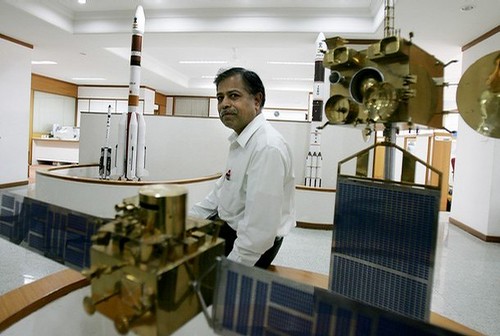
Wanted: Satellite Joint Venture in India

Monday, August 10th, 2009


It’s no secret satcom has wildly optimistic projections for providing service in India — television and Internet. Direct-to-home satellite television probably has the greatest potential. All you need to do is get beyond government bureaucracy. Simple.

Satellite companies have been trying to get more business from India for years. The AAP-1/NSS-11 satellite’s South Asian beam was specifically designed for DTH. Did they get the business? No. The government insists on majority ownership by Indian entities. Antrix books plenty of space on it, but no DTH business.

So how will they satisfy demand? Buy a satellite from another operator.

Antrix Corp, India’s only space services company, is out to break new ground in the $2.5 billion industry.

The Rs 1,000 crore firm is scouting for joint ventures with similar overseas firms to own and operate satellites.

It is talking to one European and a regional company, to buy a large sized communications satellite, managing director K R Sridhara Murthi told DNA.

"We are looking to build strengths in new areas and have kicked off talks with these parties to own and operate satellites," Murthy added. But he refused to divulge the names of the involved parties pending finalisation of a deal.

The move follows an earlier attempt at a similar JV in 2004 with Malaysia’s MEASAT Global to develop a satellite neighbourhood for broadcasting and telecom customers across the wider Asia-Pacific region. 

 Given last month’s space agreement with the U.S., it seems India will be next real power in space.

Bankrupt in Bermuda, Desperate in Delaware

Thursday, July 30th, 2009


Remember ProtoStar? We do. They’re the company that launched a satellite into orbit about a year ago, and stationed it over East Asia. Bold move by the Bermuda-headquartered, San Francisco-based company (but incorporated in Delaware). They filed for the orbital slot through Singapore, hoping to get the satellite coordinated quickly. Launched another satellite only a couple of months ago. Looks like a good business to back with some venture capital.

Well, it was a good business (and might be again sometime in the future). They filed for bankruptcy yesterday:

Protostar filed for Chapter 11 bankruptcy protection Wednesday after lenders agreed to finance the company’s operations until it sells its satellites.

ProtoStar is suffering from a liquidity crunch after two customers decided to stop using one of its satellites – moves that forced the company to shut the operations of that satellite down and stop collecting revenue from it.

Investors including New Enterprise Associates, Redshift Ventures and VantagePoint Venture Partners have provided the company with more than $182 million in equity since 2004.

Chief Financial Officer Cynthia M. Pelini said in court documents that lenders demanded ProtoStar pay off its debt. However, the company was able to negotiate an arrangement under which the lenders would provide enough financing to keep the company’s operations going until it sells one or both of the satellites.

ProtoStar is now seeking permission from the U.S. Bankruptcy Court in Wilmington, Del., to borrow up to $16 million under a bankruptcy loan from a group of lenders led by Wells Fargo and use cash collateral securing claims from secured noteholders.

Protostar also is seeking permission to enter into a multiple draw term loan agreement with lenders led by Credit Suisse, Cayman Islands Branch.

Without the financing, ProtoStar said it wouldn’t have enough cash to fund its operations while it tries to sell its assets or cover expenses related to its bankruptcy case.

Separately, ProtoStar urged the bankruptcy court to issue an order spelling out the protections it’s entitled to now that it’s in Chapter 11.

ProtoStar, which has companies that operate in foreign jurisdictions such as Bermuda, Indonesia, Korea and Singapore, said creditors and counterparties to leases and other contracts “may not be well-versed” with the U.S. Bankruptcy Code. As a result, they may not be aware that they can’t seize ProtoStar assets located outside the U.S. or terminate agreements while the company is in bankruptcy.

ProtoStar has $528 million (book value) in assets and $463 million in debt, according to court papers.

Interesting. After trying to bulldog it’s way through frequency coordinations (generally a very civil discussion among engineers and regulators), using local offices for convenience and favorable tax jurisdictions to minimize what they owe to the U.S. government, the company is arguing for protection from the courts in Delaware. How you do business permeates your organization — and affects customer relationships.

Probably scared away some customers, too. Without paying customers, what good is your rocket science business?

If the satellites are for sale, we’ve got an opportunity for another operator to buy them.


Welcome Back Horowitz

Thursday, July 16th, 2009

While I was away earlier this month, Andy Pasztor wrote a piece in the WSJ on former SES AMERICOM CEO Ed Horowitz teaming up with former International Launch Services CEO Mark Albrecht to form U.S. Space:

A clutch of former Pentagon brass is helping to start a company that offers a new service: satellites intended solely for military communications that would be built, launched and owned by private investors.

The new company, called U.S. Space LLC, attempts to meet a need that the U.S. military has struggled to fill. As U.S. forces deploy to out-of-the-way regions, the Pentagon frequently needs more satellite capacity for communications and distribution of video surveillance than it can get its hands on.

The military’s own satellites are expensive, and often take too long to deploy to satisfy fast-changing battlefield needs. Meanwhile, the military hasn’t always been able to lease sufficient bandwith on traditional commercial satellites, particularly in remote areas such as Afghanistan.

The new company intends to build and launch relatively small and inexpensive commercial satellites that would be optimized for military use and leased only to military customers, according to Mark Albrecht, the company’s chairman and co-founder.

Backers said the price of the satellites would be held down by keeping them small, modular and relatively basic, without tailoring them for special needs and piling on bells and whistles.

"This is absolutely responsive" to the Pentagon’s needs for quickly supplementing current capacity wherever it’s needed, said Mr. Albrecht, a former head of Lockheed Martin Corp.’s international rocket business.

The company’s board members count three former Air Force generals, including retired Lt. Gen. Michael Hamel, who until recently served as the military’s top uniformed space-acquisition official; retired Major General James Armor, a former space policy maker; retired Major General Craig Weston, who is also the president and chief executive of U.S. Space. The company’s backers include firms headed by former Attorney General John Ashcroft and former Defense Secretary William Cohen.

Each proposed high-altitude satellite is envisioned to cost less than half of the roughly $350 million price tag for building and launching a large, top-of-the-line commercial satellite. The Pentagon and various national-security customers already lease significant commercial capacity, often at expensive spot rates that by some estimates amount to more than $800 million annually.

In addition to being less costly, the venture aims to be more flexible because the in-orbit locations and transmission frequencies specifically will be intended for military uses.

The U.S. Space models are intended to be ready for service in roughly three years, versus a decade or more in development for most Pentagon satellites.

The project is risky, partly because no firm financing or contracts to supply capacity have been signed. The Pentagon is notorious for balking at long-term satellite leasing arrangements.

But military brass "have really endorsed" the commercial approach and "encouraged us to continue the discussions," said Edward Horowitz, a U.S. Space co-founder and former president of the U.S. unit of global satellite-services giant SES Global.

Industrial firms backing the venture include a group of second-tier aerospace contractors led by Orbital Sciences Corp., which is in line to build the satellites and launch them with a beefed-up version of its Minotaur rockets.

Ed was the inspiration and force behind this blog, and Mark was at helm of ILS when they began publishing their launch blogs. They will surely impact the commercial space business.


Broadband Stimulus in Space

Wednesday, July 15th, 2009


Terrestar-1 was launched a couple of weeks ago. In-orbit testing is going well, and the antenna is up. Wish we could say the same about the Solaris Mobile bird.

As we’ve blogged before, the company behind it has an interesting propostion: a diverse path for communicating via smartphone.  No signal? No problem: connect via satellite.

More interesting is they’ll be one of many satcom-based communications companies going after some of the US$7.2 billion set aside for broadband, as reported by the Wall Street Journal:

 The launch is significant because it could make the case to policymakers, who may have government grants or business to offer, that satellite Internet service is a viable alternative to cable or cellular hookups.

The sheer size of TerreStar’s satellite, which has a 60-foot antenna, will ensure that military personnel, emergency responders, and rural customers are always connected, said TerreStar President Jeff Epstein.

TerreStar has developed a smart phone that operates both on its satellite network and a traditional cellular network. The company has secured a roaming agreement with AT&T Inc. (T), and it could pursue similar agreements with other wireless carriers.

"Off the network grid, you can make calls via the satellite," Epstein said. "It’s a redundant path."

TerreStar will be among the first satellite carriers to offer Internet speeds that are comparable to high-speed WiFi or cellular broadband. That could make the company eligible for some of the $7.2 billion in economic stimulus money for high-speed Internet connections in unserved and rural areas.

Right now, government officials and industry analysts say satellite Internet service is too spotty and slow to be a good candidate for the government money.

The advantage of satellite service, however, is that it can cover much wider swaths of the country than other types of connections.

With a robust network, satellite could become the ideal method to deliver high-speed Internet to sparsely populated areas, a top priority of President Barack Obama.

But TerreStar’s Internet service rollout might be too late for an economic stimulus subsidy. By law, the government Internet grant money must be distributed by the end of September 2010, which means grant makers will start allocating the last round of funds sometime next spring.

Before TerreStar can start selling voice and data service, it has to test its network in orbit. Epstein said he wants to complete that testing by the end of the year.

SkyTerra Communications Inc. (SKYT) has similar plans to offer mobile Internet services. It announced earlier this month that it will launch one of two next-generation satellites in the first half of 2010.

Both SkyTerra and TerreStar have agreements with Qualcomm Inc. (QCOM) and Infineon Technologies AG (IFNNY) to develop more models of regular-size satellite-cellular devices.

More power to them!

Here’s the launch video, courtesy of Space Systems/Loral


Liquidty Bankrupts Sea-Launch

Tuesday, June 23rd, 2009
 
 
Well, this doesn’t compare to the anomaly from two and a half years ago, but its still significant. Sea-Launch filed for bankruptcy today, via Reuters:
 
Satellite-launch services provider Sea Launch Co and 5 affiliates filed for Chapter 11 bankruptcy protection, citing liquidity concerns and recurring losses from operations.

In a filing on Monday with the U.S. Bankruptcy Court for the District of Delaware, Sea Launch listed assets of up to $500 million and liabilities of more than $1 billion.

The Long Beach, California-based company said in the filing it intends to explore the sale of one or more of its divisions.

Sea Launch, which offers commercial space launch capabilities from the Baikonur Space Center in Kazakhstan, is owned by among others Boeing Co (BA.N), Russia’s RSC Energia and Norway’s Aker ASA (AKER.OL).

The case In re Sea Launch Co LLC et al, U.S. Bankruptcy Court, District of Delaware. No. 09-12153.

 
Oh, the irony. Liquidity problems. From a company that launches Zenit rockets from a converted oil platform.
 
Here’s the funny part: they filed just after a Land Launch version of the Zenit rocket delivered a Measat spacecraft to GTO. Citigroup may feel otherwise, having underwritten a $245 million one-year Term Loan last week.
 
Probably won’t impact the worldwide launch industry as much as the NSS-8 failure of 2007.

Satcom News

Monday, June 15th, 2009

Last week’s news summary, courtesy of Bill McDonald:

TeamCast and BBC will partner to develop new DVB-T2 modulator for professional applications.
[Satellite Today – 06/12/2009]

Euroconsult, a French satellite consulting firm, forecasts that nearly 1,200 satellites will be built and launched between 2009 and 1028, and increase of about 50% over previous decade.
[Satellite Today – 06/11/2009]

Intelsat plans launch of 11 satellites by end of 2012, 5 of which will refresh Asia-Pacific fleet.
[CNBC – 06/11/2009]

Thaicom opens gateway in Jakarta, Indonesia, the 15th gateway in the Asia-Pacific region.
[Satellite Today – 06/11/2009]

GOES-O launch date moved back to June 26th so design changes can be incorporated in linear shape charge system of Range Safety command destruct system of Delta IV rocket..
[SatNews – 06/11/2009]

Marlink acquires capacity on Tlesat’s Telstar 11N to extend its WaveCall maritime coverage into the North Atlantic Ocean.
[Satellite Today – 06/11/2009]

Successful 19 month Japanese moon mission concludes with a controlled crash landing on the surface.
{R&D Magazine – 06/11/2009]

MEASAT Satellite Systems and Classica Asia sign 5 year agreement for UNITEL CLASSICA HD channel to be distributed via MEASAT-3 satellite.
[SatNews – 06/11/2009]

C2SAT enters into licensing agreement for Shanghai based Xinguo IT to produce C2SAT stabilized antenna systems in China.
[SatNews – 06/11/2009]

Lockheed Martin team successfully mates infrared sensor payload to spacecraft bus for Air Force’s GEO-2 satellite.
[SatNews – 06/11/2009]

Digi International enters satellite market with acquisition of all assets of all assets of MobiApps Holdings Private Limited, a developer of machine-to-machine communications technology focused on satellite, cellular, and hybrid solutions.
[Satellite Today – 063/11/2009]

Citrix partners with TeleCommunications Systems to support the satellite communication capabilities of the U.S. Army.
[UPI – 06/10/2009]

Iridium is awarded a phase II contract for continued development of the Distributed Tactical Communications System for the U.S. Navy.
[UPI – 06/10/2009]

ILS gets second contract of 2009  from Intelsat for two new firm satellite launches and one optional launch.
[SatNews – 06/10/2009]

Integral Systems signs deal with Orbital Sciences Corp tfor primary and backup satellite command and control systems for Koreasat-6.
[Satellite Today – 06/10/2009]

Satellite manufacturing facility planned for Dubai based on engineering skills learned during Dubai-Sat 1 construction in South Korea.
[Khaleej Times – 06/10/2009]

Spacenet announces Innovation & Technology award to Missouri Department of Transportation for innovative emergency communications satellite solution.
[TMCnet – 06/10/2009]

Cable and satellite TV providers use the digital TV transition today, Friday June 12, to push to add subscribers.
[nvdaily – 06/10/2009]

Univision and Televisa argue before federal judge over rights to stream Televisa’s shows on line and on cell phones in U.S.
[AP – 06/10/2009]

DirecTV VP for government affairs accuses Comcast and other cable companies of pushing Massachusetts legislation for 5% sales tax on satellite DTV service as Satellite Broadcasting and Communications Association launches media offensive against the legislation.
[Boston Herald – 06/10/2009]

Caprock Government Solutions receives Satellite Industry Leadership Award from 2009 International Satellite and Communications exchange conference in San Diego.
[SatNews – 06/09/2009]

TerreStar announces rescheduling of launch of TerreStar-1 for July7-12, 2009 to ensure on-orbit anomaly on another operator’s satellite has no bearing on flight-worthiness of TerreStar-1.
[SatNews – 06/09/2009]

KVH adds dedicated Crew Calling Gateway to mini-VSAT system for Nor-Shipping in Norway.
[SatNews – 09/09/2009]

Air Force formally terminates contracts with companies including Lockheed Martin Corp. for TSAT communications satellite system.
[Forbes – 06/08/2009]

General Dynamics wins $119m U.S. Army WIN-T order for 293 satellite terminals and support services.
[Satellite Today – 06/08/2009]

KCPC Satellite Communications announces offer to purchase shares of Gilat Satellite Communications.
[Business Wire – 06/08/2009]

WildBlue provides hands-on demonstration of "next generation" satellite broadband for consumers on Capitol Hill.
[Business Wire – 06/08/2009]

Eutelsat announces data rate increase of Tooway consumer broadband service from 2 Mbps to 3.6 Mbps at no additional cost.
[PR Newswire – 06/08/2009]

Inflatable tower, built from materials available today, could climb to the edge of space and be used for research, tourism, telecommunications, or launching spacecraft.
[New Scientist – 06/08/2009]

Senator Feinstein expresses "extraordinarily serious concern" over new electro-optical satellites for the DOD recently approved by President Obama.
[got geoint? – 09/10/2009]

WBMSAT PS – Satellite Communications Consulting Services


Buen Trabajo, Por Satélite

Monday, June 8th, 2009


Satcom service companies in Latin America seem to be doing well, going where other telecom services can’t, and, well, there’s video.

No other technology delivers video to more people simultaneously than satellite. Here’s the press release from Frost & Sullivan:

 "Fiber networks are limited to the most developed regions, leaving important space for satellite-based solutions to grow," says Frost & Sullivan Consultant Andrés Sciarrotta. "Moreover, the higher requirement for mobile content is, in turn, driving demand for data applications transmitted by satellite."

Users, irrespective of their location, can use fixed and mobile solutions to gain access to Internet broadband satellite. The fixed version provides broadband access throughout Latin America, at speed comparable to those available in the big cities.

Users can access their e-mails, transfer files, communicate through voice over Internet protocol (VoIP), or schedule meetings through video conference IP. This type of solution offers the benefits of communication from anywhere in the region (regardless of whether it is inhabited or not), a specially optimized coverage for South America, and a wide range of available services.

Despite these advances, the satellite service market is yet to stave off competition from terrestrial infrastructure and has to find a solution to the unattractive cost structure and payment methods, despite just having overcome historic low prices. The market is also challenged by the underwater cable network in Chile and other land installations. However, market participants can take heart from the governments’ efforts to spur connectivity programs in order to minimize the digital distance among some regions.

"Developments of TV digitalization and high definition TV (HDTV) broadcasting are also expected to drive the demand for transponders," notes Sciarrotta. "Further, the introduction of Ka-Band can augment the array of applications provided over satellite."

The study may be unique in its analysis, but I’d be interested in seeing research similar to what ASTRA produces in Europe. Market penetration estimates in the free-to-air and paid TV services via satellite is something programmers and content owners would be something they’d like to see. I’m certain of that.

What I think the Latin American market needs is more satellite capacity/inventory. If most the best satellites are sold out, what have you got to sell? Mierda!

WBMSAT Satellite Industry News Bits for June 5, 2009

Friday, June 5th, 2009

Air France crash may put pressure on airlines to improve satellite surveillance systems to allow air traffic controllers to track a plane’s progress across open ocean.
[Associated Press – 06/05/2009]

General Dynamics wins $119m modification to existing U.S. Army contract, to provide additional terminals, trucks, and other parts for Warfighter Information Network-Tactical program.
[Charlotte Business Journal – 06/05/2009]

Iridium wins $22m contract to provide Navy with communications services and develop new tactical communications system for the Marines.
[Washington Business Journal – 06/05/2009]

Blue Sky Network and Iridium Satellite announce they will supply the Open Passage expedition with voice communications and GPS mapping during upcoming four month Arctic Journey.
[SatNews – 06/05/2009]

KVH assumes operational responsibility for the mini-VSAT Broadband service supporting North American and the Caribbean regions, previously managed under revenue sharing agreement with SES AMERICOM.
[PR Newswire – 06/04/2009]

Orange and France Televisions will offer the French Open men’s final live and in 3D on cinema screens in France and Spain, delivered by satellite by Globecast.
[SatNews – 06/04/2009]

Launch preparations in Kourou for SES AMERICOM-NEW SKIES’ NSS-9 satellite to be featured on National Geographic’s World’s Toughest Fixes program.
[SatNews – 06/04/2009]

DirectTV CEO Chase Carey quits to return to News Corporation.
[TCMnet – 06/04/2009]

SES AMERICOM-NEW SKIES announces three-year agreement with BT in Latin America for nearly three full transponders on NSS-10 to support extension of BT’s IP network deep into remotest regions of Brazil.
[SatNews – 06/04/2009]

Mars Orbiter communications resumed in safe mode after unexpected re-boot Wednesday evening, June 3.
[SatNews – 06/04/2009]

Reason satellites could not help find lost Air France plane – on board GPS systems are primarily used for crew navigation and do not constantly enable tracking by a ground crew.
[CNN – 06/03/2009]

Satellite TV channel based in Egypt to promote moderate Islam and challenge extremist ideas when it launches in August.
[SatNews – 06/03/2009]

Ariane 5 integration of TerreStar-1 payload ready to proceed in preparation for launch of world’s largest commercial telecommunications satellite.
[SatNews – 06/03/2009]

Dish Network ordered to pay TiVo $103m by U.S. District Court Judge David Folsom of the Eastern District of Texas for contempt of 2004 patent infringement judgement by using software workaround which allegedly still infringed on TiVo patent.
[CED Magazine – 06/03/2009]
Dish Network wins temporary stay of contempt order in a federal appeals court in Washington.
[Business Journal- Denver – 06/03/2009]

NASA completes review of Endeavour’s readiness for June 13 launch for STS-127 mission to the International Space Station.
[SatNews – 06/03/2009]

Newtec ships 50,000th Sat3Play terminal for low cost, easy-to-install high-speed satellite internet access for consumers and small businesses in Europe.
[SatNews – 06/03/2009]

Iridium subscribers up 31.2%, total revenue up 2.0%, net income down 41.9% primarily on Iridium NEXT costs.
[PR Newswire – 06/02/2009]

SES AMERICOM-NEW SKIES announces 3-year agreement with Telefonica del Peru for nearly a full transponder on NSS-10 to deliver corporate voice and data solutions as well as broadband and mobile phone services to remote areas of Peru.
[SatNews – 06/02/2009]

MEASAT 3a returns to Baikonur in preparation for late June launch aboard a Land Launch rocket, following six-month process to repair damage caused by a crane at the launch site.
[SatNews – 06/02/2009]

SkyVision and Eutelsat sign multi-year agreement for capacity on newly-launched W2A satellite.
[PR Newswire – 06/02/2009]

KVH signs multi-year agreement with SKY Perfect JSAT to lease satellite capacity on JCSAT-1B and the new Intelsat-15 satellites as it continues to move toward offering global coverage for its mini-VSAT broadband service.
[SatNews – 06/02/2009]

VoCeM, world’s most efficient satellite communications compression software for VOIP or GSM, is launched by satellite communications company TriaGnoSys – it allows Inmarsat or Ku-band payload usage to be increased by factor between 5 and 10.
[SatNews – 06/02/2009]

DirecTV signs two-year extension on contract with Convergys to provide customer-service support for DirecTV customers.
[Broadcast Newsroom – 06/02/2009]

Lockheed Martin wins $1.5 billion contract to build the third Space Based Infrared systems Geosynchronous Earth Orbit satellite.
[Satellite Today – 06/02/2009]

Globecomm Systems acquires Telaurus Communications, provider of maritime communications, for $6.5m.
[newsday – 06/01/2009]

Stratos Global Corporation announces its selection by MISC Berhad to provide crew communications to its entire fleet of more than 100 vessels.
[PR Newswire 06/01/2009]

SpaceX and Astronautic Technology of Malaysia announce new launch window of July 13 – July 14 for Falcon 1 Flight 5, carrying the RazakSAT satellite to orbit.
[SatNews – 06/01/2009]

SES AMERICOM-NEW SKIES wins multi-year distribution agreement form In Demand for delivery of NBA League Pass and Major League Soccer’s Direct Kick programming packages.
[Satellite Today – 06/01/2009]

Do we need to go to the moon to get to Mars? It might be argued that money spent on a return to the moon might be better spent on a Mars mission.
[IEEE Spectrum – June 2009]

Former astronaut Franklin R. Chang Diaz is working on a rocket engine which in its most ambitious form would be nuclear, and capable of taking people to Mars.
[IEEE Spectrum – June 2009]

Some believe China, which conducted its first three-person space mission last September, could be the first to reach Mars, if it accelerates its rate of progress.
[IEEE Spectrum – June 2009]

Elon Musk, who started Tesla Motors and PayPal, and most recently Space Exploration Technologies Corp., discusses the costs and risks of space exploration and getting to Mars.
[IEEE Spectrum – June 2009]

WBMSAT PS – Satellite Communications Consulting Services

Sherman’s March

Tuesday, June 2nd, 2009


Rep. Brad Sherman‘s case against ITAR export controls continues, via the current issue of National Defense:

Restrictions on exports of U.S. space technology have spurred a global demand for products made outside the United States.

The market for so-called “ITAR-free” technologies is growing to the detriment of U.S. space suppliers, said industry experts and government officials.

The International Traffic in Arms Regulations (ITAR) control the export and import of defense-related products and services that are specified on the U.S. Munitions List. Information and materials associated with any items on the list may not be shared with foreign countries without authorization from the State Department.

ITAR for years has been an irritant for suppliers of high-tech products, including satellites.

Companies have complained that the regulations hinder their competitiveness in global markets. After 9/11, however, security trumped all other concerns.

The economic crisis and expectations of downward government spending on space and defense technology, alas, have sparked new fears in the industry, particularly as non-U.S. suppliers threaten the nation’s dominance in the global markets.

“Some foreign firms advertise systems as ITAR-free,” says the Defense Department’s annual industrial capabilities report, which was sent to Congress in March.

Some members of Congress, especially those from states with a high concentration of space-related jobs, are beginning to worry about the future of the industry. “The space industry has made credible arguments that ITAR has hurt business and the space industrial base,” said Rep. Brad Sherman, D-Calif., who chairs the Committee on Foreign Affairs’ terrorism, nonproliferation and trade subcommittee. “This claim is echoed, in private at least, by the intelligence community who sometimes finds it more and more difficult to source satellite and related equipment domestically,” Sherman said during a recent subcommittee hearing.

A big source of frustration for U.S. firms is that if a satellite is on a munitions list, every component down to a simple screw becomes a munition.

“This has hurt second- and third-tier suppliers,” said Sherman. “Europeans and other buyers would rather just avoid U.S. regulations.”

An “ITAR-free movement” is taking hold in European markets, said Sherman. “European satellite maker Thales Alenia is now promoting satellites and satellite components that are, quote, ‘ITAR-free.’”

Apprehensions about declining U.S. dominance in the space market are prompting lawmakers to question whether it’s time to revamp the ITAR regime.

In the 1990s, satellites were not treated as munitions under State Department jurisdiction but rather as dual-use items that are governed by less restrictive Commerce Department export rules.

But a breach of security occurred in 1998, when a Chinese space vehicle supplier was provided with classified information after a failed launch of a Hughes Co.-built satellite. The response was to reclassify commercial satellites as munitions. Maybe that was an overreaction, said Sherman.

“We need new ideas about how to balance our economic interests and also the national security interests,” he said.

“It’s fair to ask if Congress’ toughening of satellite licensing 10 years ago has played a role in reducing American leadership in satellite communications,” said Rep. Edward Royce, R-Calif. “The playing field for this $120 billion a year industry clearly is more crowded and more competitive than it’s ever been before, and our export control system has poorly responded.”

The loss of international sales means the space industry is now heavily dependent on the U.S. government for its survival. About 90 to 95 percent of the industry’s sales are related to the U.S. government.

“We’re arsenalizing the industry,” said Pierre Chao, senior associate of the Center for Strategic and International Studies. He co-chaired a study on the health of the U.S. space industrial base and the impact of export controls.

The industry currently has overcapacity, and not enough work, Chao said at the hearing. A noticeable weakness is seen in the second and third tier of the industries.

Restrictions on U.S. exports — intended to prevent other powers such as Russia and China from acquiring advanced space systems — have not achieved that objective, said Chao. “Many of the countries that have gained capability in space got it from the Russians or from others.”

The Chinese are banned from acquiring U.S. space technology or from launching any satellites that have U.S. components. But China nonetheless has bolstered its clout as a provider of lower cost launch services.

Western launch vehicles cost around $80 million, while the Chinese launch vehicles are half that amount, noted lawmakers at the hearing.

“We found that the export control regime had the perverse unintended consequence of encouraging others to develop indigenous capabilities,” said Chao.

U.S. export rules also make it difficult for the government to work with allies, said Chao. This conflicts with the national space policy that encourages international cooperation.

It is time for the administration and Congress to review these issues and consider making changes, suggested Chao.

U.S. companies increasingly will see disadvantages against suppliers of ITAR-free satellites, said Patricia Cooper, president of the Satellite Industry Association.

In the past few years, European manufacturers have managed to produce the requisite parts and components to make spacecraft without any U.S. content, she told lawmakers.

European countries do not regulate satellites as munitions so ITAR-free satellites are traded as commercial dual-use products under far less stringent export controls. “We know of at least six such ITAR-free satellites sold by Thales to date, initially to Chinese and Hong Kong customers and more recently to Indonesian, Egyptian and European satellite operators,” Cooper said.

Most satellites cost between $200 million and $500 million. Some ITAR-free birds are being sold at a 5 to 10 percent premium, Cooper said.

A decade ago, U.S. companies controlled 65.1 percent of the world’s satellite manufacturing market. By 2007, that was down to 41.4 percent. Cooper said some of the initial decline was attributed to losing Chinese customers that U.S. companies were prohibited from seeking. ITAR constraints also are a factor, she said.

“We’ll be very interested to see statistics in the next year or so when the contrast is between U.S. ITAR-regulated satellites and European non-ITAR-regulated satellites,” Cooper said. “That contrast hasn’t been as clear or apparent in years previous to the development of an ITAR-free satellite.”

On the other end of the debate are those who fret that any relaxation of current rules will boost China’s influence. “I urge you to keep satellite exports control in the Department of State,” said Larry Wortzel, vice chairman of the U.S.-China Economic and Security Review Commission and a former military attaché at the U.S. embassy in China. “Given the way that satellite programs are being used in China, exports of dual-use technologies that would improve China’s remote sensing satellite capabilities still require careful control,” he said at the hearing.

That sentiment was echoed by Rep. Dana Rohrabacher, R-Calif. “As a Republican and a believer in free markets, I do not begrudge satellite operators, who are making millions of dollars of profit,” he said. “But the fact is that we should not be compromising the security — long-term security interests of our country for that short-term profit.”

The Pentagon’s assessment of the space industry — published by the office of the undersecretary of defense for acquisition, technology and logistics industrial policy — said that top tier manufacturers are in good financial health, but there are some “areas of concern.”

Revenues of U.S. satellite manufacturing firms were down 20 percent in 2007 from 2006, after having been up 56 percent in 2006 from 2005.

The space industry employed 144,400 workers in 2008 — 16,184 in satellite manufacturing, 78,162 in launch manufacturing and operations, and another 49,423 in satellite services. Employment had increased from 120,000 to 145,500 from 2003 to 2006.

Three prime contractors account for the majority of major defense space programs: Boeing (Global Positioning System II, Wideband Gapfiller Communications, and Delta Evolved Expendable Launch Vehicles), Lockheed Martin (Global Positioning System II/III, Space Based Infrared System, Advanced Extremely High Frequency Communications, and Mobile User Objective Communications) and Northrop Grumman as the prime contractor on the weather satellite system National Polar-orbiting Operational Environmental Satellite System and on the Missile Defense Agency’s Space Tracking and Surveillance System.

Defense space procurement funding is at all-time high as a result of the modernization of space systems for military missions, including early warning and surveillance, communications, weather and navigation, said the Pentagon study. Defense space procurement funding for 2009 is $11.9 billion, a 5.3 percent increase from 2008. A drop of 12 percent is forecast for 2011. This could “create volatility in the sector and could lead to consolidation,” the report said.

Regarding the ITAR issue, Pentagon officials appear to be somewhat worried that the regulations may be unintentionally creating new security problems for the Defense Department.

“The office of the deputy undersecretary for industrial policy is concerned that U.S. suppliers are replicating or making new technology investments overseas to avoid export control and ITAR competition barriers,” the report said. “Anecdotal data surfaced in some industrial sectors — mostly dual-use areas where we no longer lead the world — where U.S. firms are disadvantaged in foreign competitions due to delays in acquiring export control and ITAR licenses.”

A joint government-industry group is studying whether the Defense Department should consider putting forth a legislative proposal to limit or eliminate the competitive disadvantages to U.S. firms in certain sectors.

Mighty Americom

Monday, June 1st, 2009


So after nearly ten years at Americom, my job was eliminated and I found myself looking for something else — in a weak economy. Started up an LLC in New Jersey and I’ve got some decent work to keep myself busy. Sure, I’ve cut back some things to lower expenses. One expense I find necessary is my subscription to Business Week, which I’ve renewed continuously since 1985. I consider it essential reading, week in and week out.

When Americom was a part of General Electric, there was lots of coverage — not of Americom, but G.E. Once there was a piece on satcom and it caused a ruckus in the office. Things changed when SES bought Americom in 2001. My job got busier. Although I miss the place, I’m not bitter, nor do I regret having spent so much of my working life there. Good job; good memories.

As with any successful business, there will be critics — of managers, strategies, tactics, and various departments (depending on where you stood). You get the picture, don’t you? Sure, I was a critic, but being an optimist, nearly always with a solution to help make things better. Change and optimism is a constant in American business. Get used to it.


Back to my reading. In the 25 May 2009 issue of Business Week, there’s an excerpt from a new book my Jim Collins: How the Mighty Fall. I found the similarities between the typical company in decline and my old employer troubling. It’s not something recent; it’s been going on for years. Can’t find my paper copy (#$%^& pain in the neck!), which had an excellent comparison chart of organizational behavior that gave me pause. Soon as I find it, I’ll add it to this post. The book is worth reading — one of the best ever, in my opinion.

About the five stages…

STAGE 1: HUBRIS BORN OF SUCCESS

Great enterprises can become insulated by success; accumulated momentum can carry an enterprise forward for a while, even if its leaders make poor decisions or lose discipline. Stage 1 kicks in when people become arrogant, regarding success virtually as an entitlement, and they lose sight of the true underlying factors that created success in the first place. When the rhetoric of success ("We’re successful because we do these specific things") replaces penetrating understanding and insight ("We’re successful because we understand why we do these specific things and under what conditions they would no longer work"), decline will very likely follow. Luck and chance play a role in many successful outcomes, and those who fail to acknowledge the role luck may have played in their success—and thereby overestimate their own merit and capabilities—have succumbed to hubris.

STAGE 2: UNDISCIPLINED PURSUIT OF MORE

Hubris from Stage 1 ("We’re so great, we can do anything!") leads right to Stage 2, the Undisciplined Pursuit of More—more scale, more growth, more acclaim, more of whatever those in power see as "success." Companies in Stage 2 stray from the disciplined creativity that led them to greatness in the first place, making undisciplined leaps into areas where they cannot be great or growing faster than they can achieve with excellence—or both. When an organization grows beyond its ability to fill its key seats with the right people, it has set itself up for a fall. Although complacency and resistance to change remain dangers to any successful enterprise, overreaching better captures how the mighty fall.

Discontinuous leaps into areas in which you have no burning passion is undisciplined. Taking action inconsistent with your core values is undisciplined. Investing heavily in new arenas where you cannot attain distinctive capability, better than your competitors, is undisciplined. Launching headlong into activities that do not fit with your economic or resource engine is undisciplined. Addiction to scale is undisciplined. To neglect your core business while you leap after exciting new adventures is undisciplined. To use the organization primarily as a vehicle to increase your own personal success—more wealth, more fame, more power—at the expense of its long-term success is undisciplined. To compromise your values or lose sight of your core purpose in pursuit of growth and expansion is undisciplined.

STAGE 3: DENIAL OF RISK AND PERIL

As companies move into Stage 3, internal warning signs begin to mount, yet external results remain strong enough to "explain away" disturbing data or to suggest that the difficulties are "temporary" or "cyclic" or "not that bad," and "nothing is fundamentally wrong." In Stage 3, leaders discount negative data, amplify positive data, and put a positive spin on ambiguous data. Those in power start to blame external factors for setbacks rather than accept responsibility. The vigorous, fact-based dialogue that characterizes high-performance teams dwindles or disappears altogether. When those in power begin to imperil the enterprise by taking outsize risks and acting in a way that denies the consequences of those risks, they are headed straight for Stage 4.

STAGE 4: GRASPING FOR SALVATION

The cumulative peril and/or risks gone bad of Stage 3 assert themselves, throwing the enterprise into a sharp decline visible to all. The critical question is: How does its leadership respond? By lurching for a quick salvation or by getting back to the disciplines that brought about greatness in the first place? Those who grasp for salvation have fallen into Stage 4. Common "saviors" include a charismatic visionary leader, a bold but untested strategy, a radical transformation, a dramatic cultural revolution, a hoped-for blockbuster product, a "game-changing" acquisition, or any number of other silver-bullet solutions. Initial results from taking dramatic action may appear positive, but they do not last.

When we find ourselves in trouble, when we find ourselves on the cusp of falling, our survival instinct and our fear can prompt lurching—reactive behavior absolutely contrary to survival. The very moment when we need to take calm, deliberate action, we run the risk of doing the exact opposite and bringing about the very outcomes we most fear. By grasping about in fearful, frantic reaction, late Stage 4 companies accelerate their own demise. Of course, their leaders can later claim: "But look at everything we did. We changed everything. We tried everything we could think of. We fired every shot we had, and we still fell. You can’t blame us for not trying." They fail to see that leaders atop companies in the late stages of decline need to get back to a calm, clear-headed, and focused approach. If you want to reverse decline, be rigorous about what not to do.

STAGE 5: CAPITULATION TO IRRELEVANCE OR DEATH

The longer a company remains in Stage 4, repeatedly grasping for silver bullets, the more likely it will spiral downward. In Stage 5, accumulated setbacks and expensive false starts erode financial strength and individual spirit to such an extent that leaders abandon all hope of building a great future. In some cases the company’s leader just sells out; in other cases the institution atrophies into utter insignificance; and in the most extreme cases the enterprise simply dies outright.

How the Mighty Fall and Why Some Companies Never Give In By Jim Collins, © 2009 By Jim Collins

Here’s a video of Jim Collins, on the the topic of how a company can be saved: