Archive for the ‘Astronomy’ Category

Angola’s Drive to Satcom

Monday, September 1st, 2008


It’s official, according to the Angola Press Office:

O Governo oficializou, mediante publicação no Diário da República de 15  de Julho último, o projecto de criação do satélite angolano "Angosat", integrando a sua produção, lançamento e operação.

A resolução inserida na I Série, nº 130 deste órgão oficial, a que a Angop teve acesso, refere que o projecto inclui também a criação de recursos humanos e infra-estruturas.

O referido diploma aprova igualmente os contratos de empreitada referentes à construção, colocação em órbita e operação do satélite Angosat, celebrado entre o Ministério dos Correios e Telecomunicações e a Empresa Federal Unitária Estatal "Rosoboronexport", em representação do consórcio de empresas russas, no valor de 327 600 000.00 dólares.

O projecto tem em consideração que as características do território nacional, em especial a sua dimensão e densidade populacional, aliadas a necessidade de harmonização do crescimento económico, mesmo nas zonas mais recônditas do país, torna necessária uma infra-estrutura de telecomunicações via satélite a curto e médio prazos.

Tem ainda em conta a necessidade crescente de recursos de transmissão incluindo por satélite, face ao engajamento do Estado angolano na criação de condições que tornem o país um membro activo da sociedade da informação através da utilização crescente das tecnologias de informação que requerem banda larga.


Thank you, Red Orbit, for the efficient translation:

The government of Angola has formalized, through an announcement in the State Gazette of last 15 July, the project of creating the Angolan satellite dubbed "Angosat", including its production, launch and operation.

Angop learnt on Saturday [23 August], from decision included in the First Series No 130 of this official organ, that the project also includes the creation of human resources and infrastructures.

The referred document also approves the contracts for the construction, placing in orbit and operation of the Angosat satellite, signed between the Ministry of Post Office and Telecommunication and the state-run federal unit firm "Rosoboronexport", in representation of the consortium of Russian companies, estimated at 327.6m US dollars.

The project takes into consideration that the characteristics of the national territory, especially its dimension and population density, linked to the need of harmonizing the economic growth, even in the most remote zones of the country, demands a short- and mid- term satellite telecommunication infrastructure.

It also takes into account the growing demand for resources of transmission by satellite, due to the Angolan state’s engagement in the creation of conditions that turn the country into an active member of the information society through the growing use of information technologies that demand broad band system.


Petro dollars can help rocket science prosper almost anywhere.

Global Mobile Satcom

Wednesday, August 20th, 2008


Inmarsat CEO Andrew Sukawaty said it best:

The Inmarsat-4s are the world’s most sophisticated commercial network for mobile voice and data services, and the successful launch of the third I-4 allows us to complete the global coverage for our broadband services. Once the third I-4 is operational, Inmarsat will have the only fully-funded next-generation network for mobile satellite services.

Very cool mission: complete global coverage from 3 satellites, for land, air or sea.  Oh, and so many spot beams:

Each I-4 can generate 19 wide beams and more than 200 narrow spot beams. These can quickly be reconfigured and focused anywhere on Earth to provide extra capacity where needed.


A spacecraft this powerful is a biggie:

Each satellite can digitally form more than 200 spot beams. More power and spectrum can be allocated to certain beams to cope with the fluctuations in traffic. An on-board digital signal processor routes the signals to the different beams, acting like a switchboard in the sky: any signal uplink can be routed to any mobile downlink beam and vice versa.

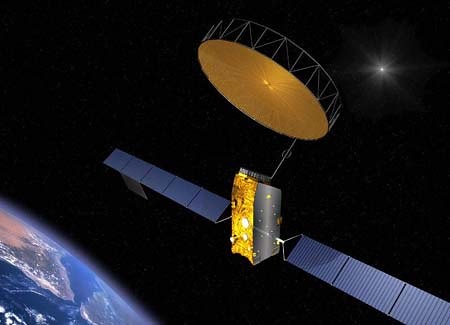
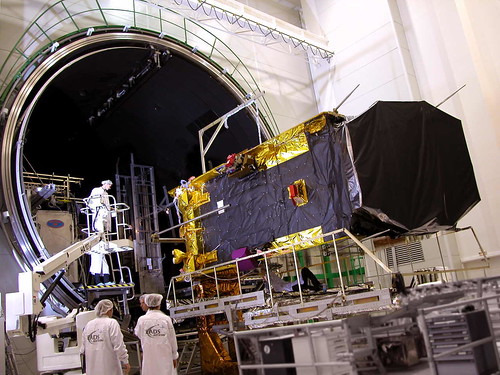
All three satellites are identical and interchangeable – their coverage is programmable and can be reconfigured in orbit. They are based on the E3000 version of Astrium’s outstandly successful Eurostar satellite platform series, and equipped with electric propulsion system. Their 45m-long solar array generates 14 kW of electrical power at beginning of life and the spacecraft weighs approximately 5,950 kg at launch. The main body is 7 metres high and the unfurlable antenna reflector has a diameter of about 10 metres.

Here’s the launch video:


Merger Time for Satellite TV

Wednesday, August 6th, 2008


Now that we have the two satellite radio companies combined, are we that far off from the two major satellite TV companies trying to merge again? Good question.

Considering DISH Network’s recent subscriber loss, Robert Holmes at TheStreet.com are asking just that:

Dish-DirecTV Deal Won’t Fool Feds

Prompted by the first subscriber losses at a major U.S. satellite-TV provider, Dish NetworkDISH could revive a merger attempt with rival DirecTVDTV, but industry observers say a potential deal will once again be found to be anticompetitive.

Six years removed from failing at a $16 billion tie-up, Dish Network Chairman and CEO Charles Ergen has said market conditions are more welcoming to a deal, according to a report in The Wall Street Journal. Ergen has reportedly calculated the potential savings of a merger at up to $2 billion a year, and he also harbors hopes of a potent broadband offering from a combined satellite company — something neither has been done individually.

However, a renewed bid to combine Dish and DirecTV would revisit the same problems that plagued the 2002 attempt — and would once again fail to pass muster with the Federal Communications Commission and the Justice Department, the government bodies that would again examine the merger.

In its October 2002 decision, the FCC said a combination of Dish Network, then under the umbrella of parent EchoStarSATS, and DirecTV, which was then owned by Hughes Electronics, would likely harm consumers by eliminating a viable competitor in every market, creating the potential for higher prices and lower service quality, and hurting future innovation.

Three weeks later, the Justice Department agreed that a merger would reduce competition in markets served by cable, and eliminate it in areas served only by direct broadcast satellite.

"That merger was the first in recent memory that the FCC turned down," says Adam Candeub, an associate assistant professor of law at Michigan State University College of Law, who was an attorney-adviser for the FCC and worked on the 2002 deal between Dish and DirecTV. "That’s something [Dish and DirecTV] would like to correct and would give it another go-round."

The recently approved deal between Sirius Satellite RadioSIRI and XM Satellite Radio has given Dish’s Ergen hope, though, that consolidation among satellite companies would be better received by government officials, especially if both Dish and DirecTV can argue they compete not only against each other but cable and telecom companies, such as ComcastCMCSA, AT&TT and VerizonVZ, which have started bundling television, Internet, and phone services.

However, when going strictly by FCC and Justice comments about both Dish and DirecTV – and about XM and Sirius — Candeub argues that the government bodies would not likely bend to concessions, even if Ergen wants to use the XM-Sirius deal as a blueprint.

"From a market-definition perspective, it’s not clear that the satellite radio market has much to do with the video market," Candeub says. "They’re very different. There are so many various ways to get audio, like AppleAAPL iPods. Arguably, one analysis would not work for the other."

The Journal reported that Ergen, attempting to assuage fears over what a Dish-DirecTV merger would do to the competitive landscape, is willing to peg monthly charges to the lowest fees paid by subscribers in rural regions, where satellite antennas are currently the only way for customers to receive pay-TV options. A cap on prices would be similar to Sirius and XM’s pledge to hold off on price increases for three years after their merger was completed.

Craig Moffett, senior analyst for U.S. cable and satellite broadcasting with Sanford Bernstein, says that a commitment to national pricing is one way to ameliorate the potential for monopoly pricing power in rural markets, although such a move would still not prevent a deal from being labeled anticompetitive.

"These kinds of concessions are commonplace in the FCC … but the test in the [Justice Department] is an objective ‘rule of law’ test," he writes in a research note. "Voluntary a priori commitments such as national pricing plans are therefore generally not considered as relevant when considering whether a merger does or doesn’t meet the letter of the law."

Moffett adds that under the precedent set by Sirius and XM, the two satellite-TV providers would have to prove there was an alternative distribution model for television in rural areas, one that would be a suitable substitute for Dish and DirecTV’s service. One approach would be to wait until TV-over-the-Internet connections are more available to rural customers, although Moffett finds that to be a Catch-22.

"This itself is problematic, inasmuch as TV-over-the-Internet requires a high quality broadband connection, which generally means either cable modem or telco fiber," Moffett says. "The very definition of ‘rural’ to be applied by the [Justice Department] in 2002 presumes that connections of this kind are not available."

Of course, a few variables have changed that arguably could make a deal more palatable for regulators. "When the Dish/DirecTV merger was out there in 2002, there was a Republican majority in the Senate," Candeub says. "Many of those Senate seats were held by Republicans who represent people from big rural states who rely on satellite and who would see higher rates."

In the last six years, though, there has been a shift of political power. While then-FCC Chairman Michael Powell, a Republican, argued that a Dish and DirecTV combination would replace competition with "a regulated monopoly," a Democratic majority in Washington might be more open to regulation of satellite television.

Despite this shift, though, analysts say those pesky laws cannot simply be circumnavigated. "In rural America, a merger would still be two [companies in the field]-to-one. Two-to-one mergers are unlawful under U.S. antitrust law," Moffett asserts. "Nothing in six years has changed."

The New York Times posted a story last night on this topic, based on a WSJ piece:

As Dish Network copes with the first quarterly subscriber losses reported by a major U.S. satellite-TV provider, the company is considering another attempt to merge with DirecTV Group, The Wall Street Journal reported citing unnamed sources.

Dish Network’s chairman and chief executive, Charles Ergen, is considering the first run at a satellite-TV merger since 2001. That attempt was shut down by opposition from federal and state regulators, but Mr. Ergen has been emboldened by the drawn-out but successful union of satellite radio companies Sirius and XM Satellite, the Journal said.

Efforts to reach another deal, such as a sale to AT&T, may be hamstrung by Dish Network’s loss of 25,000 subscribers in the past quarter. Concerns about that shrinking customer base offset news about Dish Network’s 50 percent increase in net income, to $335.9 million, or 73 cents a share.

Hey, you never know.

Uncommon Carrier

Wednesday, July 30th, 2008


Clay T. Whitehead passed away last week. Former director of Nixon’s Office of Telecommunications Policy, he was largely responsible for completely changing the commercial satcom business the U.S. and Europe. RCA, Hughes, PanAmSat and SES et. al. owe their success to his vision and work.

Excellent obituary by Adam Bernstein in the Washington Post:

Clay T. "Tom" Whitehead, 69, who helped the cable industry flourish by bringing competition to the domestic satellite market in the early 1970s, died July 23 at Georgetown University Hospital. He had prostate cancer.

During the Nixon administration, Mr. Whitehead became the country’s first telecommunications policy adviser and championed free markets in the satellite business. He later revolutionized the way communications satellites were sold — outright to cable providers instead of leasing them to those companies.

Starting in the mid-1980s, he challenged Europe’s state-owned television systems by spearheading the first private Pan-European television satellite system, Luxembourg-based SES Astra. It became one of the continent’s most popular and profitable private satellite systems.

Dr. Whitehead had degrees in engineering and management but little knowledge of communications when in 1970 he was appointed the first director of the old White House Office of Telecommunications Policy. Considered bright and able, he said his chief concern was trying to get the federal government to become "more anticipatory" in addressing rapid technological changes.

During his four years overseeing the office, he sough to demolish the monopoly model that had given tremendous power to large international corporations such as Comsat and Intelsat. He set in motion policies that allowed domestic satellite competitors to succeed, and far more cheaply.

His work had an enormous impact on the cable industry, which because of his efforts could get its own programming channels via satellites to a national audience. Before, that reach was impossible unless a cable channel wanted to lease land lines from the monopoly provider AT&T.

HBO, the Turner cable networks and C-Span were among the key beneficiaries of Dr. Whitehead’s decisions.

Henry Geller, a Washington telecommunications lawyer and Federal Communications Commission general counsel, said Dr. Whitehead "changed the entire landscape of television in the United States and throughout the world" by advocating an "open skies" policy toward domestic satellites.

Geller said Dr. Whitehead "stopped the FCC cold, which was still promoting Comsat as a domestic monopoly. Satellite service became more competitive, allowing such companies as RCA and Hughes to achieve greater innovations more cheaply."

Dr. Whitehead was credited with formulating policies that gave more autonomy to local stations in the public broadcasting system, which was seen by some PBS executives as an attack on the service in large part because of Dr. Whitehead’s early reputation for antagonizing the press.

He called network television news a haven for "ideological plugola" and "elitist gossip." His criticisms extended to the public broadcasting system, which he called a "fourth network" for alleged liberal biases.

He apologized before a Senate committee, saying his own comments "did not serve a very useful purpose."

Clay Thomas Whitehead, was born Nov. 13, 1938, in Neodesha, Kan., and raised in Columbus, Kan.

An early interest in astronomy led him to the Massachusetts Institute of Technology, where he received a bachelor’s degree in electrical engineering in 1960 and doctorate in management in 1967.

He was a Rand Corp. economist before joining the Nixon team in 1968 as an expert on budget policies. He also helped create the Office Telecommunications Policy, which was folded into the Commerce Department’s National Telecommunications and Information Administration during the Carter administration.

In 1979, Dr. Whitehead became the founding president of Los Angeles-based Hughes Communications, a satellite-manufacturing subsidiary of Hughes Aircraft Co. His greatest achievement was the Galaxy program of commercial communications satellites, which addressed the needs of a rapidly growing cable television market.

He likened the Galaxy program to a mall with an "anchor tenant," such as HBO. Each subsequent company would buy a piece of the satellite. This approach made enormous profits for Hughes, reportedly $200 million for the 24 transponders on the Galaxy I that launched in 1983.

"I suppose the thing I like to do most is set things up and make them run," Dr. Whitehead had once told the New York Times. He left Hughes in 1983 because he said he tired of working for a big company.

He spent the next two years laying the financial, technical and political groundwork for a $180 million enterprise that became SES Astra.

Some European politicians criticized the proposed system as "Coca-Cola satellite" and dismissed it as cultural imperialism, all to protect their government-run television channels.

"I think we’re seeing wounded national pride," Dr. Whitehead told Forbes magazine in 1985. "There would be more European programming if a large commercial marketplace already existed there."

SES Astra, in which Luxembourg is a major stakeholder, grew tremendously. Its programming is beamed into more than 65 million homes, and its worth was estimated to be more than $1 billion.

A contractual dispute led Dr. Whitehead to sue SES Astra and the Luxembourg government for $600 million. He was consumed by the lawsuit for a decade, until prevailing in 2003. The final agreement was confidential.

Rapid TV News did provide a settlement figure in its write-up:

Unfortunately he spent some 10 years of his life in a legal squabble with SES Astra (and the Luxembourg government) claiming a total of $1.8bn and receiving some €30m as dividend payments in a Court-ordered settlement in June 2002.

And as far as the extent of ASTRA’s reach in Europe*, the number are greater today than they’ve ever been:

  • At year end 2007, 117.2 million homes receive audiovisual broadcast and broadband services via ASTRA at 19.2º, 23.5°, 28.2º East or SIRIUS at 5.0º East.
  • The ASTRA Group** consolidated its position as the top European satellite fleet for DTH reception.
  • By end of 2007, 50.3 million homes receive ASTRA or SIRIUS services directly via satellite. A further 66.9 million homes receive services via ASTRA Group satellites in cable.
  • More than 4 out of 10 of all TV homes within the ASTRA Group footprint are now receiving digital services.
  • Satellite continues to be the most popular digital reception mode, with a 58% share of the total digital market.
  • 81% of all ASTRA satellite homes are digital.

* 35 countries within the ASTRA Group footprint
** ASTRA Group reach includes ASTRA at 19.2°E, 23.5°E, 28.2°E and SIRIUS at 5.0°E

Debi Decides Satellite Radio Merger

Wednesday, July 23rd, 2008


Deborah Taylor Tate is the FCC commissioner who will cast the deciding vote to approve the Sirius/XM merger, via the Wall Street Journal:

Republican commissioner Deborah Taylor Tate is the only FCC member left to vote on the deal and she is expected to do so shortly, two FCC officials close to the negotiations said. She is expected to sign off on the deal in exchange for a consent decree that resolves several enforcement issues involving the satellite radio companies and a combined fine of about $20 million, an FCC source close to the deal said.

Ms. Tate has also asked for a variety of other minor conditions, an FCC source said. An adviser to Ms. Tate did not respond to a call for comment. Exact details about the deal are not known since FCC officials and lawyers for the companies appear to still be working them out.

Ms. Tate’s vote would finally end the agency’s 13-month review of the deal. Her vote is critical for the deal’s approval since the rest of the five-member board remained evenly split on the deal.

As of Wednesday morning, both of the FCC’s two Democratic commissioners had voted against the deal. Democrat Jonathan Adelstein announced his decision in a statement, noting he was hoping for a "bipartisan solution" but that the other commissioners weren’t interested.

Last week, Mr. Adelstein proposed conditions including a six-year price cap, a 25% channel set-aside for non-commercial and minority-owned stations and interoperable radios that would receive high-definition signals from terrestrial radio stations.

FCC chairman Kevin Martin had made it clear to the rest of the commissioners Tuesday evening that Mr. Adelstein’s conditions would not be a focus of the negotiations, an agency source said.

In recent days, Ms. Tate has been the center of negotiations, as the companies have wrangled over how to resolve several outstanding enforcement issues that have been raised. They include issues involving complaints that some of the satellite radio receivers exceeded FCC power limits and bled into the signals of some local radio stations.

Concerns have also been raised that Sirius has yet to bring to market an interoperable radio despite an FCC requirement that it develop one. Broadcasters have also complained that satellite booster towers were placed in nonapproved locations.

The Russians Are Coming

Wednesday, July 23rd, 2008


Yes, that’s the title from a memorable 1966 movie, a comedy. That’s also the title of an Agence France-Presse bulletin issued earlier today that begins with "The Russian are coming…"

The Guiana Space Centre (CSG) is girding for a new era when it will host Russian rockets and Russian engineers who just a short while ago were Europe’s space rivals.

For 40 years, this base on the coast of French Guiana was the prestigious symbol of French, and then European, ambitions in space.

On Sunday, a freighter is due to dock in Cayenne bearing a first consignment of 150 containers of equipment to fit out a launch pad at CSG where, from the second half of 2009, the first "European" Soyuz is scheduled to blast into space.

Nothing funny about the space business — very serious business indeed. This might be the beginning of greater cooperation in space, especially the business side. Launching commercial spacecraft is big business, costing anywhere from $80 to $100 million or more for heavy-lift launches. Satcom operators need access to reliable launch service providers, and if they could increase capacity.


The Russians are coming — to chessboxing, too. "Chessboxing?" That’s right: it’s a new sport. Brains and brawn. Just like the rocket launch business.


Here’s the CNN report…


And one from Ukrainian television…

Olympics VOD

Tuesday, July 22nd, 2008

The 2008 Olympics in Beijing is right around the corner and, despite the political controversy, one thing is clear: this year’s games will be easier to watch than ever before.

It’s all because of VOD: Video-on-Demand.

NBCU is producing lots of VOD, which will be available via DIRECTV.

NBCU is providing DIRECTV with 10 VOD titles each week, including athlete features, Beijing previews, and more. The service will be available through the end of the Olympics in both standard-definition and HD. NBCU will produce more than 500 titles now through the end of the 2008 Beijing Olympic Games.

The VOD offerings are just part of NBCU’s extensive coverage of the games, which will also be available on FiOS, Broadband, and Verizon’s V CAST mobile service.

For those who prefer to watch online, NBCU’s website will give fans access to approximately 2,200 total hours of live streaming and video coverage of 25 different sports. The site will also feature blogs, live chat, athlete profiles and, of course, the latest results.

The servers and platform for the groundbreaking digital content will be provided by Sun Microsystems.

If you want to psych yourself up for some amazing sports action in Beijing, search YouTube for some great moments in Olympics history. Take, for example, the 1968 Olympics in Mexico City where Bob Beamon set a new world record in the long jump that stood for 23 years.

English language version here.

Predicting Space Weather

Monday, July 21st, 2008

On reading that title, you might be asking yourself “why in the world would I need to predict space weather?” Well, I’ll tell you. Space weather – the range of high-energy radiation, such as X-rays and gamma rays, that constantly bombard the Earth’s atmosphere – affects the performance of some of your favorite gadgets, like GPS and satellite TV.

With this camera, scientists can predict changes is space weather, allowing for communications companies to compensate for electromagnetic interruptions to their signals. Never again will your Planet of the Apes marathon be spoiled by a bad signal. Oh, and it’ll help the military predict and plan for interruptions in their communications too.

The project – the Global-Scale Observations of the Limb and Disk – is known by a catchy acronym: GOLD.

The GOLD Camera will fly on an SES AMERICOM satellite. Physicist Richard Eastes, who leads the GOLD project, says this is the first time that a NASA instrument has flown on a commercial communications satellite.

This is the second “hosted” payload for an AMERICOM spacecraft just this month. The other was for the Air Force’s CHIRP (Commercially Hosted Infrared Payload).

SOCOM: Moving With Satcom

Thursday, July 17th, 2008


Carl von Clausewitz once famously observed that war is the extension of politics by other means.

So it seems fitting, at least in the sense that truisms are true, that the satcom-on-the-go platform that has been bringing the American people live coverage of the presidential election (which we blogged about here) is now being used by U.S. Special Forces in the Middle East.

We’re speaking, of course, of the ArcLight Mobile Satellite Communication System by ViaSat. We’ve written before about how the broadcast networks use the system in moving vehicles, and how the same platform is being used by AMERICOM and KVH for maritime mobile broadband

Now comes a press release announcing that ViaSat Airborne Broadband Ku-band satcom is being deployed by U.S. Special Forces for real time data and video communications: 

The system is already in use in the Middle East and coverage areas will expand as more terminals and hubs are delivered. This new operational capability, an extension of the ArcLight® mobile broadband system, is installed on C-130 aircraft, primarily for sending high resolution video back to higher command authorities for further analysis and identification.

Here’s a video of the type of real-world situations that the ArcLight system can help commanders in-field and at the United States Special Operations Command address. It’s taken from an AC-130 Gunship observing insurgents in Iraq. (Warning: Video contains violence and may not be suitable for all viewers.)


 The C-130 satcom system is built around the advanced ArcLight modem and networking technology using a spread spectrum waveform to enable the use of mobile satellite antennas as small as 29 centimeters in diameter. The antenna is enclosed in a radome attached to a redesigned emergency escape hatch. In a few minutes, operators can configure an aircraft for their specific mission without any permanent aircraft alterations, then quickly return the aircraft to its normal configuration when the mission is complete, while maintaining safety-of-flight integrity. The U.S. Air Force-certified hatch-mount terminal enables secure access to Department of Defense wide area networks at raw data rates up to 10 Mbps inbound and 512 kbps outbound while airborne.

Satellite Broadband Gets an Upgrade

Monday, July 14th, 2008

If thoughts of super-fast satellite link-ups from spy movies have you considering satellite broadband service, we have some news you’d like to hear.

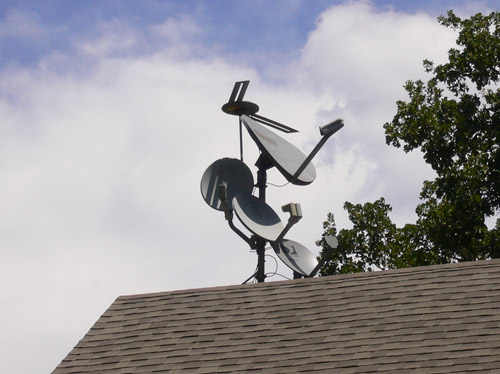
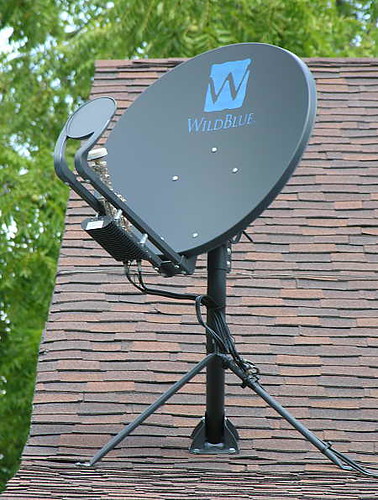
WildBlue, one of the top satellite broadband providers in the US, is upgrading its capacity to allow for 150,000 new customers. How are they doing it? Rather than launching a new bird, they’re upgrading their transmission link hardware and software to allow 50 percent more information bits through the same existing radio link.

Some are skeptical that these upgrades will actually lead to better service. But, if you live in an area where dial-up is your only other option, most reviews say jumping to satellite is worth it.

For those of us who live in urban areas and take it for granted that we can shop around for internet service, we should count ourselves lucky:

WildBlue estimates that there are over 11 million households in areas throughout the United States where DSL or cable broadband services are not available and that over 7.5 million of these households are still accessing the Internet through a traditional dial-up connection.

With WildBlue’s latest upgrades, they seem to be beating out their other major competitor in the satellite broadband space: HughesNet. In fact, in a Consumer Reports review of ISPs, HughesNet got the lowest possible rating in all categories. This customer seems to agree.