Archive for the ‘Astronomy’ Category

Bharti Time for Gilat and IBM

Tuesday, January 22nd, 2008


After a rough 2007 — in which they lost $335,000 on nearly $40 million in revenues,  compared to a 2006 profit of just over $250,000 — Israel’s Gilat Satellite Networks Ltd. is entering 2008 with some good news:

Israel’s Gilat Satellite Networks Ltd. announced Monday that it will supply India’s Bharti Airtel with a broadband satellite network comprising more than 13,000 small two-way ground stations.

The new network, using Gilat’s SkyEdge technology, will be used by Bharti Airtel to offer information and communication services to the local citizens of India’s Gujarat State.

The agreement "will enable remote citizens in the state of Gujarat to benefit from information and e-governance services," Erez Antebi, CEO of Gilat Network Systems, said in a statement.

Gilat offers VSATs or very small aperture terminal, a two-way satellite ground station with a dish antenna, in India.

SkyEdge is a satellite communications system that delivers high-quality voice, broadband data and video services over a powerful unified system. 

No word yet on the value of the contract, but it’s probably just a taste of the satellite broadband opportunities that are rapidly emerging in India. Compare it, for example, to the deal Bharti signed with IBM, which includes direct-to-home satellite services and IPTV:

In a bid to boost its triple play platform, Bharti Airtel has awarded a $150-million contract to IBM to provide IT solutions and services to support broadcasting services such as DTH and IPTV.

Bharti had already outsourced its IT requirement for the telecom business and the new deal is aimed at providing a one-stop experience spanning mobile, PC and television. 

A direct-to-home satellite TV service in India is, of course, the satcom motherloade. People have been trying to launch that kind of service for years. Back in 1999, News Corp’s ISkyB attempted it in partnership with Hughes; Star TV India was another service from News Corp, which is now a collection of premium content for India.  


AT&T’s Satellite Radio System

Wednesday, January 16th, 2008

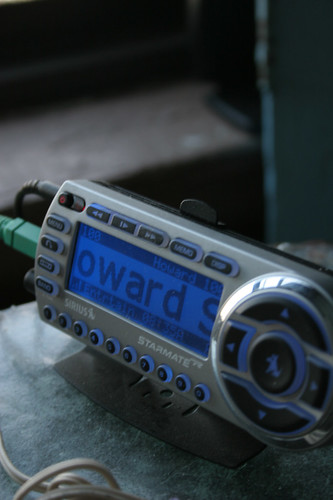
What happens to all that extra capacity if and once Sirius and XM merge? Mobile TV, perhaps? Judging from the initial success of vestigal sideband tests, they’d need something different.

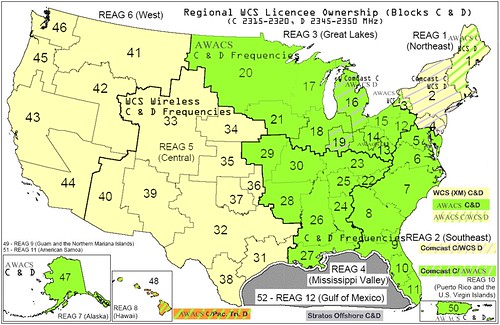
I seem to recall AT&T owning Wireless Communications Services (WCS) spectrum that was in two 15MHz blocks at 2.3GHz with satellite radio (XM and Sirius) in and around those blocks. There was concern that once new WCS came around, there would be interference with satellite radio services — especially C and D channels of this WCS spectrum. But if you grab some of the spectrum that become available after a merger, then one could essentially coordinate the frequencies nicely.

So what do we see AT&T file with the patent office last week? Two applications for a satellite radio system with feedback. Nice catch by Satellite Radio TechWorld:

Through various mergers, AT&T has acquired enough spectrum that could possibly make satellite radio practical. Plus, technology has developed that would make spot beams more practical. There are only a few players left. It wouldn’t take but a few players to come together for nationwide service. Most of the WCS license holders are planning to use WiMax, but it is not practical under the current regulations. They are trying to change the rules in order to make it practical and the same time the FCC is trying to determine the final rules for satellite radio repeaters. If rules are not adapted that would make WiMax practical, then satellite radio might be the next best practical use of the spectrum.

And the timing? Ingenious:

It is interesting to note that this application was filed after XM and Sirius announced the merger (September 24, 2007). Applications can be kept away from the public for up to 18 months, if we recall correctly. This was less than four months ago. They wanted this to be public. However, this is not new. It is based on an application filed in September 2003 and recently became patent on September 25, 2007. No doubt it is enough to give XM and Sirius pause for consideration. 

Here are the two applications (in PDF):

Digital Radio Feedback Apparatuses, System, and Methods

Digital Radio Feedback Systems

More Satcom Internet in Europe

Tuesday, January 15th, 2008

Last week, we wrote about ViaSat and Eutelsat teaming up to offer new broadband capacity via Ka-band, and the impact the joint effort may have on internet satellite offerings in the United States and Canada.

But the growing satellite broadband market isn’t limited to North America, of course. In Europe, SES Astra’s ASTRA2Connect (which we blogged about last August) utilizes the commercially mature Ku-band technology to deliver broadband across the continent:

The home equipment is so easy to install that you can even do it yourself. A complete kit of accessories comes with the package including:

  • A satellite antenna (typically 75-80cm)
  • A transmitter/receiver (LNB), which sits on the front of the dish
  • A satellite modem, which is connected via an Ethernet cable to your PC

ASTRA2Connect is sold through resellers.  Just last month, SES Astra signed deals with Euro Marketing Group (to offer ASTRA2Connect in Poland through such brands as SkySatPlus) and with Zug, Switzerland-based telecoms provider Yato, who will distribute the service in Germany.

And today, the news is out that ASTRA2Connect is available in France and Italy as well:

Nine months after the product launch in April 2007, SES Astra now has distribution agreements in seven European countries, the satellite operator said.

Future revenue secured by these contracts amounts to 165 mln eur with more than 200,000 consumer terminals to be installed within three to five years, it said.

SES Astra had already signed contracts for Astra2Connect in Germany, Austria, Switzerland, Ireland and Poland. Additional contracts in several other European countries are under negotiation, the group said.

In France, the product will be distributed to consumers under the brand Viveole by communications service provider Auvea Ingenierie.

In Italy, Astra2Connect will be marketed to consumers by the broadband service provider Digitaria, an affiliate of the network and satellite service providers Netdish and Eurosatellite, SES SA said.

At last count, the ASTRA satellite system reaches 109 million homes in Europe and North Africa, broadcasting nearly 1,900 TV and radio channels in analogue and digital formats.

Solar Cycle 24

Tuesday, January 8th, 2008


A new cycle of solar activity, officially "Solar Cycle 24," is upon us according to a NOAA press release:

A new 11-year cycle of heightened solar activity, bringing with it increased risks for power grids, critical military, civilian and airline communications, GPS signals and even cell phones and ATM transactions, showed signs it was on its way late yesterday when the cycle’s first sunspot appeared in the sun’s Northern Hemisphere, NOAA scientists said.

“This sunspot is like the first robin of spring,” said solar physicist Douglas Biesecker of NOAA’s Space Weather Prediction Center. “In this case, it’s an early omen of solar storms that will gradually increase over the next few years.”

A sunspot is an area of highly organized magnetic activity on the surface of the sun. The new 11-year cycle, called Solar Cycle 24, is expected to build gradually, with the number of sunspots and solar storms reaching a maximum by 2011 or 2012, though devastating storms can occur at any time.

During a solar storm, highly charged material ejected from the sun may head toward Earth, where it can bring down power grids, disrupt critical communications, and threaten astronauts with harmful radiation. Storms can also knock out commercial communications satellites and swamp Global Positioning System signals. Routine activities such as talking on a cell phone or getting money from an ATM machine could suddenly halt over a large part of the globe.

The discussion on Slashdot ranged from light polarity to global warming to AIDS research, which may or may not be entertaining, depending on your point of view.

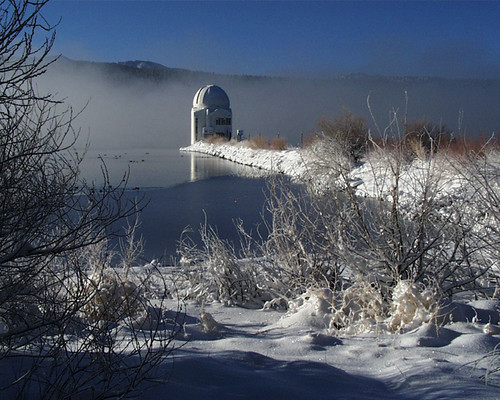
You can bet the Big Bear Solar Observatory will be watching this intently. It may be in California, but it’s run by the New Jersey Institute of Technology (NJIT).

Having your ATM machines go cold suddenly is probably because that location depends on a VSAT terminal to process transactions, which uses a geosynchronous communications satellite to connect to the banking system. If that VSAT network uses an AMERICOM satellite, hopefully it won’t be a problem (disclosure: AMERICOM underwrites this blog). The satellites that AMERICOM operates are designed to withstand the effects of extreme solar events, categories S5 and G5, and with more than the predicted number of events of all levels over the life of each satellite as part of the design. Electronic components that are known to degrade in the presence of solar radiation have been "oversized" to degrade acceptably and operate nominally during the expected radiation exposure associated with soloar storms. In addition, shielding is utilized to reduce the exposure of electronic components to the effects of solar radiation and geomagnetic storms.

As always, check SpaceWeather for the latest developments.


Sirius Subscribers

Friday, January 4th, 2008

The suspense around the Sirius-XM merger continues, but I like their growth for 2007. Up 38%, according to Business Week:

Sirius Satellite Radio Inc. said Thursday it ended 2007 with 8.3 million subscribers, up 38 percent from a year earlier.

The company added about 2.3 million net subscribers during the year.

In October, Sirius had said it expected to have 8 million subscribers by year-end.

Chief Executive Mel Karmazin said, "Our gross subscriber additions in 2007 were the highest in the history of satellite radio."

"Based upon preliminary financial data, we expect to report significantly greater positive free cash flow in the fourth quarter of 2007 than the company reported in the fourth quarter of 2006," Karmazin added.

Sirius is awaiting federal approval of its plan to acquire competitor XM Satellite Radio Holdings Inc. XM signed an agreement in February outlining a sale to Sirius in a $13.6 billion deal that has drawn close regulatory scrutiny. Terms call for Sirius to pay 4.6 shares for each XM share.

Sirius also reported on churn rates, or the percentage of subscribers who end service in a given month. Its full-year monthly subscriber self-pay churn rate was 1.6 percent and overall churn was 2.2 percent, consistent with the low end of its guidance.

In October, Sirius said its net loss for the third quarter narrowed to $120.1 million, or 8 cents a share, from $162.9 million, or 12 cents, a year earlier. Revenue was $241.8 million, up from $167.1 million.

Sirius shares rose 10 cents, or 3.3 percent, to close at $3.15 Thursday.

South Pole South Paw

Thursday, January 3rd, 2008

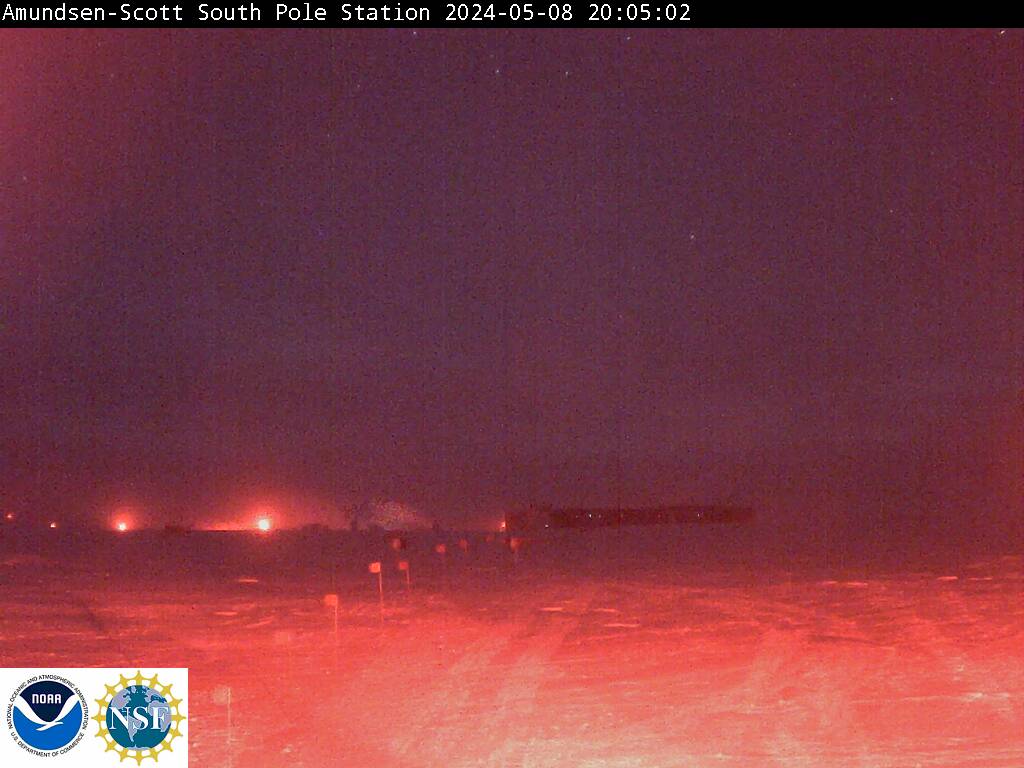
We recently blogged about a new satcom connection in Antarctica and a terrific new map of "the coldest continent," so we were somewhat amused to read about the "drunken brawl" around Christmas at the Amundsen-Scott South Pole Station:

"There was an altercation between two people … there’s no indication of the cause or of the background between the two folks," said US National Science Foundation spokesman Peter West.

Dr Karl Erb, head of the US Antarctic programme, said the man had been sacked.

"The assailant has been removed from Antarctica and his contract terminated by his employer. Such behaviour has no place whatsoever in the US Antarctic programme."

Mr West said the injured person had been flown to the larger McMurdo Station – near New Zealand’s Scott Base – for treatment.

Medical staff at McMurdo assessed the man’s injury to be more serious than they could treat, and he was flown to Christchurch – accompanied by a flight nurse and paramedic – on board a US Air Force Hercules. Dozens of workers at McMurdo had to work on their day off to help the evacuation.

Mr West said the incremental cost of the medivac was approximately US$85,000 ($110,000) including fuel costs and reimbursement for flight hours.

"The additional costs were incurred because the medivac was required during a period of normally reduced flight activity – specifically the Christmas holiday.

"The injured party is, to my knowledge, still in Christchurch and is recuperating after being treated."

A Christchurch Hospital spokeswoman said a man was admitted on Christmas Day, and was discharged on Boxing Day.

It’s summer there now, as seen on this NOAA webcam:

Wow, US$85,000 to rescue the guy with the busted jaw. Both were apparently employees of Raytheon Polar Services, the IT contractor. I remember reading about the IT guy in a Computerworld interview last month, who has his own blog. In the interview, he talks about one of his more outrageous experiences, the 300 Club:

We have this tradition called the 300 Club. When the temperature drops below -100 we hike the sauna up to 200 degrees and stay in there as long as we can stand it. Then we run outside, naked, around the geographic pole and back inside so we get that total 300-degree change in temperature. That happens every year and it’s absolutely amazing. Just the feel of that cold on your skin is like nothing else. People always wonder if you can feel the difference between 60 below and 100 below and the answer is absolutely.
 

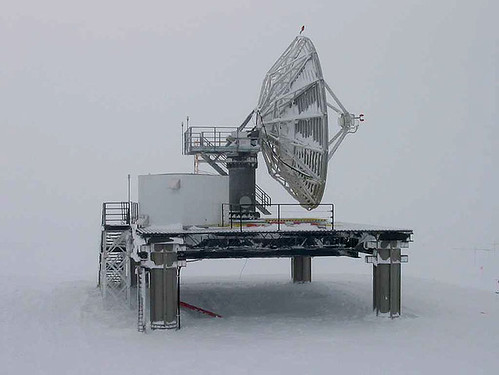
Check out his photo gallery for this and other scenes from the South Pole. Pretty interesting story, too. They use three inclined orbit satellite for communications, available for only a few hours each day. Geosynchrounous satellites are positioned over the equator, so an antenna at the either of the poles can’t really "see" them as they are beyond the horizon.

Your Sirius Radio, however, will work at the North Pole. Their elliptical orbit is focused on North America and is sometimes referred to as a "tundra orbit."

Dude, Where’s My Satellite?

Monday, December 17th, 2007

My grandmother used to say that a good scare could take five years off someone’s life. Is that what happened to India’s Insat-4CR satellite?


              Missing?
 

"One of the best-kept secrets of the Indian Space Research Organisation (Isro)" is that Insat-4CR (the launch of which we blogged about in September) "’disappeared’ in space about a month later," according to Daily News Analysis:

The satellite, which has 12 transponders meant for defence applications, direct-to-home (DTH) services and news gathering for television channels, was, however, “spotted” again with the help of the US-based National Aeronautics & Space Administration (Nasa) and brought back to a near geosynchronous orbit (36,000 km above earth). This took 15 days of manoeuvres, which consumed fuel normally meant for five years. This means the life of the satellite has come down from 10 years to five years.

A satellite’s life is determined by its fuel supply. As it keeps drifting in space, it has to be propelled back to the desired orbit using precious fuel.

A highly-placed source told DNA that Insat-4CR “disappeared” some time in October, almost a month after its orbit was raised for the fifth time to a near-geosynchronous orbit from the master control facility (MCF) at Hassan in Karnataka on September 7. The GSLV-F04 launch carrying Insat-4CR was critical for Isro after it lost Insat-4C #one minute after launch on July 10, 2006. Insat-4CR had a perfect launch, but the unusual drift in space was totally unexpected. Insat-4CR, weighing 2,130 kg, is identical to Insat-4C.

When its tracking systems failed to locate the satellite, Isro sought help from Nasa. The Nasa Orbital Debris Program Office located it a few days later. “Reclaiming the satellite was no mean achievement,” said the source, “but in the process, the satellite lost fuel meant for five years.” 

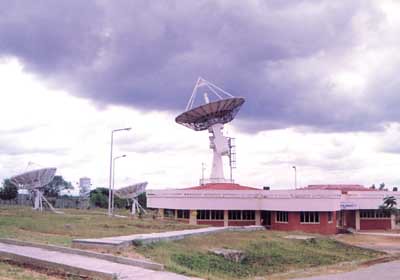
ISRO’s satellites are tracked from a giant 32 meter antenna installed at the Indian Deep Space Network (IDSN) at Byalalu, 40 km from Bangalore.

ISRO has denied the report that Insat-4CR went missing: "It’s totally false and baseless. We totally deny it," ISRO spokesperson S Satish said.

Master Satcom

Wednesday, December 5th, 2007

The original vision by Sir Arthur Clarke was you could cover the world with three satellites. There are lots of satellite channel distributed worldwide today. Came across a new one today: a press release about Supreme Master TV being distributed worldwide by RRSat of Israel. What’s all this "supreme master" then? Believe me, it’s got noting to do with hip-hop pioneer Grand Master Flash:

The Supreme Master TV Channel is a free-to-air satellite channel broadcasting 24 hours a day, 7 days a week, with a variety of programs in English with over 40 languages and subtitles.

As part of the agreement, RRsat started broadcasting the channel at the beginning of November 2007, reaching North America, South America, Asia, Africa, Middle East, Australia and New Zealand, including over such prominent satellites as Galaxy 25, Hispasat 1C, Intelsat 10 and Optus B3.

Lily Able, Director of Programming of Supreme Master TV commented "It’s inspiring in that there is a tremendous appreciation for uplifting news and programming. Viewers worldwide have enthusiastically responded to Supreme Master Television in their countries. We’re very pleased and honored to bring positive media to all cultures around the world. RRsat, through its global network of 29 satellite partners is ideally suited to help spread the Supreme Master TV’s positive media around the world, by bringing the channel to millions of new households worldwide."

The channel is available on 12 satellites, so you can’t miss it. So what’s the "uplifting news" like? Here’s a clip from earlier this year:


Now, who is this "supreme master?" The person behind this global television service, broadcast from Los Angeles, is Supreme Master Ching Hai, a Vietnamese vegetarian who advocates meditation:


Master Ching Hai initiates sincere people longing to know the Truth, into the Quan Yin Method. The Chinese characters "Quan Yin" mean contemplation of the Sound Vibration. The Method includes meditation on both the inner Light and the inner Sound. These inner experiences have been repeatedly described in the spiritual literature of all the world’s religions since ancient times.


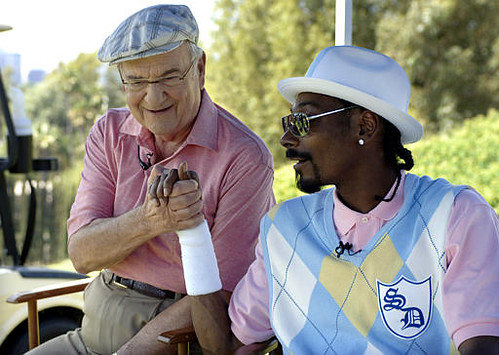
I was hoping this new channel was about Big Business and CEOs — a "captains of industry" channel of sorts. Or perhaps a channel from Grand Master Flash himself featuring today’s hip-hop innovators such as the "Doggfather of Rap" himself, Snoop Dogg. Or why not both? CEO programming during the day time, hip-hop programming at night. Hey, it’s not that far-fetched. Remember Snoop Dogg and Lee Iacocca getting together to shoot the Chrysler TV spot a couple of years ago? I remember reading the inside account in the Detroit News:

They traded lines like it was the most natural thing in the world that a 6-feet-4-inch, goateed rapper would be teeing it up with a grey-haired corporate big-shot.

Their off-camera moments were priceless. In one scene, Snoop drives a pimped-up golf cart with spinner wheels and white leather seats, with Iacocca sitting next to him. When Snoop gunned the cart down a steep hill, Iacocca held on tight.

"How are the brakes on this thing, Snoop?" he said.

"I got you baby," Snoop replied. "But that would be a funny commercial if I tipped over with the boss in here."

"Yeah," Iacocca huffed. "That’s funny alright."

Getting back to Grand Master Flash, here’s an original video of his showing a snapshot of New York City in the early 80’s:


Choices, Choices: Triple Play or HDTV?

Tuesday, December 4th, 2007


It’s not just the holiday season. With just more than 13 months to go until U.S. broadcasters shut off the analog, and with the increasing proliferation of HDTV broadcasting, the race is on between cable and satellite television providers to convince consumers that their product will give them the most bang for the buck.

One of the primary selling points has been offering HDTV and DVRs, long favored by the satellite TV marketers as their value-added proposition. Cable has been favoring "triple play" — bundling digital TV, IP phone, and internet into one package.

For the time being, it seems that cable/sat TV divide is likely to remain in place, as the new owners of DirecTV believe the period of rapid growth for triple play has passed: 

 Liberty Media CEO Greg Maffei said Monday that DirecTV Group’s strategy of concentrating on video services – primarily HDTV – apparently seems to be working and when his company takes over control of the satellite TV giant later this year, there won’t be a big change in strategy….

When LGreg Maffeiiberty agreed to take control of the satellite TV giant, there was speculation that the Denver-media conglomerate would invest heavily in bringing a wireless high-speed data product to DirecTV. But at the UBS Securities Media & Entertainment conference Monday, Maffei seemed to downplay the need for a high-speed Internet play.

Maffei credited DirecTV’s current management team, which has differentiated the product from cable and telco offerings by focusing on HDTV content and high-end digital video recorders. Their success was proven in the most recent quarter, where DirecTV added about 240,000 customers.

While Maffei admitted that the triple play bundle of voice, video and data may have hindered DirecTV’s subscriber growth in the past, that time appears to have gone by. That, he said is backed up by the recent basic subscriber losses at the larger cable companies.

“Most of the growth in voice and data has already occurred; that is why you’re seeing slowing growth rates for the cable guys,” Maffei said. “By concentrating and differentiating around content and HD and the TV experience, DirecTV has been able to find a customer set that enjoys that product and reaches for that product.”

The early adopters, it seems, have all chosen their path; now the marketplace is focusing on picking up the rest of the subscribers — and the competition is fierce. DirecTV and Dish are matching each other’s offers, though DirectTV has a leg up in its HDTV offerings, providing 85 HDTV channels to Dish’s 34. (On the cable side, the score is this: Cablevision has 42 HDTV channels, including all New York Metro local sports in HD for free, while Comcast has 44 and TimeWarner offers approximately 30.)

Another channel sparking demand for direct-to-home satellite TV is RFD-TV, which bills itself as "Rural America’s Most Important Network" and is the new home of the "Imus in the Morning" video simulcast. RFD-TV is one of the 285+ video channels available on IP-PRIME, the IPTV service built for small and mid-size telcos. 

Meanwhile, the cable guys clearly disagree with Maffei’s observation that triple play’s heyday of growth is behind them; they feel triple play remains underpenetrated

But will a new "quadruple play" — adding wireless cell coverage to cable’s triple play offering — shake up the marketplace? TimeWarner and Comcast are opting out of bidding for the new wireless spectrum being made available by the end of analog, but Cox is in:  

Cox Communications Inc. said Monday it plans to bid in an eagerly anticipated auction of wireless spectrum, likely making it the lone major cable operator to take part.

Parties must indicate Monday if they want to participate in next month’s auction for wireless spectrum, which can be used for cellphone service or new mobile-Internet technologies.

Companies such as Google Inc. and Verizon Communications Inc. are expected to bid billions of dollars to capture the valuable slices of airwaves.

Cox… and characterized the move part of its push towards mobility and convergence of its services. "We like having options," said David Grabert, a Cox spokesman. With other cable operators, Cox bought wireless spectrum in a separate government auction last year.

The company, a unit of Cox Enterprises Inc., has more than 6 million customers nationwide.

So in the end, how will it all shake out? Will one bundle become the VHS to another Betamax? Unlikely, but time will tell.

SWE-DISH to Help Spanish TV

Friday, November 30th, 2007

Some good news for DataPath’s Swe-Dish portable satellite terminals:

SWE-DISH Satellite Systems AB,a DataPath company, has received an order for up to 20 SWE-DISH Drive-Away 150systems for several Spanish broadcasters, primarily Television Espanola (TVE).The agreement was secured in close cooperation with SWE-DISH’s Spain-basedsales and service partner, Atlas Sistemas. TVE will base 16 of thevehicle-mounted 1.5-meter antenna systems throughout Spain, giving thebroadcaster greater mobility to produce high-quality live broadcasts of localnews and events.

The news comes on the heels of last month’s announcement that the United States Marine Corps has selected Swe-Dish for one of its new programs: 

DataPath, Inc., a leading provider of satellite and wireless communications networks around the world, has been selected by the U.S. Marine Corps to provide an ultra-portable satellite communications (SATCOM) solution for the Support Wide Area Network (SWAN) program, enabling the Marines to extend the network and improve warfighter mobility while they establish and maintain broadband communications on the battlefield.

The DataPath solution will include:

– SWE-DISH IPT Mil Suitcases (AN/USC-68), quick-to-air terminals that are small enough to be carried as suitcases or backpacks.

– Customized, portable baseband kits providing NIPRnet, SIPRnet and voice-over-IP services.

– Technical support services that include training and field engineering from DataPath’s experienced support personnel.

The multi-year contract award, with options, could total up to approximately $30 million, including an initial delivery order of $1 million.

From the Swe-Dish website, in English (da da dum):

SWE-DISH Satellite Systems has developed a new class of groundbreaking small satellite terminals – the Suitcases. It’s a new class of small (suitcase size), hand portable, highly mobile and fully automated satellite terminals. They are used by numerous leading broadcasters, as well as several defense organizations such as the US Special Operations Command.

The Suitcase is recognized for being
• Compact and hand-portable
• Fast, one-person operation with a unique, user-friendly, Graphical User Interface
• Motorized set-up and antenna positioning
• No requirement of specially trained personnel
• LAN standard – working like any LAN through 10/100 base-T interface
• Rugged – used by military units world wide

It’s as light as a bag of cement — watch them lift the suitcase in this video: