Archive for the ‘Astronomy’ Category

DIY Friday: Build Your Own Satellite Truck

Friday, March 14th, 2008

Ever want to combine the life of the open road with your interest in satcom? Then checking out this blog on the life of a satellite truck operator is a must-do.

Of course, if you really want to turn the dream into reality, you’ll need a truck. And that can cost some serious dough.

This customized truck used by NBC news to cover the invasion of Iraq cost $500,000:


Frontline Communications builds and sells a variety of satellite trucks — but again, it costs a pretty penny. 

The low(er) cost solution to living the dream, of course, is to Do It Yourself. Several years ago the Daily Wireless blog did a post on how to build your own satellite truck. Unfortunately, most of the links there are now dead.

But to stay in budget, you just have to make some serious decisions about what kind of equipment you want in your custom rig. Typically satcom trucks are pretty decked out — but how much do you really need? 

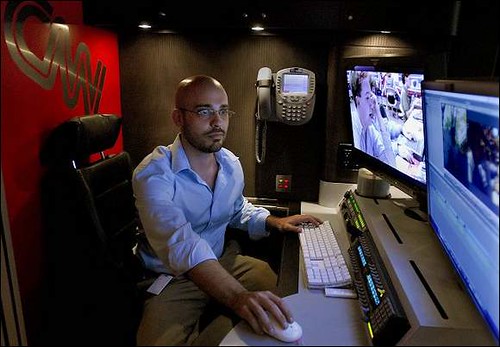
For CNN’s Election Coverage, they decided they needed quite a bit — building their own Election Express vehicle complete with a portable HD studio:

Frontline Communications was the systems integrator and overall project manager for the vehicle. The two-year effort also included another Clearwater, Fla., company, Parliament Coach, a specialist in high-end vehicles….

The bus uses a satellite pool from iDirect Technology, a Herndon, Va.-based developer of satellite broadband systems. The system provides reliable bandwidth for the four video feeds as well as ordinary Internet, telephones and the intercom system.

With their Atlanta area codes, the onboard phones behave just like landlines, said Bohrman.

And the 64×64 RTS Cronus intercom system can connect over iDirect to Atlanta or anywhere else, according to Frontline Project Manager Jeff Steele.

Massive patch panels are on both port and starboard (so the bus can still operate with one side blocked). Two 25 kW diesel generators rumble in the stern—one for the lighting and normal front-end bus operations and one for the racks and racks of TV-related systems in the rear. And if one fails, the other can take over.

A video of the CNN rig can be seen here. Here’s a photo of the interior:


Daily Wireless has additional details, as does the Washington Times:

WiFi connectivity and a phased array Intelsat BGAN terminal allow the bus to transmit video while in motion. Two Clearwater, Fla., companies — Frontline Communications and Parliament Coach — spent two years merging the demands of a live satellite truck with a tour bus for the press, making the 45 foot Prevost H-45 bus into a traveling press room, capable of going live virtually anywhere.
 

However you decide to pimp your satcom ride, don’t forget to get Leslie Nielsen to promote your new rig, as this Sacramento station did back in 1986.


Happy DIY Friday!
AMC-14 to Lift Off on Friday Night

Thursday, March 13th, 2008


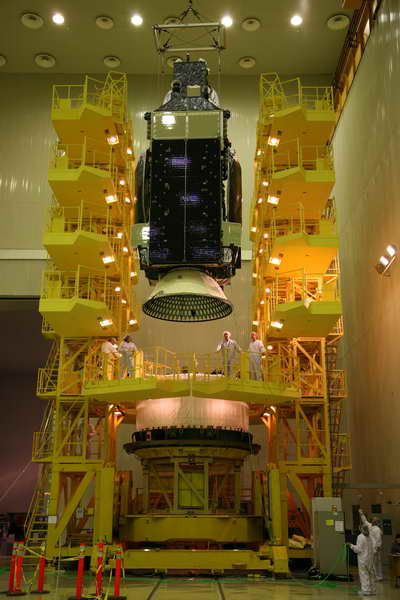
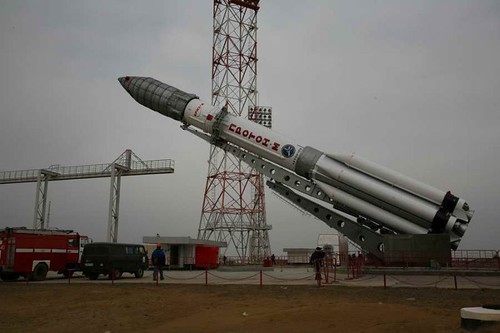
SES-AMERICOM’s AMC-14 launches from Baikonur Cosmodrome in Kazakhstan aboard a Proton M rocket on Friday night.

Local time for the launch is 5:18 a.m. on Saturday 15 March 2008 — or 23:18 GMT on Friday the 14th of March.

What that means is you can watch the launch live in the United States — but if you’re on the East Coast, you may wish to start feeding the kids at 6 o’clock.

The live webstream will be available here, or watch on on C-band: AMC-1, transponder C17, 4040 Horiz., NTSC, analog, in the clear or on DISH channel 101.

The last update from the launch blog (on March 11) tells us:

The roll-out of the fully assembled Proton Breeze M launcher, carrying the AMC -14 spacecraft, to Launch Pad 39 commenced early in this morning (at 6:30 a.m. Baikonur time). By 10 a.m. the rocket was erected in vertical position. Once installed onto the pad, the Proton was enclosed inside a mobile service tower.


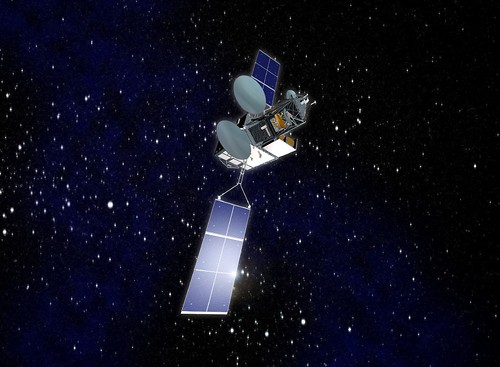
AMC-14 was originally part of a grand plan for direct-to-home services. 8.2 KW of power, the spacecraft has an active phased array (APA) payload consisting of a receive mode APA antenna, and the highest levels of redundancy on core components such as amplifiers, receivers, commanding beam and computer control systems. This means coverage can be reshaped while in orbit.

Developed primarily by Lockheed Martin Commercial Space Systems, the APA will be a key satellite technology for future missions.

From the get-go, AMC-14 will provide AMERICOM2Home® services in the United States for EchoStar Communications’ DISH Network.


DISA Big Contract

Thursday, March 6th, 2008

The Defense Information Systems Agency (DISA), the communications support agency for the Department of Defense, has a pretty big RFP out there – $500 million/year for a new satellite services contract:

The Defense Information Systems Agency has kicked off a follow-on procurement for commercial satellite services that could be worth $500 million a year and may attract a large field of bidders, ranging from small businesses to large systems integrators.

The procurement, which could directly effect operations in Iraq and Afghanistan, is expected to be a pretty competitive process – continuing what they beleive to be an efficient public-private partnership:

The Defense Department has mandated that all the military services use DSTS-G, Cowen-Hirsch said, which leverages the department’s buying power. DISA’s cost for satellite services is 25 percent below the industry average. The agency said in its request for information for the Future Commercial Satellite Services Acquisition that it wants to maintain this "price competition, while ensuring maximum effectiveness by considering lessons learned, market evolution and anticipating future DoD needs."

It appears that a large pool of vendors stand ready to meet these requirements, and not just the small businesses that won the DSTS-G contracts in 2001. Eaton estimated that about 50 bidders submitted written responses to the new RFI, including his company and the two other DTTS-G incumbents, Artel Inc. and Spacelink, acquired by DRS Technolgies in 2006.

Rebecca Cowen-Hirsch is the director of DISA’s program executive office for satellite communications. In a recent interview before the follow-up procurement was announced, she was eager to defend the agency’s commercial partnerships:

There has been much debate over the advantages or perceived disadvantages of our primary contract vehicle for acquiring commercial SATCOM services. And yet it remains an incredibly successful tool in acquiring fixed satellite services, bandwidth for our customers. It continues to provide the warfighters great flexibility at some of the best prices in the industry. In fact, we have shown that the DSTS-G contract has provided service globally tailored to the unique needs of the warfighters with prices that are on average 25 percent lower than market averages. This value is derived principally by openly competing COMSATCOM requirements across the commercial marketplace and leveraging the benefits of competition, DoD’s buying power, and DISA’s strong partnership with the commercial satellite industry. We are able to procure very short duration leases, say on the order of a few days or a month, or long multiyear leases. The competition created by our vendors has been very beneficial to the department. Additionally, we have been able to add within the scope of our existing contract capabilities the warfighter values such as protection, access to commercial X-Band, portability, responsiveness and additional flexibilities.

While DSTS-G has been very effective is supporting the DoD, it will come to the end of its life cycle in 2011 [with all options exercised]. We are actively strategizing for our future services acquisition to build on our past experiences and to put in place the DoD’s next generation of commercial SATCOM services. We will continue to rely on DSTS-G while we plan for the future.

Despite the large-scale increase in capacity, some vendors think the procurement should be more expansive:

Tom Eaton, president of Arrowhead Global Solutions, one of the three vendors on DISA’s current Defense Information System Network Satellite Transmission Service-Global (DSTS-G) contract, said his company intends to bid on the follow-on procurement, known as the Future Commercial Satellite Services Acquisition. He said DISA should widen the scope of the procurement to include mobile satellite services as well as the fixed satellite services covered in the current contract, which expires in 2011.

Eaton said DISA also should consider bundling satellite terminal hardware into the Future Commercial Satellite Services Acquisition, along with mobile services, to cut down on administrative overhead and consolidate all commercial satellite communications requirements into one contract vehicle.

Eaton said that demand for satellite communications bandwidth far outstrips the capacity of military systems, a gap that can be filled by commercial satellite services.

DISA, by the way, is constructing a new building at Fort Meade in Maryland. The design contract was almost as much as this satellite procurement—$370 million—but it looks like the design firm knows what they’re doing.

Kizuna: The Big Kahuna in Satcom Bandwidth

Sunday, March 2nd, 2008


JAXA‘s new spacecraft, launched via an H-IIA rocket last week, promises 155-Mbps downlink and 6-Mbps uplink speeds:

It is expected that this information and telecommunications network’s speed and capacity will be much higher than anything achieved previously. KIZUNA satellite communication system aims for a maximum speed of 155Mbps (receiving) / 6Mbps (transmitting) for households with 45-centimetre aperture antennas (the same size as existing Communications Satellite antennas), and ultra-high speed 1.2 Gbps communication for offices with five-meter antennas.

In addition to establishing a domestic ultra high speed Internet network, the project also aims to construct ultra high speed international Internet access, especially with Asian Pacific countries and regions that are more closely related to Japan.

KIZUNA project is responsible for the demonstration of the validity and usefulness of technologies related to large-capacity data communications in our space infrastructure project, "i-Space," the purpose of which is to promote the use of satellites in such fields as Internet communications, education, medicine, disaster measures and Intelligent Transport Systems.

JAXA’s been working on this "i-space project" for a while now:

The Japanese Government announced in January 2001 that Japan becomes one of the most advanced countries in the world in the field of Information Technology (IT). They also set a ambitious target to launch an ultra-high speed Internet satellite (i.e. WINDS) by 2005 and completes verification testing of its function.

Recognizing the importance of this commitment toward an advanced information society and in response to a growing social demand to realize broadband communications environment and advanced mobile communications, JAXA proposes a new space project named "i-Space Project". The i-Space Project intends to make contribution to a revolutionized information society, and is accomplished by developing new space-based communication capabilities effectively integrated with ground communication infrastructure. It is also promoted by demonstrating an experiment(s) to prove its effectiveness in as many space-based application areas as possible.

Here’s the launch video:


Host My Payload

Wednesday, February 27th, 2008


Very interesting news from California this morning about Space Systems/Loral and Northrop Grumman’s Space Technology division getting together to go after U.S. government business. Building spacecraft for fully-funded government projects can be more profitable than going after commercial projects. Sounds like a simple agreement:

"The agreement with Northrop Grumman will allow SS/L to cost-effectively add capacity to address increased near-term commercial satellite opportunities," said Pat DeWitt, chief executive officer, Space Systems/Loral. "The agreement will also streamline the process for our companies to collaborate on providing the world’s best satellites for both civil and defense applications."

"The resulting strategic agreement will be important to increasing our competitiveness. These initiatives will present win-win opportunities for both companies and our U.S. government customers," said Alexis Livanos, corporate vice president and president of the company’s Space Technology sector. "For some of our mission areas, we believe that assured access to SS/L’s 1300 bus and bus subsystems would improve our cost and delivery schedule competitiveness. In addition, hosted payloads hold the promise of providing us greater ability and flexibility to rapidly respond to our government customers’ evolving needs."

Some of these new opportunities included "hosted payloads" where specialized instruments or entire subsystems can be added on to a satellite bus whose primary mission is paying most of the build cost. Given the importance of the role space plays in today’s C4ISR systems (Command, Control, Communications, Computers, Intelligence, Surveillance and Reconnaissance), and the expected ends-of-life of the spacecraft currently in orbit, we’ll need a bunch of new launches in the short term. Factor in programs being behind schedule — with some going way over budget —  and you might conclude we have a problem, Houston. Intelsat General is going after this market, too.

Northrop Grumman is involved in a new moon mission for NASA, the LCROSS (Lunar CRater Observation and Sensing Satellite):


HDTV Whopper

Wednesday, February 13th, 2008


In the earnings release issued by DirecTV earlier today, lots of good news with numbers. Or should I say lots of numbers with good news?

"DIRECTV’s content and service leadership continue to drive superior results in a tougher marketplace that reflects increasing competition and a slowing economy. Advanced services–including the launch of the industry’s best HD programming–played an increasingly important role in DIRECTV U.S.’s top-line and bottom-line results," said Chase Carey, president and CEO of The DIRECTV Group, Inc. "Strong net subscriber additions of 275,000 were punctuated by the lowest monthly churn rate in eight years. This 15 basis point reduction in monthly churn to 1.42% was largely due to the significant growth in customers with HD and DVR services–increasing from about 30% of our subscriber base last year to over 40% this year–as well as tighter credit policies. The continued strong subscriber growth coupled with an 8.3% increase in ARPU drove revenues up 14% to $4.38 billion. As with churn, the strong ARPU growth reflects the improving quality of our customers who are purchasing an array of new services."

Billions of dollars, double-digit percentage increases. Good for them.

What all the "satnuts" are asking is where are the 100 channels of HD you promised us a year ago?

To satisfy the insatiable appetite for a greater number of movies in HD, DIRECTV will offer an expanded line-up of HD programming available from all premium movie channels.

"This is DIRECTV’s break-out year for HD," said Chase Carey, president and CEO, DIRECTV, Inc. "The launch of our two new satellites will complete the largest capacity expansion in DIRECTV history, and no other video service will be able to match the sheer volume and quality of our HD programming. With HD adoption now reaching critical mass in the U.S., and 40 million homes projected to have HD-capable TVs this year, DIRECTV will be uniquely positioned as the best choice for HD programming."

With the launch of DIRECTV 10 and DIRECTV 11 satellites in 2007, DIRECTV will have the ability to deliver more than 1,500 local HD and digital channels and 150 national HD channels, in addition to new advanced programming services for customers.

I think I read they ended the year with 97 channels of HD. Three weeks after they made that announcement, Sea Launch had that horrible failure (the NSS-8 satellite was lost when the rocket exploded on the pad). Considering both DirecTV 10 & 11 satellites were on the Sea Launch manifest in 2007, getting 97 out of 100 is not too shabby.

DirecTV 10 was launched out of Kazakhstan, but there was some trouble with the spot beams during testing. Boeing just delivered DirecTV 11, which is scheduled for a March launch via Sea Launch.

More HDTV: that’s what people are looking for. Comcast says they’ve got twice as much (thank you, on demand HD). Cablevision is offering all local New York sports in HD — for free. Dish Network has a new $30 package of "HD essentials. Cox in California has a bunch, too. And don’t forget Verizon FiOS. Even smaller rural telephone cooperatives like West Kentucky are getting into the HD action.

So all these people who bought or gave HDTV sets recently are probably feeling like they’re in the new Burger King TV spots. They want a Whopper. In this case, HD content — and more of it. Like the Wendy’s commercial from the mid-80s, TV viewers want the beef…


The Winds of Thor are Blowing Cold

Monday, February 11th, 2008

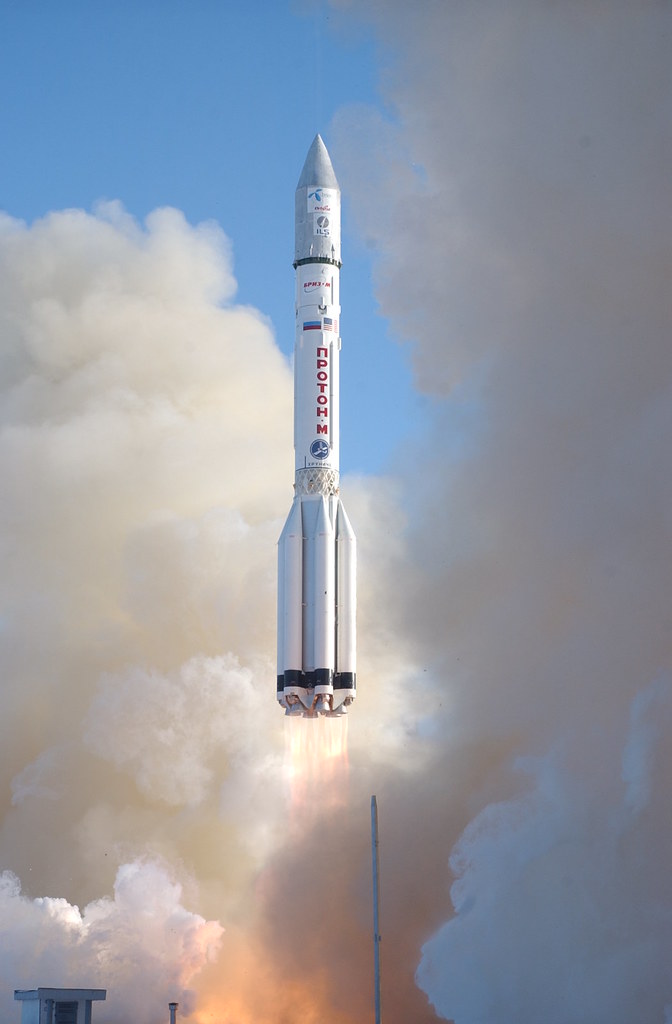
 thor-5_launch

A Proton rocket launched Telenor‘s Thor 5 satellite from the Baikonur Cosmodrome over the weekend, delighting Cato Halsaa:

“I was delighted to see THOR 5 successfully being launched”, said Cato Halsaa, CEO of Telenor Satellite Broadcasting. “I would like to thank our partners, Orbital, for carrying out the entire THOR 5 mission programme and ILS, for performing a successful launch.

The THOR 5 satellite will now go through extensive in-orbit testing before it is brought into its final geo-stationary position at 1 degree West and commence operating commercial services.  From 1 degree West, THOR 5 will carry all broadcasting services which currently reside on Thor II and provide additional capacity to allow growth in the Nordic region and expansion into Central and Eastern Europe.

THOR 5 is the first new satellite to be launched in Telenor Satellite Broadcasting’s replacement and expansion programme for satellites, which has a total investment frame of 2.5bn NOK. With the completion of the programme, Telenor will have doubled its capacity on 1 degree West, which will facilitate both organic growth and expansion for Telenor.
 
“The satellite replacement and expansion programme demonstrates Telenor’s commitment to the satellite industry and our firm belief that satellites will continue to play an important role as a distribution platform for TV entertainment”, says Cato Halsaa, CEO of Telenor Satellite Broadcasting. “Driven by HDTV, new niche channels, and the expansion within emerging markets, the need for high powered capacity is increasing, and with our new satellites, we will are able to support the future growth requirements of our customers in Europe”.

Pretty cool: a daytime launch is something I haven’t seen in a while. The weather was on the cold side, with the high temparature that day of 10° F and a low of -15° F (-12° C and -26° C, respectively). Here’s the roaring launch clip:


Voom With A View

Wednesday, February 6th, 2008

Remember the Voom Satellite Service? It was an all-HDTV service intended to compete for viewers with DirecTV, Dish Network and local cable systems. Owned by Cablevision and the Dolan family, they built and launched the Rainbow 1 satellite in 2003. I remember the launch had a rocketcam and they produced the video in HD, of course. Here’s the launch clip (action begins around 1:30):


Unfortunately, the service shut down in 2005 and all subscribers were transitioned to Dish Network, who bought the satellite, which is now a.k.a. EchoStar 12. Fortunately for those looking for HD content, they’re still broadcasting the 15 Voom HD channels — many with original content — to Dish and Cablevision subscribers. Neither DirecTV nor Verizon FiOS offer those channels. I just upgraded my service to HD and I dig those Voom channels, in all its 1080i glory, 24×7 and commercial-free. There’s content for kids, like Flipper from the 60s and UFO from the 70s, a cartoon channel called Animania and for those crazy kids, Rush HD — featuring extreme and action sports. The program they put together on downhill skiing was very well done:


THE THIN LINE: Life on the Edge – HD Trailer from VOOM HD on Vimeop>

Seeing how HDTV is really catching on in the marketplace. Now that the Super Bowl is over, expected prices to drop:

Missed a great deal on an HDTV this past week? Don’t sweat it. Analysts over at Pacific Media Associates say we can expect a 15.6% drop on flat panel display prices this year. According to the research company, last year they saw a 14.7 percent price drop on HDTVs, which increased sales by 41 percent. If their estimates are correct, over 113 million displays were sold worldwide instead of the 80 million units they had predicted.

If you think about it, the idea was ahead of its time. Demand for HD content will continue to increase, and Voom offers good, differentiated content — designed for and originated in HD.

And Voom sees growth outside the U.S., too. An international Voom HD channel is available in Northern Europe on Thor 2 (1° West, transponder 15, 11434V, SR 25000, FEC 2/3) and Southeast Asia on Measat 3 (91.5° East, 3752V, SR 13330, FEC 2/3) — both in MPEG-4, and HD, naturally.

SatelliteWiki.com Launches

Thursday, January 31st, 2008


Photo Caption: A model of Explorer 1, held by JPL’s Director William Pickering, scientist James Van Allen and rocket pioneer Wernher von Braun (from left to right). The team was gathered at a news conference at the National Academy of Sciences in Washington, D.C., to announce the satellite’s successful launch. America’s first satellite, Explorer 1 had launched a few hours before, on Jan. 31, 1958.

It may not be on par with the launch of Explorer 1, but  SES Americom is proud to announce the launch of satellitewiki.com today:

Using the same style and software used to power Wikipedia, satellitewiki.com, satellitewiki.com lets visitors explore the history of man-made satellites, definitions of satellite terms and learn about how satellites impact a wide range of industries from oil and gas to television….

From the first U.S. satellite’s bleep in 1958 to modern satellites with their own neighborhoods, users exploring the wiki can find interesting facts, download imagery and discover how satellites work. With input from other users and readers, information can be updated, changed and added, as well.

Want to know the difference between ‘carrier frequency’ and “geostationary transfer orbit”? Or when the best time to look up in the night sky to see a satellite passing over your neighborhood? Log on at  satellitewiki.com.

Although SES AMERICOM has funded the creation of satellitewiki.com, the site is open to the public to add and edit content in true wiki fashion. SES AMERICOM invites all players in the satellite industry to visit satellitewiki.com and add their content so that the website can grow into an important resource for anyone interested in the satellite industry. SES AMERICOM and U.S. satellite historical timeline

As BusinessWeek reported last spring, many corporate wikis are going viral. Both Nokia and investment bank Dresdner Kleinwort, for example, have successfully used wikis to collaborate on solving specific product-design problems and as alternatives to e-mail and collaborative software.

Wikis are also becoming interfaces for B-to-B marketing. IBM is exploring opening up its wikis to explain new products to potential customers,  while Hewlett-Packard has used wikis as a focal point for their "The Computer is Personal Again" marketing campaign:

 In the first two weeks after the campaign broke in late August, more than 220,000 visitors clicked through to a microsite for small and midsize businesses, and the HP Community wiki recorded more than 1,400 visitors. Other Web-based printing activities are being added, and the marketing campaign will continue to evolve, based on the feedback HP receives from customers via the wiki.

The current initiative isn’t just an advertising tactic but a marketing strategy designed to reinforce the brand’s relevance in a changing world.

In marketing, how many people wikis reach may be less important than who is reached. As Ross Mayfield puts it, "It’s no longer about impressions you make but who you impress."

But wikis, once they hit a critical mass, can be just plain fun. Equotes, for example, has some good quotes from all sorts of luminaries, including Neil Armstrong. There’s a SpaceWiki for astronomy buffs. And feel free to add your own insights and knowledge of the satcom industry at our new satellitewiki.com.

Or, you can start your own free wiki here

Let India Launch Your Spacecraft

Wednesday, January 30th, 2008

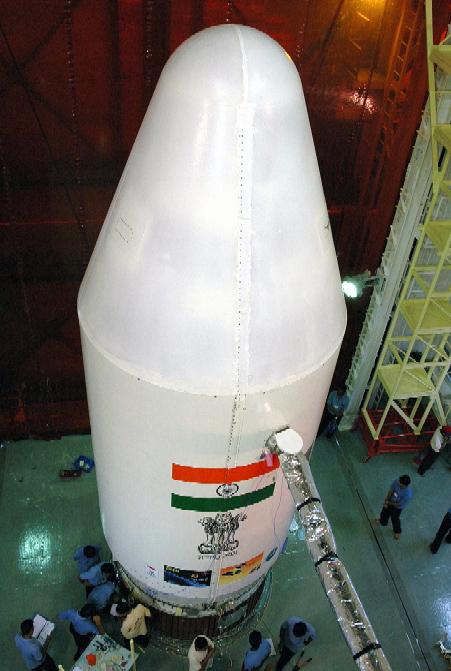
Last week’s launch of an Israeli observation satellite, and an Italian one last April, has put the Indian Space Research Organization’s (ISRO) capabilities on display for the world to see. Developing a commercial launch operation is a huge undertaking and now Antrix, the commercial/marketing arm of the ISRO, is ready to compete in the launch business:

Antrix hopes to bag around three commercial launch contracts for PSLV in 2009.

To be a major player in the launch market, Antrix is also planning a slew of measures. These include a three-stage PSLV to ferry 500 kg satellites for low earth orbit, a new 229-tonne ‘core alone’ configuration that can carry 1,100 kg satellites into SSO, and a vehicle to carry 1,900 kg satellites in SSO by increasing the fuel in stage two and improving the thrust power.

‘We can also look at the potential of our other rocket, Geosynchronous Launch Vehicle (GSLV), only in its Mark III version,’ Murthi said.

According to Frontline, the folks at Antrix are very proud of their accomplishment and happy to share some details surrounding the TecSAR mission (and some pricing info):

At the press conference itself, the emphasis was on how it was “a red-letter day” and “a landmark” event for Antrix because the successful orbiting of Tecsar signified the second full-fledged commercial launch by Antrix. The first one was on April 23, 2007, when a core-alone configuration of PSLV, without its customary six strap-on motors that surround the first stage, put an Italian astronomy satellite called Agile into orbit. Madhavan Nair said, “We won the contract [for launching Tecsar] against stiff competition from many other players. The orbit we achieved will be the envy of any person in the launch service. It recognises the launch capability of ISRO on par with other leading players in the world.”

K.R. Sridhara Murthi, Managing Director, Antrix, said that for putting Tecsar into its difficult orbit, they had “charged quite a lot above” the international rate of $15,000 to $20,000 a kg. During launches in January, April and September 2007, from Sriharikota, and also during the International Astronautical Congress in Hyderabad in September 2007, ISRO top brass had dodged questions on whether ISRO was planning to launch any Israeli satellite. As per the original plan, the core-alone PSLV that was to launch Tecsar in September 2007 had been assembled, and the satellite had reached SHAR from Israel and undergone tests. But the launch was postponed. So ISRO dismantled the vehicle and the Israelis bottled up the satellite.

In the first week of December 2007, newspapers and television channels went to town saying that ISRO had “abandoned” the launch of Tecsar under pressure from the United States, which did not want ISRO to get a slice of the launch market. Informed ISRO officials, however, said there was pressure from the Gulf countries on India to call off the launch of the Israeli satellite, and so the Ministry of External Affairs wanted ISRO to bide its time.

Madhavan Nair denied any such pressure from the Gulf countries. The lift-off was to take place in September 2007, but certain “technical issues” [with the satellite] forced the postponement of the launch, then the monsoon intervened. The launch took place in January after the monsoon, he said. According to the ISRO Chairman, Israel did not want any publicity until the launch was successful.