Archive for the ‘Astronomy’ Category

Full-Time Uplinking for Cable Channels

Tuesday, May 22nd, 2007

The list of cable channels keeps growing and they all need to find a way to get it to the top 100 cable systems. Since 1976, the best way to get your cable channel distributed is by satellite — it is the technology that made HBO and CNN what they are today.

First step is to secure a lease on a C-band satellite that cable systems are already "looking at" (have a downlink antenna assigned to it). CED Magazine’s series of wall charts include the annual "Orbital Arc Chart" (link launches PDF), which shows you a snapshot of all the cable channels and which satellites they’re on. Want more detail? Check Lyngsat for each satellite’s ladder chart.

Getting space segment in a high-value "cable neighborhood" is not cheap. For a start-up, viable alternatives to going it alone include origination and uplink centers such as Comcast Media Center (CMC) in Colorado and Crawford Communications in Georgia. 

CMC uplinks the entire HITS ("headend in the sky") platform, which carries a ton of channels.

Broadcast Newsroom just ran a piece on Crawford setting a record for new channel uplinks: 14 new channels so far this year. overall, they uplink 135 full time cable channels. I like their new video tour:


Free Speech on Satellite Radio?

Thursday, May 17th, 2007


Well, sort of…

Via the Los Angeles Times:

Listeners shocked by XM hosts’ suspension

Many cancel the service. Some suspect a proposed merger with Sirius is a factor in the punishment.

By Jim Puzzanghera and Amy Kaufman, Times Staff Writers
May 17, 2007

WASHINGTON — Satellite radio bills itself as the Wild West of the airwaves, an uncensored outpost beyond the reach of federal regulators where expletives fly with impunity and the banter can get as raunchy as at a strip club.

But the decision this week by XM Satellite Radio to suspend shock jocks Opie and Anthony for 30 days for crude sexual comments about First Lady Laura Bush, Secretary of State Condoleezza Rice and Queen Elizabeth II has listeners wondering whether there’s a new sheriff in town.

Some XM listeners were outraged — not at the comments but at XM’s reaction.

"I signed up for XM because it’s uncensored. I like these guys because they are so unfiltered," said Placentia resident Paul Hebert, who canceled his $12.95 monthly XM subscription Tuesday in protest.

He wasn’t alone. Hundreds of angry subscribers have flooded XM’s operators with calls to cancel since the suspension was announced Tuesday. About 60 listeners smashed their XM receivers Wednesday outside the WFNY-FM studios in New York, where Gregg "Opie" Hughes and Anthony Cumia continued to air their tamer, over-the-air broadcast for CBS Radio.

"The reaction is mind-blowing," said Ryan Saghir of North Branford, Conn., who runs a blog about satellite radio called Orbitcast. "One of the main attractors to satellite radio is the unregulated content. Once you take away that … you’re going to have some upset subscribers."

But industry observers said XM might have been more worried about offending federal regulators, who can block the company’s proposed merger with its only rival, Sirius Satellite Radio, than staying true to its slogan, "Beyond AM. Beyond FM. XM."

Sensitivities have been heightened in Washington since the controversy over veteran shock jock Don Imus’ racially offensive comments about the Rutgers University women’s basketball team, which led to his firing last month by CBS Radio.

"It’s hard to read anything into it other than that they’re catering to federal officials," said William Kidd, a media analyst with Wedbush Morgan Securities in Los Angeles.

XM spokesman Nathaniel Brown would not comment on whether the pending merger was a factor in the suspension and would not say how many people had canceled their subscriptions. XM has suspended on-air personalities before, he said, but none with as high a profile as Hughes and Cumia.

It’s not the first time a skit has landed the two shock jocks in trouble. CBS Radio, then known as Infinity Broadcasting, fired them in 2002 for broadcasting two listeners apparently having sex in New York’s St. Patrick’s Cathedral. The Federal Communications Commission fined Infinity $357,000 for the stunt.

XM, which does not fall under the FCC’s indecency rules because it is a pay service, hired Hughes and Cumia in 2004. Their program, "The Opie & Anthony Show," airs from 6 a.m. to 9 a.m. on XM and 24 CBS radio affiliates, which picked the duo back up last year.

It continues until about 11 a.m. only on XM, a segment that the show’s website touts as "uncut, uncensored and totally filthy."

On May 9, the XM portion of the show aired a skit featuring a character called Homeless Charlie, who graphically described having sex with Bush, Rice and the queen. Hughes and Cumia played along, laughing and asking questions.

XM issued a statement condemning the comments, and Cumia and Hughes apologized on the air Friday.

On Monday’s show, Hughes and Cumia complained about "dumb rules" and an "umbrella of morality and decency" that led Imus and some other hosts to get fired. XM officials suspended the pair Tuesday, saying the comments "put into question whether they appreciate the seriousness of the matter."

Satellite radio followers said the suspension was unprecedented. Some XM listeners were stunned and angry when they heard about it.

Ed L. Kelley of Wagoner, Okla., said he spent six hours on the phone Tuesday night trying to cancel. He’s talking to an attorney about a class-action suit, saying that because "The Opie & Anthony Show" appears on one of XM’s "explicit-language" channels, the company has violated its promise to deliver uncensored content.

"These guys make me laugh and they make fun of everybody equally," Kelley said.

Debbie Wolf, co-founder of People Against Censorship, called the suspension "outrageous" and organized the demonstration outside CBS Radio’s studios. Christopher Lewis of Glenmoore, Penn., quickly registered http://www.cancelxm.com , and the message boards there and on other satellite radio sites have filled up with dozens of angry comments.

"I will not support a company that has decided the one true reason they exist no longer matters," wrote one poster on Orbitcast.

Howard Stern, who left traditional radio in 2004 after battling regulators, also weighed in from his new post at Sirius.

"If you want free speech," he told his listeners Wednesday, "walk in a closet and talk to yourself."

Kidd said the suspension could make it difficult for XM to attract edgy radio personalities who have viewed satellite as a haven for their outrageous acts.

"This will probably be a decision that XM will have to live with and, I suspect, likely regret over time," he said.

The suspension would be as surprising as HBO pulling "The Sopranos" for offensive content and will reverberate through the industry, said Tom Taylor, a former program director who edits the trade journal Inside Radio.

"People in the satellite world have felt safe … until this week," he said.

On or Off? Intelsat Still Confused in Sri Lanka

Wednesday, May 16th, 2007

According to the Sri Lankan Army, LTTE broadcasts continue via the Intelsat 12 satellite. Via the Asian Tribune:

THE SRI LANKAN EMBASSY in Washington has complained to the US Justice Department, State Department and the Federal Bureau of Investigation (FBI) against Washington based Intelsat Ltd., for reneging its promise of removing the National Television of Tamil Eelam (NTT) channel and Pulikalin Kural radio from the Intelsat 12 satellite transponder and for continuing to facilitate and broadcast terrorist propaganda.

Before lodging the complaint, the Sri Lankan Embassy brought to the communication satellite company’s notice that despite its assurance that it has removed both channels from its transponder, it continues to broadcast National Television of Tamil Eelam, and Pulikalin Kural (Voice of Tigers radio) the official television and radio of the LTTE.

Intelsat Ltd., according to sources, laid down conditions to the Sri Lanka Embassy that talks with them should not be publicised or divulged to anyone which the Embassy refused even to consider.

Subsequently, the Sri Lankan Embassy alleged that the satellite provider is violating US law by continuing to broadcast the propaganda television and radio services of the foreign terrorist organisation LTTE, through the satellite they own despite public assurances given ago to the contrary.

National Television of Tamil Eelam, the official television channel of the LTTE is a free-to-air channel to Asia and an encrypted channel to Europe.

The four-hour daily programme of the NTT channel broadcasts propaganda material of the LTTE, a terrorist organisation banned in United States of America, Canada, India and in European Union countries.

The illegal transmission of the NTT channel of the LTTE was for the first time brought to Intelsat Ltd’s notice by Asian Tribune on March 10.

Dianne VanBeber, Intelsat Ltd Vice President in charge of Investor Relations and Corporate Communication, told ‘Asian Tribune’ that the LTTE is pirating the Intelsat’s 12 bandwidth without the company’s knowledge.

"Intelsat has notified the original customer for the capacity that they are in violation of their contract, and Intelsat has informed them to cease transmissions," VanBeber said.

Asked to identify the original customer of Intelsat, VanBeber refused to disclose the service provider’s name who has accommodated the LTTE’s media without Intelsat Ltd’s knowledge.

Asked whether Intelsat was not aware that the LTTE’s National Television of TamilEelam was using the Intelsat 12 satellite bandwidth since 2005, she clarified that Intelsat Ltd acquired PanAmSat only on July 3, 2006, and LTTE’s National Television of Tamil Eelam might have come to quietly share the Intelsat 12 satellite.

She said: "We are taking action to cease their transmission soon." Subsequently this issue was taken up by Bernard Goonetilleke, Sri Lanka’s Ambassador in Washington with Intelsat’s General Counsel, Phillip Spector.

A press statement was released by the Intelsat after the meeting.

In a press statement dated April 10 Intelsat Corporation said: "Intelsat officials, including its technical experts, met with Sri Lanka’s Ambassador to the United States, Bernard Goonetilleke, on April 10 to discuss the steps Intelsat is taking to address the unauthorised use of one of its satellites by the LTTE.

During the meeting, Intelsat’s General Counsel, Phillip Spector, said:’ "Intelsat does not tolerate terrorists or others operating illegally on its satellites. Since we first learned of the LTTE’s signal piracy, we have been actively pursuing a number of technical alternatives to halt the transmissions. We are clear in our resolve to ending this terrorist organisation’s unauthorised use of our satellite’."

Later, the Sri Lankan embassy revealed that Intelsat Ltd., stated that during April 21-22 they switched off the transponder of the free to air NTTE channel beamed to Asia and the encrypted channel beamed to Europe.

The Lyngsat site confirms that both the television and radio broadcasts were up and running on 29 April 2007 — nearly three weeks after we first blogged it. The program can be found every day, from 18:00 to 21:30 GMT, on Intelsat 12, transponder 2 (downlink frequency: 11,504 Vertical; symbol rate: 2894; FEC: 3/4).

How did that happen? If you read ToTheCenter.com, you’d think it was indeed turned off:

INTELSAT INFORMS SRI LANKA EMBASSY IN WASHINGTON IT SWITCHED OFF LTTE BROADCASTS FROM THEIR SATELLITE

( By Walter Jayawardhana)

Sri Lanka’s envoy in Washington, D.C. said his office had been given an assurance by Washington based Intelsat Corporation that they have switched off the transponder used by the Liberation Tigers of Tamil Eelam (LTTE) to broadcast its propaganda, during the last weekend.

“We were told last evening by Intelsat executive Phillip Spector that the transponder used by the LTTE was switched off during the weekend,” Bernard Goonetileke, Washington, D.C.’s Sri Lankan Ambassador told this correspondent.

However, Goonetileke said he was still not sure whether the banned terrorist group has made some other arrangements with a European satellite company to carry on with the broadcasts continually.

He said inquiries are made to check whether LTTE is continuing its broadcasts and whether they are doing it through another channel, suspected to be Globe Cast satellite of a European company.

A press release issued by the Washington, D.C. Embassy of Sri Lanka said,
“Intelsat Ltd., a U.S. based satellite company has terminated the “unauthorized” use of one of its satellites, Intelsat12, by the Sri Lanka based terrorist organization, the Liberation Tigers of Tamil Eelam (LTTE), for its TV and radio transmissions to Europe and Asia.”

The Executive Vice President and General Counsel of Intelsat Ltd., Mr. Phillip Spector, confirmed to Rajika Jayatilake, Counselor (Information) at the Sri Lanka Embassy in Washington, D.C., that Intelsat Ltd. had, over the April 21/22 weekend, shut down the transponder, which the LTTE had used for its transmissions, the press release said further.

Whatever new channel the LTTE is using will have to be advertised through some means since the viewers and listeners of its propaganda have to be informed about the changes in the broadcasting frequencies. So far, no such advertisement has been found.

Following the meeting with Ambassador Goonetileke on April 10, 2007, Mr. Phillip Spector, of Intelsat Ltd., stated that the LTTE transmissions were “unauthorized.” Countering the position taken by Intelsat Ltd., speaking from Sri Lanka’s north to wire services in Colombo, the LTTE denied it was using the satellite services illegally. “We are accessing it legally and there is no signal piracy,” said an LTTE spokesman.

However, inquiries by this correspondent could not find out any evidence to confirm the statement of Phillip Spector, that the LTTE was a pirate of the satellite.

The Embassy press statement traced the history of the LTTE-INTELSAT connection as follows: “Since March 2005, the LTTE had been transmitting TV and radio programs through Europe Star 1 satellite owned by French satellite provider, Alcatel. PanAmSat, a satellite operator headquartered in Wilton, Connecticut in the U.S., acquired Europe Star 1 satellite in July 2005. In July 2006, Intelsat Ltd. acquired PanAmSat, following which, Europe Star 1 satellite was renamed Intelsat12. The programs that the LTTE had been transmitting through Europe Star 1, thus continued uninterrupted even after Intelsat Ltd. acquired the satellite.”

It is believed that it was the intense pressure used by the Washington Embassy of Sri Lanka and the U.S. State Department and the Department of Justice, together with press publicity, that was adversely affecting Intelsat that finally brought an end of the deal.

The Sri Lanka Embassy said, the U.S. Department of State and the Department of Justice had both been informed that a terrorist group designated by the U.S. as a Foreign Terrorist Organization (FTO), was using a satellite owned by a U.S. based satellite company to transmit their TV and radio programs to Europe and Asia. (EOM)


Sensor Flight Computer Anomaly

Tuesday, May 15th, 2007

Launched in March, the Orbital Express mission has been progressing nicely. We blogged this cool space video last month, and I like the possibilities of this mission: on-orbit servicing of satellites. Potentially saving millions for all dependent on commercial space systems.

Then we read this from the DARPA Public Affairs Office, via SpaceRef.com:

15 May 2007 Update from Jan Walker, DARPA PAO:

"During Scenario 3-1 execution on the evening of May 11, Orbital Express encountered a serious sensor flight computer anomaly on the ASTRO while stationkeeping at 10 meters separation distance from the NextSat. Onboard fault protection reacted immediately, placing the ASTRO into an abort trajectory which carried it to a hold-point 120 meters from the NextSat. The Orbital Express team has spent the past several days recovering from this fault and from problems associated with loss of relative navigation at the longer-than-anticipated separation distances for this scenario. The ASTRO has since coasted at distances of up to several kilometers from the NextSat. Both vehicles are safe. The ASTRO powered up its redundant sensor flight computer and is processing sensor data nominally. The team is in the process of developing a recovery scenario for ingress and remate, and hopes to execute this ingress in the next several days."

Editor’s 14 May 2007 note: At this point ASTRO and NextSat should be a few meters apart. Some observers are suggesting that they are kilometers apart. No word from DARPA.

OE observed with Nextsat, SeeSat-L

"… NEXTSAT appeared to trail by about 0.5 deg, when at a range of about 600 km, which indicates a distance of about 5 km."

The account by New Scientist was more alarming than that:

The US military’s experimental satellite mission, Orbital Express, may be in peril. The lead spacecraft ASTRO has drifted several kilometres away from where it should be.

No updates from Boeing yet, but they’ve got a great team of people working on this mission. I’m sure they’ll recover from this without a scratch.


Nigeria’s NigComSat1 Launches in China

Monday, May 14th, 2007

 Nigeria’s NigComSat1 (which we reported on just a couple of weeks ago) lifted off successfully from the Xichang Satellite Launch Center in southwest China’s Sichuan Province just after midnight this morning. The Nigerian paper The Guardian had some of the most extensive coverage of the launch:
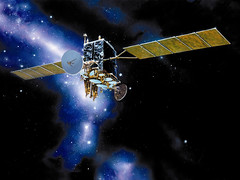
True to prediction, the much awaited launch of the Nigerian communication satellite, the first of its kind in Africa, took place and went on the 20 to 30 – minute trip into orbit where it is expected to provide robust and reliable satellite services to citizens in Africa and Europe.

The excitement at the site, according to Nigerian officials at the launch, was "electrifying."

Head of Corporate Affairs and Media at the National Space Research and Development Agency (NASRDA), Mr. Felix Ale, told The Guardian on phone that the launch was successful.

He quoted the agency’s Director General Prof. Robert Ajayi Boroffice, as saying that the 30-minute movement of the satellite went on without delay.

According to Ale, "Prof. Boroffice has also called President Olusegun Obasanjo to inform him of the success of the launch. The President was impressed and full of praises for NASRDA.

NASRDA is, of course, Nigeria’s national space agency, who, incidentally, also has a pretty cool PowerPoint presentation available about NigComSat1 online.

In addition to be the first communications satellite launched on behalf of an African country, the launch of NigComSat1 also marks a significant first for China, as the first time a foreign buyer has purchased a Chinese satellite and its launching service. The Chinese news service, Xinhua, also points out that the launch represents the culmination and beginning of a relationship between Nigeria and China that will likely continue throughout the life-span of the satellite (about 15 years)…

The satellite will be monitored and tracked by a ground station to be built in Abuja, the capital of Nigeria, by Chinese firm Great Wall Industry Corporation, and a ground station in Kashgar, in northwest China’s Xinjiang Uygur Autonomous Region.

The satellite’s ground facility in Abuja "had the potential of making Nigeria a major traffic hub in the west and central African region" and will prompt Nigeria and neighboring countries to "expand their switching facilities to be able to handle international traffic", according to a Nigerian communication official.

The Chinese company will offer support services and training for Nigerian technicians.

China was awarded the deal in 2004 after it outbid 21 international rivals to secure the 311 million U.S. dollar deal.

And also, may point to China’s expanding relationship with the developing world.

The satellite represents China’s wish to cooperate with developing countries in the peaceful use of outer space and to promote a closer relationship between China and African countries, observers say.

China has signed several cooperative contracts offering commercial launching services for foreign satellites, said an official on space development, citing a similar satellite contract with Venezuela in November 2005 and adding that China has been commissioned to send about 30 foreign satellites into space.

Want more info on NigComSat1? Check out the photo gallery over at Xinhua and the Google Map’s powered realtime tracking at n2yo.com.

ASTRA 1L Launch Video

Saturday, May 5th, 2007

GSA Awards $750m in Satcom II Contracts to 24 Companies

Thursday, May 3rd, 2007

The General Services Administration (GSA) yesterday inked deals with 24 satellite communications companies to deliver the next-generation satellite solutions for government agencies, known as Satcom II.


The Satcom II program is meant "to provide an expanded range of end-to-end satellite solutions for government agencies and serves as the primary replacement vehicle for the highly successful Satellite Services contracts."

Among the service providers are nine small business contractors, according to Washington Technology:

The large contractors are Americom Government Services Inc.; Arrowhead Global Solutions Inc.; Artel, Inc.; AT&T Corp.; DRS Technical Services; EDS Corp.; Global Communications Solutions Inc.; Hughes Network Systems LLC; Intelsat General Corp.; Mackay Communications Inc.; Segovia Inc.; Stratos Mobile Network Inc.; Telecommunications Systems Inc.; Telenor Satellite Services and ViaSat Inc. The small business awardees are CVG Inc.; DasNet Corp.; E&E Enterprises Global; Knight Sky Consulting and Associates LLC; New Orleans Teleport Inc.; Psi Systems Inc.; RiteNet Corp.; Satellite Communication Systems Inc. and Skjei Telecom Inc.

The same story provides details on the Satcom II system:

The Satcom II system will allow federal workers to use hand-held receivers similar to cell phones, as well as access full broadband computer networks, anywhere in the world. It is designed for use in areas where no phone or cable lines exist and to help federal workers fight wilderness wildfires, patrol remote borders and rescue the trapped and injured from hurricanes or tornadoes.

The system also makes possible broadcast services in distance learning for federal customers throughout the world…

The GSA press release notes that the "SATCOM-II program has an estimated value of $750 million over the life of the five-year, indefinite delivery, indefinite quantity contracts, and… offers competitive pricing throughout the life of the contract, as well as flexible ordering and billing."

Computerworld also files a report on the contracts, which, while certainly important to the businesses that inked them, essentially provide basic satcom services. The really cool technological breakthroughs (such as the next-stage C4ISR bandwidth, advanced extremely high frequency satellites and Wideband Global Satcom program) tend to come through military contracts.

Ariane Launching ASTRA 1L Satellite

Wednesday, May 2nd, 2007


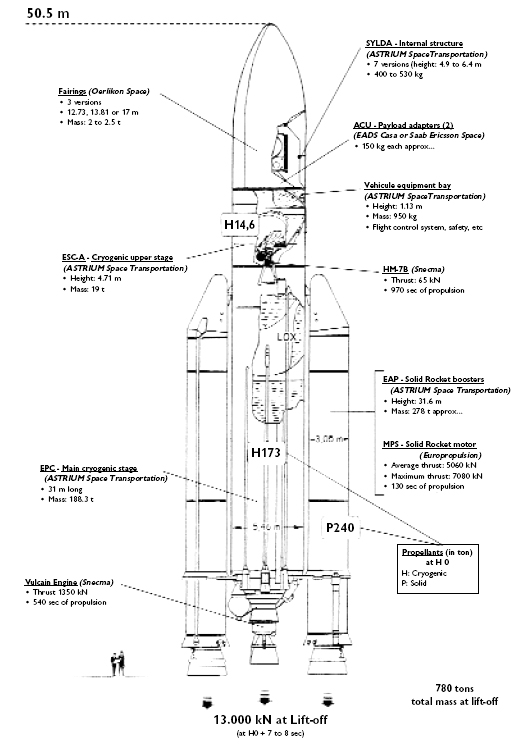
We have a potentially record-setting launch coming up on Thursday, 3 May 2007, from the jungles of French Guiana. We’re talking some heavy payload here. The news via L’Express

La fusée européenne Ariane 5 doit décoller jeudi soir de Kourou pour mettre en orbite une masse sans précédent constituée de deux satellites de communication.

La masse totale – celle des deux satellites Astra 1L et Galaxy 17 et des interfaces – s’élève à 9,4 tonnes, un record mondial pour un lancement sur orbite géostationnaire, rapporte Arianespace, l’exploitant du lanceur.

Le décollage est prévu à 19h29 (22h29 GMT) du Centre spatial guyanais, la base de l’Agence Spatiale Européenne.

Il s’agit du 176e lancement d’Ariane, du 32e vol d’une Ariane 5 et du 10e d’une Ariane 5 ECA, modèle le plus puissant de la gamme, qui peut mettre jusqu’à dix tonnes sur orbite.

Le satellite Astra 1L doit être placé sur orbite 27 minutes après le décollage et Galaxy 17 cinq minutes plus tard.

Construit par l’industriel américain Lockeed Martin Commercial Space Systems en Californie, Astra 1L a une masse au décollage de 4,1 tonnes, selon Arianespace.

Il sera positionné au-dessus de l’Europe continentale, d’où il assurera la diffusion de chaînes de télévision de haute définition (HD) pour le compte de SES Astra, société du groupe Société Européenne des Satellites (SES), basée au Luxembourg.


I’m making plans to watch it myself. The launch window opens at 22:29 GMT and closes at 23:13 GMT on 3 May 2007. Local time in French Guiana is right after dinner (between 19:29 and 08:13 on 3 May 2007), but I doubt anyone will be able to eat beforehand. Here are some local times:

New York: 18:29 to 19:13 on 3 May 2007

Luxembourg: 00:29 to 01:13 on 4 May 2007

Singapore: 06:29 to 07:13 on 4 May 2007

Live television broadcast begins at 21:50 GMT (17:50 EDT; 23:50 CET): 

  • In Europe, the launch will also be broadcast live via ASTRA satellite from the orbital position 19.2° East (downlink frequency: 12.5515 GHz, vertical polarization, service ID 12122, service name ASTRA Vision 2).
  • In North America, lock your antenna on Galaxy 3 at 95 West (transponder 22, C-band; Format: digital 9 MHZ, 4126.5 Vertical, FEC: 3/4, Symbol Rate: 6.1113).
  • Click here to watch the live webcast.

According to our friends at ASTRA, the satellite will be performing a critical mission:

ASTRA 1L will be located at 19.2° East, ASTRA’s prime orbital position for delivering broadcast services to continental Europe, where it will also transmit the increasing number of HDTV channels. The new satellite will allow SES ASTRA to move its satellite ASTRA 2C from 19.2° East to 28.2° East, in order to meet the high demand for capacity from the U.K. and Irish markets. It will also extend the ASTRA coverage from the Canary Islands in the West to the Russian border in the East and further strengthen SES ASTRA`s unique in-orbit back-up scheme.


The launcher itself is described in great detail on the ESA Web site.

TO SAVE MY COUNTRY, I NEED TO BORROW THE SUM OF $200 MILLION

Tuesday, May 1st, 2007

Nigeria is a country best known for its email marketing scams. You know, the ones written in all caps and started off something like…

"Dear Friend,
It is with heartfelt hope that I write to seek your co-operation and assistance in the context stated below, I am Barrister Fenner Mark Elvis, the personal Attorney to the late Mr. Nobert Spagele. I got your contact through the help of my brother-in-law that works with the American Chambers of Commerce and Tourism, though I did not disclose to him my humble intention for an honest foreigner like you, having noted the confidence reposed on your person by the sponsor of the recommendation…

Well, according to SpaceMart, last January a Chinese Bank fell for a similar line and, at present, is financing the construction of Nigeria’s first communications satellite, NigComSat, which is now set to launch before the end of this month.

While this is not Nigeria’s first satellite, a title held, according to allAfrica.com, NigeriaSat-1, launched in 2003 to take photos of Nigeria’s environs, it does mark the first time a Sub-Saharan African country has launched and retained control of their own communications satellite.

Recently "replaced" Nigerian President General Olusegun Obasanjo said that the satellite is a part of his country’s commitment to development:

"This commitment has informed our embarking on programmes and initiatives that would effectively address the challenges of poverty, food security, infrastructural development, sustainable energy, affordable health and housing, and protection from natural and man-induced disasters.

Space technology is key to the realization of the Millennium Development Goals (MDGs) and the objectives of our holistic reform agenda as encapsulated in the NEEDS document. It guarantees the availability and speedy access to real-team data and geo-partial information, as well as the availability of relevant infrastructure and backbone for information communication"

The Chinese, who are financing, building, and launching the project, are also proud of the effort, the first step in a move to develop a satellite design and construction export business. The launch will take place at the Jiuquan Satellite Launch Center, which has launched some 30 satellite since 1990, 24 of which were commercial launches for overseas clients.


The satellite itself is being constructed by China Great Wall Industry Corp., based on China’s latest model of satellite platform, DFH No. 4, and will feature 28 transponders, including 4 C band, 18 Ku band, 4 Ka band and 2 L bands. The whole thing weighs somewhere around 5000 kg and has an anticipated life-span of 15 years.

GE Deal For AsiaSat

Wednesday, April 25th, 2007

Remember Tianamen Square? To many people, it remains a fuzzy memory. The U.S. State Dept. remembers it well — especially the laws and regulations created since then regarding technology transfer. Satcom falls under that category.

We thought AsiaSat was going to be taken private by GE (see this comment from 2 months ago) after SES bought them out. The South China Post reports this US$295 million deal won’t be happening:

The Bush administration’s decision to stop a General Electric subsidiary from teaming up with state-owned Citic Group to privatise Asia Satellite Telecommunications Holdings is the latest in a long line of mainland-related deals that the United States has blocked for political reasons.

At the root is a policy put in place by former US president George H.W. Bush, father of the current president. On June 5, 1989, the day after the Tiananmen Square crackdown, Mr Bush issued a moratorium on all US military exports to the mainland, including satellites.

Shortly after, the US Congress passed laws banning satellite exports to China. There were two exceptions: the president could issue a special waiver on the grounds that either the mainland had achieved political and human rights reforms or the deal was in the US national interest.

What constitutes "national interest" has since been a subject of keen debate in Washington, and it appears that Citic and GE’s HK$2.3 billion bid for AsiaSat is the latest victim.

"The US Department of State has in correspondence with General Electric said it will not grant the approval necessary to implement the proposed privatisation," AsiaSat said yesterday in an announcement on the scuttling of the deal.

As the leading regional satellite operator in the Asia-Pacific, the company makes for an attractive target. It serves more than two-thirds of the world’s population with its three satellites: AsiaSat 2, AsiaSat 3S and AsiaSat 4. They provide services to the broadcast and telecommunications industries.

More than 240 digital television channels and 130 radio channels are now delivered by AsiaSat’s satellites, reaching about 96 million households with more than 360 million viewers across the Asia-Pacific.

Last year, AsiaSat tapped California’s Space Systems/Loral, a subsidiary of US high technology firm Loral Space & Communications, to build AsiaSat 5. The new-generation satellite is slated for launch next year and it is unclear what impact, if any, the State Department’s latest action will have on that deal.

It is not the first time the company has been at the centre of the US-China export dispute.

In December 1989, despite an outcry in the Congress, the elder Bush ruled that exporting satellites – the manufacture of which is dominated by several US companies – was in the national interest. That cleared the way for AsiaSat 1, which in April 1990 became China’s first commercially launched US-made satellite.

But the following year, Mr Bush blocked the sale of satellite components to the mainland.

The move was interpreted as an attempt to appease Congress – which was upset with Chinese sales of military equipment to Middle East nations – and to win support for Mr Bush’s plans to further liberalise trade with the mainland.

The present-day Bush administration’s move against the Citic-GE deal may have had a similar political motive.

As the US prepares for another presidential election cycle, analysts have interpreted the recent World Trade Organisation case against China as an attempt by beleaguered Republicans to head off some of the inevitable China-bashing that is likely to emerge from a Democrat-controlled Congress.

But, for now, the only obvious loser is business.


And this from Variety:

A plan to take Asia Satellite Telecommunications Holdings, which operates three satellites across the region, into private ownership was quashed Tuesday (April 24) when it was blocked by the U.S. Dept. of State.

The private-ownership plan was proposed by AsiaSat and AsiaCo, a joint venture between China’s state-owned Citic Group and GE Capital Equity Investments from the U.S.

If the company had gone private, Citic and GE would each have owned 50%. GE became a major shareholder of AsiaSat in early April with a 34% holding.

Deal was subject to a number of conditions, one of which was approval by the State Dept. and compliance with U.S. International Traffic in Arms Regulations.

As a result, a court meeting and special general meeting scheduled for Tuesday morning were "adjourned indefinitely" only hours before they were skedded to take place.

The deal appears to have raised national security hackles at the U.S. State Dept. concerning transfer of satellite technology to China.

AsiaSat didn’t immediately return phone calls for comment.

Trading in AsiaSat shares were suspended from just before noon on Monday and trading in American Depositary Shares (ADS) on the New York Stock Exchange was suspended Monday.

Trading resumed Wednesday morning at 9:30 in Hong Kong and once the NYSE opens its trading day Wednesday, ADS trading will start up again.

In an increasingly competitive market, AsiaSat’s shares have continued to drop over the past three years. Price of shares decreased almost 12% during that period compared to a more than 51% increase in the Hang Seng Index.

The company hoped being taken private would give it greater flexibility to focus on the development of business and marketing activities; and relieve it of the financial and administrative burden of dual listings on both the Hong Kong Stock Exchange and the New York Stock Exchange, according to a press release dated Feb. 14.

AsiaSat’s three satellites serve two-thirds of the world’s population with its three satellites, which provide services to the broadcast and telecom industries.

It has more than 270 TV channels and 130 radio channels delivered via its satellites and reaches 96 million households in the Asia-Pacific region.


AsiaSat’s shares fell 5.7% on Wednesday, closing at HK$16.50. It’s U.S. ADRs were down 8.97% on the NYSE.