Archive for the ‘Astronomy’ Category

Herbie the Satellite Bug

Tuesday, June 19th, 2007

Sirius Satellite Radio is having a tough time selling the merger with XM in Washington, as we read in Radio Ink:

A letter signed by 72 members of the House of Representatives was sent this week to FCC Chairman Kevin Martin, Attorney General Alberto Gonzales and Federal Trade Commission Chairman Deborah Platt Majoras expressing opposition to the proposed merger of XM and Sirius Satellite Radio.

"On its face, we believe that sanctioning the marriage of the only competitors in the satellite radio market would create a monopoly which would be devastating to consumers," said the letter, which was authored by Reps. Gene Green (D-TX), vice chair of the Subcommittee on Health, and Jim Sensenbrenner (R-WI), second highest ranking member of the House Judiciary Committee.

Among the 47 Democrats who signed the letter are: Budget Committee Chair John Spratt (D-SC), Agriculture Committee Chair Collin Peterson (D-MN), Rules Committee Chair Louise Slaughter (D-NY), and presidential candidate Dennis Kucinich (D-OH).

Among the 25 Republicans who signed the letter are former House Speaker Dennis Hastert (R-IL), Republican Whip Roy Blunt (R-MO), and National Republican Congressional Committee Chairman Tom Cole (R-OK).

 

We’ve been fond of the original "pocket rocket" for years, so we were glad to read some good news early this morning: Volkswagen is installing Sirius Radio in all their cars:

"The Volkswagen of America, Inc. plan to offer SIRIUS as standard equipment in select models not only proves VW’s commitment to the customer, but also shows VW’s commitment to technology that enhances driving pleasure and enjoyment in every sense," said Adrian Hallmark, Executive Vice President of Volkswagen of America. "SIRIUS Satellite Radio helps to enhance the driving experience and Volkswagen ownership pride."

"Since the first launch on the New Beetle in 2004, to now making it standard on the New Beetle and other key models, VW has always shown to be a significant partner in the growth of SIRIUS," said Mel Karmazin, CEO of SIRIUS. "Volkswagen of America’s decision to move in the direction of standardizing SIRIUS on key models only shows their commitment for expansion and growth of our capabilities."

SIRIUS and Volkswagen of America, Inc. announced in March 2006 that Volkswagen will offer SIRIUS as its sole satellite radio provider for vehicles sold in this country through 2012. Volkswagen has exclusively offered SIRIUS beginning with its 2007 model year vehicles and expects to equip approximately 80% of its vehicles with SIRIUS satellite radio receivers. Volkswagen additionally offers three months of complimentary service on vehicles equipped with SIRIUS.

That’s going to make VWs even more attractive for us rocket scientists, but it still doesn’t beat our favorite, the jet-engine New Beetle, putting out 1450 horsepower.

Of course, we love their "unpimp your ride" TV spots:



Liberty and EchoStar to Buy Intelsat?

Thursday, June 14th, 2007

Is it roundup time on the satcom ranch? Might be, partner. Time to drive these little doggies to HDTV city.

Here’s a market-shaker via today’s Wall Street Journal (subscription):

Liberty, EchoStar Plot Intelsat Bid
   
Joint Offer Would Set Up Unusual Pairing of Rivals Looking to Reduce Costs
   
By DENNIS K. BERMAN, ANDY PASZTOR, and DANA CIMILLUCA
June 14, 2007; Page A3
   
Liberty Media Corp. and EchoStar Communications Corp. are preparing a surprising joint offer for satellite-communications provider Intelsat Ltd., which is accepting final bids for its auction today, according to people familiar with the matter.
   
The pairing represents a bold cooperation between satellite-TV broadcaster EchoStar and media holding company Liberty, which is slated to take control of competing satellite-broadcaster DirecTV Group Inc. in the coming months. The two firms still could decide against making a formal bid.
   
Intelsat is expected to draw bids of $4.5 billion to more than $5.5 billion, according to people familiar with the auction. The company already supports about $11.5 billion in debt, put on the company after a series of mergers and one-time dividends paid to its group of four private-equity owners.
   
If it succeeds, the joint bid would create a highly unusual partnership between two strong-willed rivals who run satellite-to-home broadcast systems that currently compete with each other. But the two have been exploring ways to work with one another, according to people familiar with their discussions. Their main goal is to reduce operating costs, these people say, and a substantial amount could be cut from both firms with an Intelsat purchase.
   
The satellite-broadcast segment is different from the satellite-services business, where Intelsat is the industry leader. Intelsat provides wholesale capacity over 51 satellites, and its best customers are cable-television providers. The businesses rely on separate fleets, ground facilities and capital-investment schedules.
   
But there are similarities between the designs and technical details of the satellites used for both purposes. Last year, EchoStar Chief Executive Charles Ergen surprised many on Wall Street by projecting an investment of more than $1.6 billion to dramatically expand EchoStar’s satellite fleet, with some of the proposed satellites slated to lease wholesale capacity.
   
Federal regulators are bound to carefully scrutinize any such partnership, partly because the cable industry traditionally has considered satellite broadcasters as archrivals when it comes to attracting subscribers. The bid also could pave the way for closer ties between DirecTV and EchoStar, or possibly even lead to a merger proposal that consumer groups and other critics have long asserted would hurt consumers.
   
People familiar with the process said Intelsat’s current private-equity owners believe that because Intelsat is in a different business than EchoStar and DirecTV, the joint bid doesn’t pose antitrust hurdles. Under this argument, cable operators would retain existing long-term contracts for satellite capacity, or they could switch to fiber lines as an alternative.
   
Antitrust questions are likely to come up in the course of the auction, which could conclude as early as this weekend. Private-equity firm Blackstone Group, which prompted the auction, isn’t expected to bid, according to two people close to the process. Providence Equity Partners, another private-equity firm, is expected to participate, as well might a group of other players such as Carlyle Group and Australia’s Macquarie Bank Ltd., according to people familiar with the auction.
   
But the most intriguing combination is clearly the Liberty-EchoStar group. Over the years, Mr. Ergen has repeatedly broached the idea of forming a limited joint venture between his Dish Network and rival DirecTV. In the past few months, Liberty Chairman John Malone and Mr. Ergen have met several times to discuss ways to develop broader cooperation, according to people familiar with the discussions, including gaining access to additional satellites already in operation.
   
EchoStar, Liberty and Intelsat declined to comment.

Connectivity While Adrift

Thursday, June 14th, 2007

Isolation has been among the defining characteristics of maritime travel ever since man first crossed the oceans in primitive boats. Once you left shore, there was no way to reach those still on land until the journey was over.

Radio, of course, changed that, though it was not until the advent of satcom that true global connectivity became available. And today the progression of maritime communications continues with the introduction of seamless global roaming for data and voice communications at sea.

A truly seamless system would give each ship a direct phone number that would work anywhere in the world — meaning you could call, say, the rower of the Zeeman Ocean Challenge to say, "How are your arms feeling now?"


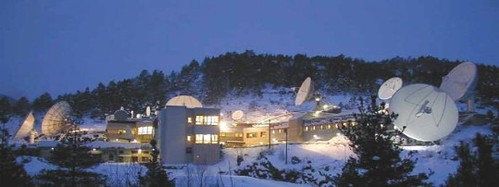
Telenor (whose Eik teleport station in Norway, which provides telecom services to the the North Sea, is pictured above) has just unveiled their product to reach a marketplace that is literally oceans-wide:

OceanRoam™ will provide vessels worldwide Internet and telephone connectivity around-the-clock using the ships’ assigned IP addresses and telephone numbers regardless of location. 
Telenor’s OceanRoam will offer “always-on” Internet access and IP-based service at a fixed monthly price.  The service will enable voice services and unlimited data transfer for ship’s business and crew communications and will feature a variety of committed information rate (CIR) service levels up to 128 kbps.  Additionally, OceanRoam will meet vessels’ communications requirements for bandwidth intensive applications, such as video conferencing and large data transfers, by providing a series of optional bandwidth on demand information rates of up to 1024 kbps.

(Note that the Director of Media and Public Relations is named, appropriately enough, Tom Surface.) 

We haven’t quite delved into the details of how OceanRoam differs from another Telenor product, WaveCall, but Alan Spicer runs a good blog on marine telecom that provides in-depth analysis of products and trends for those interested in following the maritime space (no pun intended) more closely. DigitalShip is also a good resource for tracking the convergence of IP, satcom, and other communications platforms in the maritime marketplace.

New Canadian Satellites

Wednesday, June 13th, 2007


Happy news from Ottawa

Two Ottawa-based satellite companies have awarded a total of 12 licences by the federal government to launch new satellites to improve broadcasting and telecommunications services to Canadian entrepreneurs and customers.

We blogged about Canada’s Community Access Program being at risk in Labrador, and new broadband solutions in Saskatchewan, so we know how important satcom will be in the Great White North.

Ensuring Canadians have acccess to vital communications services, Industry Canada issued several new satellite spectrum licenses today:

Licence                   Frequency Band/Orbital Position          Applicant
2                              17 GHz BSS/72.5W                                 Telesat
5                              17 GHz BSS/82W                                    Telesat
6                              17 GHz BSS/86.5W                                 Telesat
8                              Ka FSS/91W                                            Ciel
9                              17 GHz BSS/91W                                    Ciel
12                            17 GHz BSS/103W                                  Ciel
14                            17 GHz BSS/107.3W                               Ciel
16                            Ka FSS/109.2W                                       Ciel
17                            Extended Ku FSS/111.1W                       Ciel
23                            Ka FSS/118.7W                                       Telesat
24                            17 GHz BSS/118.7W                               Telesat
28                            12 GHz BSS/138W                                  Ciel


Here’s the news release:


The Honourable Maxime Bernier, Minister of Industry, today announced the results of a licensing initiative to authorize the development of new Canadian satellites that will increase and improve broadcasting and telecommunications services to Canadian entrepreneurs and consumers. The first satellites are expected to provide services as early as 2010.

"Canada needs to increase its satellite capacity to keep pace with the ever-increasing demand for satellite services," said Minister Bernier. "By awarding these new licences, we are helping the expansion of satellite capacity and services that will benefit Canadians for years to come. We’re helping to foster an environment that will bring all the benefits of competition, including increased product and service offerings, choice in supplier, competitive prices and export revenues."

Canadian satellite operators Ciel Satellite LP and Telesat Canada have indicated their intention to invest several billion dollars in building and launching new Canadian satellites, which will provide the capacity needed to fully implement high-definition television in Canada and carry important new and advanced telecommunications services such as satellite Internet. These new satellites will also help connect all regions of Canada, especially in the North, where satellites are the vital link to providing public safety, national security and government services. This process represented the largest spectrum licensing initiative ever undertaken in Canada and will lead to Canadian consumers and businesses gaining access to emerging satellite broadcasting and telecommunications services such as high-definition TV, Internet Protocol Television (IPTV), satellite broadband and multimedia consumer applications.


Europe Jumping Into Space Tourism Race

Monday, June 11th, 2007

A decade ago, space tourism was just a dream, even for the richest of the rich. In 2001, Dennis Tito became the first space tourist, paying more than $20 million. Since then, a number of multi-millionaire and billionaires have made the journey on Russia’s Soyuz spacecraft. (The program is booked-up until 2009.) Now, space tourism might be possible for even six-figure savings accounts.

Looking to cash-in on the new desire for out-of-this-world travel, an explosion of commercial space tourism is underway. Most of the proposed programs propose suborbital flights, which still provide a traveler with a view of the earth’s curvature and a short period of weightlessness, without the danger and expense of full re-entry. Single tickets are expected to sell for $200 to $300 thousand dollars.

While a half-dozen companies are already developing plans (including RocketPlane and PlanetSpace), Virgin Galactic appears to be the most established. Galactic draws together the only company to actually put a privately developed craft into outerspace (California-based Scaled Composites) with the financial and marketing genius of British Billionaire, Richard Branson. The company will launch its “flights” as early as late-2009 from California’s Mojave Spaceport until New Mexico’s Spaceport America is complete (making Virgin Galactic essentially an American enterprise). Watch Virgin’s promotional simulation (very cool):

Now, Europe is expected to jump into the game with an announcement at this week’s Paris Air Show. From the London Times:

EUROPE is to enter manned space travel for the first time, almost half a century after the first cosmonaut orbited the Earth.

EADS Astrium, Europe’s biggest builder of satellites and rockets, is this week expected to announce plans to carry tourists into space. The firm is due to unveil plans at the Paris air show for a spacecraft that will carry tourists out of the atmosphere for a brief ride at 3,000mph before ferrying them back to Earth.

Europe stood on the sidelines during the space race between America and Russia in the cold war, largely because of the vast cost. The first human space flight carried Yuri Gagarin, the Soviet cosmonaut, once round the Earth in 1961, and in 1969 Neil Armstrong became the first person to set foot on the moon.

Europe’s programme, conducted through the European Space Agency, has confined itself to unmanned probes, such as the Giotto mission of 1986, which explored the tail of Halley’s comet. However, European astronauts, including the Britons Helen Sharman and Michael Foale, have flown on Russian and Nasa missions.

A spokesman for EADS Astrium said: “We are going to reveal a space tourism project next week for the Paris air show.” The scheme is thought to be the first step in a plan to take space tourists into orbit and even to dock at a “space hotel”.

STS-117 Launch Update

Friday, June 8th, 2007

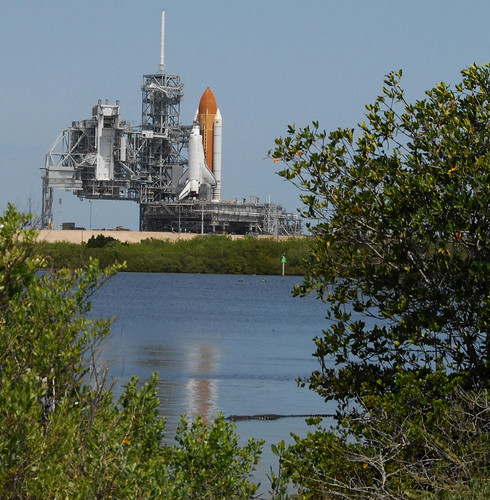
NASA’s space shuttle is on schedule to launch at 7:38 p.m. EDT (23:38 GMT) tonight, 8 June 2007. NASA’s Launch Blog will begin coverage at 1:30 p.m. (17:30 GMT). Read more about the countdown here. Take a close look at the photo above and you’ll see an alligator in the foreground.

Live HDTV coverage begins at 6:00 p.m. (22:00 GMT) on HDNet, and naturally NASA TV:

NASA Television is carried on an MPEG-2 digital signal accessed via satellite AMC-6, at 72 degrees west longitude, transponder 17C, 4040 MHz, vertical polarization. A Digital Video Broadcast (DVB) – compliant Integrated Receiver Decoder (IRD) with modulation of QPSK/DBV, data rate of 36.86 and FEC 3/4 is needed for reception. NASA TV Multichannel Broadcast includes: Public Services Channel (Channel 101); the Education Channel (Channel 102) and the Media Services Channel (Channel 103).

Long March Launches SinoSat-3

Monday, June 4th, 2007

Let’s hope this one turn out better than Sinosat-2 did. Here’s the news report, via IHT:

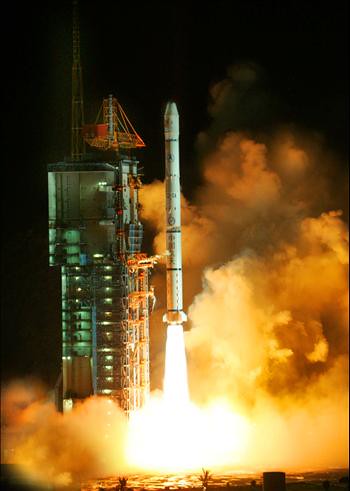
China launched a new communications satellite into orbit early Friday [1 June 2007] to provide broader radio and television signal coverage across the country, state media reported.

The Long March-3A rocket lifted off from the Xichang launching center in southwestern China eight minutes after midnight (1608 GMT) and separated from the SinoSat-3 satellite 24 minutes later, the Xinhua News Agency said.

The long-scheduled launch follows the failed deployment last October of another communications satellite, SinoSat-2, whose solar panels and communications antennae did not operate properly, Xinhua said.

China has spent decades building an indigenous space program and is trying to attract customers from abroad, after a series of failed launches in the 1990s dampened demand for Chinese launch services.

Both the rocket and the satellite used Friday were mainly developed and manufactured domestically, Xinhua said.

The satellite deployed Friday was not developed as a replacement for the inoperable SinoSat-2, Xinhua said, though Sino Satellite Communications Co., the satellite’s operators, may use SinoSat-3 to replace part of the service the other satellite was to have provided.

Xinhua quoted a company spokesman as saying that a substitute satellite would take at least three years to develop.


Robert Berry to be honored with Lifetime Achievement Award

Monday, June 4th, 2007

This Wednesday, at the ISCe 2007 Conference in San Diego, Robert E. Berry – former systems fellow and chairman of Ford Aerospace and SS/L – will be given a Lifetime Achievement Award.

More about Berry from the press release announcing the award:

"Berry led SS/L and its predecessor, Ford Aerospace, from 1977 to 2000 and, with his willingness to push innovative concepts, was responsible for some of the world’s most advanced communications and meteorological satellite projects for defense, civil, and commercial applications. He cultivated the international market for U.S.-based satellite manufacturing, and under his leadership, SS/L developed the technologies that have put the company at the forefront in providing high-power satellites for direct-to-home television, satellite radio, broadband Internet and international fixed satellite services."

During Berry’s tenure at Ford Aerospace, his team built many satellites for IntelSat, including the notable IntelSat 5 and IntelSat 7 series. After Ford Aerospace was sold to Loral in 1990, Berry led SS/L in developing the FS-1300, which was a very advanced and reliable satellite that in some cases exceeded its design life of 10 – 15 years.

More from the press release:

"Berry was instrumental in providing three generations of satellite platforms to Intelsat, helping the intergovernmental consortium provide fixed satellite services to more than 149 countries, territories, and dependencies. He initiated and managed Ford Aerospace’s participation on the Milstar industry team and advocated multi-mission satellite systems, with SS/L providing military communication payloads for commercial satellites for France, Japan, Spain and Australia. Currently at SS/L, he consults with both government and commercial interests to explore new applications arising from combining satellite, wireless, and fibered transmission."

The ISCe 2007 conference takes place this week, June 5th – 7th, in San Diego. Besides honoring Robert Berry, the conference is hosting a number of other impressive speakers and sure-to-be engaging talks. Check out the speaker list here.

In a related note, Berry’s company Ford Aerospace is also where Linda Hudson, currently of BAE Systems, got her start. She was the first woman manager at Ford, overseeing the quality assurance division. After making a name for herself as an executive at Ford, she eventually became the first female vice president at General Dynamics and now, as the president of BAE’s land and armaments division, has made a significant impact in the defense industry with BAE’s recent $4.1 billion purchase of Armor Holdings. London newspaper The Times calls her "the most powerful woman in the American defence industry" (link).

Recently, Hudson travelled to London to host a BAE leadership conference. She must have made quite an impression, as one British observer noted that "she talked a lot of sense – without the jingoism and rubbish you normally hear from American defence experts" (link).


DirecTV-10 Satellite Launch Postponed

Friday, June 1st, 2007


According a local news agency, Kazakhstan Today, DirecTV’s new HD-dedicated satellite won’t be launched until next month:

Launch of space vehicle DirecTV-10 planned for June 20 has been postponed at the cosmodrome Baikonur. Federal space center Baikonur press service informed the agency.

According to the press service, the launch date of the American telecommunication satellite DirecTV-10 has been shifted for July. "The date transfer has been done due to the request of foreign manufacturers of the satellite and is connected with the terms of preparation of a space satellite and its delivery to the cosmodrome," the press service informed.

The exact date of the satellite launch by means of a carrier rocket Proton-M will be defined later after delivery of the satellite to the cosmodrome and will depend on the degree of readiness of foreign partners.

This was indeed confirmed by DirecTV’s press guy, via SatelliteGuys.us:

here’s a statement i just received from bob mercer, directv’s director of public relations:

“The launch date of D10 has slipped to july 7. there were some late processing issues in the Boeing factory but they have been resolved and we are moving forward.”

he sent me a follow-up email from his blackberry to clarify the date:

“that’s actually july 6 in the US.”

Back in January, DirecTV promised up to 70 national HD channels via this and another new satellite in 2007. This is a key launch for them.


SumbandilaSat Launch via Submarine Scrubbed

Wednesday, May 30th, 2007


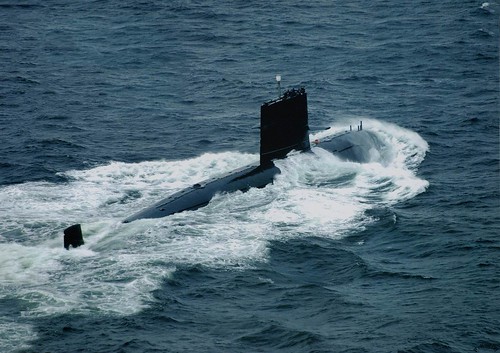
South Africa’s SumbandilaSat, an 81-kg LEO (low-earth orbit) observation/imagery satellite, which was to launch via a Russian submarine in the Barents Sea, has been postponed. The story, via Engineering News (South Africa):

The launch of South Africa’s first government satellite from a Russian submarine next month has been postponed indefinitely, an official said on Tuesday.

"It has been postponed because official documentation still needs to be arranged to issue a decree for the launch," said Nhlanhla Nyide, spokesman for the Department of Science and Technology.

"They are currently working on the process … We will hear from them when they have set a new date for launch," Nyide said.

He told said no additional costs will be incurred and South Africa’s nascent space programme would not be affected because of the cancellation of the launch, which was to have taken place in the Barents Sea near Norway.

The R26-million satellite, intended to orbit some 500 km (310 miles) above earth and have a life-span of three years and longer, would carry high-resolution imaging cameras.

The images from the South African-built satellite would be used across a wide array of applications, from agriculture to land use and infrastructure mapping.

South Africa has pledged millions of rands to build its astronomy and space sector, with the construction of the South African Large Telescope creating a hub for astronomy research in southern Africa.

In July 2006 cabinet approved the establishment of a South African Space Agency as an institutional vehicle to look at space science and technology.


This would have been a cool launch. Back in December, 2006, the satellite was handed off to Russia:

South Africa’s low-earth-orbiting microsatellite, SumbandilaSat, left for Russia on Thursday, ahead of its launch into space off a submarine in early 2007.

The 81-kg SumbandilaSat will generate satellite imagery through its remote sensing camera at 6,25 m ground sampling distance.

Upon arrival in Russia, SumbandilaSat will be taken to the Russian naval base at Murmansk, where the Russian navy will integrate it with a launch rocket. The satellite will then be transported to a submarine at Severemorsk, just off the Russian coast, where it will be launched into space.

The launch window period is between April and May and is strongly dependent on weather conditions at the time. Once in orbit, SumbandilaSat will pass over South Africa mid-morning and mid-evening, at an average orbit altitude of 500 km.

In addition to its earth observation and communications payloads, SumbandilaSat carries five experimental payloads, which will present the scientific community with exciting results in low frequency radio waves, radiation, software defined radio, forced vibrating string and radio amateur transponders.

Speaking at the hand-over ceremony, in Stellenbosch, Science and Technology Minister Mosibudi Mangena said that the development of SumbandilaSat offered South Africa a number of competitive advantages and would support decision-making in natural resource management and sustainable development. He added that the images yielded by the satellite would be used in various applications, which had direct benefits to societies, such as flood and fire disaster management; enhancing food security through crop yield estimation; ensuring better human and animal health through enabling the prediction of the outbreaks of diseases; better monitoring of land cover and use; as well improved capabilities for water resource management.

The actual construction of the SumbandilaSat had been completed at the end of September and had been followed by a battery of trials, including functional testing, space environmental testing, vibration testing and burn-in testing, designed to establish the satellite’s readiness prior to a flight acceptance review.

“The environmental-testing phase determined SumbandilaSat’s ability to withstand extreme variance in temperatures, while the vibration tests verified its ability to endure the shocks it will undergo as it is launched into space. The burn-in testing phase comprised the actual and continual running of the satellite and its systems in order to confirm that all components are fully functional,” the Department of Science and Technology (DST) said.

Sunspace project manager for SumbandilaSat Harry van der Heyden said that the review presentation included an introduction to the hardware produced, as well as the ground support equipment developed for the satellite. “We also conducted demonstrations to illustrate how the satellite communicates with the ground support equipment.”

The birth of SumbandilaSat was initiated by the DST and was given life by numerous stakeholders, including the University of Stellenbosch, Sunspace, the South African Space Council, the Departments of Foreign Affairs, Trade & Industry, and Communications, as well as the Centre for Scientific and Industrial Research.

The launch of SumbandilaSat is envisaged to strengthen South Africa’s technological capability and innovation in space science and technology, as well as reinforce the country’s role in national, regional and international space initiatives.

This is but one aspect of a budding interest in space, as evidenced by South Africa’s National Astrophysics and Space Science Programme. The first "space age school" was established in 2003.

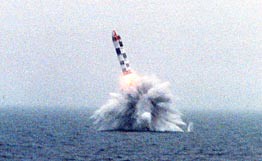
Here’s a clip of U.S. Trident missiles being launched from a sub: