Archive for the ‘Astronomy’ Category

DISA Issues RFI for TCA to Industry, With Help from the Comms FIO and NSSO

Thursday, January 11th, 2007

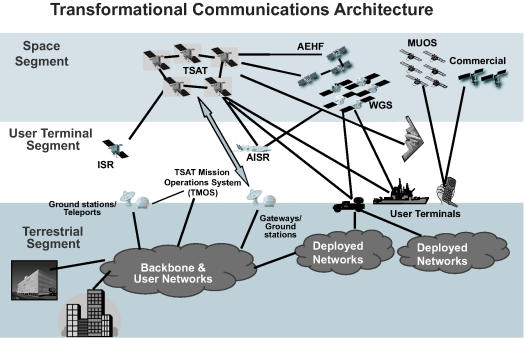
DISA (Defense Information Systems Agency) is turning to the commercial satcom community for what appears to be a huge undertaking: the TCA (Transformational Communications Architecture). It includes satcom systems serving NASA, DoD and the Intelligence Community. Like I said: HUGE.
Federal Computer Week has the story:

Transformational Communications Architecture will address the potential for an expanded role for commercial satellite communications to meet the requirements of DOD, NASA and the intelligence community through the year 2020, according to the request for information released Jan. 9.

The Communications Functional Integration Office (FIO) of the National Security Space Office (NSSO) is overseeing the project.

According to the RFI, the agency wants to assess the ability of the commercial satellite industry to meet a wide range of requirements, including wideband and narrowband communications provided by satellite systems operating in L, S, C, X, Ku, and Ka bands.

DISA also needs to know how well commercial services can support various communication platforms, such as handheld, airborne (including unmanned aerial vehicles) and shipboard communications. Replies to the RFI are due Jan. 26.

Bernie Skoch, a consultant with Suss Consulting who worked for DISA as director of customer advocacy, said it makes sense to bundle future NASA requirements with DOD because NASA has a lot of satellite assets that lie fallow between space missions.

Skoch said that the RFI indicated that DOD does not have enough in-house expertise to develop its own architecture and needs to reach across the table for help from industry.

In a briefing delivered to a Satellite Industry Association conference late last year, Cmdr. Allan Assel of the FIO said DOD needs a new architecture to address potential shortfalls in the coming years as the demand for satellite communications exceeds capacity.

Assel said next-generation communications architecture should also leverage IP-based communications, which can support interoperable voice, video and data streams, memory in space, and information assurance. The new TCA should also work in concert with DISA’s Global Information Grid to help synchronize multiple acquisitions.

NSSO, in cooperation with the Transportation Department, is also developing an architecture for satellite-based positioning, navigation and timing services.
Satcom: The Fiber Cut Remedy

Tuesday, January 2nd, 2007

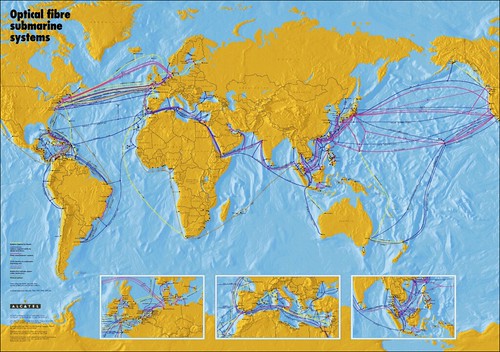
Heard about that Pacific earthquake near Taiwan while taking a break last week. Read in the New York Times how data and Internet traffic was significantly distrupted:

The quake disrupted services in Taiwan, Singapore, Hong Kong, South Korea and Japan, but a ripple effect was felt in other parts of the world. Many phone subscribers could not get through to Europe, regional telecommunications operators reported, as they raced to reroute their traffic to alternative lanes.

How prepared was everyone with mission-critical operations suddenly stopping? How vulnerable are these undersea fiber optic cables?


Was it really that bad? Seems like it was. The Korea Times reported that 6 of Korea’s 7 cables were cut, disrupting banking operations:

LG Dacom, which provides Citibank Korea’s dedicated data cables, said that the bank’s lines were cut by the 6.7-magnitude quake that struck the southern part of Taiwan.

Citibank Korea said the disruptions would not have happened if the bank had its own communication network in Korea.

"A network systems team in Taiwan oversees Citibank transactions in Korea. Severance of the submarine cable cut our connections with them, causing all the problems,’’ an official said, requesting anonymity.

HSBC Korea also relies on a foreign carrier for dedicated data lines, which are managed by its Asia-Pacific headquarters in Hong Kong.

Officials at KT and Dacom, Korea’s fixed-line operators, which jointly manage with foreign partners the cables damaged by the quakes, said other data lines were affected.

"A total of 92 dedicated data lines were severed, partially disrupting the operations of 32 of our corporate customers,’’ a KT official, Park Hae-dong, said.

KT’s clients include the Ministry of Foreign Affairs and Trade, Reuters, AT&T Korea, Posdata and SK Telink. Among financial clients are Metlife Korea, Korea Exchange Bank and Kookmin Bank.

Dacom, Citibank’s service provider, said the quake cut 26 of its lines.

Fortunately, satellites over the Pacific act as back-ups for some, while others rely exclusively on space-based redundancy for their critical communications. Several intra-Asian satellites, such as those operated by AsiaSat, came to the rescue. You can bet you sweet bippy trans-Pacific satellites such as Telstar 18, NSS-5, IS-701, AMC-23 and PAS-8 got some business from this outage.

 With communications returning to normal, we may not know the extent of the damage for another 2 weeks.  I can tell one thing we’ll know in a couple of weeks. THE hot topic at the Pacific Telecommunications Council’s annual conference in Honolulu will be the race to build another cable across the Pacific.

Satellite Internet Coming to Saskatchewan

Tuesday, December 19th, 2006

Say that three times fast, eh?

We’ve written before about the challenges of bringing broadband access to remote, rural regions of Canada (in communities like Black Tickle, Labrador) — and the resulting lack of Internet access options for rural residents in the north.

But there’s good news today for those who want broadband in Saskatchewan:

Saskatchewan Communications Network (SCN) Minister Glenn Hagel and OmniGlobe Networks, Inc. (OGN) Chair Julian Costley today signed a Memorandum of Understanding to form a long-term strategic alliance.  The two companies will work together to deliver a satellite-based wireless broadband Internet service capable of supporting video-conferencing, Voice over Internet Protocol (VoIP) and other e-solutions to rural and remote communities across Canada….

Earlier this year, SCN and OGN undertook a six-month project together to deliver wireless broadband Internet service to several remote communities in northern Quebec.  The success of the Quebec project demonstrated large-scale interest for a national service combining satellite with terrestrial wireless access, inspiring the two organizations to jointly extend the model across Canada.

Omniglobe has years of experience delivering VSAT services (such as distant learning) to rural Canada. But delivering true broadband to Canada is going to require far more spectrum (bandwidth) then VSAT. Where will that spectrum come from?

The most likely answer is Ciel Satellite Group, which recently filed applications for 9 licences in Canada: 

On November 15, the Ciel Satellite Group filed nine applications with Industry Canada for multiple satellite orbital positions across several frequencies. The applications were submitted in response to Industry Canada’s Call for Applications to License Satellite Orbital Positions, the largest in Canadian history. Applicants who are awarded licences from the Call will have the opportunity to build and launch satellites to bring new spectrum into use for DTH, HD and broadband services, for the benefit of Canadians in all regions of the country….

David Lewis, President and CEO of Ciel, noted, "This is a key event in Ciel’s history and, at the same time, a defining moment in the history of Canadian telecommunications."

Ariane 5 Launches AMC-18 and Wildblue-1

Friday, December 8th, 2006


Watched the launch live via satellite from French Guiana. A little cloudy, but still pretty cool. They may can it for viewing here.

Hope tomorrow’s STS-116 launch from Florida is clearer.

According to Arianespace:

Dans la nuit du vendredi 8 au samedi 9 décembre 2006, Arianespace a mis en orbite de transfert géostationnaire deux satellites pour deux opérateurs privés américains : WildBlue-1 pour WildBlue Communications et AMC-18 pour SES Americom.

Trentième lancement d’Ariane 5, seizième succès d’affilée

Ce nouveau succès du lanceur Ariane 5, le cinquième en 2006, confirme que l’offre de Service & Solutions d’Arianespace est la référence la mieux adaptée aux besoins des opérateurs, qu’ils soient privés ou institutionnels.

Au cours de ces 12 derniers mois, Arianespace aura mis en orbite douze satellites de télécommunications et une expérience technologique.

Aujourd’hui, Ariane 5 est le seul lanceur opéérationnel disponible sur le marché commercial capable de lancer simultanément deux charges utiles.

Au service de deux clients américains prestigieux

Le choix d’Arianespace par un nouvel opérateur du secteur des télécommunications spatiales américains et par le plus grand opérateur de services par satellites aux Etats-Unis, illustre la reconnaissance d’un service de lancement de qualité.

C’est en utilisant les capacités du satellite Anik F2 de Telesat, lancé par Ariane 5 en juillet 2004, que la société WildBlue Communications, basée dans le Colorado, a lancé son activité Internet. WildBlue-1 permettra à WildBlue Communications d’élargir son offre en large bande à destination des utilisateurs privés et des petites entreprises dans les zones où l’offre terrestre est actuellement inexistante.

Le satellite AMC-18 est le vingt-cinquième satellite confié au lanceur européen par le groupe SES Global (Euronext Paris et Bourse du Luxembourg : SESG), le plus grand opérateur privé de satellites au monde. Le satellite AMC-18 sera exploité par SES Americom, premier fournisseur de services par satellite aux Etats-Unis, qui exploite une flotte de 18 satellites en orbite, fournissant principalement ses services sur l’ensemble du continent américain. En tant que membre de la famille SES Global, SES Americom est aujourd’hui à même de fournir des solutions de télécommunication de bout en bout dans toutes les régions du globe.

Sirius Satellite Television?

Monday, December 4th, 2006

We’ve been to the back seat to watch TV, but the antenna was a little on the big side. With a few modifications, Sirius Satellite Radio can send TV to their subscribers (probably for an extra fee). They’ve been talking about this for a while, and we heard Bell Labs was working on something for them. Some think TV in cars is dangerousSkyreport reports on CEO Mel Karmazin’s revelation at the Reuters Media Summit:

"We have three content deals that are very close to being finalized. I don’t know if they will be done by CES, but that is what we are shooting for," he said. "We will have video in the rear seat of the car up and running."

While the comments aren’t completely new – the company said in 2004 it would offer video by mid-2005, Oppenheimer’s Thomas Eagan said they are "intriguing" because Sirius could cost-effectively improve its financial and operational wellbeing with a video service.

Sirius could launch a video service with its existing satellite and repeater infrastructure without reducing its audio content, the analyst said, but consumers would need new or different handsets/in-car receivers to get the signal. Eagan said the video product would consist of three or more children’s channels (i.e. Nickelodeon, Disney and HBO Family) with a DVR downloading service sometime down the line.

"We don’t expect significant difficulties integrating a video service into OEM assembly as many of Sirius’ auto partners, such as Ford and Chrysler are already assembling SUVs with drop down LCD screens," Eagan said. "The size of the video market is clearly smaller than the audio market (and) without significant costs we expect the higher OEM conversion rate and higher ARPU would be accretive."


Watch this Reuters clip of the Karmazin interview. I found it interesting.

WiMax Coming to India

Wednesday, November 29th, 2006

Following up on Spektor’s post on EduSat in India (below) comes more news on how new technologies are bridging the communications gap in India’s rural areas. The Economic Times reports on how Motorola plans to cash in on the demand for wireless broadband:

The world’s second largest maker of mobiles is in discussions with telecom operators to provide network and equipment for offering Wimax (highspeed Internet access over a wireless connection).

The annual broadband wireless equipment market opportunity in India is pegged at around $4.5 billion by ’12 and Motorola is keen to bite into this pie. "Motorola will design networks and provide customer premises equipment (CPEs) and handhelds . Our end-to-end solutions will be deployed by operators beginning next October," Mr Amit Sharma, vice-president , strategy and business development, Motorola Asia Pacific, told ET.

India is targeting 30 million broadband (high speed Internet) users by 2010 while the current base is just 2 million. The most difficult part of providing broadband access is last mile, the final leg of delivering connectivity from a communications provider to a customer , as it requires fanning out of wires and cable. Wimax is an easy solution as it doesn’t require a direct line of sight between the source and endpoint. With a service range of 50 km, Wimax supports peak data rates of 23 Mbps. Samsung and Alcatel are other vendors eyeing the Indian wireless broadband market. 

SDAIndia has more projections of WiMax growth in India and Asia; also be sure to check out this article in CIOL from several months ago, outlining why WiMax is emerging as a popular technology for providing rural connectivity:

With common service centers dotting India’s rural map, WiMax can play a major role in delivering various applications. These include online bill payment, processing and submission of government documents, delivery of agriculture, healthcare and entertainment services, in education, research and information sharing and for e-commerce activities including commodity price information, online trading and banking transactions.

The government of India is already working on programs in order to develop simple, low-cost messaging terminals that could extend wireless communications to poorer communities; an operating system for smart cards; and various building blocks for an available mobile communications infrastructure, with Wi-Fi and WiMax key elements.

“WiMax can play a major role towards providing wireless broadband connectivity for the rural masses in India. We have already seen some pilot deployments going on at various locations in India. Moving forward, we are pretty positive about the potential of this technology and how it can deliver more for less for a country like India,” said Karthik Rangarajan, Product Manager, Navini Networks, a broadband wireless access solution provider.

What Dish? That Antenna Looks Like a Turkey

Wednesday, November 22nd, 2006

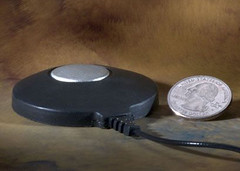
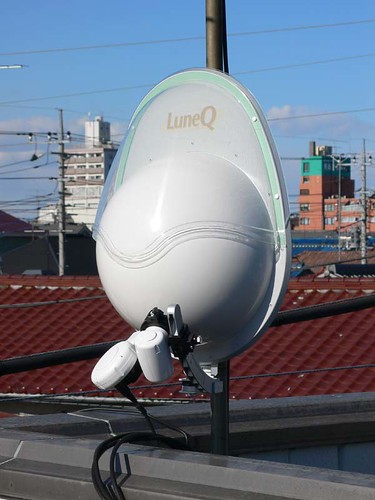
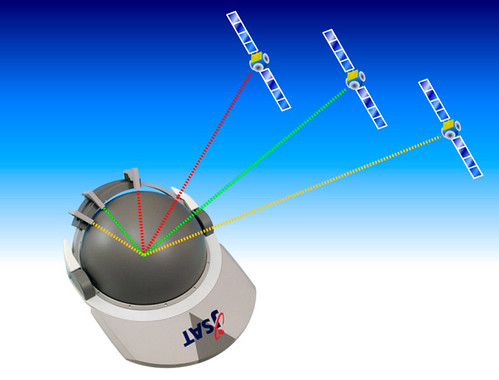
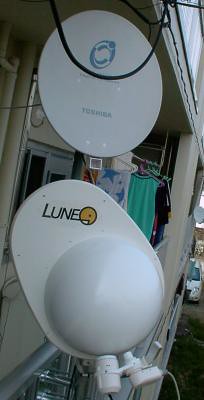
There’s a revolutionary satellite antenna being sold in Japan, based on the Luneberg Lens, capable of receiving signals from multiple satcoms. JSAT’s press release in 2001 announced this breakthrough, and a joint release with Sumitomo Electric introduced it to the marketplace in 2003. This photo journal demonstrates assembly, which looks simple enough.


But was it really a “breakthrough?” I think it was – at least from a marketing perspective.  R. K. Luneberg proposed the principle of this lens for electromagnetic waves in 1944, where a sphere made of materials with relative dielectric constants varying in square distribution from 1 at the surface to 2 at the center becomes a dielectric lens with countless foci on its surface. A dielectric constant is a measurement of a material’s capacity to modify electromagnetic waves. This suggests a single lens antenna is capable of receiving and transmitting waves to and from multiple directions simultaneously – without moving the sphere. Brilliant!


What we have here is a high-gain, low-cost antenna that may have substantial market potential in the U.S and Europe, too.  Presently, antennae based on the Luneberg Lens have been used in mobile military applications, especially on aircraft where a low profile is required. Datron makes and sells a Luneberg Lens Array (LLA). Lun’tech of France is selling one today, and Raven in the U.K. has been talking about one for some time.


Pretty cool how this 60-year-old technology may have an impact in today’s most advanced satellite communications systems. Want to learn more? This comprehensive overview from Stevens Tech in Hoboken is very useful. And if you want to start selling them, the folks at Rozendal Associates can help you make them.


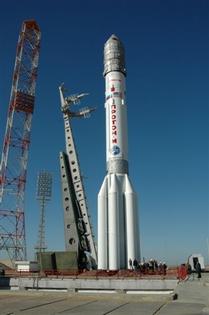
Arabsat Launches Today

Wednesday, November 8th, 2006
ILS is launching the BADR-4 satellite today from Baikonur at 19:40 GMT. Watch it live or tune your satellite receivers to…
In North America:
IA-6 @ 93 West
C-band, analog/NTSC
Transponder 14, 3980H
In Europe & Asia:
NSS-7 @ 338 East
Ku-band, digital/PAL
Transponder: WHL4/EUH3,Channel-1, 11,098.9H
Symbol Rate: 6.1113 Msps
FEC: 3/4
In Africa & Asia:
BADR-C (formerly Arabsat 2C) @ 26 East
Ku-band, digital/PAL
Transponder: C21, 4,120H
Symbol Rate: 27.5 Msps
FEC: 3/4

We like their blog.


BIG Airplane Lands in Cayenne

Tuesday, November 7th, 2006

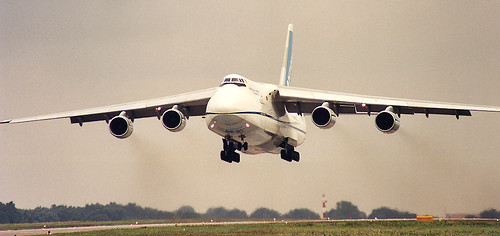
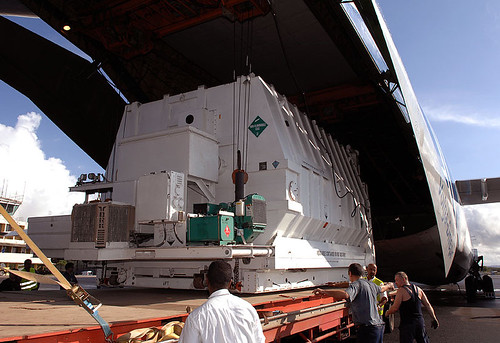
What is THAT? Is it the Big Kahuna landing for Election Day in Florida? No, that’s an Antonov 124 delivering the AMC-18 satellite at Cayenne’s Rochambeau International Airport. The satellite, scheduled for launch in December, is now being transferred to Europe’s Spaceport.

Space Station Unloads Supply Ship; Microsoftie to be next Space Tourist

Friday, October 27th, 2006

With the safe arrival of Anousheh Ansari, the first female space tourist, as we reported a few weeks ago, life continues to be interesting aboard the International Space Station. Today, the Space Stations residents were finally able to open the hatch leading to an unmanned supply shipped that docked with the station 24-hours before. As CBS News reports:

"The Progress M-58 cargo ship, carrying supplies to the station’s three-man crew, docked at the station Thursday at 6:28 p.m. Moscow time (10:28 a.m. EDT) on autopilot, as planned.

Mission Control could not confirm, however, that its antenna had folded as required for the craft to clamp securely on the station although later it announced that it had solved the glitch."

Fortunately, Mission control reports, the crew, which was never in danger of being without food or oxygen, has opened the cargo ship and begun unloading supplies.

In other ISS related news, the billionaire who helped create Microsoft Excel and Word, Charles Simonyi, is supposedly set to be the next space tourist according to the Seattle Post Intelligencer. Simonyi is currently set to join the Space Station crew for eight days (during a ten day mission) aboard a Russian Soyuz spacecraft set to launch on March 9,2007.

Everyone will, of course, be able to follow Simonyi on his travels through his blog at charlesinspace.com.