Archive for the ‘Astronomy’ Category

XM-4 Ready to Join Rock and Roll Satellites

Thursday, October 26th, 2006


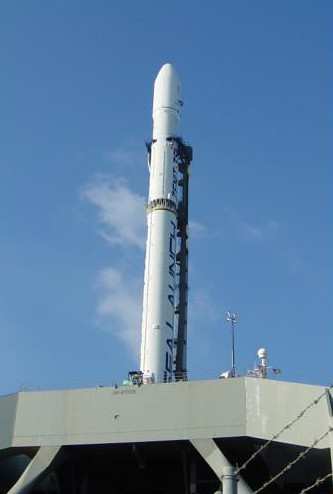
Sea Launch is now preparing for the launch of the XM-4 satellite on 26 October 2006, at 23:49 GMT. Here’s the feed from their webcam:

Live broadcast of the launch will be available in North America via the AMC-3 satellite’s Ku-band payload, transponder 18. The satellite is located at 87 degrees West Longitude. Here are the particulars:
          
Downlink Frequency:   12064  Mhz Vertical
DIGITAL PARAMETERS:      4:2:0      FEC:  3 / 4      Symbol Rate: 6.1113
Audios:    Audio channel 1 / Audio channel 2 = Program Mix ( English)
Standard:    525 NTSC

Transmission test begins at 23:00 GMT, with the live transmission beginning at 23:35. Launch window opens at 23:49 and closes 00:57 on 27 October 2006.

Or you can watch the webcast.

SKY Perfect Merging With JSAT

Wednesday, October 25th, 2006


The Nihon Keizai Shimbun reported that Japanese DTH service SKY Perfect is merging with satellite operator JSAT, which provides carriage for the satellite TV service. The news report prompted this reply from SKY Perfect:

SKY Perfect is currently looking into strengthening its relationship with and possible merger with JSAT, but nothing definite, including the stock transfer ratio, has been decided on at this stage. SKY Perfect will immediately disclose if anything on this matter is decided.

But Reuters goes a little deeper:

Japanese satellite broadcaster Sky Perfect Communications Inc. will acquire satellite communications company JSAT Corp. and create a holding company next spring, the Nihon Keizai business daily reported in its evening edition on Wednesday.

The paper said Sky Perfect will become a holding company, while creating a new entity for its operations. The holding company will bring the new firm and JSAT under its umbrella.

Each JSAT share will likely be swapped for about 4 shares in the holding company, the paper said.

Based on Sky Perfect’s closing share price on Wednesday, the deal would value JSAT at around 93.7 billion yen ($786 million), 7.5 percent below actual market capitalisation.

Shares in Sky Perfect closed down 1.9 percent at 65,700 yen, and JSAT ended down 2.4 percent at 284,000 yen. They underperformed the benchmark Nikkei average’s 0.48 percent fall.

Sky Perfect currently does not own JSAT shares. JSAT, which transmits programming for Sky Perfect’s Sky PerfecTV, holds a 6.9 percent stake in Sky Perfect.

Interesting to note SKY Perfect, the leading satellite TV service in Japan, started up its own IPTV service, OptiCast. For about $25 (3,000 yen), you get 68 channels.  Such a deal.


Lunar Lander XPrize

Monday, October 23rd, 2006


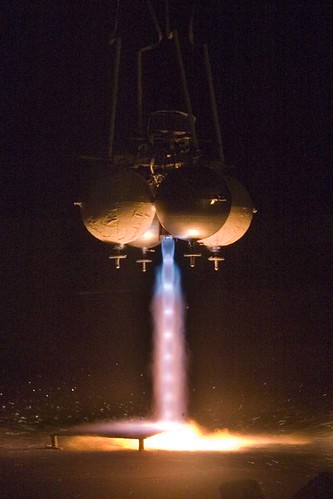
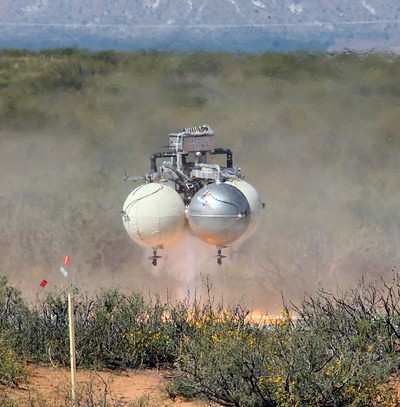
Armadillo Aerospace’s  lunar lander impressed quite a few people at the XPrize Cup in Las Cruces this weekend. Aero-News Net gives this account:

 …the final flight on Saturday, the one that would have earned Armadillo the first tier prize, was frustrated when minor damage done in the previous landing caused a series of events that initiated an inflight abort when the vehicle banked too aggressively shortly after liftoff, and the vehicle went down, damaging itself beyond the ability to fly again.


U.S. National Space Policy

Wednesday, October 18th, 2006

"Consistent with this policy, the United States will: preserve its rights, capabilities, and freedom of action in space; dissuade or deter others from either impeding those rights or developing capabilities intended to do so; take those actions necessary to protect its space capabilities; respond to interference; and deny, if necessary, adversaries the use of space capabilities hostile to U.S. national interests."

Click here to read the unclassified version.

Interesting: a comparison to Clinton’s policy of 1996.

X-Prize Cup Tournament This Friday & Saturday in New Mexico

Wednesday, October 18th, 2006

For readers that haven’t established weekend plans just yet, you might want to consider a quick jaunt out to La Cruces, NM where the Wirefly X-Prize Cup will be taking place this coming Friday and Saturday (Oct. 20 & 21).

The main event of the weekend will, of course, be the $2.5 million in Prize competitions that will being going on throughout the exposition.

The Northrop Grumman Lunar Lander and Vertical Lander Challenge will probably be on of the most watched events, but the Spaceward Foundation‘s Space Elevator Challenge may be among its most technically interesting. In the Space Elevator Games, teams will be competing for two, separate $200,000 prizes, one for who builds the best climber (a machine capable of traveling up and down a tether ribbon, with powering being beamed to a transmitter on the device) and the team that builds the strongest tether (first competing against other teams and then by proving that its tether is 50% stronger than the off-the-shelf variety.

While we’ve written about the space elevator competition in the past, Really Rocket Science readers will also have a leg-up on other attendees in terms of other events going on at the space exposition. Also taking place during the fair will be the unveiling of the Rocket Racing League’s X-Racer (written about at RRS here) and meet and greet with the world’s first space tourist, Anousheh Ansari (written about on RRS just a few weeks ago).

Stay tuned to Really Rocket Science for all the information coming out of New Mexico in the next few days. While we won’t be there, we’re going to stick to this story in the days ahead.

Nice Launch: Ariane 5 ECA

Monday, October 16th, 2006

Mission réussie pour Ariane 5 ECA
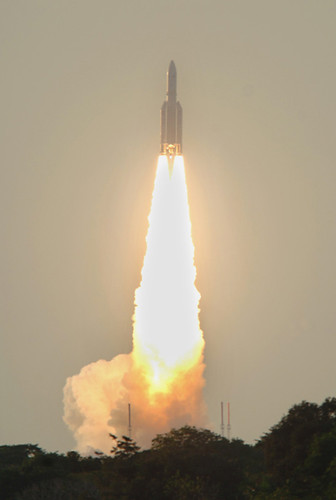
Dans la nuit du vendredi 13 au samedi 14 octobre 2006, Arianespace a mis en orbite de transfert géostationnaire le satellite DIRECTV 9S pour l’opérateur américain DIRECTV et le satellite OPTUS D1 pour l’opérateur australien OPTUS. Grâce au plateau ASAP 5, le lancement emportait également le réflecteur expérimental LDREX-2 pour l’agence spatiale japonaise JAXA.

Arianespace placed two satellites into geostationary transfer orbit: DIRECTV 9S for the U.S. operator DIRECTV Inc., and OPTUS D1 for the Australian operator OPTUS. The Ariane 5 ECA launcher was also fitted with the ASAP 5 platform, allowing it to deploy the LDREX-2 experimental reflector for the Japanese space agency JAXA.

Provisional parameters at injection of the cryogenic upper stage (ESC-A) were:
Perigee: 249.4 km for a target of 249.5 km (±3)
Apogee: 35,940 km for a target of 35,946 km (±160)
Inclination: 6.98 º for a target of 7.0 degrees (±0.06º)

DIRECTV 9S was built by Space Systems/Loral in Palo Alto, California, and will be positioned at 101 degrees West. Weighing approximately 5,530 kg at liftoff, DIRECTV 9S is fitted with 52 high-power Ku-band transponders and 2 Ka-band transponders. It will provide direct TV broadcasts using digital compression technology. DIRECTV 9S will give American TV viewers a greater choice of broadcast services, while prefiguring tomorrow’s multibeam satellites for multimedia applications. Design life is about 15 years.

OPTUS D1 was integrated by American manufacturer Orbital Sciences Corporation in Dulles, Virginia, based on a Star-2 platform. OPTUS D1 will weigh about 2,300 kg at launch. Positioned at 160 degrees East, it will provide direct TV broadcasts, Internet links, voice and data services for Australia and New Zealand. Its design life is 15 years.

LDREX-2 (Large-scale Deployable Reflector Experiment 2), launched on behalf of the Japan Aerospace Exploration Agency (JAXA), is a small-sized partial model representing the large deployable antenna to be used on the ETS-8 technology satellite, which will be launched in December 2006.
Arianespace to Launch DirecTV Satellite Tomorrow

Thursday, October 12th, 2006

Among those who aren’t suspicious of undertaking major endeavors on Friday the 13th, you can include both Arianespace and DirecTV.

The Ariane 5ECA rocket is scheduled to launch tomorrow afternoon between 4:56 and 5:56 pm, U.S. Eastern time. The launch will take place from the ESA spaceport in Kourou, French Guiana.

The launch will service three customers and deploy three satellites: DirecTV’s 9S, Optus’ Optus D1, and JAXA’s LDREX-2.  

The 9S satellite "will be capable of providing up to 54 transponders for high-quality local and national digital video service broadcast into 27 beams. In an alternate configuration, the satellite will be capable of providing up to 44 transponders broadcast into 30 beams."

Want to know what to expect from the launch, second by second? Check out Spaceflight Now’s cool launch cue card

Labrador Internet Connections At Risk

Tuesday, October 10th, 2006

Sailing from England with one vessel, the Matthew, on 20 May 1497, John Cabot (Giovanni Caboto) and a crew of 18 reached what some historians now believe was Labrador on 24 June 1497. He went ashore to take possession of the land, exploring the coast for some time and departing on or about the 20th of July.

Upon his return to England, Cabot was well rewarded (a pension of 20 pounds a year), and a patent was written for a new voyage. In 1498, he sailed for America with 5 ships. One of the ships became distressed and diverted to an Irish port. Nothing was ever heard of the other — or John Cabot — ever since.

Will the same happen to Internet connections in Labrador today? The CBC reports that’s what might happen if Industry Canada’s Community Access Program (CAP) cuts funding. In a town like Black Tickle, where dial-up service became available only recently, people see the need:

The cut may mean the closure of 21 internet sites in Labrador. In many coastal communities, the only efficient way to connect to the internet is via satellite.

Brenda Roberts, principal of St. Peter’s school in the southern Labrador community of Black Tickle, said CAP sites are used broadly. Students use the connection for research, and the school’s administration depends on it.

"Our fee for this internet connection to [the] satellite system is around $220 a month, so basically, if you compare it to a human body, well, we’re going to die of heart failure in January," Roberts said.

Residents in the community rely on satellite-based CAP sites for everyday things, including commerce and filling out government forms.

"We’ve got no bank here now and it’s easier to get a piece of gold nugget here than cash, so being able to bank online is all right," she said.

Who will step in to help? Will it be Canada’s dominant satellite operator, Telesat? Perhaps this is the type of situation where Telesat’s new competitor, Ciel Satellite, saves the day? There are other options, of course: resellers such as Barrett Xplore, who use satellites operated by Intelsat.

Remember The Schwartz!

Wednesday, October 4th, 2006

We recently heard about a new venture between Brooksfilms Ltd. and MGM Studios to produce and distribute a new animated TV series based on the 1987 Mel Brooks feature film "Spaceballs." The G4 cable network and Berliner Film Companie are also in on the development and production.

The show is set to debut on G4 in the fall of 2007. Owned by Comcast, the G4 channel is distributed to nearly 60 million households in the U.S. via satellite and cable systems. G4 has exclusive U.S. distribution rights.


Mach 23 Will Set You Free

Tuesday, October 3rd, 2006

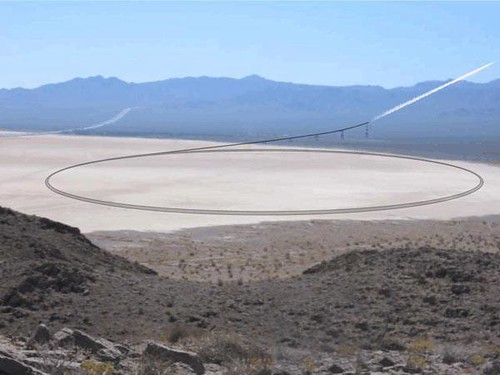
The U.S. Air Force Office of Scientific Research thinks it’s possible, and a company in California wants to prove it: a large electromagnetic ring will be able to launch small satellites into space. Discovery Channel Canada gives us the scoop:

A large circular metal track could accelerate objects to supersonic speed using electromagnets and spit them out into space, says a report from the U.S. air force’s Office of Scientific research.

Tagged as the Launch Ring by its inventing company, Launch Point Technologies, the track would be several kilometers in diameter. Similar to trains that hover on electromagnetic tracks, a sled would hover over the ring and be propelled forward using powerful magnets.

According to the company, a satellite protected by an eggshell-like capsule could sit atop the sled and slowly accelerate over a matter of hours to a supersonic 10 km/sec. Then a small explosion could detach the capsule from the sled and it would hurtle into a side tunnel.

From there, it would shoot up a ramp and through the atmosphere into outer space. Traveling at a 23 times the speed of sound, the capsule would experience forces 2,000 times that of normal gravity on Earth.

A rocket strapped on the capsule would correct the trajectory so that it correctly aligned itself in orbit.

The Goleta California company has received funding to begin a two-year study within several weeks. Boosters of the ring hope to one day use it for thousands of launches a year, at a fraction of today’s cost of putting things in space.

Humans could never withstand the forces exerted during the ring’s launch process. Under existing technological limitations, it could only be used to propel supplies to be used by humans on a long-term mission in outer space, or to put satellites into orbit.

The Air Force also suggests it could be used for military purposes, quickly launching weapons around the world.

For more details, try NewScientist.com.