Archive for the ‘Cool Stuff’ Category

Big Bang Monday: Carina Nebula

Monday, February 13th, 2012

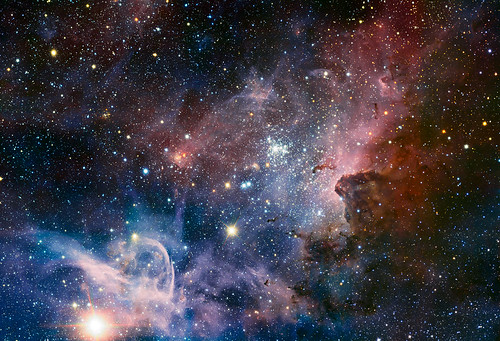
Awesome image from the European South Observatory (image credit: ESO/T. Preibisch)…

This broad panorama of the Carina Nebula, a region of massive star formation in the southern skies, was taken in infrared light using the HAWK-I camera on ESO’s Very Large Telescope. Many previously hidden features, scattered across a spectacular celestial landscape of gas, dust and young stars, have emerged.

Sit back a watch this “trailer” about the VLT (Very Large Telescope)…

Loading player…

Get yourself a huge piece to hang on your wall at Big Bang Prints. Good stuff!


Light Pollution, Seen From The ISS

Monday, February 13th, 2012


Big Bang Monday: Supernova Remnants

Monday, February 6th, 2012

After a very nice Super Bowl yesterday, those of us who spent the time watching eating and drinking massive quantities of stuff we shouldn’t, may be dealing with remnants on another kind of bowl.

How appropriate that today’s Image of the Day from NASA is “Remnant of A Supernova” (G350.1+0.3)…

Vital clues about the devastating ends to the lives of massive stars can be found by studying the aftermath of their explosions. In its more than twelve years of science operations, NASA’s Chandra X-ray Observatory has studied many of these supernova remnants sprinkled across the galaxy.

The latest example of this important investigation is Chandra’s new image of the supernova remnant known as G350.1+0.3. This stellar debris field is located some 14,700 light years from the Earth toward the center of the Milky Way.

Evidence from Chandra and from ESA’s XMM-Newton telescope suggest that a compact object within G350.1+0.3 may be the dense core of the star that exploded. The position of this likely neutron star, seen by the arrow pointing to “neutron star” in the inset image, is well away from the center of the X-ray emission. If the supernova explosion occurred near the center of the X-ray emission then the neutron star must have received a powerful kick in the supernova explosion.

Data suggest this supernova remnant, as it appears in the image, is 600 and 1,200 years old. If the estimated location of the explosion is correct, this means the neutron star has been moving at a speed of at least 3 million miles per hour since the explosion.

Another intriguing aspect of G350.1+0.3 is its unusual shape. Many supernova remnants are nearly circular, but G350.1+0.3 is strikingly asymmetrical as seen in the Chandra data in this image (gold). Infrared data from NASA’s Spitzer Space Telescope (light blue) also trace the morphology found by Chandra. Astronomers think that this bizarre shape is due to stellar debris field expanding into a nearby cloud of cold molecular gas.

The age of 600-1,200 years puts the explosion that created G350.1+0.3 in the same time frame as other famous supernovas that formed the Crab and SN 1006 supernova remnants. However, it is unlikely that anyone on Earth would have seen the explosion because of the obscuring gas and dust that lies along our line of sight to the remnant.

These results appeared in the April 10, 2011 issue of The Astrophysical Journal.

Image Credits: X-ray: NASA/CXC/SAO/I. Lovchinsky et al; IR: NASA/JPL-Caltech

The description references the “Crab Nebula” — get your prints here.


Aurora Australis

Friday, February 3rd, 2012

Red Aurora Australis from Alex Cherney on Vimeo.

Oy!, nice video, mate!.

After chasing it for more than two years I was finally rewarded with two displays of Auroa Australis (Southern lights) within a week visible from Mornington peninsula, not far from Melbourne. The nights were warm an clear and the Moon was not in the sky either – I could not have asked for better conditions.

The red color of this aurora is caused by the charged particles from the Sun exciting oxygen atoms high in the Earth’s atmosphere. Hopefully there will be more to come as Sun’s activity increases in 2012-13.

Being able to photograph it all night I came up with a nice video. The brighter Aurora happened on January 22nd and the smaller one, featured in the middle section, was from January 16th, followed by a rather bright Moonrise.


Dawn of the Personal Space Age?

Tuesday, January 24th, 2012

Interesting project developing at Cornell University, via grad student Zac Manchester: KickSat. Want one? It’s only a few hundred bucks and will transmit text message from space. That’s cool.

They need help…

I need your help to put as many Sprites into orbit as possible to demonstrate that they can be safely launched and operated. A minimum fundraising goal of $30,000 (that’s 100 people sponsoring one Sprite each) will allow us to build, test, and integrate all the hardware for KickSat and the Sprites.

As soon as funding is in place, we’ll apply for a free launch through several programs, such as NASA’s ELaNa CubeSat program. While we are not guaranteed a free launch, there are many such opportunities each year and I believe this project has enough technical appeal and value to NASA to compete with anything out there.

If at least 400 spacecraft-adventurers sponsor Sprites, we’ll be able to use the additional funding to purchase a commercial launch, which will help ensure us a ride into space and allow us to get there sooner than we could relying on a free launch – by early 2013 if all goes well.

If at least 1000 space pioneers join us by sponsoring Sprites, we’ll be able to dramatically improve and shrink our design by getting custom microchips made. If we can do that, then costs could be driven down so that every school or even every school child could one day have their own spacecraft to explore the solar system.

Yeah, it’s pretty small (3.8 cm) and was promoted by Radio Shack not too long ago.


Killer 3-D

Monday, January 23rd, 2012

Named after the scientific name for a killer whale and accurate to less than a millimeter, a new camera system developed by NEK is making waves in 3-D modeling.

Via PhysOrg.com

The OrcaM system involves a large sphere, likened by one viewer as a giant maw, inside which one places the desired object for 3-D scanning. Once the object is placed inside, the sphere is sealed shut and the seven cameras and lights go to work. The cameras take simultaneous high-definition photos of the object at different angles. Serving to define the object’s geometry, various combinations of lights illuminate the object differently for every shot, capturing the finest details. After the photo processing, computer processing of the image creates the 3-D model. Observers say the end result is a highly impressive agreement of the real object.


The Name is Matter. Dark Matter

Thursday, January 19th, 2012

Last week, while many were awaiting news of fresh electro-gadgets from the CES in Las Vegas, The American Astronomical Society held its 219th meeting in Austin.

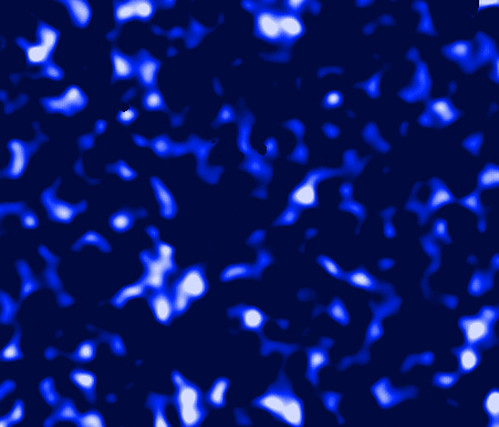
At the meeting, research was presented on a vast, one-billion-light-year-wide map showing lots of dark matter…

Astronomers have created a vast cosmic map revealing an intricate web of dark matter and galaxies spanning a distance of one billion light-years.

This unprecedented task was achieved not by observing dark matter directly, but by observing its gravitational effects on ancient light traveling from galaxies that existed when the Universe was half the age it is now.

Constructed by astronomers from the University of British Columbia and University of Edinburgh, this is the largest dark matter map ever built and took five years to complete.

The research was presented at the American Astronomical Society meeting in Austin, Texas, on Monday.

Dark matter pervades the entire observable universe, accounting for 83 percent of the mass of the cosmos. But as it does not scatter or radiate light (or any kind of electromagnetic radiation for that matter), we cannot see it. Naturally, this poses an interesting problem for astronomers hoping to map the stuff.

However, astronomers can indirectly observe dark matter as its mass exerts a gravitational force on the space-time surrounding it. As light travels from distant galaxies, it will be bent around gravitational distortions in space-time — much like the paths of marbles rolling across a bent sheet of plastic — being caused by the dense regions of dark matter.

With this in mind, the international team of astronomers analyzed light from 10 million galaxies in four different regions of the sky — all of which are around 6 billion light-years from Earth.

And the CES? It wasn’t much fun, according to Pogue

C.E.S. really is primarily a deafening showcase for tablets, thin TV screens, superthin laptops and Android phones.

Check it out: the universe is 96% dark matter.

Energomash: High Security Factory

Friday, January 6th, 2012

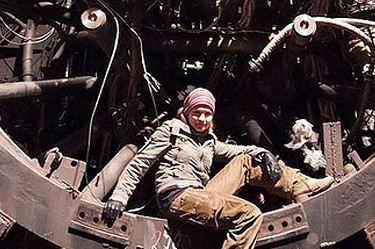
There’s a new “hero of the motherland” in Russia this week. Her name is Lana Sator. She used an old tunnel entrance to gain access to one of the world’s most important rocket factories.

She took lots of cool pictures over five nightly trips through the tunnels. The Russian government? Not happy about it. She published their letters, too.


Yes, MASTER?

Wednesday, December 14th, 2011

There’s no shortage of DoD acronyms. There was that hosted payload on one of the SES spacecraft, CHIRP (Commercially Hosted Infrared Payload). The topper is now MASTER: Modular Architecture for Signal-processing, Tracking and Exploitation Research program. Yeah, seems a bit of a stretch. It comes to us via the rocket scientists at Northrup Grumman:

MASTER supports the government ground processing effort for the Air Force’s Commercially Hosted IR Payload (CHIRP) program’s on-orbit period. An experimental CHIRP sensor is hosted on a commercial SES satellite operating in geosynchronous orbit over the United States. The SES satellite was successfully launched on Sept. 21 from French Guiana.

“MASTER provides an important sensor-agnostic ground processing capability for our customer,” said Ron Alford, Northrop Grumman’s director, sensor exploitation systems and Colorado campuses. “The architecture utilizes an enterprise approach with an open architecture and plug-and-play components. In future data processing systems, measurable cost savings can be enjoyed by using the MASTER architecture to provide common processing capabilities across sensor types and system constellations without the need for customized processing chains.”

“This approach not only reduces costs, but facilitates new missions, new sensor/data providers and the participation of third parties in specialized processing algorithms for new and changing missions,” Alford said.

The enterprise architecture developed for the MASTER program can be used by multiple types of sensors without the redundant cost of redeveloping the ground mission processing software, but currently is prototyped against Overhead Persistent Infrared (OPIR) sensors.

MASTER has been successful in integrating and using algorithms provided by outside third parties as well as processing data from multiple operational OPIR sensors and new experimental simulated data. The MASTER architecture has also enabled innovative parallel data processing with multiple plug-and-play algorithms, along with significant advances in star and static-source line-of-site correction methods.

The MASTER contract is a follow-on effort to the Alternative Infrared Satellite System program, begun in 2006 and renamed Third Generation Infrared Surveillance as a technology maturation program. MASTER has been focused on developing an open, plug-and-play, sensor-agnostic processing architecture for the government to use in evaluating whole earth-staring array sensors.

Yes, you read that right: “earth-staring array sensors.” Our favorite is AFRTS (Armed Forces Radio & Television Services). Pronounced as you would expect.


Big Bang Monday: Tripping in Tromsø

Monday, December 5th, 2011

Of all the countries of the world, I always thought the Kingdom of Norway would be a great place to live. As long as you can deal with the long winters, pretty much all else is taken care of. With the highest per capital oil production of any country outside the Middle East, your cost for education is zero. Gasoline prices are pretty high — to keep consumption down. Why go anywhere by car when you could walk, bike or sled?

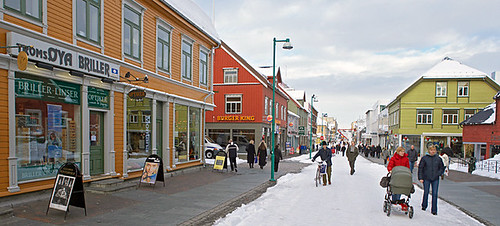
In the northern parts, particularly Tromsø (“the capital of the Arctic” — tourist site offers only summer pics), the Northern Lights provide enough entertainment to last a lifetime. No need for a telescope here — low light pollution and the most spectacular visuals.

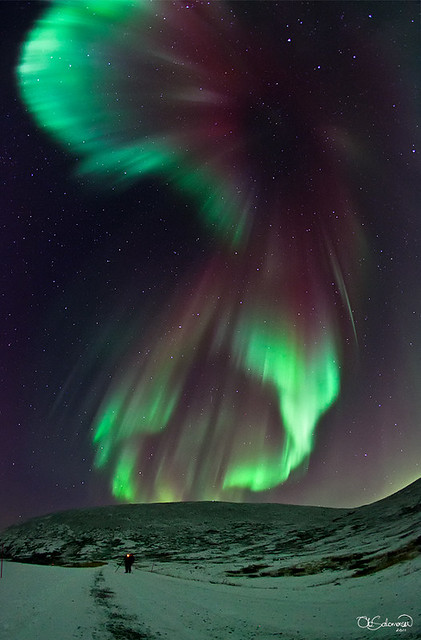
Today’s APOD by Ole Christian Salomonsen is just that: spectacular!

Explanation: It was one of the most memorable auroras of the season. There was green light, red light, and sometimes a mixture of the two. There were multiple rays, distinct curtains, and even an auroral corona. It took up so much of the sky. In the background were stars too numerous to count, in the foreground a friend trying to image the same sight. The scene was captured with a fisheye lens around and above Tromsø, Norway, last month. With the Sun becoming more active, next year might bring even more spectacular aurora.

One of these days, a vacation in Norway awaits.