Archive for the ‘Cool Stuff’ Category

Big Bang Monday: Gliese 581g

Monday, November 28th, 2011

Located 20.5 light years away (123 trillion miles), Gliese 581g has a 100% chance of sustaining life. The planet is located in the “Goldilocks” zone, which is considered habitable. If you used a rocket traveling at 1/10 the speed of light (19,000 MPH), it would take 200 years to get there — who has time for that, Dave?

It was announced in September:

A team of planet hunters from the University of California (UC) Santa Cruz, and the Carnegie Institution of Washington has announced the discovery of a planet with three times the mass of Earth orbiting a nearby star at a distance that places it squarely in the middle of the star’s “habitable zone.”

This discovery was the result of more than a decade of observations using the W. M. Keck Observatory in Hawaii, one of the world’s largest optical telescopes. The research, sponsored by NASA and the National Science Foundation, placed the planet in an area where liquid water could exist on the planet’s surface. If confirmed, this would be the most Earth-like exoplanet yet discovered and the first strong case for a potentially habitable one.

To astronomers, a “potentially habitable” planet is one that could sustain life, not necessarily one where humans would thrive. Habitability depends on many factors, but having liquid water and an atmosphere are among the most important.

The new findings are based on 11 years of observations of the nearby red dwarf star Gliese 581 using the HIRES spectrometer on the Keck I Telescope. The spectrometer allows precise measurements of a star’s radial velocity (its motion along the line of sight from Earth), which can reveal the presence of planets. The gravitational tug of an orbiting planet causes periodic changes in the radial velocity of the host star. Multiple planets induce complex wobbles in the star’s motion, and astronomers use sophisticated analyses to detect planets and determine their orbits and masses.

Washington State’s Dirk Schulze-Makuch has a group of scientists working on it.


ISS Time-Lapse Video of Earth

Wednesday, November 23rd, 2011

Time Lapse From Space – Literally. The Journey Home. from Fragile Oasis on Vimeo.

Great video by American astronaut — and SUNY Oneonta graduate — Ron Garan

The video shows his first attempt at time-lapse photography, suggested by his photography instructor Katrina Willoughby. He set up a Nikon D3S camera in the Cupola windowed observatory to take about 500 pictures at 3-second intervals. The project continued using D3S and D2XS cameras.

All the sequences that appear in the video were shot by either Garan or Fossum. It shows the space station’s orbits around the Earth, though the photography seems to speed up the motion.

The breath-taking sights seen on the video include the world from central Africa to Russia, Europe to the Middle East and footage of the United States. It also includes hurricanes Katia and Irene and several lightning storms.

It is set to the music of Peter Gabriel, featuring his songs “Downside Up” and “Down To Earth.”

Vertical Landing

Tuesday, November 22nd, 2011

Blue Origin’s New Shepherd features a reusable first stage booster.

Vertical landings are cool.

The company is backed by Amazon.com’s Jeff Bezos, so if you like what you see, do your shopping there this week.

Yeah, vertical landing is the stuff of old science fiction. Like this from Bugs Bunny…


Big Bang Monday: Know Your Black Hole

Monday, November 21st, 2011

Stephen Hawking was wrong. He bet Kip Thorne at CalTech that Cygnus X-1 did not contain a black hole. Now we know for sure, with scientists having done a complete description.

Here’s how

Though Cygnus X-1 has been studied intensely since its discovery, previous attempts to measure its mass and spin suffered from lack of a precise measurement of its distance from Earth. Reid led a team that used the National Science Foundation’s Very Long Baseline Array (VLBA), a continent-wide radio-telescope system, to make a direct trigonometric measurement of the distance. Their VLBA observations provided a distance of 6070 light-years, while previous estimates had ranged from 5800-7800 light-years.

Armed with the new, precise distance measurement, scientists using the Chandra X-Ray Observatory, the Rossi X-Ray Timing Explorer, the Advanced Satellite for Cosmology and Astrophysics, and visible-light observations made over more than two decades, calculated that the black hole in Cygnus X-1 is nearly 15 times more massive than our Sun and is spinning more than 800 times per second.

“This new information gives us strong clues about how the black hole was born, what it weighed and how fast it was spinning,” Reid said. “Getting a good measurement of the distance was crucial,” Reid added.

“We now know that Cygnus X-1 is one of the most massive stellar black holes in the Milky Way,” said Jerry Orosz, of San Diego State University. “It’s spinning as fast as any black hole we’ve ever seen,” he added.

In addition to measuring the distance, the VLBA observations, made during 2009 and 2010, also measured Cygnus X-1’s movement through our Galaxy. That movement, the scientists, said, is too slow for the black hole to have been produced by a supernova explosion. Such an explosion would have given the object a “kick” to a much higher speed.

That top image would make a really good, big print.


Dude, Check Out The Moon!

Friday, November 18th, 2011

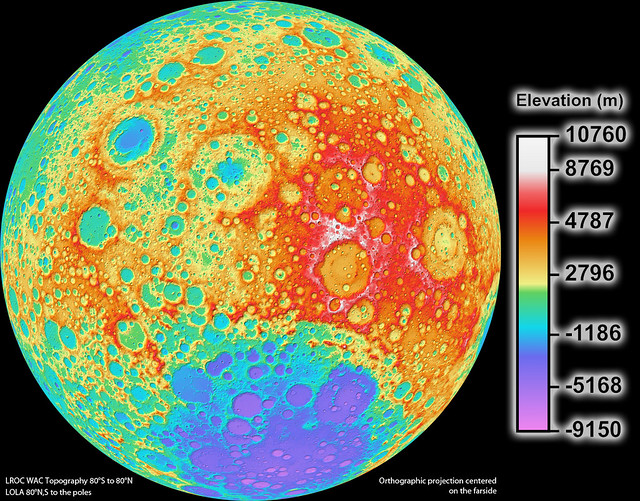
Yeah, that’s cool. It’s a new 100m scale map of the moon, says NASA

“Our new topographic view of the moon provides the dataset that lunar scientists have waited for since the Apollo era,” says Mark Robinson, Principal Investigator of the Lunar Reconnaissance Orbiter Camera (LROC) from Arizona State University in Tempe. “We can now determine slopes of all major geologic terrains on the moon at 100 meter scale. Determine how the crust has deformed, better understand impact crater mechanics, investigate the nature of volcanic features, and better plan future robotic and human missions to the moon.”

Called the Global Lunar DTM 100 m topographic model (GLD100), this map was created based on data acquired by LRO’s WAC, which is part of the LROC imaging system. The LROC imaging system consists of two Narrow Angle Cameras (NACs) to provide high-resolution images, and the WAC to provide 100-meter resolution images in seven color bands over a 57-kilometer (35-mile) swath.

The WAC is a relatively small instrument, easily fitting into the palm of one’s hand; however, despite its diminutive size it maps nearly the entire moon every month. Each month the moon’s lighting has changed so the WAC is continuously building up a record of how different rocks reflect light under different conditions, and adding to the LROC library of stereo observations.

The LROC (WAC) has a pixel scale of about 75 meters (246 feet), and at the average altitude of 50 km (31 miles) a WAC image swath is 70 km (43 miles) wide across the ground-track. Since the equatorial distance between orbits is about 30 km (18 miles) there is complete overlap all the way around the moon in one month. The orbit-to-orbit WAC overlap provides a strong stereo effect. Using digital photogrammetric techniques, a terrain model can be computed from the stereo overlap.

The near-global topographic map was constructed from 69,000 WAC stereo models and covers the latitude range 79°S to 79°N, 98.2% of the entire lunar surface. Due to persistent shadows near the poles it is not possible to create a complete stereo based map at the highest latitudes. However, another instrument onboard LRO called LOLA excels at mapping topography at the poles. Since LOLA ranges to the surface with its own lasers, and the LRO orbits converge at the poles, a very high resolution topographic model is possible, and can be used to fill in the WAC “hole at the pole.” The WAC topography was produced by LROC team members at the German Aerospace Center.


Shrimp TV

Thursday, November 17th, 2011

Our friends at KVH Industries have been on a tear in recent years. We last read about their TracVision M1 system being a critical component in a boat’s entertainment system. And in September, their MiniVSAT Broadband service went global, licensed to operate offshore and in-port in 125+ countries.

Today we read the National Marine Electronics Association has named the TracVision M1 “Best Marine Entertainment Product” for the 3rd year in a row.

KVH Industries, Inc., and its TracVision family of satellite TV products are the choice of the National Marine Electronics Association (NMEA) for the 14th consecutive year. The company’s TracVision M1, the world’s smallest maritime satellite TV antenna, was recently honored with its third consecutive “Industry Award” for best marine entertainment product — the product received this honor after its introduction in 2009 and again in 2010. Each year, NMEA members vote for their favorite products in a range of categories, and the product that receives the most votes in a given category is honored with that year’s Industry Award. These awards have become a trusted symbol of outstanding quality throughout the marine electronics industry.

Marine electronics technicians continue to bestow this honor on TracVision M1 both for its ease of installation and because it opened up a completely new market for maritime satellite TV.

“The TracVision M1 allows us to put live TV on boats for which it was previously out of the question financially, or on which larger domes would look ridiculous,” says Duncan Nevard of Intrepid Marine Electronics in Stamford, CT. “It weighs less than eight pounds, so we can literally replace someone’s little flying saucer over-the-air TV antenna — on the same bracket — with a first-class, in-motion satellite TV solution. That allows us to bring high-end marine electronics to a whole new group of boats.”

I agree: a shrimp-size satellite TV set-up for a couple “Grover Clevelands” ain’t bad. Look, you’re paying for the damn boat, so why not pay a little more for the good stuff.

Meanwhile, back in Middletown, Rhode Island, it’s all smiles at KVH.


Asteroid 2005 YU55

Monday, November 7th, 2011

A 400-meter wide Near-Earth asteroid will be cutting it close tomorrow. Will you be able to see it? Yes, but it won’t be easy.

Astro Guyz explains…

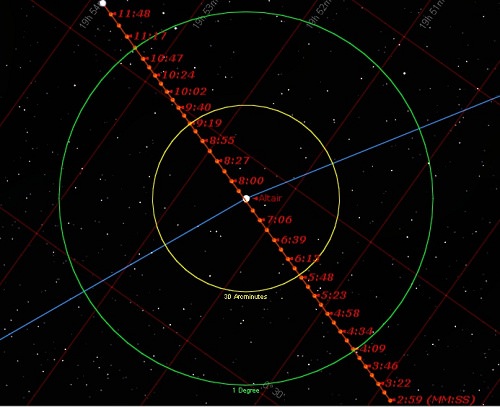
Closest approach to Earth occurs at 11:29 UTC/06:29 EST at about 202,000 miles distant, placing it high to the south west for observers on the US Eastern Seaboard. (Don’t forget to “fall back” to Standard time on Sunday, November 6th; you wouldn’t want to miss seeing the asteroid because of  an anachronistic convention, but I digress..)  At its closest approach, 2005 YU55 will glide along at one degree every 7 minutes, easily noticeable after a few minutes of observation at low power. I plan to target selected areas with my GOTO mount, sketch the field, then watch for changes. I may also take some wide-field piggyback stills with the DSLR, but mostly, this one will just be fun to watch. The asteroid will pass through the constellations Aquila, Delphinus, and Pegasus as it heads westward. Interestingly, 2005 YU55 passes within a degree of Altair centered on 6:07:30PM EST only 27 minutes after local sunset, and also makes a very close pass of the star Epsilon Delphini during closest approach. These both make good visual “anchors” to aim your scope at during the appointed time and watch. Keep in mind, the charts provided are rough and “Tampa Bay-centric…” on an approach as close as this one, two factors muddle the precise prediction coordinates of the asteroid; one is the fact the gravitational field of the Earth will change the orbit of 2005 YU55 slightly, and two is that the position will change due to the position of the observer on the Earth and the effect of parallactic shift. Many prediction programs assume the Earthly vantage as a mere point in space, fine for positioning deep sky objects but not so hot for ones passing near the planet. A good place to get updated coordinates is JPL Horizons website which lets you generate an accurate ephemeris for your exact longitude latitude and elevation.


Big Bang Monday: Super-energetic Millisecond Pulsar

Monday, November 7th, 2011

I like pulsars and I love how our friends at NASA GSFC explain it — with animation.

An international team of scientists using NASA’s Fermi Gamma-ray Space Telescope has discovered a surprisingly powerful millisecond pulsar that challenges existing theories about how these objects form.

At the same time, another team has located nine new gamma-ray pulsars in Fermi data, using improved analytical techniques.

A pulsar is a type of neutron star that emits electromagnetic energy at periodic intervals. A neutron star is the closest thing to a black hole that astronomers can observe directly, crushing half a million times more mass than Earth into a sphere no larger than a city. This matter is so compressed that even a teaspoonful weighs as much as Mount Everest.

“With this new batch of pulsars, Fermi now has detected more than 100, which is an exciting milestone when you consider that, before Fermi’s launch in 2008, only seven of them were known to emit gamma rays,” said Pablo Saz Parkinson, an astrophysicist at the Santa Cruz Institute for Particle Physics at the University of California Santa Cruz, and a co-author on two papers detailing the findings.

One group of pulsars combines incredible density with extreme rotation. The fastest of these so-called millisecond pulsars whirls at 43,000 revolutions per minute.

Millisecond pulsars are thought to achieve such speeds because they are gravitationally bound in binary systems with normal stars. During part of their stellar lives, gas flows from the normal star to the pulsar. Over time, the impact of this falling gas gradually spins up the pulsar’s rotation.

The strong magnetic fields and rapid rotation of pulsars cause them to emit powerful beams of energy, from radio waves to gamma rays. Because the star is transferring rotational energy to the pulsar, the pulsar’s spin slows after this transfer is completed.

Typically, millisecond pulsars are around a billion years old. However, in the Nov. 3 issue of Science, the Fermi team reveals a bright, energetic millisecond pulsar only 25 million years old.

The object, named PSR J1823−3021A, lies within NGC 6624, a spherical collection of ancient stars called a globular cluster, one of about 160 similar objects that orbit our galaxy. The cluster is about 10 billion years old and lies about 27,000 light-years away toward the constellation Sagittarius.

Fermi’s Large Area Telescope (LAT) showed that eleven globular clusters emit gamma rays, the cumulative emission of dozens of millisecond pulsars too faint for even Fermi to detect individually. But that’s not the case for NGC 6624.

“It’s amazing that all of the gamma rays we see from this cluster are coming from a single object. It must have formed recently based on how rapidly it’s emitting energy. It’s a bit like finding a screaming baby in a quiet retirement home,” said Paulo Freire, the study’s lead author, at the Max Planck Institute for Radio Astronomy in Bonn, Germany.

J1823−3021A was previously identified as a pulsar by its radio emission, yet of the nine new pulsars, none are millisecond pulsars, and only one was later found to emit radio waves.

Despite its sensitivity, Fermi’s LAT may detect only one gamma ray for every 100,000 rotations of some of these faint pulsars. Yet new analysis techniques applied to the precise position and arrival time of photons collected by the LAT since 2008 were able to identify them.

“We adapted methods originally devised for studying gravitational waves to the problem of finding gamma-ray pulsars, and we were quickly rewarded,” said Bruce Allen, director of the Max Planck Institute for Gravitational Physics in Hannover, Germany. Allen co-authored a paper on the discoveries that was published online today in The Astrophysical Journal.

Extreme UV Flash

Friday, November 4th, 2011

From our friends at SpaceWeather.com, report of a huge sunspot…

NOAA forecasters have upgraded the chance of X-class solar flares today to 20%. The source would be AR1339, one of the biggest sunspots in many years. The active region rotated over the sun’s eastern limb two days ago and now it is turning toward Earth. Solar flare alerts: text, voice.

The sunspot has already unleashed one X-flare on Nov. 3rd around 2027 UT. A movie from NASA’s Solar Dynamics Observatory shows the extreme ultraviolet flash.

The flare created waves of ionization in Earth’s upper atmosphere, altering the normal propagation of radio waves over Europe and the Americas. In Ireland, the flare’s effect was felt even after dark.

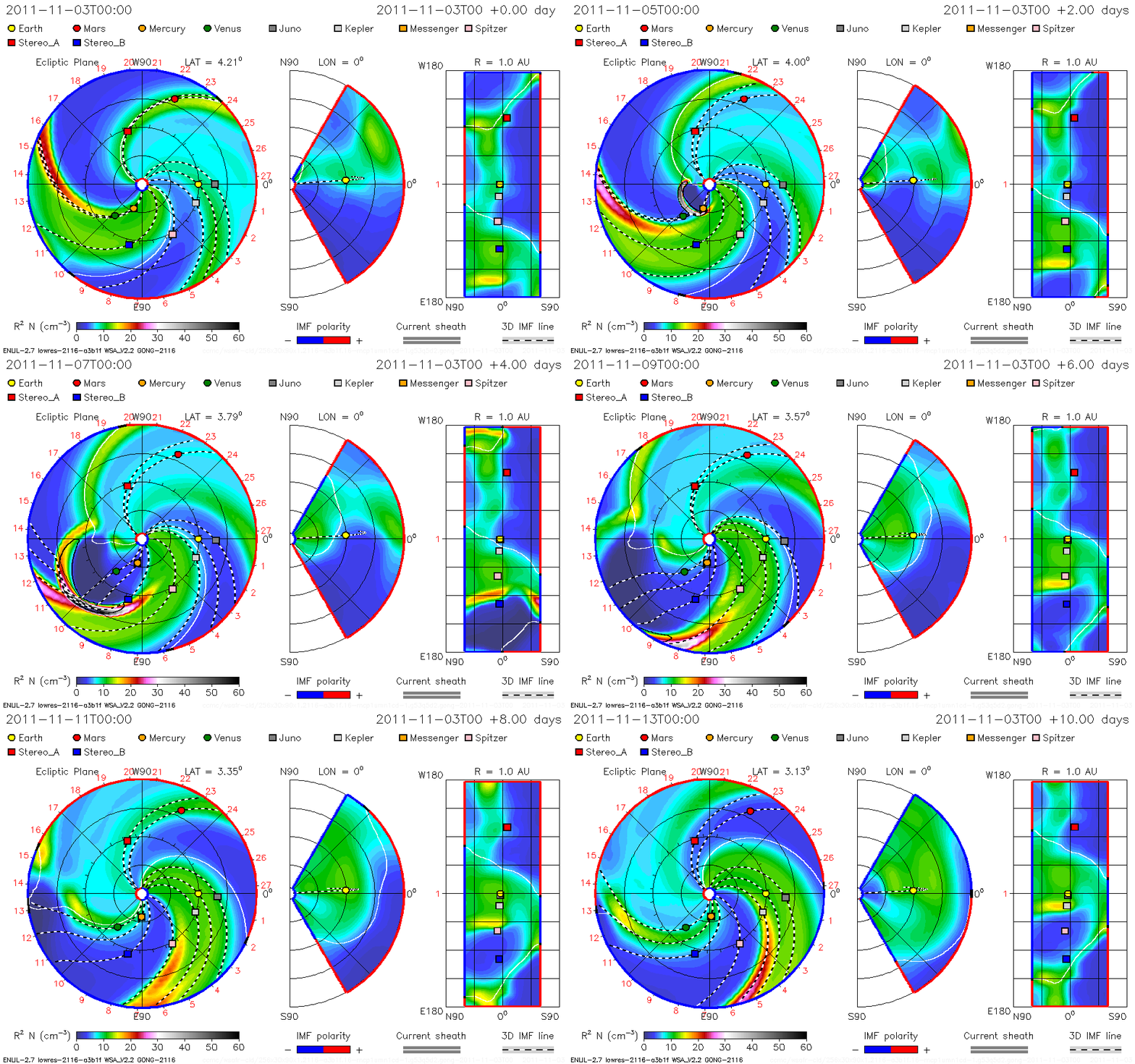
A cloud of plasma or “CME” raced away from the blast site at 1100 km/s. The CME is not heading for Earth. It is, however, heading for Mercury and Venus.

Check out the storm track.


DIY Friday: Jack-O-Lantern Flamethrower

Friday, October 28th, 2011

So this may not be exactly rocket science, but you’ve got to admit THIS IS SO COOL!!

Flamethrowing Jack-O’-Lantern from Randy Sarafan on Vimeo.

Via Instructables, naturally…

A flamethrowing jack-o’-lantern keeps the trick-or-treaters a safe distance from your house and is a fine addition to any anti-Halloween arsenal. At the first sign of any sugar-obsessed imp, simply press the trigger button and wirelessly shoot a one-second burst of flames out of the jack-o’-lantern’s mouth. This plume of hellfire will make even the most bold of people think twice about approaching your door. Very few people are willing to risk life and limb for the chance of a tiny box of milk duds.

WARNING!: This pumpkin is extremely dangerous and you definitely should not make one of these. The instructions were posted here are for entertainment purposes only. I do not condone the manufacture or use of flamethrowing jack-o’-lanterns. Seriously, nothing good will come of making one of these. Don’t do it.

For entertainment only.