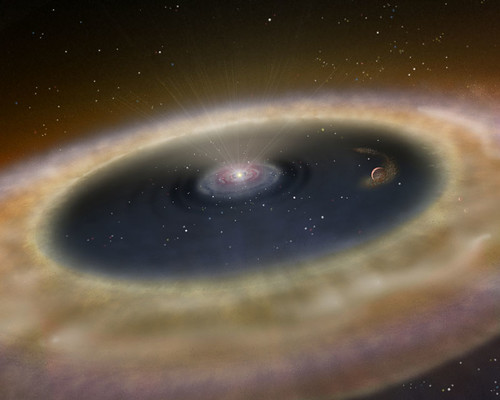
Great work by astronomers Adam Kraus (University of Hawaii Institute for Astronomy) and Michael Ireland (Macquarie University and the Australian Astronomical Observatory) in finding the youngest planet ever.
“LkCa 15 b is the youngest planet ever found, about 5 times younger than the previous record holder,” said Kraus. “This young gas giant is being built out of the dust and gas. In the past, you couldn’t measure this kind of phenomenon because it’s happening so close to the star. But, for the first time, we’ve been able to directly measure the planet itself as well as the dusty matter around it.”
Kraus will be presenting the discovery at an Oct. 19 meeting at NASA’s Goddard Space Flight Center. The meeting follows the acceptance of a research paper on the discovery by Kraus and Ireland by The Astrophysical Journal.
The optical sleight of hand used by the astronomers is to combine the power of Keck’s Adaptive Optics with a technique called aperture mask interferometry. The former is the use of a deformable mirror to rapidly correct for atmospheric distortions of starlight. The latter involves placing a small mask with several holes in the path of the light collected and concentrated by a giant telescope. With that, the scientists can manipulate the light waves.
“It’s like we have an array of small mirrors,” said Kraus. “We can manipulate the light and cancel out distortions.” The technique allows the astronomers to cancel out the bright light of stars. They can then resolve disks of dust around stars and see gaps in the dusty layers where protoplanets may be hiding.
“Interferometry has actually been around since the 1800s, but through the use of adaptive optics has only been able to reach nearby young suns for about the last 7 years.” said Dr. Ireland. “Since then we’ve been trying to push the technique to its limits using the biggest telescopes in the world, especially Keck.”
The discovery of LkCa 15 b began as a survey of 150 young dusty stars in star-forming regions. That led to the more concentrated study of a dozen stars.
“LkCa 15 was only our second target, and we immediately knew we were seeing something new,” said Kraus. “We could see a faint point source near the star, so thinking it might be a Jupiter-like planet we went back a year later to get more data.”
In further investigations at varying wavelengths, the astronomers were intrigued to discover that the phenomenon was more complex than a single companion object.
“We realized we had uncovered a super Jupiter-sized gas planet, but that we could also measure the dust and gas surrounding it. We’d found a planet at its very beginning” said Kraus.
Drs. Kraus and Ireland plan to continue their observations of LkCa 15 and other nearby young stars in their efforts to construct a clearer picture of how planets and solar systems form.
Communication satellites in geosynchronous orbit (GEO), approximately 22,000 miles above the earth, provide vital communication capabilities to warfighters. Today, when a communication satellite fails, it usually means the expensive prospect of having to launch a brand new replacement communication satellite. Many of the satellites which are obsolete or have failed still have usable antennas, solar arrays and other components which are expected to last much longer than the life of the satellite, but currently there is no way to re-use them.
The goal of the Phoenix program is to develop and demonstrate technologies to cooperatively harvest and re-use valuable components from retired, nonworking satellites in GEO and demonstrate the ability to create new space systems at greatly reduced cost. Phoenix seeks to demonstrate around-the-clock, globally persistent communication capability for warfighters more economically, by robotically removing and re-using GEO-based space apertures and antennas from de-commissioned satellites in the graveyard or disposal orbit.
I suspect we’ll get a response from the good people at ViviSat and MDA in Canada. Although they’re talking about on-orbit refueling, not scavenging for parts.
DARPA seeks innovators for its satellite servicing technology programs, with goal of cooperatively harvesting and re-using valuable components from nonworking retired satellites in geosynchronous orbits. [SatNews – 10/21/2011]
China expects to launch its first Mars probe between November 8th and November 20th, following a two-year delay. [SatNews – 10/21/2011]
Boeing delivers 50,000th Combat Survivor Evader Locater combat search and rescue communications system to U.S. joint services. [SatNews – 10/21/2011]
Democratic Voice of Burma web site says Burmese government is preparing to allow licenses for satellite television receivers again following a six-year ban. [Advanced Television – 10/21/2011]
TSF (Telecoms Sans Frontieres) faces conflict and insecurity and can only be on site in daytime as it works to establish communications for humanitarian organizations in Sirte Libya, Gaddafi’s home town and where he was killed. [SatNews – 10/20/2011]
ViaSat-1, touted as DSL competitor, is in orbit following International Launch Services Proton rocket launch from Baikonur Cosmodrome in Kazakhstan. [Space News – 10/20/2011]
Space Systems/Loral announces that ViaSat-1 is performing post-launch maneuvers according to plan. [SatNews – 10/20/2011]
Telesat, owner of nine Canadian beams on ViaSat-1, is delighted with the successful launch of the satellite; has 15-year agreement with Xplornet Communications for use of the capacity. [SatNews – 10/20/2011]
ViaSat-1, launched Wednesday afternoon aboard Proton rocket in Kazakhstan, will allow Xplornet of Canada to provide broadband service to 1.5 million North American customers, and download speeds up to 25 Mbps. [CBC News – 10/20/2011]
Russia’s space program – presently the only way that the United States can access the International Space Station, also seeks to match or even surpass the United States in overall space capabilities. [SatNews – 10/20/2011]
Hermes Datacomms announces that offshore and onshore VSAT services are back in full operation in Libya. [SatNews – 10/20/2011]
EUMETSAT’s Metop-A achieves 15 years of service, providing weather and climate monitoring for Europe. [SatNews – 10/20/2011]
Euroconsult consulting firm says governments will continue to drive Earth observation industry over the coming decade through new satellites and growing demand for data. [SatNews – 10/20/2011]
KVH opens Asia-Pacific headquarters featuring state-of-the-art demo and training lab to serve partners and customers. [MarketWatch – 10/20/2011]
Selex Elsag of Italy to upgrade NATO’s satellite communication systems and associated infrastructure. [UPI – 10/20/2011]
Indian media criticizes government for constant delays in the Indian military satellite program. [SatNews – 10/20/2011]
NSD reaches 20 million homes (100 million viewers) for its Indian pay-TV service. [SatNews – 10/20/2011]
Bently Walker selected by Wayuyu Taya Foundation to provide satellite Internet to Los Lechosos school in remote area of Venezuela. [SatNews – 10/20/2011]
Government and Defence markets prepare for significant growth in satellite data rates, according to leading international satellite market research and consulting firm NSR. [SAT PR – 10/19/2011]
Newtec expects significant growth based on the NSR report on Government and Defence markets, posturing its FlexACM as a solution for maximizing bandwidth efficiencies. [SatNews – 10/19/2011]
SkyBlue receives third extension to its Iridium frequency bandwidth approval for aviation satellite communications in China. [Satellite Today – 10/19/2011]
Caribbean’s newest low fare airline REDjet chooses Blue Sky Network for new tracking and communication systems. [MarketWatch – 10/19/2011]
Farm groups anxious for resolution of issue of interference by proposed LightSquared wireless network with GPS. [AgAlert – 10/19/2011]
European Space Agency picks Thales Alenia Space to lead nine-month study on satellite communications for unmanned aerial systems. [UPI – 10/18/2011]
Globe Wireless is granted Blanket Wireless Radio Station License by Japanese Ministry of Information and Communications, allowing it to offer Inmarsat FleetBroadband mobile satellite services in Japan and on Japanese registered vessels. [Marine Link – 10/18/2011]
Sir Richard Branson, children Sam and Holly, and troupe of dancer/acrobats, scale down, dancing, on walls of new Virgin Galactic Spaceport in New Mexico during dedication.
[SatNews – 10/18/2011]
NASA books flight on Virgin Galactic, with options for two more, to allow engineers, technologists, and scientific researchers to conduct experiments in suborbital space. [SatNews – 10/17/2011]
Newtec gives support for standardization and adoption of industry-wide counter-measures to combat interference, with the DVB accepted work topic Carrier ID as a first step. [SatNews – 10/17/2011]
NASA and Japan release the most complete digital topographic map of Earth produced to date. [SatNews – 101/17/2011]
Small satellites from less-than-500-kilograms to less than 100 grams prompt big ideas for next 25 years. [Space.com – 10/17/2011]
Astrium accepts financial backing from European Space Agency to build new high-speed data relay service for Europe while simultaneously creating a market for it. [Aviation Week – 10/17/2011]
Harris Corporation receives $51.5M delivery order for advanced satellite terminals under U.S. Army’s Modernization of Enterprise Terminals program. [Business Wire – 10/17/2011]
ViaSat wins U.S. DoD study contract to assess bandwidth cost reduction methods for commercial communication satellite systems. [Market Watch – 10/17/2011]
Locus Traxx to use GSM service from Vodafone, and ORBCOMM’s satellite network, to support dual-mode SmartTraxx shipment monitoring, reporting, and alerts solution. [TMCnet – 10/17/2011]
The Hubble Ultra-Deep Field (HUDF) is an image of a small region of space in the constellation Fornax, composited from Hubble Space Telescope data accumulated over a period from September 24, 2003, through to January 16, 2004. It is the deepest image of the universe ever taken,[1] looking back approximately 13 billion years (between 400 and 800 million years after the Big Bang), and it will be used to search for galaxies that existed at that time. The HUDF image was taken in a section of the sky with a low density of bright stars in the near-field, allowing much better viewing of dimmer, more distant objects. The image contains an estimated 10,000 galaxies. In August and September 2009, the Hubble’s Deep Field was expanded using the infrared channel of the recently attached Wide Field Camera 3 (WFC3). When combined with existing HUDF data, astronomers were able to identify a new list of potentially very distant galaxies.[2]
Located southwest of Orion in the southern-hemisphere constellation Fornax, the image covers 11.0 square arcminutes. This is just one-seventieth the solid angle subtended by the full moon as viewed from Earth, smaller than a 1 mm-by-1 mm square of paper held 1 meter away, and equal to roughly one thirteen-millionth of the total area of the sky. The image is oriented so that the upper left corner points toward north (−46.4°) on the celestial sphere.
If you’ve ever dreamed of visiting Mars, buckle up: The following video of NASA’s Mars Opportunity Rover crawling the surface of the red planet between September 2008 and August 2011 is about as close as you’re going to come at this point.
Opportunity’s panoramic still-image camera captured 309 photos as the rover crawled 13 miles to get from Martian Victoria to another, larger crater, the 14-mile-diameter Endeavor, where the rover is currently still located, busy inspecting Martian rocks. The still images were then stitched together to create the video slideshow. A soundtrack was also added by taking data from Opportunity’s accelerometers and speeding it up by 1,000 times to achieve an audible frequency.
If you’ve ever seen the movie Dune (1984), you’ll recall the dramatic worm sightings when you see the Mars terrain…
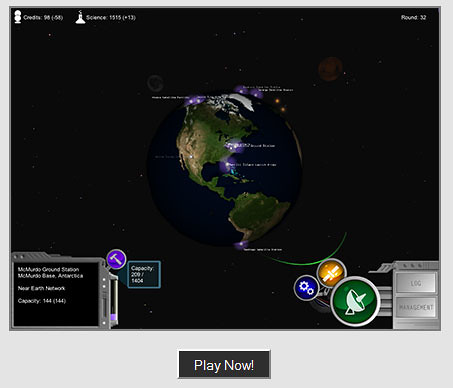
Developed by the Information Technology Office at NASA’s Ames Research Center at Moffett Field, Calif., NetworKing gives players an insider’s perspective into how astronauts, mission controllers and scientists communicate during space missions.
“For any young person who ever dreamed of one day contributing to space missions, NetworKing lets players develop a kingdom of multiple space communication networks working together to support space missions,” said Barbara Adde, policy and strategic communications director for SCaN at NASA Headquarters in Washington.
To successfully construct fast and efficient communication networks, players must first establish command stations around the world and accept clients conducting space missions, such as satellites and space telescopes. Resources are earned throughout the game as players continue to acquire more clients. Players can strategically use accumulated resources to enhance and increase their networks’ capabilities.
Players with the most integrated communications networks will have the ability to acquire more complex clients, such as the International Space Station, Hubble Space Telescope and the Kepler mission.
“As a simple and fun introduction to the complex world of space communications, NetworKing gives players the opportunity to enjoy a challenging game while absorbing the basic concepts of space communication,” said Daniel Laughlin, games researcher at NASA’s Goddard Space Flight Center in Greenbelt, Md. “It’s an engaging way to increase interest in science, technology, engineering and mathematics areas of study and open minds to potential careers in those fields.”
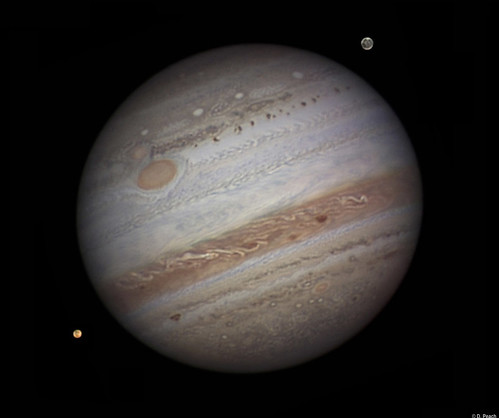
From detailed solar flares to an amazing image of Jupiter and two of its moons, this tour of our solar system has been captured by an amateur British astronomer in his back garden.
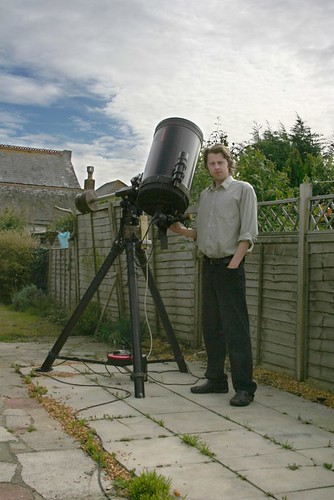
Damian Peach, an electronic engineer from Selsey, West Sussex, has spent the last ten years documenting the changing face of our solar system.
Spending a relatively modest £10,000 on a high-speed telescope and electrical equipment, Mr Peach’s crystal clear images are good enough to rival those of Nasa and the European Southern Observatory in Chile.
So much so that in 2010, he became the only Briton to win the prestigious Astronomy Photographer Of The Year Award for his composite photograph of Jupiter’s moons, Ganymede and Io, orbiting the stormy surface of the gas giant.
Mr Peach said: ‘It’s just fantastic that it’s possible to do something like this from your own back garden.
‘This has been made possible by recent leaps in technology. These days surprisingly good results are possible with small telescopes and low cost webcams.
‘The results possible for home astronomers now were not achievable until the 1990s by even the largest telescopes on Earth.
‘The resolution possible with large amateur telescopes could now be considered of a professional quality in what the images reveal on the planets.’
This composite image of NGC 281 contains X-ray data from Chandra (purple) with infrared observations from Spitzer (red, green, blue). The high-mass stars in NGC 281 drive many aspects of their galactic environment through powerful winds flowing from their surfaces and intense radiation that heats surrounding gas, “boiling it away” into interstellar space. This process results in the formation of large columns of gas and dust, as seen on the left side of the image. These structures likely contain newly forming stars. The eventual deaths of massive stars as supernovas will also seed the galaxy with material and energy.
This gorgeous video was made by science teacher James Drake using images downloaded from The Gateway to Astronaut Photography of Earth. This is a great online resource with basically all of the images taken from orbit, categorized into a searchable database by region and date. He used a free program calledVirtualDub to create the final edit.
James explains on YouTube: “This movie begins over the Pacific Ocean and continues over North and South America before entering daylight near Antarctica. Visible cities, countries and landmarks include (in order) Vancouver Island, Victoria, Vancouver, Seattle, Portland, San Francisco, Los Angeles. Phoenix. Multiple cities in Texas, New Mexico and Mexico. Mexico City, the Gulf of Mexico, the Yucatan Peninsula, Lightning in the Pacific Ocean, Guatemala, Panama, Columbia, Ecuador, Peru, Chile, and the Amazon. Also visible is the earths ionosphere (thin yellow line) and the stars of our galaxy.”
My favorite parts are the golden reflections of the cities’ lights on the solar panels of the ISS and the strobelike flashes of lightning visible in some of the clouds.