Archive for the ‘Cool Stuff’ Category

До свидания, Mio Bambino!

Thursday, February 24th, 2011


Dosvedanya Mio Bombino: Musical best wishes to astronauts Paolo & Aleksandr for ATV docking from Daniel Scuka on Vimeo.

Nice mashup by the ESA.

 Seattle, USA-based band Pink Martini have sent in a fantastic video greeting for the entire ISS crew and especially ESA astronaut Paolo Nespoli, from Italy, and Russian cosmonaut Aleksandr Kaleri as they get ready for today’s ATV Johannes Kepler docking. Lead singer China Forbes sends the group’s best wishes and she’s dedicated one of their favourite tracks, Dosvedanya Mio Bombino – a song about Russia and Italy – to the two astros in space. We’ve mashed up her greeting with some recent ISS and ATV footage, which we hope you’ll enjoy. Thanks, China, and thanks to everyone at Pink Martini for your support and encouragement! Music, Lyrics Copyright (C) Pink Martini – used with permission.

Blog That Hosted Payload

Friday, February 11th, 2011


Interested in government payloads hosted by commercial spacecraft? There’s a blog for that! That’s right, rocket scientists: Space News and Intelsat General put together a Drupal-based blog entitled "Hosted Payloads" last week. Good idea, but will you have enough content to sustain it?


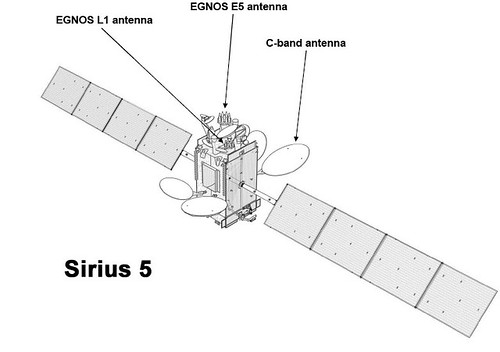
 Satellite operators Intelsat and SES have been talking about it for years, so why not blog about it? Cisco’s IRIS is up, and CHIRP will be going up this year, with a second EGNOS payload on Sirius-5 to follow. Brilliant idea to get Intelsat to sponsor the "microsite."

The timing is actually pretty good. Today’s Wall Street Journal has a piece on space budgets and actually gives some ink to hosted payloads, with Intelsat saying it’s working on three hosted payloads…

Intelsat and other companies have also joined with some Pentagon offices to champion putting more "piggyback" military payloads aboard privately funded and operated satellites.

Such arrangements offer expanded surveillance and communication capabilities significantly faster than, and at a fraction of the cost of, building and launching military satellites. Intelsat has three such agreements in place with the U.S. government and is discussing several others, industry officials said.

What I find peculiar is the Pentagon is talking to two Luxembourg-based companies for hosted payloads. Why not talk to the home boys at U.S. Space LLC? I’d rather deal with Telesat, as they fly a WAAS payload on Anik F1R.

To really get a taste of the details and possibilities of hosted payloads, you should read the Jon Glass story in GeoPlace.com. Excellent summary…

 "It’s the speed and cost efficiency that is really driving the government’s interest in this," adds Jeff Foust, senior analyst with Futron Corp., a technology-management consulting firm that helped organize several government/industry workshops on hosted payloads. "There’s a steady stream of opportunities for hosted payloads, because you have 20 to 25 commercial GEO satellites being ordered and launched every year, plus you have special opportunities such as Iridium NEXT that have a much larger number of satellites in a global system."

Because hosted payloads are relatively new, developing a set of policies and procedures that make it easier for government agencies and the private sector to partner on projects is a challenge. This includes developing mechanisms that regulate contracts and pricing as well as enable federal agencies to take advantage of available opportunities. Because of existing regulations and bureaucratic barriers, government agencies can find it difficult to move at the same speed as the private sector.

A key purpose of hosted-payload workshops has been to give industry and government officials a forum to identify potential barriers and begin to develop solutions. The important thing, notes Foust, is that with the new U.S. space policy, government supporters of hosted payloads now have the official backing of the administration to pursue opportunities.

"It’s a trite phrase, but the use of hosted payloads has the potential to be a win-win," adds Foust. "It’s an opportunity for the industry to maximize potential revenue by making use of satellite capacity that otherwise might go unused. For the government side, it provides a greater degree of flexibility to get important payloads up faster and less expensively than the traditional way of doing business. There’s a great potential here to do more with less and provide some real savings to the taxpayers."

Oh, and SES WorldSkies has a blog now, too. Good luck commenting on that one. SEO, anyone?

Satcom Egypt

Friday, January 28th, 2011


Good luck trying to shut down the Internet in Egypt. You can’t close off the satcom links — especially Thuraya, Iridium, Globalstar or Inmarsat satellite phones.

Although the Internet remains locked down in Egypt, Al-Najjar has been participating in the lively stream of posts on Twitter using the hashtags #Jan25 and #Egypt.

Some of those postings suggest the use of satellite Internet services offered by companies such as Thuraya, Iridium and Inmarsat.

"While in conversation last night, two guys said that they will have the ability to buy one of those phones and transmit," Al-Najjar said. "They were given 18 [phone] numbers outside Egypt to send [photos] to."

Foreign media posted in Cairo published dramatic photos on Friday of protestors battling police firing tear gas and using water cannons to disperse crowds. But absent Internet or mobile phone access, it’s much more difficult for most Egyptians to self-publish, an act that has become an increasingly important component of breaking news coverage.

Satellite Internet services aren’t cheap, however, compared to wired Internet access. Al-Najjar said a satellite-capable phone could cost around US$1,300 in Egypt.

A Thuraya customer service representative said on Friday there were no issues with its service in Egypt, but she did not know if there was an uptick in traffic coming from the country.

Satellite services are not dependent on local carriers for connectivity. So someone in Egypt, for example, could snap a photo of the protests and upload it to a computer connected to a BGAN satellite modem.

As long as the person has aimed the portable modem properly at the satellite, the person should have broadband Internet access, said a sales representative based in South Africa for GlobalCom, which sells portable Internet access for Iridium, Thuraya, Inmarsat and Globalstar Satellite.

 Who started this mass protest stuff? The Ukrainians with their Orange Revolution!

More Money for O3b

Monday, November 29th, 2010


More interesting news for O3b Network: $1.2 billion in funding. As reported by the WSJ

 Satellite communications company O3b Networks said Monday it has raised $1.2 billion from a group of investors and banks, its final funding round before the launch of its global satellite broadband network.

O3b, which is backed by Google Inc., plans to launch its fiber-quality Internet service serving emerging markets in the first half of 2013, after securing $770 million of debt financing and $410 million of equity investment.

The firm’s name refers to the “other 3 billion” people in the world currently without access to broadband Internet.

“We are looking to connect the unconnected, now we can start to do that,” Chief Executive Mark Rigolle said in an interview.

The company already has around 10 customers for its service, who have signed deals valued at $500 million to $600 million to use its infrastructure, Mr. Rigolle said.

O3b is selling capacity on its network on a wholesale basis to Internet service providers and telecom companies. Mr. Rigolle said he expects the strongest long-term demand to come from mobile phone companies in emerging markets, which lack the fiber-optic infrastructure to offer their subscribers high-speed Internet access. O3b’s network will be able to offer “backhaul” connections in place of a fiber network.

Chicken & egg contingencies aside, this is a positive step for O3b. Or is it?

Yes, they’re fully funded for design, build and launch, but will it work well enough to really get some cash coming in? We’ll have to wait another two years to see whether that question will be answered. In real “Internet time,” two years is a very long time and things could change materially — especially in high-risk space-based ventures.

Curiously, this venture is still referred to as “backed by Google,” while SES will increase its ownership to 34%. And they only have to contribute US$75 over the next two years. Judging by the composition of its board of directors, SES seems to be in control here.

Considering the utter lack of connectivity in the regions where “the other 3 billion” people are situated, this is still a good idea. 100-millisecond latency is good enough. Add the possibility of micro-payments via mobile Internet, this could prove to be a real winner. Now hurry up and launch the spacecraft!

DIY Friday: TRON Costumes

Friday, October 29th, 2010


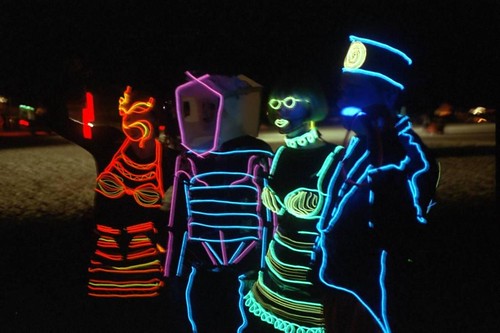
Sure, I remember the Disney movie TRON . Loved it — thought it was one of the coolest movies around. Yes, it stars one of the girls who appeared in Caddyshack (heh). With the new TRON Legacy movie getting good reactions to the preview making the rounds, maybe this Halloween is a good time to make your own TRON costume using electroluminescent wire?

Sonja Thompson posted a "how to" on TechRepublic in August, so I’d start there. Pretty good step-by-step report. Yes, it features "Tron Guy" Jay Maynard, who has gained a fair amount of notoriety in geekdom.


Tech News Daily goes into some details about using EL wire…

“Electroluminescent (EL) wires are really the best option. When you use the LEDs, you have to put them in one at a time, and it takes a while. You can make them react to sound, or make different patterns with them,” said Diana Eng, a fashion designer and author of “Fashion Geek: Clothes, Accessories, Tech” (North Light Books, 2009).

“It’s pretty easy to use. All you need is some AA batteries,” Eng said.

EL wire is regular copper wiring coated in a colored sheath that glows when current runs through the wire. Essentially a very long LED, you can weave it through your costume to add highlights, or give it a futuristic touch, Eng said. By soldering EL wire to a controller, users can program the wires to blink in rhythmic patterns, or respond to sensor input like motion or sound.

The stuff’s made by LyTec, with distributors worldwide. Try Live Wire in New York.

Oh yeah, here’s the TRON lightcycle scene…


And I like this "I’m blue" mash-up…


Buzz Aldrin’s Rocket Experience

Friday, July 30th, 2010

Simply awesome.


DIY Friday: iPhone 4 Antenna Fix

Friday, June 25th, 2010


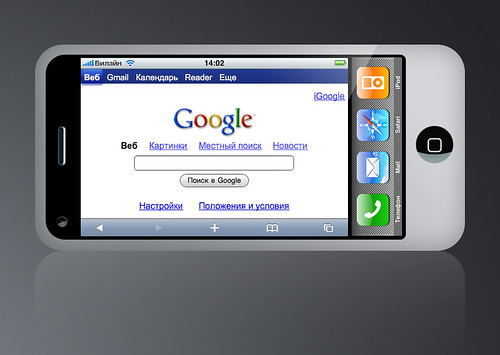
Holding the new iPhone 4 can cause interference between the GSM and WiFi antennae, so naturally the Net is abuzz with this "problem." Hey, it doesn’t take a rocket scientist to figure this one out.

Brilliant Scotchtape solution from Kit Eaton, and costs almost nothing, via Fast Company

  1. Get about an inch of scotch tape off the reel (that’s Sellotape if you’re in the U.K.).
  2. Cut it carefully so that you make a rectangle something over a half-inch long and just tall enough to exceed the iPhone 4’s height (about 0.4 inches should do it).
  3. Align the piece of tape so that it’s covering a section of the lower left metal side of the iPhone 4, some below the thin black plastic line and some above.
  4. Stick it around the phone’s metal edge, making sure that all of the back of the edge’s metal strip is covered–you may even be able to leave the front uncovered, as it’s the back where your hand will rest. The main thing is to ensure that it’s unlikely that your palm will touch the metal on both sides of the black plastic line.

 
Result: Your iPhone 4’s twin antennas are now insulated against skin short-circuiting in the "problem corner". You don’t even have to use scotch tape–make a statement and do it in bright red electrician’s tape, if you feel better for it. 

 It’s about time the geniuses at 3M got some attention.


Oh, and the new iPhone? It’s lovely; held one yesterday.

HFS: Buzz Aldrin!

Thursday, June 17th, 2010


NASA won a Webby Award, which second-man-on-the-moon Buzz Aldrin accepted on their behalf. I love their approach: no more that five words. You’ve got to choose your words carefully, as Buzz did: "Humanity. Colonization. Phobos. Monolith. Mars!"

And Jake from CollegeHumor.com’s "Jake and Amir," who changed his speech when he realized who he was standing next to offstage: "Holy f*cking sh*t, Buzz Aldrin!"

I think space is cool again, thanks to the general public’s curiosity and fascination with space. Let’s not forget the "we could use the money elsewhere" critics, as they’ve got a valid point.

Then there’s the British metal band Iron Maiden, who opened a new tour in Texas. Yeah, they paid a visit to Johnson Space Center and got to play with the Space Shuttle Simulator.


Check out this podcast about this simulator…


DIY Friday: Chumby 3G Router

Friday, April 30th, 2010


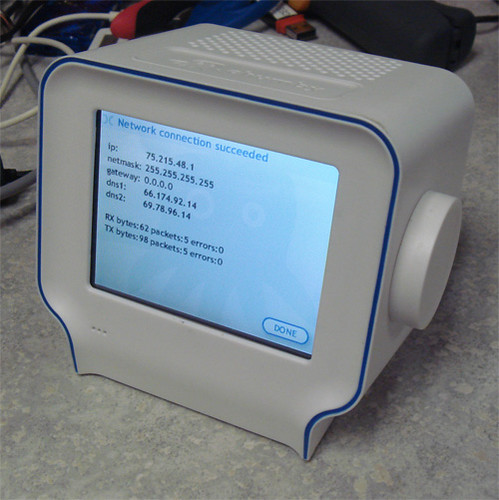
Bunnie’s blog has the coolest 3G router you can make yourself with a Chumby

There’s an Easter Egg inside the chumby One (which is now on sale at Costco online for $99, cheaper than chumby.com’s $119 price!) that enables it to work with certain 3G USB modems and function as a 3G router (similar to a MiFi). Use of the Easter Egg is documented on the chumby wiki, but it can be quite simple:

  1. Plug in your 3G card.
  2. Go to the Network Config screen by pressing the top button, going to Settings, then tapping on Network.
  3. Select "create a new connection", press OK, and wait for the scan to time out.
  4. Select "Other"
  5. Enter 3G as the name of the access point. It must have a capital G for it to work.
  6. Wait for the subsequent scan to time out.
  7. Select "Manual".
  8. Tap "OK" to select None as the encryption type.
  9. Tap "OK" to select Automatic IP allocation.
  10. Tap "OK" to confirm settings and connect to the network

To activate local wifi sharing, ssh into the device (or plug in a USB keyboard to activate the drop-down console) and use the command "touch /psp/start_ap" to flag the network setup scripts to configure your chumby One as an access point. Note that AP mode also works with other network sources, such as Ethernet-over-USB.

Cute.


Apps for the Army

Thursday, March 4th, 2010


 It was bound to happen: using an "app phone" in a combat zone. We’ve seen the DishPointer app in use in Aghanistan, and it probably won’t be long before a "tough" unit is out for warfighters in the field. Sure, there must be some proprietary software to keep it secure, but does it have to be so complicated?

Now the U.S. Army is throwing its considerable weight behind it with their "Apps for the Army" program:

Ever since we launched Apps for Democracy for DC’s Office of the CTO back in September 2008 the world has been a-buzz with “Apps for” contests. We recently released a guide for how to create your ownin order to make this kind of innovation method more accessible to people around the world. There are now about a dozen of these innovation contests being run by cities, national governments and various non-profits.

Today I’m happy to announce a new Apps initiative – one which iStrategyLabs has been contracted to create with the Army’s CIO/G6. A special thank you goes out to Tim O’Reilly – who envisioned this program and served as an advisor/connector to make it happen. Below you’ll find full details from the Army’s official media advisory (download as .DOC), and a summary is as follows:

  1. A media and bloggers’ roundtable will take place March 3 at 1:30 pm in the Pentagon, Room  1E462.  Lieutenant General Jeffery Sorenson (Army CIO) will discuss Apps for the Army and take questions. To attend the roundtable in person, or if you plan to call in, please contact: Ms. Ashley McCall-Washington at 703-614-1649 or [email protected]
  2. The competition runs from March 1st to May 15st 2010
  3. There are 40 employee cash awards totaling $30,000 for mobile and web apps
  4. Only 100 initial teams can participate
  5. Awards will be announced in June, with public demonstrations at LandWarNet
  6. Registration forms and other details can be found on AKO: http://www.army.mil/ciog6/armyapps
  7. Forge.mil will serve as a collaborative software repository
  8. RACE – a cloud based development sandbox will be provided. Participants can access a Windows server, Linux server and mobile app emulation software for Android and Blackberry. iPhone apps will need to be developed outside of RACE.
  9. MilBook’s Apps for the Army group will serve as the core collaboration space for all participants
  10. If you’re on twitter, use the hashtag #apps4army to follow the conversation

Video summary…


Cool approach by reaching to developers with real cash prizes.

For more on what’s happening out there, it’s always a good idea to keep up with Wired’s Danger Room:

In the military’s vision of future, the real trick will be getting information down to the individual soldier on the battlefield. Now the Army plans to test a smartphone for soldiers that will have mobile applications that could — in theory — access everything from technical manuals and maintenance records to maps and cultural intelligence.

In a discussion yesterday with reporters, Maj. Gen. Keith Walker, director of the Army’s Future Force Integration Directorate at Fort Bliss, Texas, said that around 200 soldiers would receive an “iPhone-like device” with digital apps installed.

Walker said the devices would have “various apps for system maintenance, instruction manuals — that we can all remotely upgrade. Also, we’re working to allow soldiers to have a distributed way of getting feedback to us on the equipment, where they can do Wikipedia-style upgrades to tactics, techniques and procedures, and comments on performance of hardware and software.”

Further down the road, Walker said he could envision tactical applications, like an app with GPS capability that could pinpoint the user’s location, or a digital tool that would allow troops to analyze terrain.

“This initiative we are moving out on,” Walker said. “We will see this happen this year.”

It’s part of a larger project called Connecting Soldiers to Digital Applications. While there is not yet a definite plan to procure and field a combat iPhone, troops at Fort Bliss will experiment with the handset to test ways that some of these new technologies might actually be integrated into the force.

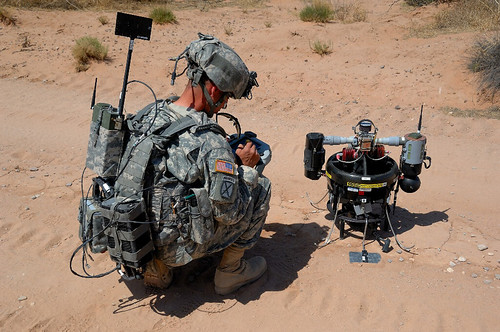
It’s not the only experiment underway at Fort Bliss. Soldiers of the service’s 5th Brigade, 1st Armored Division at Fort Bliss are testing and evaluating pieces of the Army Brigade Combat Team Modernization plan — a more streamlined successor to the service’s now-defunct Future Combat Systems program. Other items being tested include a common controller, a Nintendo-style control that can be used to maneuver both the Small Unmanned Ground Vehicle robot and the Class I Unmanned Aerial Vehicle (affectionately known as the “flying beer keg”).

 Need some imagination? Check out these gadgets and robots…