Archive for the ‘Cool Stuff’ Category

Sir Arthur’s iPad

Tuesday, February 2nd, 2010

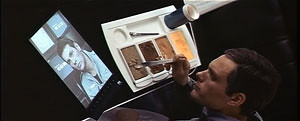
TUAW’s Steven Sande picked up on the "Newspad," envisioned by Sir Arthur Clarke in 2001: A Space Odyssey.

 When he tired of official reports and memoranda and minutes, he would plug his foolscap-sized Newspad into the ship’s information circuit and scan the latest reports from Earth. One by one he would conjure up the world’s major electronic papers; he knew the codes of the more important ones by heart, and had no need to consult the list on the back of his pad. Switching to the display unit’s short-term memory, he would hold the front page while he quickly searched the headlines and noted the items that interested him.

Each had its own two-digit reference; when he punched that, the postage-stamp-sized rectangle would expand until it neatly filled the screen and he could read it with comfort. When he had finished, he would flash back to the complete page and select a new subject for detailed examination.

Floyd sometimes wondered if the Newspad, and the fantastic technology behind it, was the last word in man’s quest for perfect communications. Here he was, far out in space, speeding away from Earth at thousands of miles an hour, yet in a few milliseconds he could see the headlines of any newspaper he pleased. (That very word "newspaper," of course, was an anachronistic hangover into the age of electronics.) The text was updated automatically on every hour; even if one read only the English versions, one could spend an entire lifetime doing nothing but absorbing the ever-changing flow of information from the news satellites.

It was hard to imagine how the system could be improved or made more convenient. But sooner or later, Floyd guessed, it would pass away, to be replaced by something as unimaginable as the Newspad itself would have been to Caxton or Gutenberg.

From 2001: A Space Odyssey , by Arthur C. Clarke.
Published by Del Rey in 1968


This video clip show the iPad-like device in action…


Helping Haiti

Thursday, January 14th, 2010


What can you do to help if you’re too busy? Text "Haiti" to 90999, and you’ll be billed $10 as a donation to the Red Cross.

GeoEye-1 spacecraft captured this image:


This half-meter resolution satellite image shows Port-au-Prince, Haiti after a 7.0-magnitude earthquake struck the area on Jan. 12, 2010. The image clearly shows extensive damage, roads covered with debris from collapsed structures, and people crowded in the streets and public places such as sports fields and stadiums. The white-colored National Palace shows damage along the roof line. The image was taken by the GeoEye-1 satellite from 423 miles in space at 10:27 a.m. EST on Jan. 13, 2010 as it moved from north to south over the Caribbean at a speed of four miles per second.


Here’s a little "Bible-thumping" effort in Haiti worth watching, if only to see how people live…


Real Hope For Haiti from Corrigan Clay on Vimeo.

;


11-11 Campaign

Monday, November 9th, 2009

Hey, got $11 to spare? Sure you do.


Near-Space Photos

Thursday, September 17th, 2009


Students at MIT sent a weather balloon up with a camera. It reached 93,000 feet. That’s cool.

It cost them less than $150. That’s dope.

The summary, via Wired:

Meet the $150 (almost to) Space Camera.

Bespoke is old hat. Off-the-shelf is in. Even Google runs the world’s biggest and scariest server farms on computers home-made from commodity parts. DIY is cheaper and often better, as Justin Lee and Oliver Yeh found out when they decided to send a camera into space.

The two students (from MIT, of course) put together a low-budget rig to fly a camera high enough to photograph the curvature of the Earth. Instead of rockets, boosters and expensive control systems, they filled a weather balloon with helium and hung a styrofoam beer cooler underneath to carry a cheap Canon A470 compact camera. Instant hand warmers kept things from freezing up and made sure the batteries stayed warm enough to work.

Of course, all this would be pointless if the guys couldn’t find the rig when it landed, so they dropped a prepaid GPS-equipped cellphone inside the box for tracking. Total cost, including duct tape? $148.

Great photos, too. Here’s a video…


DIY Friday: Vortex Cannon

Friday, July 31st, 2009

This is pretty awesome: a vortex cannon demonstration, seen on BBC One:


Can I make one myself? You bet: Instructables has it for you.

This one is so easy to make and gives great results. You will need a fog machine to generate the rings for both of these projects.

What You Need…

1. 32 Gallon Plastic Trash Can
2. Heavy Duty Trash Bag
3. Golf Ball
4. 2 Bunjee Cords
5. Tape
6. Box cutter


Who’s afraid of the big bad wolf?


Iran Satellite Jam

Wednesday, June 17th, 2009

Amnesty International is telling us the BBC’s satellite feeds from Iran are being jammed. But they still got this report out:


I especially like this report. The Internet? Its a war zone:

More and more of Iran’s pro-government websites are under assault, as opposition forces launch web attacks on the Tehran regime’s online propaganda arms.

What started out as an attempt to overload a small set of official sites has now expanded, network security consultant Dancho Danchev notes. News outlets like Raja News are being attacked, too. The semi-official Fars News site is currently unavailable.

“We turned our collective power and outrage into a serious weapon that we could use at our will, without ever having to feel the consequences. We practiced distributed, citizen-based warfare,” writes Matthew Burton, a former U.S. intelligence analyst who joined in the online assaults, thanks to a “push-button tool that would, upon your click, immediately start bombarding 10 Web sites with requests.”


Mobile Planetarium

Wednesday, May 13th, 2009


Yeah, the iPhone apps get all the attention. Here’s one from Google for the Android:

We were able to play around with a T-Mobile G1 test device in the office and were intrigued by all of the sensors that were available. The GPS and clock allowed us to generate maps for the exact time and location, but the compass and accelerometer were what made Sky Map truly interesting. Using these two sensors, the app can determine the exact direction that your phone is facing and display the stars that are visible. If you want to identify that bright star in the west, all you have to do is point the device in that direction and you’ll see "Venus" appear on your screen.

 Very cool.

DIY Friday: Old Dish Signal Booster

Friday, March 27th, 2009


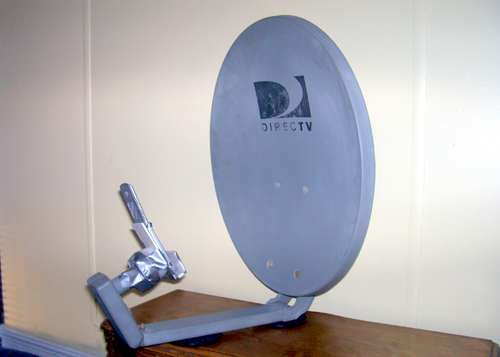
We’ve blogged about the "cantenna" and repurposing old parabolic dishes for boosting WiFi signals. With people switching from direct-broadcast satellite TV (DISH and DirecTV) to Verizon FiOS, AT&T Uverse, back to cable TV or just cutting all pay television services and using free over-the-air HDTV, you might want to consider using your old antenna for something else.

Birdbaths and Spartan shields are OK ideas, but using it to boost cell phone or WiFi signals might be more useful. We’ve got a place up in the mountains and finding a good cell signal can be tricky.

Via Instructables, here’s the solution:

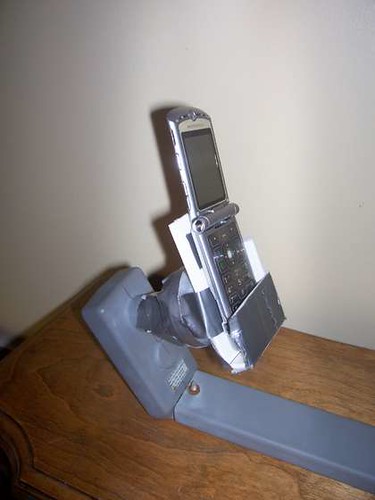
While working in my yard one afternoon I noticed an old satellite TV dish on top of a pole in my backyard. It had been left there by the previous residents. Suddenly a light bulb came on. I grabbed some wrenches, took down the dish and held my cell phone next to the antenna’s horn. I was amazed to find that I instantly got full signal. I could not believe my eyes. I went from no signal to full signal and had not spent a dime or changed anything on my cell phone. Just to make sure I made a call using speaker phone and found that this thing truly did work.

The next test came when I took the assembly inside the house to try it. With aluminum siding on the house I have problems even getting a television signal using a rabbit ear antenna. To my surprise, I got two bars inside so long as I pointed the dish at a double window in my living room. I no longer miss calls and I don’t have to leave home to talk on my cell phone. It isn’t an ideal setup but it works and did not cost me anything. It is also a great way to recycle that old dish antenna that would have ended up in the trash otherwise.

I will try this myself, as I have the two main elements: weak cell signal and an old antenna.


DIY Friday: Solar Cell of Donuts and Tea

Friday, March 20th, 2009

Excellent use of resources: powdered donuts and tea, via Register Hardware:

In a fast-paced video, the presenter runs through a process that essentially combines chemicals from tea and American-style sugared doughnuts to form a solar energy soaking film that can be applied to a sheet of glass.

The process isn’t easy and requires a fair amount of scientific kit, but he starts by extracting “titanium dioxide nanoparticles” from some powdered sugar doughnuts.

Roughly ten layers of these nanoparticles applied to a sheet of glass is, according to the video’s presenter, “pretty much a solar cell”.

But because this set-up on its own won’t work with “regular sunlight", the presenter next extracts organic dyes from a cup of sweet tea that enables the solar cell to “absorb light we can see”.

Finally, to prove that his invention works, the solar scientist hooks the cell up to a multimeter that appears to show an electrical current being generated from the DIY solar cell. 

Donuts. Is there anything they can’t do?


Satellite News Bits

Monday, March 16th, 2009


For the week ending 13 March 2009, courtesy of Bill McDonald:

Inmarsat reports 20% jump in revenue, representative of strong earnings being reported by the world’s largest satellite-services companies, apparently unaffected by current economic climate. [Wall Street Journal – 03/13/2009]

North Korea notifies international agencies that it plans to launch a satellite between April 4 and April 8; U.S. and south Korea say there are signs North Korea may test a missile capable of reaching Alaska. [Bloomberg – 03/12/2009]

Japan warns North Korea, saying it can legally shoot down any threatening object if it falls toward its territory. [New York Times – 03/13/2009]

Five years since last its reboot, Odyssey’s backup systems are restored by a restart, and other systems may also be restored. [SatNews – 03/13/2009]

Arianespace and European Space Agency elect to postpone launch of Herschel and Planck satellites to perform additional ground segment checks. [SatNews – 03/13/2009]

Astronauts evacuate International Space Station as a piece of space debris is expected to pass close to the station. [SatNews – 03/12/2009]

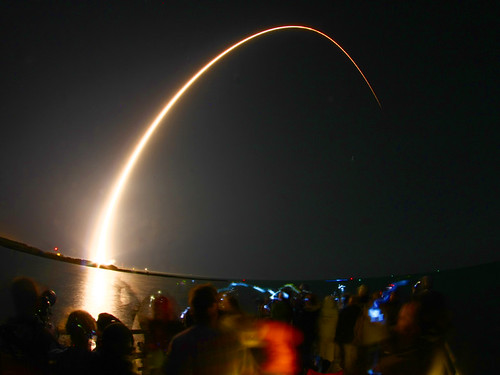
The U.S. Air Force will launch the second Wideband Global Satellite Communications satellite aboard an Atlas V rocket on March 14. [Patrick AFB News – 03/12/2009]

Iridium places backup satellite in service for satellite lost in collision with Russian satellite over Siberia in February. [msnbc – 03/12/2009]

W3C satellite commissioned by Eutelsat, to be built by Thales Alenia Space, a rapid satellite order following the decision in January not to integrate W2M into its fleet due to a major anomaly which occurred during its transfer to its operating orbit position. [SatNews – 03/12/2009]

Networkfleet, Inc. uses high-resolution satellite and hybrid maps to observe vehicles in a real-world setting with 3-D Earth imagery. [SatNews – 03/12/2009]

SpaceX completes full mission firing of Merlin vacuum engine. [Satellite today – 03/12/2009]

Financially struggling Sirius XM Radio plans to stream its subscription radio service to the iPhone and iPod Touch devices from Apple this spring. [CED Magazine – 03/12/2009]

AsiaSat will deregister from U.S. Securities and Exchange Commission and terminate its reporting obligations. [Satellite Today – 03/12/2009]

The Society of Satellite Professionals International will induct five new members into its Satellite Hall of Fame on March 25. [SatNews – 03/11/2009]

SES Astra will move Astra 2C satellite from 28.2 degrees East to 31.5 degrees East to take over mission of Astra 5A, which is no longer in service. [Satellite Today – 03/11/2009]

France’s Orange Business Services deploys customized satellite communications system for Bourbon marine services group vessels. [Businesswire – 03/11/2009]

Thales Alenia Space gets contract with JSC "Iss – Reshetnev Company" to build payload for Telkom-3 communications satellite for Indonesian operator PT Telekomunikasi Indonesia TdK. [SatNews – 03/11/2009]

International Launch Services gets contract to launch the ViaSat-1 satellite, to be highest capacity North American satellite with 10 times capacity of other Ka band satellites, under construction by Space Systems Loral, on an ILS Proton in the first half of 2011.  [SatNews – 03/11/2009]

SWE-DISH and Saab announce new on-the-move satellite solution designed for both land and marine applications with close to world-wide coverage using Ku band for up to 10 Mbps broadband communications. [Satellite TMCnet – 03/10/2009]

The European Defence Agency announces plan to set up procurement cell to coordinate EU member states’ orders of commercial satellite communications services to improve access at competitive prices. [DefenseNews – 03/09/2009]

NASA’s planet-hunting telescope, Kepler, was launched into space Friday night, March 6, on a mission to search for planets similar to Earth in the far reaches of the Milky Way. [R&D – 03/09/2009]

Satellite and cable TV providers seek to increase profit margins by promoting pay-per-view pornography. [AdvertisingAge – 03/09/2009]

Connecticut satellite and cable TV providers pursue customers who may lose signal as switch from analog to digital TV broadcasting takes place there. [Harford Courant – 03/08/2009]