Archive for the ‘Cool Stuff’ Category

Hello, Chief?

Sunday, February 22nd, 2009


Yo, Rocco’s back. Lots of interesting stories since I last blogged here. Last week’s item almost had me blogging. Now that RRS has a new editor, I’m back as the lead blogger.

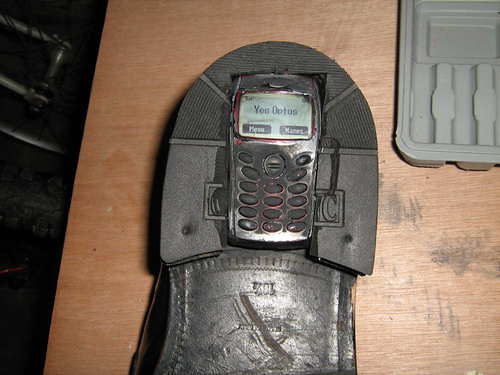
First, there was the working bluetooth shoe. Now we’ve elevated the technology to a working shoe phone:

The entire world has been waiting for decades with baited breath for the arrival of real, working shoe phone technology. You find that hard to believe? Would you believe that someone, somewhere, has been occassionally thinking about shoe phones? Well, the shoe phone finally lives, as you will discover below, and as you can hear for your self, here or here, or listen to an ABC interview which gets interrupted by the shoe phone ringing.

Listen to a radio interview conducted by shoe-phone!

The attention the shoe phone has generated has been quite flattering, including the production of shoe phones by others, resulting in an instructibles article and the first shoe phone on ebay. Perhaps what is most surprising is that noone had actually made a working shoe phone before. But now that cat has been let out of the bag …

Remote Patient Care: The Serious Side Of Shoe Phones

A significant part of the shoe phone project is the potential medical applications, as summarised in this television report:


Spitzer Spots Spock’s Planet

Wednesday, October 29th, 2008


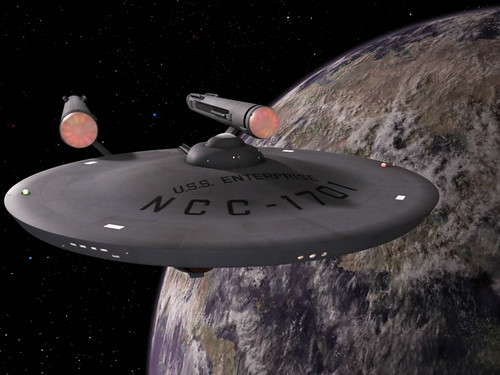
Star Trek fans may remember Spock’s home star, Epsilon Eridani. Now, with the help of the Spitzer Space Telescope, the discovery of asteroid belts within the nearby system (10.5 light years away) is prompting new comparisons to our own system — and perhaps a planet Vulcan:

NASA’s Spitzer Space Telescope has detected two asteroid belts around Epsilon Eridani, the planetary system closest to ours and home to Star Trek’s fictitious First Officer Spock, the space agency reported yesterday.

A planet near the inner asteroid belt was identified eight years ago. The newly spotted planet is in the vicinity of the outer belt.

Epsilon Eridani is around 10 light-years, or 62 trillion miles (98 trillion kilometers), away from Earth’s solar system and, at a mere 850 million years old, is considered a younger, similar version of our own 4.5- billion-year-old system. Star Trek creators made it the home of Vulcan, and it’s possible that there are as-yet-unseen Earth-like planets between the star system and its inner ring, astronomer Massimo Marengo of the Harvard–Smithsonian Center for Astrophysics told McClatchy Newspapers.

"We certainly haven’t seen it yet, but if its solar system is anything like ours, then there should be planets like ours," Marengo told USA Today.


Naturally, this prompted an active discussion on Slashdot, with several citations to literary fiction. More serious discussions abound.

The update from the Harvard-Smithsonian Center for Astrophysics doesn’t mention Mr. Spock or Vulcans, just what it means to scientists:

Epsilon Eridani and its planetary system show remarkable similarities to our solar system at a comparable age.

"Studying Epsilon Eridani is like having a time machine to look at our solar system when it was young," said Smithsonian astronomer Massimo Marengo (Harvard-Smithsonian Center for Astrophysics). Marengo is a co-author of the discovery paper, which will appear in the Jan. 10 issue of The Astrophysical Journal.

Lead author Dana Backman (SETI Institute) agreed, saying, "This system probably looks a lot like ours did when life first took root on Earth."

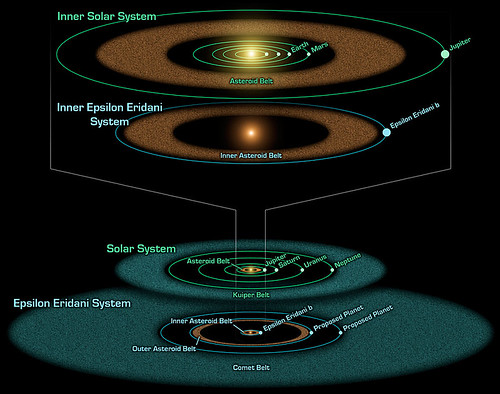
Our solar system has a rocky asteroid belt between Mars and Jupiter, about 3 astronomical units from the Sun. (An astronomical unit equals the average Earth-Sun distance of 93 million miles.) In total, it contains about 1/20 the mass of Earth’s Moon. Using NASA’s Spitzer Space Telescope, the team of astronomers found an identical asteroid belt orbiting Epsilon Eridani at a similar distance of 3 astronomical units.

They also discovered a second asteroid belt 20 astronomical units from Epsilon Eridani (about where Uranus is located in our solar system). The second asteroid belt contains about as much mass as Earth’s Moon.

A third, icy ring of material seen previously extends about 35 to 100 astronomical units from Epsilon Eridani. A similar icy reservoir in our solar system is called the Kuiper Belt. However, Epsilon Eridani’s outer ring holds about 100 times more material than ours.

When the Sun was 850 million years old, theorists calculate that our Kuiper Belt looked about the same as that of Epsilon Eridani. Since then, much of the Kuiper Belt material was swept away, some hurled out of the solar system and some sent plunging into the inner planets in an event called the Late Heavy Bombardment. (The Moon shows evidence of the Late Heavy Bombardment – giant craters that formed the lunar seas of lava called mare.) It is possible that Epsilon Eridani will undergo a similar dramatic clearing in the future.

 

Some of us would like to believe another planet like ours exists, which recalls the power of the Vulcan Mind Meld in convincing people to think otherwise. 

Here’s one of my favorite clips from the original TV series:


Elliptical C-band Uplink Antennas

Friday, October 24th, 2008

Via Doug Lung’s RF Report:

In some cases, it isn’t possible to install an uplink dish that meets the FCC off-axis antenna pattern envelope. In the past, the FCC allowed operation of uplinks with non-compliant antennas upon a showing by the licensee that the effective isotropic radiated power (EIRP) would be reduced enough to keep the energy in side lobes below the level that would have existed using an uplink with a compliant dish at maximum power. This required a detailed engineering showing that often slowed FCC processing.

In the Eighth Report and Order and Order on Reconsideration (FCC 08-246), the FCC adopted an off-axis EIRP envelope approach as one method for applicants to apply for fixed satellite service (FSS) Earth stations using small antennas operating on conventional C and Ku-band frequencies.

It states, "This off-axis EIRP approach gives earth station applicants the flexibility to reduce their power levels to compensate for a small antenna diameter. Thus, using these envelopes as criteria for licensing should enable us to license more earth station applications routinely, expediting the provision of satellite services to consumers and enhancing the types of services available, without increasing the likelihood of harmful interference to adjacent satellite operators or to terrestrial wireless operators."

The Order adopts rules that facilitate the use of elliptical C-band uplink antennas. While the new rules do not specifically state that the major axis of the elliptical antenna be aligned with the geo-stationary orbit plane, the Order notes that "that starting the off-axis EIRP envelope at 1.5 degrees off-axis within the GSO orbital plane, and at 3.0 degrees outside that plane, has the same effect as requiring elliptical antennas to be aligned with the GSO plane in most cases."

The Satellite Industry Association (SIA) claimed that it is not possible to develop an off-axis EIRP envelope for analog video signals because the power density of such signals fluctuates. SES Americom opposed new analog regulations because the current rules are working well. The FCC decided to retain the current regulatory framework for analog services at this time. It dropped plans for eliminating analog video transmission over satellite entirely, noting, "The record in this proceeding has shown convincingly that requiring the transition from analog to digital video transmissions proposed in the Third Further Notice would be unreasonably expensive and burdensome."


Send In The Rocket Scientist

Wednesday, October 8th, 2008


Watched the U.S. presidential debate last night and neither could explain their position on this $700 billion bailout/rescue. Seems their economic talking points haven’t changed much in six months (Main Street, middle class, tax the rich). We need Madison Avenue to start selling these leading candidates.

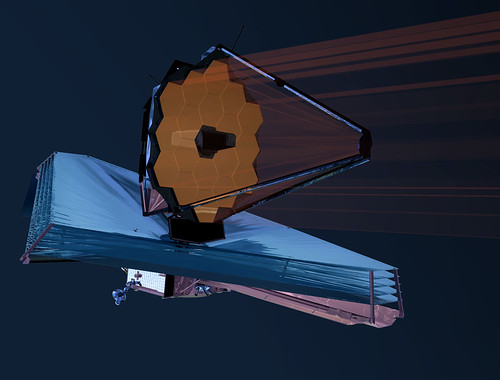
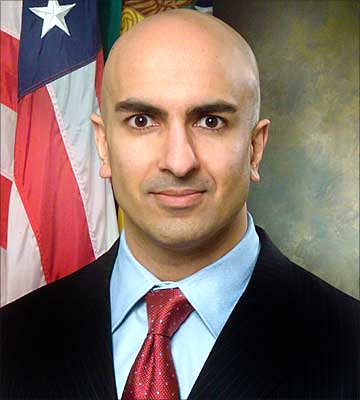
Now we’ve got an interesting angle, as far as we’re concerned and way to go, NPR! They called it before we did in today’s Morning Edition piece on Neel Kashkari, the new Interim Assistant-secretary for Financial Stability: "Ex-Rocket Scientist To Oversee Financial Bailout." He worked on NASA’s Jame Webb Space Telescope at TRW. Click here to listen:

Back in the 1990s, Tom Dautel worked on a team led by Kashkari to design a solar car called the Photon Torpedo at the University of Illinois. He says Kashkari worked like a slave, often even on projects he wasn’t directly overseeing.

"He meant business. He wanted to get the job done. He was very focused, and it doesn’t surprise me he ended up where he is," Dautel says.

Poorni Bid says Kashkari’s intensity made the man she and other classmates called Rocket Scientist seem wise and competent beyond his years.

"He stood out in just his focus and just his intensity," she says. "And you’d think everyone in MBA school would be like that, but there was a different quality about him."


The Independent (U.K.) gives us some background:

Before he became one of the "masters of the universe", as the ambitious bankers of Wall Street are known, Mr Kashkari was headed towards becoming a master of the cosmos, doing important work for Nasa’s space program. Banking is not in his blood. Science is. His father, Chapman, is a retired professor of engineering, and his mother Sheila is a pathologist. It was to science that the young Neel Kashkari originally hewed, taking a bachelor’s and a master’s in engineering at the University of Illinois at Urbana-Champaign, his home state’s flagship public university. His first major career was as a research and development investigator at a company called TRW in Redondo Beach, California, which had an illustrious history as a contractor to Nasa, creating several of its deep space satellites. At TRW, Mr Kashkari helped develop technology for new space science missions such as the James Webb Space Telescope, which is due for launch in 2013 as a successor to the ageing Hubble telescope and which will go searching for light from the first stars formed after the Big Bang.

The sheer complexity of this situation will take a rocket scientist to fix, but it’s already affecting the presidential race:

Within the poll numbers, Obama appears to have been helped by a number of factors. For one, voters generally tend to say they believe Democrats are better at handling the economy than Republicans, and that appears to have happened here. A new Hotline poll shows that over the last week the percentage of respondents who feel McCain is better prepared than Obama to handle the economy fell five percentage points, from 43 to 38 percent.

McCain’s personal performance, from his attempt to cancel the initial presidential debate to his silence in presidential meetings on the bailout, did not gain him new votes, at least in the short term. A USA Today/Gallup poll taken before the bailout failed to pass the House on Monday showed that 53 percent of respondents judged his actions unfavorably.


Smile For The Satellite

Thursday, October 2nd, 2008

Chelyabinsk is one happy town. They’ve come a long way from being "the most contaminated spot on the planet."

Here’s an interesting story from Slashdot:

Citizens of the Russian town Chelyabinsk calculated when the satellite, QuickBird, which takes images for Google Earth and Google Maps, would cross above their city and used people to make a giant smiley face. A rock concert on the main square attracted many people and everyone got a yellow cape. It looks like someone at Google was quicker than usual to put up the new data. Maybe Google likes the idea of an entire town working hard to get its 15 minutes of fame. The article has a screenshot of Google Maps and images taken directly at the event."

They did pretty good:


This isn’t the first time that Google Earth or Google Maps has captured something interesting from space. Longtime readers of Really Rocket Science will recall the Ipod that fell to Earth, which we wrote about way back in March of 2006:


But there’s more to be seen than "Ipods" and smiley faces in the world of Google Earth. GoogleSightSeeing.com — whose tag line is "Why Bother Seeing the World for Real?" has a great series of blog posts on cool sights that you can see right from your computer desk. Be sure to check out this map of global points of interest.

Here’s a clip on Chelyabinsk:


Reverse Electromagnetic Waves

Tuesday, September 30th, 2008


Fascinating story, first posted to PhysOrg.com (and since garnering quite a few Diggs) Well, leave it to Doug Lung to draw some interesting conclusions:

What if you could design a satellite dish or microwave antenna with the feed horn behind the reflector instead of in front of it? That may be possible, thanks to research by Cesar Monzon, a senior scientist at Enig Associates presented in the paper Anomalous Power Flow and ‘Ghost’ Sources published in Physical Review Letters (payment required to view the full paper).

The abstract describes the effect this way:

"It is demonstrated that EM radiation from complex sources can result in real power in restricted regions of space flowing back towards the sources, thereby mimicking ‘ghost’ sources. This counterintuitive mechanism of radiation does not rely on backward waves, as ordinary waves carry the power. Ways to harness the effect by making it directional are presented, together with selected applications, of which deception is a prime example due to the nature of the phenomenon."

It goes on to say that this concept could be to such areas as mechanics, acoustics and others with technology that is already available.

The article In radiation ‘ventriloquism,’ electromagnetic waves travel backwards on Physorg.com describes how the waves are generated and listed some of the possible applications. Obviously hiding transmitters and radar emitters is desirable in military environments.

Physorg.com quotes Monzon describing how the technology could be used with dish antennas: "On the case of satellite antenna feeds, the theory indicates it may be possible to build these behind the main reflector dish, which will offer a clear field of view without blocking or the disadvantages derived from feed offsetting. The same principle applies to both transmit and receive antennas."

I recall a paper from the mid-80s published in the Ukrainian Physics Journal (by O.S. Ilenko of the Kyivskii Politekhnicheskii Institut). The abstract, translated from the original Russian:

The diffusion of cylindrical electromagnetic waves and electromagnetic energy oscillations in the near field of a radiator is analyzed based on the physical principles of Huygens (1935). It is shown that the surface of a moving electromagnetic wave which conforms to the Huygens principle will be either spherical or planar in free space. Deviations from the planar or spherical forms can lead to the development of reverse electromagnetic waves. The geometry of the wave surfaces is illustrated.

National Digital Media Day in Canada

Wednesday, September 24th, 2008


Tired of following politics in the U.S.? Go north of the border for more interesting news.

On 25 September 2008, at major urban intersections across Canada, National Digital Media Day will be marked by kissing mobs:

In celebration of National Digital Media Day, take part in the biggest Kiss across Canada on September 25th!

FLASH MOBBERS: Stop traffic at your city’s busiest intersection (TBA) for 2 minutes with some joyful kissing: simple peck, sloppy smooch, french kiss, full-on snog – you decide!

SHUTTERBUGS: Capture the Kiss moment with your iPhones, smartphones, or cameras and email/upload your pics to The Kiss website.

Kiss times:
Pacific time: 12pm
Mountain time: 1pm
Central time: 2pm
Eastern: 3pm
Atlantic: 4pm
Newfoundland: 4:30pm

Here’s the Facebook event.

Visit National Digital Media Day September 25

Visit National Digital Media Day September 25

Large Hadron Collider

Wednesday, September 10th, 2008

You’ll love this video, "Large Hadron Rap," explaining CERN’s large hadron collider in Switzerland…


What it is:

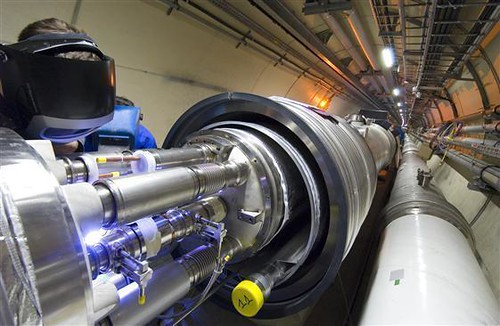
The Large Hadron Collider (LHC) is a gigantic scientific instrument near Geneva, where it spans the border between Switzerland and France about 100 m underground. It is a particle accelerator used by physicists to study the smallest known particles – the fundamental building blocks of all things. It will revolutionise our understanding, from the minuscule world deep within atoms to the vastness of the Universe.

Two beams of subatomic particles called ‘hadrons’ – either protons or lead ions – will travel in opposite directions inside the circular accelerator, gaining energy with every lap. Physicists will use the LHC to recreate the conditions just after the Big Bang, by colliding the two beams head-on at very high energy. Teams of physicists from around the world will analyse the particles created in the collisions using special detectors in a number of experiments dedicated to the LHC.

There are many theories as to what will result from these collisions, but what’s for sure is that a brave new world of physics will emerge from the new accelerator, as knowledge in particle physics goes on to describe the workings of the Universe. For decades, the Standard Model of particle physics has served physicists well as a means of understanding the fundamental laws of Nature, but it does not tell the whole story. Only experimental data using the higher energies reached by the LHC can push knowledge forward, challenging those who seek confirmation of established knowledge, and those who dare to dream beyond the paradigm.

CERN had the world’s first Web site, and today’s "firing up" was a success, via Science Daily:

An international collaboration of scientists today sent the first beam of protons zooming at nearly the speed of light around the world’s most powerful particle accelerator—the Large Hadron Collider (LHC)—located at the CERN laboratory near Geneva, Switzerland. The U.S. Department of Energy (DOE) and the National Science Foundation (NSF) invested a total $531 million in the construction of the accelerator and its detectors, which scientists believe could help unlock extraordinary discoveries about the nature of the physical universe.
 
Celebrations across the U.S. and around the world mark the LHC’s first circulating beam, an occasion more than 15 years in the making. An estimated 10,000 people from 60 countries have helped design and build the accelerator and its massive particle detectors, including more than 1,700 scientists, engineers, students and technicians from 94 U.S. universities and laboratories supported by DOE’s Office of Science and NSF.

“As the largest and most powerful particle accelerator on Earth, the LHC represents a monumental technical achievement,” said U.S. Department of Energy Undersecretary for Science Raymond L. Orbach. “I congratulate the world’s scientists and engineers who have made contributions to the construction of the accelerator for reaching this milestone. We now eagerly await the results that will emerge from operation of this extraordinary machine.”


This really is big news. I found Stephen Hawking’s opinion interesting:

"Together they [the LHC and the space program] cost less than one tenth of a per cent of world GDP. If the human race can not afford that, then it doesn’t deserve the epithet ‘human’."


Here’s the AP video, with good background…


And here’s the Reuters clip of the joyous moment…


DIY Friday: Typewriter Keyboard

Friday, August 1st, 2008

I’m moving soon, and as I’m sorting through my old junk, there are still some things I can’t part with. One of them is an old typewriter that I got from my uncle. It doesn’t work anymore, but I can’t quite bring myself to throw it away.

And now, my years of pack-rat behavior may have paid off, because I just found a way to rig up that old typewriter as a new computer keyboard.

You can also check out this page for instructions.

And if you’re looking for some real inspiration, take a look at this sweet custom brass version.

If you don’t already have an old Underwood sitting in your closet, there’s no shortage of manual typewriters on eBay.

DIY Friday: Solar Death Ray

Friday, July 18th, 2008

It’s another lazy, hot summer weekend…what to do to pass the time?

Crochet a new bathing suit? Nah.

Make a beaded pull for the ceiling fan? No thanks.

Craft some sunglasses out of popsicle sticks and tinted saran wrap? Maybe next week.

I’m looking for something a bit more bold to shake up the summer doldrums: A SOLAR DEATH RAY.

You may have seen the “#1 solar death ray on the Internet” here. But that model was so 2006.

Yes, the competitive world of solar death ray construction has moved well beyond that.

This guy, inspired by the success of the original, bought himself a c-band antenna and made a device capable of generating 13,000 watts. He calls it the “light sharpener” and you can find full instructions on his site to make your own.

The only question is, to what end will you direct the power of your very own light sharpener? The answer, clearly, is remaking the classic American cook-out.


Of course, Really Rocket Science was ahead of the curve on this one…but we have to admit that his is bigger.