Archive for the ‘Cool Stuff’ Category

Tracking Sharks

Monday, March 24th, 2008


The speed with which a great white shark released from Monterey Bay Aquarium last month has made its way down to Mexico is making the news:

The great white shark that was released from the Monterey Bay Aquarium in February definitely knew what it meant to swim and don’t look back. The great white shark has made incredible progress since leaving the aquarium, and has many stunned.

The shark took just six weeks to make it all of the way to Baja.

The shark was a young male and spent 162 days at the aquarium after it was caught by a commercial fisherman in August.

The shark was caught accidentally.

San Jose Mercury News has more on this record-setting shark:

"It’s surprising that he did it as quick as he did," said John O’Sullivan, who oversees the live animal exhibits at the aquarium.

At a speed that’s astonished even longtime researchers tracking his progress through electronic tags, the shark has made it to 40 miles west of Mazatlán and is now the fastest young great white shark on record, O’Sullivan said.

None of the other sharks tagged and released by the aquarium have made it to Mexico with such accuracy and speed.

"It’s exciting to us that this animal has shown this behavior," O’Sullivan said.

So how does the tracking system work, and who does it? Check out the science behind the tracking

 Researchers from several institutions, including Stanford University, have joined their efforts in a Census of Marine Life project called Tagging of Pacific Predators (TOPP). Since the project began in 1999, they have attached more than 3,000 tags to sharks, seals, whales, tunas, squids, turtles, albatross and more. For the first time, these TOPP researchers are getting a glimpse of a pelagic ecosystem from the California Current to the North Pacific at daily, seasonal and yearly time scales….

Through tracking the tagged sharks, the TOPP team has found two distant destinations that the sharks favor, both of which they visit on a regular, annual travel timetable. Each winter the white sharks head out from the California coast, with some going to the Hawaiian Islands. Most, however, head to another hotspot, out in the middle of the Pacific Ocean. This second location is roughly 1,300 miles from the mainland—about half the distance to Hawaii—and a few hundred miles to the south of the direct route to the islands. Dubbed "the white shark café" by the researchers, just what the attraction is out there remains something of a puzzle. But what is clear is that all the sharks that summer along the California coast show remarkable fidelity; when they return to the mainland, they head for the same local neighborhoods that they favor every summer.

Let’s just hope the great white released from Monterey Bay doesn’t favor a certain beach off the coast of Long Island. With his speed, he could just make it there by the 4th of July. 
 

Good-bye, Sir Arthur

Tuesday, March 18th, 2008


Via Skyreport "breaking news" e-mail:

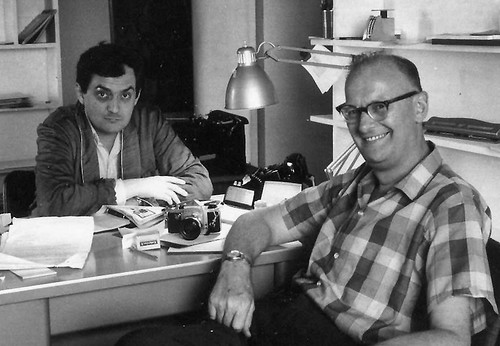
Arthur C. Clarke Passes Away

According to press reports, science fiction writer Arthur C. Clarke has passed away. He was 90.

Clarke was the author of more than 100 books, including "2001: A Space Odyssey." Clarke was well-known in satellite circles, receiving credit for developing the concept of geostationary satellites for communications. He proposed the idea in a paper titled "Extra-Terrestrial Relays" published in Wireless World in October 1945. In fact, geostationary orbit is sometimes referred to as the Clarke Belt in his honor.

Clarke, who had lived in Sri Lanka since 1956, was also a British citizen who received a knighthood in 2000.


 Sir Arthur’s last post was in December.

We enjoyed his imagination and annual "Egogram." 

HBO on YouTube

Tuesday, February 26th, 2008

HBO today seems like an old familiar standby, but the channel has a strong history of being the first to adopt new technologies to expand its audience reach.

Way back in 1975, HBO went national using the Satcom 1 satellite, leading in a direction that the rest of the cable programming industry would soon follow: 

On September 30, 1975, HBO, affectionately known colloquially as "Home Box", became the first TV network to continuously deliver signals via satellite when it showed the "Thrilla in Manila" boxing match between Muhammad Ali and Joe Frazier. On December 28, 1981, HBO expanded its programming schedule to 24 hours a day, seven days per week. (Cinemax was 24/7 from the day it signed on, and Showtime and The Movie Channel went 24 hours earlier.) In January 1986, HBO also became the first satellite network to encrypt its signal from unauthorized viewing by way of the Videocipher II System and in 1993 became the world’s first digitally transmitted television service. In 1999 HBO became the first national cable TV network to broadcast a high-definition version of its channel.

Fast forward 33 years, and its no surprise to see HBO is among the first networks to start its own channel on YouTube. We’ve seen in the presidential race the incredible reach that YouTube has when quality, entertaining content is made available to users. The pro-Obama music video Yes We Can, for example, has reached more than twice the viewers of the last presidential debate.

Al Gore’s Current TV channel, of course, has been at this nexus between the internet and television for several years, and has embraced its ancillary of user generated content. UGA is likely to further transform the media landscape, especially as the promise of IPTV opens up the possibility of millions of channels — and each of those channels will need to be fed fresh content.

Until then, you can watch the Sopranos at work, which we think is a good thing. 


Arab States Crack Down on Sat TV

Thursday, February 14th, 2008

Over the opposition solely of Qatar — which, not incidentally, is the home of Al-Jazeera—  information ministers of the 22-member Arab League voted Tuesday to adopt a document that would impose regulations on Arab satellite television.

AFP reports:

The meeting was called at the request of Egypt, which hosts the Arab League and serves as base for several Arab satellite channels.

It calls for the stations "not to offend the leaders or national and religious symbols" of Arab countries.

Cairo and Riyadh frequently complain of criticism of their regimes in talk shows aired by Al-Jazeera and other satellite channels.

The Cairo document authorises signatory countries to "withdraw, freeze or not renew the work permits of media which break the regulations".

It stipulates that satellite channels "should not damage social harmony, national unity, public order or traditional values."

The Financial Times provides more detailed background on what has motivated members of the Arab League to crack down on private satellite channels: 

In recent years the explosion in satellite channels – there are now about 500 – has meant that states have lost control over what their populations could see on television.

Channels like al-Jazeera, which at times has upset most Arab governments, have provided platforms for opposition groups and have breached taboos by broadcasting stories about human rights violations and election fraud.

An Egyptian court last week fined an al-Jazeera journalist for damaging the image of the country by filming a documentary containing reconstructions of torture in a police station. Saudi Arabia has also long had problems with al-Jazeera, though gulf watchers say the channel appears to have toned down its coverage of the kingdom after a recent rapprochement between Doha and Riyadh.

Abd-al-Bari Atwan, the editor in chief of the London-based al-Quds al-Arabi newspaper, comments that "The Arab ministers have started to coordinate in an admirable way in order to take the Arab media back to the dark ages," or to "a media of praise":

 [U]nder the new rules, the government of Nuri al-Maliki in the new Iraq can demand the closure of any Arab satellite channel if the channel refuses to call the Iraqi resistance of the U.S. occupation terrorism, and continues to host its leaders or those sympathetic to it on its satellite channels….

The Arab governments, and in particular the Saudi and Egyptian ones, want to take Arab public opinion to the previous lifeless era which prevailed before the satellite channels boom and in which the official media played the heroic role, that is, political programmes that had nothing to do with reality and reflected the views of the intelligence services and their rulers [rather than those of the public.]

More seriously, these two countries are also the ones who are investing the most, through some of their followers, in the entertainment and amusement channels which are multiplying at a frightening rate. Many believe that they aim to corrupt the young generations and steer them away from the fundamental and essential issues which affect their future, such as unemployment, corruption, human rights violations, and all kinds of freedoms.

Noting that "the time when the Arab citizen tunes in to the BBC to learn about his country’s news [was] supposed to have gone forever" with the advent of satellite TV and the internet, Atwan wonders if the new document adopted by the Arab League will spell the end of an independent Arab media.

Time will tell.

Power Pants

Monday, February 11th, 2008


We told you how to "put a rocket in your pocket" a while back by downloading an authentic Atlas rocket launch countdown ringtone to your mobile phone. Now we’ll show you how generating electricity for that phone — or other device — can be as easy as a walk in the park.

Researchers at the Simon Fraser University (S.F.U.) Locomotion Laboratory in Burnaby, British Columbia, now think they can put some power in your pants, via Scientific American:

Exercise may soon do more for you than tighten up your sagging muscles. Advances in biomechanical engineering could use energy generated while walking, hiking or running to power any device requiring portable power, including night-vision goggles and other battery-operated devices used by soldiers as well as robotic prosthetic limbs, cell phones and computers in remote locations where no other energy sources are available.

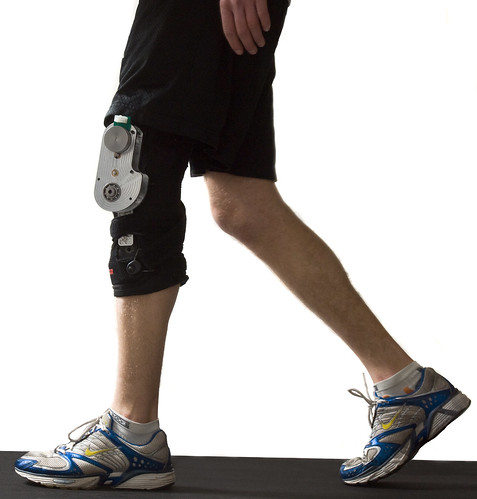
A team of researchers at the Simon Fraser University (S.F.U.) Locomotion Laboratory in Burnaby, British Columbia, are studying the amount of energy that can be generated by 3.5-pound (1.6-kilogram) aluminum and steel knee braces worn while walking or running. Volunteers, wearing a brace strapped on each leg, generated about five watts of electricity per person during a recent experiment, enough power, researchers say, to run 10 cell phones concurrently and twice that needed to keep a computer running (something useful in developing regions of Africa where electricity is scarce). They report that one brace-wearing subject generated 54 watts of power by running in place.

The best area to place a device for harnessing human energy is near a joint, because this is where the muscles—the body’s power source—work hardest, says Max Donelan, Locomotion Lab director and an assistant professor at S.F.U.’s School of Kinesiology. "There’s a long history of human power generation using hand cranks and bikes, but these require your dedicated attention, so you don’t do it for very long." The key to energy harvesting is extracting the energy from the body’s natural movement and, aside from breathing, very few unconscious muscle movements are more automatic than the action of walking.

Donelan and his team of researchers targeted a particular part of the stride, halfway through the swing of the lower leg after it has left the ground (when the hamstring comes to life to make sure you don’t have uncontrolled extension) through the time the foot returns to the ground. The brace designed to capture this energy features gears, a clutch, a generator and a computerized control system that monitors the knee’s angle to determine when to engage and disengage power generation.

The specific amount of energy generated from Donelan’s device depends upon the weight of the wearer, the difficulty of the terrain, the speed of the person’s gait and how long the device is used. In the prototype, energy generated is dissipated into resistors, although future models could include an onboard battery for energy storage. The researchers hope to be able to test their device within a year on Canadian soldiers at a field site.

Another effort underway to convert motion into energy relies on the Faraday law of induction, named after English chemist and physicist Michael Faraday, which holds that the movement of a conductor (such as a metal wire) through a magnetic field produces a voltage in that conductor proportional to the speed of movement. M2E Power, Inc., in Boise, Idaho, has developed a system of magnets and coils that, when moved, generates energy that can be used to power their host device. M2E’s technology originated at the Idaho National Laboratory, a Department of Energy–funded research group.

A good example of this would be walking with a cell phone in your front pocket or attached to your belt. The phone’s movement would cause the magnet and coil to generate energy that could be transferred to a bank of ultracapacitors that charge the phone’s battery when a certain voltage level is reached. "Think of it as a minigenerator whose power comes from movement," says Regan Warner-Rowe, M2E’s director of business development. "Because power management is such a critical issue for cell phones, we have been in discussions with handset companies." (Warner-Rowe declined to name them.)

Another goal of M2E’s research and development is to develop technology that could be used by the U.S. military. (The Australian army is working with contractors to develop its own wearable, rechargeable battery system, as well.) Much like Donelan’s work, the objective is to eliminate several pounds of weight that soldiers must lug around in the form of spare batteries. M2E has done some work developing prototype energy-rechargeable "D" cell batteries.

I like it: power walking. Very cool.


Mediterranean Submarine Cable Cut

Wednesday, January 30th, 2008


Wow, big fiber cut yesterday, about a year after the one near Taiwan. If you’re in the Middle East, you know: Internet service is disrupted in Egypt, the Gulf Region and to India, too:

Egypt’s Telecommunications Ministry said a communications cable in the Mediterranean was cut, disrupting 70 percent of the country’s Internet network.

The ministry said in a statement it was not known how the cable was cut but that services would probably take several days to return to normal.

India reported serious disruptions to its services and one Indian Internet service provider linked the problem to the Egyptian outage.

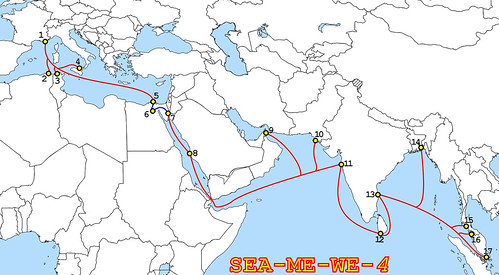
Seems the cut was somewhere between Palermo, Sicily, and Alexandria, Egypt. That sounds like the South East Asia-Middle East-West Europe 4 (SEA-ME-WE 4) cable, which has 17 landing points connected:

    1. Marseilles, France
    2. Annaba, Algeria
    3. Bizerte, Tunisia
    4. Palermo, Italy
    5. Alexandria, Egypt
    6. Cairo, Egypt (overland)
    7. Suez, Egypt (overland/return to submarine)
    8. Jeddah, Saudi Arabia
    9. Fujairah, United Arab Emirates
    10. Karachi, Pakistan
    11. Mumbai, India
    12. Colombo, Sri Lanka
    13. Chennai, India
    14. Cox’s Bazar, Bangladesh
    15. Satun, Thailand
    16. Melaka/Malacca, Malaysia
    17. Tuas, Singapore

Our friends at SES NEW SKIES probably had their phones ringing off the hook yesterday. Best remedy for fiber cuts is a satcom backup. That’s the "secret sauce" in a well-run network.


Bigfoot Found on Mars

Wednesday, January 23rd, 2008

One of the Mars rovers’ images from a few years ago shows what looks like Bigfoot or Sasquatch, according to the Mars Life blog.

Here’s the video clip from the Telegraph (U.K.):

See for yourself by downloading the original image from NASA’s JPL site — then try finding it. Fun for the whole family.

The Bigfoot Field Researchers Organization will be looking into this one, as will the folks of Willow Creek, California: the Bigfoot Capital of the World.

Remembering Bhutto

Thursday, December 27th, 2007

Not the news any of us wanted as we ease out of our holiday break. Benazir Bhutto was a brave, courageous woman, with a vision for a better Pakistan — a Pakistan that could democratize, that has greater respect for human rights, that has an eye towards modernization and economic progress. Despite repeated exiles, death threats, and assasination attempts, she always returned to her country with the well-being of Pakistan paramount.

Bhutto beleived in the democratizing force of information and media. She condemned Musharraf’s crackdown on Pakistan’s emerging independent television stations, including the government’s import ban on satellite dishes. As we discussed last month and Bhutto was shrewdly aware of, the rise of Satellites and the Internet has made state control much trickier for autocrats.

Bhutto will be missed by Pakistan and by the world.

DIY Friday: Build Your Own iPod Dock

Friday, December 14th, 2007

Us rocket scientists — and particularly Rocco — love our iPods. In fact, Rocco’s been waiting for the Apple patent/trademark filing from 2006 to come true for years now.

We like iPod docks, too. At the top of Rocco’s Christmas list is a nice, clean iPod dock that will deliver a quick charge and sync.

Let’s just say that Rocco’s been pretty good this year, and so Santa is looking. There are a lot of options to consider.

This miConnection Zork Alien iPod dock seems appropriate for Rocco’s obsession with SETI, and it’s only $23. Or we could go with something more "professional," like this basic unit for $40 or this sharp KefDock, which is designed to integrate your iPod with your home theater system.

Of course, what Rocco really wants is a dock with integrated speakers, one that will charge and sync while thumping out some heavy bass.

We could harken back to Rocco’s memories of the sock hops he attended as a lad with this jukebox, but it’s $289, and, in truth, Rocco hasn’t been that good.

So what to do? Well, Santa does have some elves, so why not a DIY or DIE ("Do it, Elves!") project, since it is the penultimate Friday before Christmas?

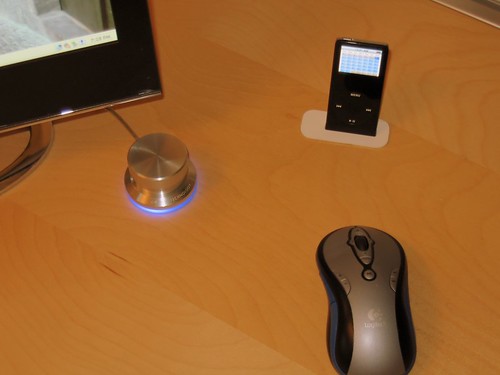
Simple Simon made a nice, minimalist iPod dock by building it into his desk:


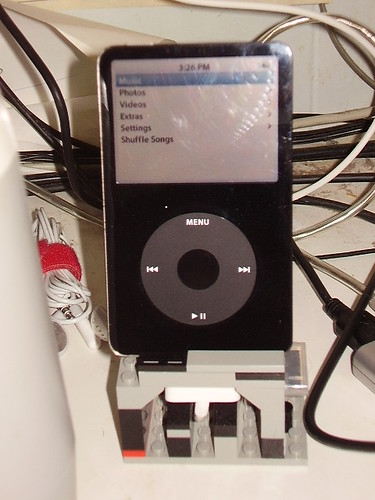
LinuxMatt added some child-like style to his DIY dock by using LEGOs: 


Or, if you want really simple — or to broadcast your green, recycling machine lifestyle — you can build a dock using the packaging material that came with your iPod. 

For ourselves, however — having a nearly unlimited supply of elves — we’re going to go with the start-from-scratch, design-it-yourself iPod super dock project recently posted Engadget.com in four parts: 1, 2, 3, 4.

Get busy, elves. 


X-Prize Contestant for Moon 2.0

Wednesday, December 12th, 2007


Fly me to the moon
Let me play among the stars
Let me see what spring is like
On a-Jupiter and Mars


That’s how the old Bart Howard song begins, popularized by Frank Sinatra in 1964 (it’s been used as a water fountain show tune at the Bellagio in Las Vegas, too). Funny how this popped into my head right on Sinatra’s birthday. The U.S. Postal Service chose to introduce the new postage stamp commemorating "Old Blue Eyes" in Los Angeles this afternoon:

Art director Richard Sheaff of Scottsdale, AZ, worked with stamp artist Kazuhiko Sano of Mill Valley, CA, to create the image based on a 1950s photograph of the entertainment icon. The stamp depicts Sinatra’s charismatic smile, trademark fedora and cobalt blue eyes that earned him the nickname “Ol’ Blue Eyes.” Sinatra’s autograph also appears on the stamp.

In a 50-year career studded with accolades, Sinatra won several Grammys, received the Jean Hersholt Humanitarian Award in 1971, and was recognized at the Kennedy Center Honors in 1983. Sinatra gave generously to many charities and was noted for his philanthropy. President Reagan awarded him the Presidential Medal of Freedom in 1985. Sinatra was born in Hoboken, NJ, in 1915. He died in 1998 and in 2002 the Hoboken Post Office was renamed in his honor.


This song came to mind recently when I read the piece in the San Francisco Chronicle on the Google Lunar X-Prize, for which they found a contestant:


Out of 375 inquiries from more than 40 countries, so far only a company called Odyssey Moon has completed the registration process to become an official contender, Diamandis said at a conference about space investment on Thursday in San Jose.

Among the commercial possibilities of such a mission: robotically mining the surface of the moon to extract silicon that could be refined into chips to create solar arrays on the moon that would eventually – by means as yet unspecified – beam power back to Earth.

Gregg Maryniak, executive director of the XPrize Foundation, began the presentation by showing a futuristic video depicting the moon as "a natural storehouse of resources that we can use to enhance life on Earth and explore our universe."

Maryniak likened the Google Lunar XPrize to the Apollo challenge issued by President John F. Kennedy in 1961.

"Now there’s a new moon race," Maryniak said, calling this "Moon 2.0" effort "a race to bring Earth’s offshore island, the moon, into Earth’s sphere of economic activity."

Odyssey Moon’s leaders include Robert Richards, a co-founder of International Space University, and Ramin Khadem, former chief financial officer of Inmarsat, a nearly 30-year-old satellite firm publicly traded on the London Stock Exchange. Officials said the company is based on the Isle of Man to take advantage of space-friendly tax policies and regulations.


Based in the Isle of Man, ey? We blogged about that space-friendly place in the Irish Sea before. Read more about Odyssey Moon. Will they be the next "giant leap for mankind?" Here’s that clip from July of 1969: