Archive for the ‘Cool Stuff’ Category

NASA 2.0

Monday, December 3rd, 2007

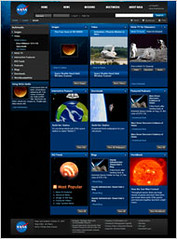
The NASA website has gone 2.0:

The National Aeronautics and Space Administration, concerned that people in the social networking generation have not shown enough interest in its work, has renovated its Web site to appeal more to the 18- to 25-year-old set.

The site, introduced over the weekend, has new blogs and widgets and more ways for people to view and manipulate content. A MyNASA feature has a “top playlist” that lets people watch clips of the space shuttle Discovery’s return to Florida or the California wildfires viewed from orbit.

The site, which has not had major overhaul since early 2003, still has information for policy makers and the media, but also more diversions. It is meant to compete with sites like Space.com (run by a company called Imaginova) and CNN, both of which have had more sophisticated presentations on space exploration.

“Younger folks look at the Web a different way,” said Brian Dunbar, Internet services manager for NASA. “They want to be able to pick and choose.” He estimates that the NASA site gets about a million unique visitors a month.

Many of the new features, like better feeds to users of aggregation sites like Digg, were made with young adults in mind.

NASA’s been providing great content for years now, but the addition of widgets and features like MyNASA will make the site even more user friendly, and allow users to stay abreast of favorite missions or research projects.

The more prominent use of blogs will also make highlighting NASA’s rich history even easier. For example, Shana Dale’s blog post reminds us that the first A in NASA stands for aeronautics:

NASA evolved from its predecessor, the National Advisory Committee for Aeronautics (NACA), which was formed by Congress in 1915 to undertake, promote, and institutionalize aeronautical research.  During the past 50 years, NASA’s aeronautical research has provided breakthrough concepts, tools, and technologies to make air travel more safe, efficient, and environmentally friendly….

Today, NASA’s Aeronautics Research Mission Directorate builds upon this legacy and continues to develop new concepts, techniques, and technologies that will enable revolutionary capabilities for future aircraft as well as the airspace in which they fly.   Much of our focus is on the Next Generation Air Transportation System, or "NextGen," a wide-ranging initiative involving six U.S. Government departments and agencies, as well as numerous industry and academic partners. The goal of NextGen is to transform our nation’s air transportation system so that, by 2025, it can handle the predicted two-to-three times increase in demand while maintaining safety and protecting the environment.  NASA aeronautics programs conduct fundamental research for NextGen in areas of safety, air traffic management and the environment

There is a great link on the NASA aeronautics website where you can click directly on sections of a commercial plane to learn more about NASA’s contributions to aviation design and safety: NASA Aeronautics Research Onboard

DIY Friday: Create Your Own Stroboscope!

Friday, November 30th, 2007

PBS has had some good new programming recently, and among our favorites is Wired Science — whom we turn to for today’s DIY adventure:

The invention of the stroboscope is frequently attributed to Doc Edgerton, but in fact stroboscopes go back to 1832: 

The term "stroboscope" comes from Greek for "whirling watcher".  The "whirling watcher" was simply a disk with slots at regular intervals.  As an observer looked at moving subject through the slots in the spinning disk, he could see successive stages of the subject’s motion.

When Edgerton began his electrical engineering studies at MIT in 1926, his research was focused on the stability of synchronous motors, observing the changes in angular displacement of the rotors as a result of disturbances to the system.  As the story goes, Edgerton noticed that flashes from the mercury arc lamps he was using made the rotor visible without blur.  This gave him the idea to build an electronic stroboscope which could be used to visually observe the changes in the motors angular displacement.

Bre’s instructions on how to build your own stroboscope can save you some serious dough, as professional stroboscopes can get quite expensive.

But when taking macro, still life shots, a stroboscope, whether hand-built or store-bought, is best used in conjunction with a macro studio.

Thankfully, the Strobist offers some tips on creating your very own DIY photography studio for about 49 cents:

 This is one of the most useful DIY gadgets you could make – especially when you consider the single-digit price tag.

What can you use it for? That’s pretty much up to you, and will be limited only by the size of the box you use. Shots of small objects in the studio, on location, items you are selling on eBay, flowers (even still in-the-ground-and-growing ones,) Absolute Vodka bottles for $50,000 ad campaigns, catalog stuff – whatever.

This little thingie does it all in spades – and with a lot of control, too.

Get clicking! 


New Satellite Radio Content

Monday, November 12th, 2007

SIRIUS has announced "Doctor Radio", a "24/7 Health and Wellness Channel" that will launch in early 2008. The new channel will be a collaborative effort from SIRIUS and the NYU Medical Center and will feature content from doctors and medical experts.

From the press release:

To serve Americans’ hunger for health, medical and wellness information, SIRIUS’ Doctor Radio will cover the human condition and the complexities of the bodies we inhabit, as well as entertain a little bit along the way. Doctor Radio will give listeners direct access to the best doctors in every field, breaking down barriers between the medical world and the everyday world, and giving listeners information to make important decisions about their health and well-being. NYU Medical Center doctors will take new medical research and findings and translate them into easy-to-understand advice and knowledge in an innovative and new way to better peoples’ lives. 

This announcement comes just five years after GE Medical Systems and NBC launched "The Patient Channel", a television channel that distributes health-related content to US hospitals. NBC also maintains "The Newborn Channel", a similar health-related network that focuses on parenting. 

Want to check out these channels but don’t want to visit the hospital? Both channels are carried by AMC-3, transponder 1K – check out Lyngsat for the latest downlink information and tune-in.

On the other side of the content spectrum, XM Radio has just announced the launch of the Led Zeppelin channel this Thursday.

From the site:

A 24/7 celebration of the music and magic of Led Zeppelin. A handcrafted channel dedicated to everything Led Zeppelin, including studio albums, rare and archival concerts, interviews, and listener interaction. A continuous and mystical radio voyage into the past, present, and future of the mighty Led Zeppelin.

This is part of "Whole Lotta Love Week" in America. It also coincides with the release this Tuesday of "Mothership", the newest "greatest hits" album in the Zeppelin catalogue, hand-chosen by the three remaining members of the band and remastered for sonic perfection (read Pitchfork’s review). The band is also re-releasing the live album "The Song Remains the Same", including versions on HD-DVD. But perhaps the biggest news is the release of the entire Led Zeppelin catalogue exclusively on iTunes tomorrow. For $99, you can purchase the "box set", which includes every single Led Zeppelin album. If you don’t already have copies of all albums in vinyl or CD, that’s a fantastic price for an essential part of anyone’s music collection.

Of course all of this recent Led Zeppelin mania has been inspired by their upcoming concert in London this December. For those who are lucky enough to go but already bought your plane tickets, you better call the airline – the concert has been postponed for two weeks because guitarist Jimmy Page broke his finger. I just hope it’s not his left ring finger – the solo on "Stairway" wouldn’t sound the same without those crazy arpeggios at the end. 

Canadian Content Changed by Chinese

Sunday, November 11th, 2007

From the Canadian Broadcasting Corporation (CBC): 

In 1992 a new spiritual practice, called Falun Gong, began to spread throughout China and by 1999 had acquired over 70 million adherents. Fearing the popular practice, the Chinese government banned Falun Gong in 1999 and began harassing and jailing practitioners. To date, over 200,000 have been sent to Chinese jails and forced labour camps, many of them brutally tortured, and at least 2,500 killed.

In 2006, new reports have come from China alleging that thousands of imprisoned Falun Gong practitioners have had their corneas, kidneys and livers forcibly removed for sale by Chinese authorities.

“Beyond the Red Wall” is a hard-hitting documentary special focusing on the movement and the persecution of these people by the Chinese authorities. It focuses on two Falun Gong practitioners – an internationally renowned painter, a Canadian citizen and resident of New York who was jailed and tortured for his beliefs, and a typically North American housewife who actively participates in and fights for Falun Gong.

The film also includes never-seen-before torture footage, smuggled out of China.


The Chinese government was quick to blame Falun Gong when one of the SinoSat satellite’s transponders was overpowered by a pirate signal in 2002. Then again in 2004 and 2005, both on an AsiaSat satellite. Falun Gong denied it, arguing they lacked the tech know-how. Was it poor satcom management? Without a sophisticated transponder locator service, I don’t see how they could quickly triangulate and concluded it came from Taiwan. Considering CITIC Group is a major AsiaSat shareholder, I’m not surprised.

Now we read in The Globe and Mail of a new episdoe in this ongoing saga:

CBC pulls Falun Gong documentary

Network postpones repeat of film aired in the spring after Chinese diplomats raise concerns

by COLIN FREEZE

November 8, 2007

CBC Television abruptly cancelled a featured Falun Gong documentary just hours before it was to air on Tuesday night, prompting complaints that the network bowed to pressure from Chinese government officials.

The network, which had actually already broadcast the documentary once in English and once on its sister French service, Radio-Canada, switched the program at the 11th hour to rerun a piece about Pakistani leader Pervez Musharraf.

A CBC spokesman said the network is simply doing its "due diligence" in holding Beyond The Red Wall: The Story of Falun Gong for prime time, in order to make it "more solid" before airing it at an unspecified date.

"If there is re-editing that’s required, we’re going to do that," CBC spokesman Jeff Keay said. He confirmed the network had been talking with Chinese diplomats who had expressed concerns about promotions the CBC had aired in the runup to this week’s broadcast.

"I was actually contacted myself by a gentleman who is a cultural consultant with the Chinese embassy," Mr. Keay said. "He was very polite." CBC will run a new version of the documentary "sooner rather than later," the spokesman added, but couldn’t say precisely when.

The Canadian director of Beyond The Red Wall says he has no intention of re-editing a piece that he spent three years working on. "We have to quote-unquote give balance," veteran filmmaker Peter Rowe said in an interview. "… I’ve never experienced anything like these kinds of demands."

The Falun Gong and Beijing are locked in a global campaign against one another. Falun Gong members said they interpret the delayed documentary as the latest example of China-sponsored interference against their movement, which Beijing considers a cult that represents a security threat.

The documentary draws attention to Falun Gong practitioners’ complaints of persecution, including beatings, torture and labour camps in China.

It also explores an investigative report done by the former Canadian MP David Kilgour and Canadian civil-liberties lawyer David Matas, who concluded last year that a "large but unknown number of Falun Gong prisoners of conscience" were being executed and their hearts, kidneys, livers and corneas harvested for transplant.

Beyond The Red Wall was to air on The Lens, which CBC Newsworld bills as a forum for Canadian filmmakers whose "up close and personal documentaries feature dramatic stories with new perspectives; films that inform, provoke and entertain."

Parts of the documentary, however, may have been too provocative for the CBC. At 5 p.m. on Tuesday, Mr. Rowe said, he spoke to CBC documentary chief Catherine Olsen, who said the piece would not air during its scheduled 10 p.m. time slot. He said the specific concerns that were raised by Ms. Olsen included explorations of self-immolations in Tiananmen Square that China and the Falun Gong accuse each other of sponsoring.

Another contentious portion was the way the documentary explores the controversial organ-harvesting report.

The Falun Gong-supporting Epoch Times newspaper featured an interview with Mr. Rowe last week in anticipation of the piece. At the time, he lauded the CBC for broadcasting the controversial documentary, especially given the network’s ties to the Olympics in Beijing.

"The fact that they’re willing to broadcast a film that has people in it advocating the boycotting of the Olympics, which they themselves are the broadcaster of in Canada, is remarkable," he told the newspaper on Oct. 29.

What’s most galling for Mr. Rowe is that English CBC already aired the film this spring, albeit in a 4 a.m. time slot.

Radio-Canada aired a French-dubbed version of the film last month, Mr. Rowe said, adding that broadcasters in Spain, Ireland, Portugal, and New Zealand are airing Beyond the Red Wall unedited. He pointed out that CBC had sponsored the project throughout. "Without their funding, the rest of the funding would not have come in," he said.

Prompting this blog post by Clive Ansley:

Human rights advocates the world over lament the Beijing government’s consistent suppression of accurate news reports in China, and its determination to ensure that Chinese citizens never receive fair and accurate information about Falun Gong. Now it is apparent that Beijing has the power to approve or disapprove what is broadcast by news services in democratic countries. CBC is apparently quite comfortable with the idea that what Canadians are allowed to see or hear should be determined by the Chinese Communist Party in Beijing.

Even the New York Times picked up on the story.
Upcoming Launches

Tuesday, October 9th, 2007


Taking a look (and translating) the Proton launch manifest, we see that the Sirius 4 satellite (pictured above) is set to lift later this month, pending review of the causes behind the launch failure of the JCSAT 11 satellite from Baikonur:

SIRIUS 4 is a multi-mission Ku/Ka-band satellite. It is built on Lockheed Martin’s reliable A2100AX platform. SIRIUS 4 will be deployed at orbital position 5 degrees East.

SIRIUS 4 will be the biggest satellite and a welcome addition to the SIRIUS satellite fleet. The satellite is intended to meet today’s growing demands and tomorrow’s new challenges. SIRIUS 4 will enhance capacity and widen the coverage of Eastern Europe.

Following Sirius 4 on successive Proton launches will be Telenor’s THOR 5 bird, which has 24 transponders with three times more payload power compared to the current THOR II  satellite that it replaces, as well as the AMERICOM-14 satellite.

Sirius is in competition with Telenor for not only the Scandinavian market (where the Thor 5 delay may be impacting the introduction of a new children’s channel, NRK Super) but for Central and Eastern Europe as well.

But Telenor is expanding. They just ordered Thor 6, which will launch aboard Ariane, about six months ago from Thales Alenia Space

THOR 6 will be based on Thales Alenia Space Spacebus 4000B2 platform and fitted with 36 active Ku-band transponders. 16 transponders will point to the Nordic countries, and 20 transponders will be positioned to serve the growing broadcasting demands within Central and Eastern Europe. With the launch of THOR 6, the 1° West will have a total of 71 transponders providing capacity to facilitate both organic growth and expansion for Telenor.

Already, Intelsat has ordered 10 transponders on the THOR 6 bird.

Telenor is also in the phone business, of course, and does business all over the world. In Asia, they’ve experienced some rough patches of late.

DIY Friday: Place-shifting

Friday, September 28th, 2007

Heard about Sling Media recently? They were recently acquired by EchoStar. Their product is really cool – stream video content, including live and recorded TV (in HD too!), to your laptop or cell phone anywhere you can get an internet connection. You buy a "Slingbox" – any one of three models – and it connects to your TV, Computer, DVD Player, etc… and allows you to access it over the internet.

This place-shifting functionality is starting to catch on. Microsoft recently announced the addition of functionality to Windows Media Center PCs allowing users to view TV schedules, manage recordings and view some content – although it does not appear to offer full streaming of all content like SlingBox.

Don’t have a Sling Box or a Windows Media Center PC? Well, you can do all of this now with your existing PC and some free software from the internet (this one is Windows only – OSX and Linux users will have to wait for another DIY post). The key is a cool piece of software called "Orb" (get it here). "Orb" runs on your PC and keeps a (configurable) record of your music, photos and videos. It "creates a secure media portal to your home PC" that you can access from any computer, cell phone or PDA connected to the internet. (More from the info page here)

Even better, Orb has a detailed guide for creating and installing widgets on computers, start pages and blogs – so you can show your favorite media to your friends and keep up to date with your latest content. You can even view your Orb content on your Wii, as this YouTube video shows. For that matter, you can also you your Wii and Orb to view your Webcam.

Orb is a really cool piece of software – and it’s hard to believe so much useful functionality is free! Definitely check this out.

And one last thing. We also liked the Slingbox alternative described by "wasteotime" on Instructables.com. Read the whole article for specific details, but it basically involves routing the audio from your radio or TV into your computer, then calling your computer via Skype to listen into the audio in real time. Compared to Slingbox and Orb, it’s only a realistic alternative for a very limited use case. But our favorite part of this is how you change the channel – just call someone at the house and have them do it!

So now your content can follow you wherever you go. Start watching!


“Yes!” For YES2 Mission

Thursday, September 27th, 2007


The second Young Engineers Satellite (YES2), involving nearly 500 university students from Australia, Japan, Europe and North America, launched on 14 September 2007 and came down safely in Kazakhstan on the 26th. The ESA’s Education Office is calling the mission a success:

The reentry capsule for the Foton-M3 spacecraft, which has been in low-Earth orbit for the last 12 days, successfully landed this morning in an uninhabited area 150 km south of the town of Kustanay in Kazakhstan, close to the Russian border, at 09:58 CEST, 13:58 local time.
 
The unmanned Foton spacecraft, which was launched on 14 September from Baikonur Cosmodrome, in Kazakhstan, carried a payload of 43 European experiments in a range of scientific disciplines – including fluid physics, biology, crystal growth, radiation exposure and exobiology.

The mission was intensively monitored throughout by 65 engineers and scientists located at ground stations at Esrange, in Kiruna, Sweden, and at the Russian flight control centre, TsUP, in Moscow, Russia. Thanks to a close cooperation with the Canadian Space Agency, ground stations in St. Hubert and Saskatoon were also used to receive data from the spacecraft. 
 
“I am extremely pleased with the success of the Foton-M3 mission,” says Josef Winter, Head of ESA’s Payload and Microgravity Platform Division. “All operations during the mission were flawless. The hard work and dedication of all involved has contributed to make this mission a success. I would like to congratulate our Russian counterparts and thank them for their outstanding cooperation.”

Helicopters were immediately at the landing site to start recovery operations, including the retrieval of experiment hardware. The European experiments will now be returned to the labs at ESA’s research and technology centre, ESTEC, in Noordwijk, the Netherlands, tomorrow evening. After further inspection at ESTEC the experiments will be returned to the scientific institutions where the data will be analysed over the coming months.
 
Only in-depth analysis will reveal the full extent of the scientific return of the mission, although data received during the flight already shows promising results – the Italian and US team responsible for the GRADFLEX (GRADient-Driven Fluctuation EXperiment) experiment received preliminary confirmation of a 10-year-old fluid science theory.

A further highlight of the mission was yesterday’s deployment of a small reentry capsule from the outside of the Foton spacecraft. The Second Young Engineers’ Satellite (YES2) experiment saw the release of the beachball-sized Fotino capsule from the end of a tether to demonstrate the smart possibility of returning small payloads to Earth.

"I am extremely satisfied that we could fly a very high number of experiments during the Foton-M3 mission and that they all worked out well. Some of them will even be further elaborated onboard the International Space Station," says Martin Zell, ESA’s Head of Research Operations for the Directorate of Human Spaceflight, Microgravity and Exploration.

 The experiment was some coverage in the almost-science press this week. Wired, for example:

The students’ critical moment came today, and so far it’s a qualified success. The payload, a small capsule dubbed “Fotino” was intended to be let out on a 18.6 mile, fishing line-thin tether before being released. But the process went more slowly than projected, and the little test capsule was cut loose by a preprogrammed command after just 5.2 miles.

European Space Agency scientists are currently tracking the little device to figure out where and how its parachute will bring it back to earth.

The mishaps may mean that the students’ tether system won’t find its way immediately into adoption for critical satellite or other launches. But the test gives space programs around the world new data on an innovative and potentially money-saving technique for orbital deployments.

They’re right about how cool this mission was. Here’s their animation:


Still no word on whether the prog-rock group Yes is comtemplating a copyright infringement complaint.

Loral’s Acquisition of Telesat Canada Approved

Monday, September 24th, 2007

Loral and its Canadian partner, the Public Sector Pension Investment Board (PSP Investments), have gained approval from Industry Canada for its acquisition of Telesat Canada.
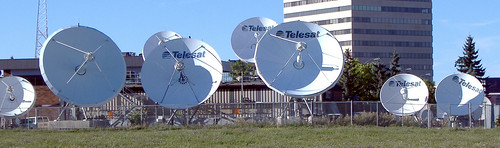
We already heard that Loral is closing the Hawley Earth Station in Pennsylvania (pictured at left), moving all those functions "elsewhere." Does this approval mean "elsewhere" is north to Canada, perhaps? 

"On December 16, 2006, the joint venture company formed by Loral and PSP Investments entered into a definitive agreement with BCE Inc. to acquire 100 percent of the stock of Telesat Canada from BCE for CAD 3.25 billion," according to the PR Newswire release.

The open question is what this new deal means vis a vis Loral’s reetnry in the U.S. market. (Loral, struglling under the weight of high debt, sold their U.S. space assets to Intelsat in 2004. As part of that agreement, Loral agreed to not compete in the U.S. satellite services market for a couple of years.)

Telesat has been an active player in the U.S. market. Portions of  Anik F2’s Ka-band payload was leased to WildBlue two years ago, and Anik F3 is leased to Echostar for Dish Network services.

Incorporated in 1969, Telesat made history with the launch of its Anik A1 satellite in 1972 – becoming the first commercial company in the world to operate a domestic geostationary communications satellite. These days they’re pushing consumer-oriented satellite broadband via resellers:

Telesat’s Anik F2 is the first satellite to fully commercialize the Ka frequency band – a breakthrough satellite communications technology for delivering cost-effective, two-way broadband services. The two-way capability means customers do not need an additional phone or cable line or the expense of a traditional dial-up ISP in order to receive high-speed Internet access. This state-of-the-art development enables dramatic improvements in access to two-way, high-speed Internet services for consumers and businesses in rural and remote areas.

(The picture below is of Telesat’s Edmonton facility.)


Home Run Ball in Space

Tuesday, September 18th, 2007

The guy who owns Barry Bonds’ record-breaking home run ball may send it into space. Voting ends on 25 September 2007:

I have my own opinion, I’ve been part of this debate just like everyone else. But I wanted to make it just a little more real. I bought this baseball to democratize the debate over what to do with it.

So what should we do with the ball? (A) Bestow it — Cooperstown; (B) Brand it — burn an asterisk into the ball, adding a permanent footnote to the record, then Cooperstown; or (C) Banish it — put the ball on a rocket ship and launch it inot orbit, a moon shot for the ages.


iCar?

Thursday, September 6th, 2007

Like many people, the iPhone shook my perspective on technology. It’s no longer about the best laptop, best mp3 player, or best phone. It’s about technological fusion — forging devices that can do it all.

So, why not an iCar? While you can’t carry it in your front pocket, there is no reason you don’t want your car to have the best technological capabilites. A radio is no longer good enough (a sad realization for a ’94 Geo Prism driver). CNET has all the nerd-gossip:

Apple and Volkswagen are reported to be in talks about an "iCar" or car integration system, according to reports from German magazine Capital and the Associated Press.

Apple CEO Steve Jobs and Audi Chairman Martin Winterkorn, who heads the Audi brand group that includes Volkswagen, met recently in California to discuss ideas, but no concrete plans, a Volkswagen representative told the Associated Press.

"We wouldn’t comment on rumors and speculation," said Tom Neumyar, senior manager for iPod and iTunes at Apple.

Volkswagen of America would neither confirm nor deny the reports.

While its currently all speculation, just imagine the possibilities: navigation system, iTunes synching, integrated touchscreens, chatting among back-seat passengers, integrated bluetooth, etc.. LAPTOP Magazine details some more wishlist items (some not-so-serious):

Dashboard on the Dashboard
We can’t wait to slip into our silver, leather-interior car and control everything–from the air conditioning to the gears–via a strictly touch-sensitive dashboard that’s void of any buttons or control wheels. Our fingers will manipulate everything on the panel with simple finger strokes and taps. In keeping with Apple’s current Mac OS X Dashboard, we’re demanding customizable Widgets with everything from Google Maps to current gas prices.

Click Wheel As Steering Wheel
It’s going to take some getting used to, or even a retake of your driver’s test, but replacing the olden-day steering wheel with an iPod-like Click Wheel will make it easier to turn the corner; you’ll merely have to slide your hand over the touch-sensitive plastic wheel. Bonus: A simple push of the center button emits a loud honk that sounds like a Leopard purr.
[…]

Smart Playlists
Using live traffic updates, your music playlists will be automatically generated by the amount of congestion. When you’re about to enter areas with heavy traffic, you’ll be soothed by the mellowest tracks in your collection. When all that’s in front of you is open highway, the bounciest and raciest pop and punk tracks will move to the top of the list. Your iCar will even customize your library based on where you are. If you’re cruising down the Jersey Turnpike, for example, you’ll hear Lynyrd Skynyrd’s "That Smell" blaring through the Apple Hi-Fi sound system.

AirPort Antennas
Pull into the garage and you’ll be able to download iTunes movies over the air to the backseat monitors for the kids to watch, or sync videos, photos, and music with your Apple TV. We’re also excited about the possibility of swapping playlists with other iCar owners via Wi-Fi while you’re at a stoplight-provided they have DRM-free tracks.

Critical to this dream iBeetle (or iPassat) will be Internet-access. What will this iPhone iCar do without the requisite AT&T signal? Perhaps Qualcomm’s Omnivision Mobile Platform can be integrated. Using OmniTracs and OmniExpress, this mobile platform can connect one’s vehicle through satellite and wireless networks.

A Geo driver can dream, right?

On an even lighter note, imagine Microsoft’s retaliation, as one CNET reader jokes:

God help us if Microsoft attempts anything similar. Considering the hackability of their operating system, we’d be in HUGE trouble…

Great Photoshop contest on Fark.com, like this "Zune Buggy:"