Archive for the ‘Cool Stuff’ Category

Throw Out Them Bunny Ears

Wednesday, September 27th, 2006
We’ve written before about how dramatically the intersection of television and computers — particularly through IPTV and satcom– will transform the media marketplace and the media consumption habits of ordinary people.

That transformation is several steps closer to reality, if news of new gadgets today is any indication.

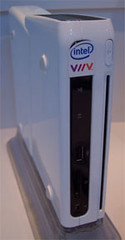
First up is the DirecTV Plus HD DVR — the result of a partnership between DirecTV and Intel:

[I]n other news to come out of the Intel Developers Forum, DirecTV and Intel are joining forces to produce the DirecTV Plus HD DVR — which we first heard about all the way back at CES — allowing viewers to check out content via the interweb when connected to a Viiv PC. In addition, there will be a new software update for DirecTV subscribers by the end of the year that turns subscribers’ set-top-boxes into digital media adapters, the companies said in a press release earlier today. The new DVR, to be released later this fall, will capture 200 hours of standard definition programming or 50 hours of HD, or whatever combination of the two your little heart desires.

CNET also reports that Apple’s iTV wireless router — connecting TV to PC or Mac — will be coming out soon:

 Apple Computer’s take on the living room became a little clearer… with its preview of a new networking product….

CEO Steve Jobs announced that Apple is working on a product code-named iTV that will allow both Mac and PC users to watch movies or television shows purchased from the iTunes store in their living rooms….

The iTV box won’t be available until the first quarter of 2007, but Jobs said it will cost $299 and walked attendees at Apple’s press event in San Francisco through a brief demonstration of its capabilities.

The iTV unit is basically a wireless router with ports for video connections to televisions, including an HDMI port for high-definition digital televisions. The idea is to hook it up to a television or set-top box as another video input device, and access video content stored on a Mac or PC through a special Apple remote control, Jobs said.

And if neither Apple nor DirecTV whet your whistle in anticipation of the coming transformation in consumer media choice, AT&T’s U-Verse fiber-based television service is set to offer some cool options, according to Engadget

 U-verse users, meet HDTV. We just got word that AT&T’s IPTV service is going to be blessed with numerous upgrades within the next few weeks that will include HDTV support, more channels, more VOD, games, personal photos and other unannounced features. This rollout seems to be within the same speculated time frame of October 25th to coincide with the launch of those brand spanking new Motorola DVR’s; whenever it does happen, though, these features will be implemented during the slow viewing times between 11 PM and 5 AM with the hope of minimizing service interruption. On a similar note, AT&T is upgrading DVRs to prep for this rollout, with customers seeing all previously recorded programs erased and all scheduled recordings canceled after October 5th. But keep in mind this is for high-def along with more content, so hopefully the ends will justify the means — you can deal with a few Adult Swim-free nights for the greater good, right?

 The times, they certainly are a-changin’.


Rescuing Inflight Broadband

Thursday, September 21st, 2006


According to Shephard Group’s Inflight-Online, Panasonic Avionics wants to offer the same inflight broadband service being shut down by Connexion by Boeing:

JUST when the Inmarsat community was relishing the prospect of an unobstructed run at the passenger broadband market, Panasonic has announced a plan to take up where Connexion by Boeing left off. The IFE giant has no intention of rushing in, though, and will not launch unless it has commitments covering a critical mass of aircraft. 

“We have a complete system designed, developed and ready to go,” strategic marketing director David Bruner told Inflight Online at the WAEA show in Miami Beach last week. “But we’re determined to avoid one of the things that brought Connexion down – lack of an initial fleet big enough to assure acceptable pricing for the airlines.”

Panasonic has set about securing agreements covering a minimum of 500 aircraft in the next 60 days. That schedule is being driven by the need to be ready to serve ex-Connexion airlines within a tolerable time after the discontinuation of that service by the end of the year. “We can’t drag our launch decision on until, say, February,” Bruner said. “There will inevitably be a dark period between the end of Connexion and the start of our service, and we want to keep that as short as possible. We already have 150 aircraft committed and feel confident we’ll make the 500. But if we’re falling badly short in 60 days’ time we will not go.”

Early takers would enjoy significant advantages over airlines that were slower of the mark, Bruner said. “In return for a minimum five-year commitment we’ll reward our launch customers with very preferential service pricing, and they will also get priority access to bandwidth.”

Panasonic’s standard wholesale price to the airlines would represent a comparatively small premium on terrestrial broadband access tariffs, Bruner said. “So far we are seeing little indication that the airlines are planning to mark this up for passengers. It’s a service they want to offer – they don’t currently see it as a revenue-generator.”

The new offering is designed to be as attractive as possible to airlines that are already equipped for Connexion. “Our solution for them is to replace only the modem on the aircraft and leave all the rest of the hardware, including the antenna, in place,” said Bruner. “That will spare them the expense of reversing the Connexion installations and then putting in our definitive equipment suite.”

That includes a compact Ku-band antenna from Californian-based L-3 Datron Advanced Technologies. Another L-3 Communications operation, the Linkabit division, is supplying the modem. Both are already fully developed for US military applications and have been modified for civil use by removing the encryption provision. Working with an existing Ku-band satellite system, the hardware is capable of delivering 12Mbit/sec to the aircraft and 3Mbit/sec in the opposite direction, according to Bruner.

Panasonic has selected a single Ku-band satellite operator to provide transponder capacity and geographical coverage at least equivalent to Connexion’s. “With an initial fleet of 500 aircraft we would anyway pay significantly less for transponders than Connexion,” Bruner pointed out. “But our technical solution will also be more efficient than theirs, allowing us to put more traffic through each transponder and thus reduce our total requirement for satellite capacity.”

Panasonic saw itself as a system designer and integrator and had no intention of incurring the costs associated with being a service provider, Bruner said. The as yet unidentified satellite operator would be responsible for system management, operation and capacity planning, and Panasonic is in talks with a global wireless roaming company for the provision of services such as customer care, billing and retail promotion. 

“We’re intent on learning from what happened to Connexion,” said Bruner. “9/11 lost them their start-up fleet, and after that they were always struggling to catch up. Our onboard equipment is lighter and cheaper, and our approach to buying transponder capacity is altogether more economical. We think these advantages will persuade the airlines and that in a couple of months’ time we’ll be ready to go ahead.”

Should the magic 500 not be achieved, however, Panasonic will continue to look for another way into connectivity. “If Ku-band proves not to make sense after all, then we’ll go down another path,” Bruner concluded.

At least one other passenger communications provider will be watching developments carefully. AeroMobile is currently to committed to L-band operator Inmarsat as the bearer system for its soon to be introduced onboard cellphone offering. But it is also looking to offer email and Internet/VPN access in the longer term, and would be open to integration with the Panasonic Ku-band system in the same way its new GSM/GPRS cellular offering is being integrated with the company’s onboard IFE infrastructure.

“We’re completely agnostic when it comes to air-to-ground data pipes,” commented AeroMobile strategic relationships and marketing director David Coiley. “In the end we could find ourselves working with Inmarsat, Panasonic and even the AirCell terrestrial broadband system in North America.”


Although some still have doubts, Australian airline Qantas is moving forward with their test.

Ricochet Laser

Wednesday, September 20th, 2006

The USAF Research Lab does some interesting work, and this one is certainly no exception: the Aerospace Relay Mirror System (ARMS). A unit of Boeing’s Integrated Defense Systems is working on the project and they had a very successful test last month:

The demonstration, conducted recently at U.S. Air Force Research Laboratory facilities at Kirtland Air Force Base, N.M., used a half-scale version of a strategic relay mirror payload that ultimately could be packaged and carried to high altitudes on airships, long-endurance aircraft or spacecraft. The payload could be used with airborne, ground-based or sea-based high-energy lasers to destroy ballistic missiles and other targets. Relay mirror systems will greatly enhance laser weapon system performance by reducing the atmosphere’s effects on laser beams and extending their range beyond line of sight.


Reminds me of an old Hanna-Barbera character called "Ricochet Rabbit," who would ping-ping-ping around the Old Southwest, where he was a sheriff — backed up by deputy Droop-a-long, who was not nearly as fast.

But this is the real deal, as described by defensetech.org last winter:

Lasers can only zap as far as the eye can see. The beams don’t curve, so ray guns can’t reach over the horizon. The Defense Department’s Office of Force Transformation wants to change that, however, with a world-wide ring of giant mirrors, that would bounce laser light to wherever the Pentagon saw fit.

This test advances their development, hopefully toward eventual adaptation to communications targets, as opposed to the other kind.

Chemical Leak Causes Scare on Space Station

Monday, September 18th, 2006

NASA declared an emergency on the International Space Station briefly this morning after technicians discovered that potassium hydroxide was leaking into living quarters. The leak of the odorless chemical was found after a smoke alarm went off while the crew was conducting some work on an Elektron oxygen-generating device and reported a "chemical smell."

Fortunately, the crew was never in any danger — at its worst potassium hydroxide can irritate the skin and eyes — and NASA reacted swiftly. Following the incident, the crew put on surgical masks and gloves and inserted a charcoal filter into the station’s ventilation system, which will supposedly clean the air and eliminate the odor.

Reportedly, Problems with the Elektron should have been expected given the track record of the device. Over the past few years the Elektro nhas been a source of a fair amount of trouble, requiring regular maintenance and troubleshooting. Still, its not known why the problem with the unit has popped up now. According to the New York Times[Registration Required], Michael T. Suffredini, NASA head of the ISS program, had said:

"he did not yet know why the crew had been working on the Elektron. ‘We’re trying to figure out why,’ he said. ‘This Elektron has been working very well.’"

For those who are curious, no word has gotten out on how the whole incident may or may not effect Anousheh Ansari’s historic journey to the station, although her blog has documented the take off that occurred much earlier this morning.

MobiTV looking into WiMAX

Wednesday, September 13th, 2006

The Wireless Report notes that mobile-delivered television service provider MobiTV is looking into the much discussed WiMAX technology as an "alternative delivery platform." Sure to take notice are those, such as Rupert Murdoch, who think television might just be the "killer app" that helps the last-mile connection method take off.

Personally, I’m probably in line with Om Malick on this one. While WiMAX could do a serviceable job delivering tv programing to an array of devices (especially those with smaller screens), the HD future means that a lot more bandwidth is going to be needed to deliver the kind of signal people are going to expect to see on the 137-in Plasma/Organic LED display of choice.

My bet for WiMax "killer app"? VoIP/Interent telephony, which is far more compatible with the bandwidth limitations of the technology and could do a lot to free us from the crappy mobile phone networks that plague the rural areas where WiMax will first emerge.

NRTC Announces Recipients of ‘WildBlue U’ Scholarships

Tuesday, September 12th, 2006

Back in June, the National Rural Telecommunications Cooperative (NRTC) and satellite internet provider WildBlue announced the creation of "WildBlue U" (opens in PDF) — a program and contest to promote the use of WildBlue’s satellite internet services in rural areas where DSL or traditional cable access to high speed internet service is unavailable.

Today the NRTC awarded Bobby Mills a $10,000 scholarship for selling the most WildBlue satellite Internet subscriptions over the summer. From the NRTC press release:

Mills was one of 28 students who participated in "WildBlue U," a program NRTC created and implemented in partnership with local utilities. The program provided paid internships to students to market WildBlue in their communities. As of Sept. 1, 2006, the interns participating in WildBlue U sold nearly 1,500 WildBlue subscriptions over the summer. Mills attends the University of Nevada, Reno where he is majoring in journalism. To help drive WildBlue sales, Plumas Sierra and Mills developed a "Got Bobby?" campaign, which featured information about Bobby and WildBlue on its Web site with an appeal to help Bobby win the contest and earn a $10,000 scholarship. "The style and coordination of the WildBlue U program offered up a competitive atmosphere that provided one with a real sense of job contentment, and an uplifting feeling of success with each closed sale," said Mills. "Commissions and rewards within the program were extremely generous, especially when taking the state of a typical college student’s wages into consideration." In addition to the $10,000 scholarship, NRTC awarded eight $1,000 scholarships. 

 
The NRTC contest isn’t the only contest promoting the intersection of today’s students with satellite technology. Next Friday marks the final deadline for submissions to the SES Americom Arthur C. Clarke Challenge (preliminary applications were due Sepember 1st. The Clarke Challenge is a "new annual award program for the very best creative, problem-solving idea that can propel the continued growth and expansion of commercial communications services and applications from satellites operating in the Clarke Orbit." More information on the Clarke Challenge can be found here; we’ll also bring you updates on the submissions and awards here at Really Rocket Science after the application date closes.

Space Shuttle Launched

Sunday, September 10th, 2006


KENNEDY SPACE CENTER, FLA. – From the top of the Vehicle Assembly Building, the fiery launch of Space Shuttle Atlantis is seen against the background of the Atlantic Ocean to the east while billows of smoke and steam roll across the launch pad. Atlantis is heading for a rendezvous with the International Space Station on mission STS-115. After launch attempts were scrubbed Aug. 27 and 29 and Sept. 3 and 8 due to weather and technical concerns, this launch was executed perfectly. During the STS-115 mission, Atlantis’ astronauts will deliver and install the 17.5-ton, bus-sized P3/P4 integrated truss segment on the station. The girder-like truss includes a set of giant solar arrays, batteries and associated electronics and will provide one-fourth of the total power-generation capability for the completed station. This mission is the 116th space shuttle flight, the 27th flight for orbiter Atlantis, and the 19th U.S. flight to the ISS. STS-115 is scheduled to last 11 days with a planned landing at KSC. Photo credit: NASA/George Shelton


NASA videos rock.

Antennas on the Move

Wednesday, September 6th, 2006


Andrew’s new MilSatCom 2.4 Meter Nomadic Antenna offers superior features—such as light weight design, high radio frequency performance, efficient gear driven pedestal mounts for high accuracy, and quad-band operation. The new antenna will debut at IBC 2006 in Amsterdam from September 8-12.

“Customers will find that Andrew has combined the best and most needed features into a single antenna system that meets the requirements of high-end users in the commercial and government sectors,” said George Tong, director, Government/Radar, Satellite Communications Group, Andrew Corporation.

The durable antenna supports interchangeable feeds that are engineered for simple removal and replacement in hostile or challenging communications environments, such as military situations, disaster relief efforts, and natural resource exploration.

Andrew’s Satellite Communications Group provides a complete line of antennas from 46 centimeters to 11.5 meters for all enterprise, government/military, and consumer satellite communication applications. Andrew-designed and -built products—which cover C, Ku, K, X, and the emerging Ka band—include type approved earth station antenna hubs and gateways for broadband and broadcast, VSAT broadband antennas for consumer and enterprise customers, DBS antennas for home satellite broadcast systems, and complete installation and testing services.

Finland’s Phone Toss

Monday, August 28th, 2006

This is one I couldn’t quite believe, especially after World Jump Day, but apparently the Finns have come up with a special day for every frustrated mobile phone user who’s ever wanted to toss the darn thing.

Phone TossEver heard of the Mobile Phone Throwing World Championship? It was held in Finland this weekend. Old phones were supplied for contestants who were allowed to pick which kind of phone they wanted to throw.

The men’s winner threw his phone 292 feet. The women’s winner tossed her phone 167 feet, a new world record according to the organizers. She said she has tossed a cell phone a time or two before.

Apparently, it’s real. And there’s even video.

I suppose it makes for a convenient excuse to upgrade your phone. I just hope all those tossed phones were properly recycled afterwards.

Flying Robots & Free Fuel?

Monday, August 28th, 2006

I don’t mean to go on about those flying robots. You know, the ones with the tentacles? In Europe? Yeah, those. I don’t mean to go on about them, but they always seem to be in the news.

This time they’re going by a different name: Stratellites. And they’re taking up a new function: wi-fi.

StratelliteBob Jones has a lofty idea for improving communications around the world: Strategically float robotic airships above Earth as an alternative to unsightly telecom towers on the ground and expensive satellites in space.

Jones, a former NASA manager, envisions a fleet of unmanned “Stratellites” hovering in the atmosphere and blanketing large swaths of territory with wireless access for high-speed data and voice communications.

…Jones believes his solar-powered, helium-filled Stratellites _ so named because they would hang in the stratosphere — could replace unsightly cell towers and cost less than satellites. Because of the airship’s altitude according to Jones, its radio equipment can cover an area the size of Texas.

Cell towers are hampered by line-of-sight limitations and limited range. Geostationary satellites suffer from the quarter-second it takes a signal to travel out 22,300 miles and back — insignificant in one-way TV transmissions, but terrible for two-way Internet computer communications.

The idea bubbled up and popped around the same time as the dot.com bust, yet it may be an idea whose time has come again. If so, Jones might want to consider some alternative fuels for getting his stratellites aloft.


Fuel Cell UAV

For example, he might look into fuel cells. These guys at the Georgia Institute of Technology got their flying robot aloft using a hydrogen fuel cell. And if hydrogen is cost prohibitive, Boing Boing says this company has build a machine that generates free energy.

Then again, if the comments and tags on that Google video are right, maybe not.