Archive for the ‘Cool Stuff’ Category

Intelsat Building for Sale

Monday, August 21st, 2006

Steve Pearlstein had an interesting column in Friday’s Washington Post regarding the changing fortunes of Intelsat and its famous headquarters in Washington, D.C.:

Time was when Intelsat was something of a metaphor for business in Washington, a government-backed enterprise that put the city at the center of the global satellite industry. Its futuristic office building on Connecticut Avenue was meant to symbolize Intelsat’s technological prowess and financial reliability.

Today, Intelsat is still something of a metaphor, but for a very different business environment. Its official headquarters is in Bermuda, its building is for sale, some operations are moving to Atlanta, and its debt is rated as junk. Intelsat’s prospects are now tied up as much with financial engineering as with the other kind.

All this is the result of transactions by private equity firms that took Intelsat from a government enterprise to a private company and merged it with Comsat, PanAmSat and parts of Loral, among others. But in the process, they have also loaded Intelsat with more than $11 billion in debt and drained much of the company’s equity value.

More information on Intelsat’s financial woes can be found here and here. Yet regardless of Intelsat’s financial outlook, the future in Washington won’t quite be the same if the Intelsat building — long a Connecticut Avenue landmark and a must-see for futurists touring the nation’s capital– gets renamed.

Unless, of course, you purchase it in our honor and rename it, say, the Sebadoh Building. (This might be the company with the listing.)

More photos: Check out this arial photo as well as this "blast from the past" photo of John Andrews with a model of the proposed building back in 1980.


DIY Friday: Solar Satellite Dish Cooker

Friday, August 18th, 2006

Here’s a true story. A few weeks ago, my gas grill was stolen from my backyard. I went outside one Friday afternoon with a spatula and some burgers and — there was nothing there.

I can’t say I was disappointed that the grill was gone. There was a certain satisfaction knowing that whoever had taken the thing had some arduous scrubbing ahead of them if they wanted to remove several years’ worth of crispy cheese and hamburger fragments that had ossified onto the grill. Losing the grill to theft, I reasoned,  had at least spared me from that long-avoided chore.

But replacing the grill did present me with another problem — that ancient dilemma that has plagued mankind for, oh, three generations now:

Gas, or charcoal? 

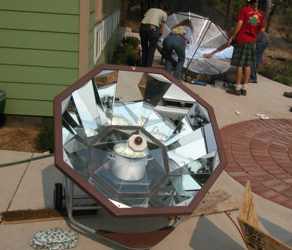
But now I learn that there is a new, third option for outdoor cooking: solar. A group of smart cookies from the Durango Renewable Energy Group have crafted a solar cooker made from a recycled satellite dish.

Reports have it that this fine addition to any suburban patio will bake cookies in under 15 minutes. Instructions on how you can create your own solar oven using mirrors (or a "cheaper" and lower-powered version using aluminum foil) can be found here.

My decision on how best to replace my grill has been further complicated by a neighbor who swears that the fourth option for grilling is pretty much the greatest invention in human history. I’m dubious about his assertion, and the clouds today raise my doubts about crafting my own solar cooker.

Which leaves me, metaphorically at least, still holding that spatula and a plate of uncooked burgers and wondering: gas, charcoal, solar, or George? 

The British Telecommunications Market 2006

Friday, August 18th, 2006

Doug Lung points to more evidence of the transformation of the media landscape. OfCom, the independent regulator and competition authority for the UK communications industries, has released The Telecommunications Market 2006 report. Lung summarizes:

The 293-page report contains some interesting findings about trends in the communications industry, including TV broadcasting, and consumer usage of, and attitudes to, various communications services. One conclusion reached was that a new "networked generation" is turning away from TV, radio and newspapers in favor of online services, downloadable content such as Podcasts and participation in online communities.

In a result that’s sure to concern traditional TV broadcasters, the report found that on average 16- to 24-year-olds in the United Kingdom spend one hour less per day watching television than the average television viewer. Their radio listening is lower too, by an average of 15 minutes per day compared to the wider population. One bright spot, however, is that among all groups, TV viewing increased slightly, by 11 minutes per week.

Digital television, consisting of both satellite and terrestrial Freeview channels, is growing in popularity. Freeview households spend more time watching digital-only channels than any of the five main public broadcasting channels, but the public service broadcasters’ own digital-only channels are gaining audience, with total viewing increasing nearly 6 percent between 2001 and 2005. Free TV remains popular and Freeview was the main driver of multichannel TV growth, adding 2.0 million homes in the 12 months ending March 2006. The report said there are now 7.1 million homes in the U.K. in which the main set receives digital terrestrial TV.

While the TV broadcasting model in the U.K. is quite different from that in the U.S., it is interesting to see that subscription revenues in 2005 were up by 8.5 percent to 3.9 billion pounds ($7.3 billon) for all pay TV services, exceeding commercial television advertising revenue in 2005 by almost 10 percent. Overall TV industry revenues increased 4 percent in 2005 compared with 2004.

A PDF of the key points of the report can be seen here.
 

All Hail Hale

Tuesday, August 15th, 2006

We found NASA’s Picture of the Day on Sunday to be particularly fascinating.

This Mars Global Surveyor (MGS) Mars Orbiter Camera (MOC) image shows dried streambeds—martian gullies— in the mountainous central peak region of Hale Crater. Some scientists have suggested that the fluid which carved these gullies was liquid water, and that it either resulted from ancient snowmelt or from release of groundwater that percolated to the surface in the intensely fractured rock of Hale’s central peak. In either case, the gullies are dry today, and dark sand can be seen as dunes near the right/lower right part of the image.


Google’s Astronomy Picture of the Day

Wednesday, August 9th, 2006

Astronomy buffs who use Google Desktop to organize their computers can now download a cool plugin that delivers an Astronomy Picture of the Day. The plugin allows users to easily share the daily picture with friends using Google Talk:

Discover the cosmos! Each day a different image or photograph of our fascinating universe is featured, along with a brief explanation written by a professional astronomer.

If Google Talk is installed on your system, you can share the sheer beauty of our universe with your friends. If neither Google Talk is available nor any friends are online, the service and its button are unavailable.

With eye candy, transparency and smooth animations for your viewing pleasure. Undocking recommended!

Click here to download the plugin. 

Google Watching You Watch TV?

Monday, August 7th, 2006

Sebadoh posted on Friday about Google getting into the satellite radio business. Well, it looks like Google is also making forays into television. Not producing, mind you, but monitoring what you watch and producing related internet content.

In a research paper presented last week at interactive television conference Euro ITV in Athens, Greece, Google researchers Michele Covell and Shumeet Baluja propose using ambient-audio identification technology to capture TV sound with a laptop PC to identify the show that is the source of the sound and to use that information to immediately return personalized Internet content to the PC.

"We showed how to sample the ambient sound emitted from a TV and automatically determine what is being watched from a small signature of the sound—all with complete privacy and minuscule effort," Covell and Baluja write on the Google Research Blog. "The system could keep up with users while they channel surf, presenting them with a real-time forum about a live political debate one minute and an ad-hoc chat room for a sporting event in the next."

… According to Boralv, the system wouldn’t be that intrusive. She writes, "If you were watching the news and wanted to delve deeper, this type of system could allow you to do that easily by automatically collecting related material and Web links for you. The beauty of the system that Michele and Shumeet describe is that it wouldn’t be a distraction. If you don’t want it you can ignore it and the PC browser will quietly update pages without bothering anyone—no input required and no audible output to form a distraction."

Those appalled by the prospect of Google tapping your television take heart: The proposal suggests user privacy would be respected. "[O]ur approach will not ‘overhear’ conversations," the paper says. "Furthermore, no one receiving (or intercepting) these statistics is able to eavesdrop, on such conversations, since the original audio does not leave the viewer’s computer." Perhaps there’s a lesson here for the National Security Agency.

Creepy? Or just the next step in increased synergy between new media and old? I can’t decide, but the Interactive TV Today blog describes in a bit more detail how Google might "overhear" what you’re watching.

[The system] would use a PC microphone to sample the ambient sound emitted by a television set and automatically determine what is being watched on that set from a small signature of that sound. The system would then use the data thus gathered to automatically present the viewer–in real time on his or her Web browser–with contextually relevant information, and with ad-hoc services that would enable social interaction around programming: thus, if the viewer were watching a sporting event, the system might present him or her with an ad-hoc fan forum; and if the viewer were to switch to a movie, it might present him or her with maps of the locales featured in the movie or with a bio of the actor currently appearing on the TV screen.

The system is composed of three distinct components: "a client-side interface, an audio-database server (with mass-media audio statistics), and a social-application Web server," the three scientists write in the paper’s introduction. "The client-side interface samples and irreversibly compresses the viewer’s ambient audio to summary statistics. [Note: the authors note that this irreversible mapping would serve to protect the viewer’s privacy.] These statistics are streamed from the viewer’s personal computer to the audio-database server for identification of the background audio (e.g., ‘Seinfeld’ episode 6101, minute 3:03). The audio database transmits this information to the social-application server, which provides personalized and interactive content back to the viewer."

One more question. How does this relate to Google partnering with Viacom to test sharing ad revenues from web videos? Is there a possible tie-in here? Maybe Google monitors what you’re watching and turns up related web videos? Clips from other shows you might be interested in, from Google’s ad partners?

DIY Friday: Convert Your Primestar Dish to 802.11

Friday, August 4th, 2006

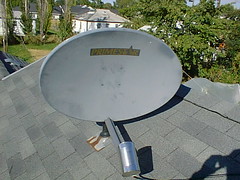
What do you do if you need to get WiFi access in a relatively remote location — say, a distant outbuilding? Waiting for WiMAX might mean waiting a long time in rural areas. Why not just grab an old Primestar dish, a tin can, and some coaxial cable, and rig up your own WiFi antenna?
A student at Walla Walla College explains: 

 It is easy to make a surplus Primestar dish into a highly directional antenna for the very popular IEEE 802.11 wireless networking. The resulting antenna has about 22 db of gain, and is fed with 50 ohm coaxial cable. Usually LMR400 or 9913 low loss cable is used if the source is more than a few feet from the antenna. The range using two of these antennas with a line of sight path is around 10 miles at full bandwidth. I must stress the line of sight part though. Leaves really attenuate the signal.

The "things you need" can be found easily by any aspiring MacGyver:

   1.  A Primestar dish.  (You may use any old dish, but if it is bigger than the Primestar the gain will be higher, and it may not be within the Federal Communications Commission rules for use within the United States.  In fact I have come to find out that there seem to be several different dishes that Primestar used, and I am only sure that the one I used, pictured above, used with the ordinary Wavelan or Airport transceiver card is within the effective radiated power limits given by the FCC.)
   2. A juice can (about 4 inches in diameter and at least 8 inches long).
   3. A chassis mount N connector.
   4. You will also need a "pigtail" connector which has the proprietary Lucent connector (for the PCMCIA card) on one end and an N connector on the other. The pigtail can be obtained from a number of online stores for $35 to $40.

Once assembled, you’ll want to brace the highly directional antenna securely against the wind. 


Launching the Coke/Mentos Rocket

Thursday, August 3rd, 2006

Being rocket scientists and all, we couldn’t help but be fascinated by the latest craze lighting up the blogosphere: instructions and videos on how to combine Mentos with Diet Coke to create and launch your own home-made bottle rocket.

This particular launch  is one of the top videos on YouTube, with nearly half a million viewings in the past six weeks:

An explanation on how it’s done can be seen here:

Of course, being rocket scientists (and, for some of us, parents as well) we must provide a caveat– bottlerockets are inherently dangerous, no matter how they’re constructed. We direct you to Newton’s Second Law of Motion for further explanation.


City Wi-Fi, Green Wi-Fi

Wednesday, August 2nd, 2006

It’s been a long time since I blogged about my enthusiasm for municipal wi-fi, but news from Boston brought the subject back to mind again.

Wi-FiBoston’s plan to create a citywide wireless Internet network entered a new phase yesterday as Mayor Thomas M. Menino named former high-tech executive Pamela Reeve to lead the search for a non profit corporation to build the network.

Reeve, a member of the mayor’s Wireless Task Force and a former chief executive of software company Lightbridge Inc., also will talk to businesses, foundations, universities, and hospitals in an effort to raise between $16 million and $20 million for the project.

The money would be used to blanket city neighborhoods with fiber-optic cable and radio transmitters that would beam WiFi signals, enabling laptops, handheld computers, cell phones, and other portable devices to connect to the Internet at high speeds anywhere in the city.

As noted at GigaOm, this model is unlike any other in blending resources from government, business and non-profits. Can it work? Who knows, but if it does the next step might be to combine it with an idea like One Laptop Per Child movement, but with a domestic focus. Nigeria just ordered (and payed for) 1 million of the wireless-equipped laptops. It could happen in the U.S. too — wi-fi access and low-cost wireless laptops opening up new opportunities for a lot of kids.

And as long as cities are launching wi-fi networks, the might want to consider making them green too.

Green Wi-FiThe technical concept behind the Green Wi-Fi network is fairly simple. Each node in the network consists of a battery-powered router and a solar panel to charge the battery. The nodes are mounted on rooftops, and the network’s Wi-Fi signals are transferred over a grid using a wireless network standard known as 802.11b/g.

The first seed money has arrived, enough to produce and test prototype nodes. It came from the One Laptop Per Child initiative (OLPC), which aims to construct a $100 laptop to be distributed to children in developing countries. OLPC showed immediate interest in the Wi-Fi initiative, Pomerleau said.


Send Your Junk Into Space

Thursday, July 27th, 2006

This might be a good way of getting rid of excess junk that you have lying around: Send it to space. Earlier this month I posted about the launch of Robert Bigelow’s inflatable spacecraft, Genesis I. Well, via Space Pragmatism comes news of Bigelow’s next big plan. When Genesis II goes up, he’s gonna let you fly your stuff into space, and send you pictures too.

Whereas space was once the domain of only the privileged, Bigelow Aerospace is offering the public an exciting new opportunity to reach the final frontier. For the first time, you can actually send an item of your own into space. Your personal selection will be floating inside a spacecraft hundreds of miles above the Earth. If all systems function properly, your personal treasure (be it a photo, ring, bottle-cap or toy) will be floating in space for years.

And here is the best part: You might even be able to see it. That’s right! The Bigelow Aerospace spacecraft known as Genesis II will be carrying multiple cameras. Some of these cameras will be viewing areas inside the spacecraft where your prized possession is floating. Everyday, Bigelow Aerospace will be downloading images and video from these cameras to its Website. If you log onto the Bigelow Aerospace Web portal, you will have a chance to actually see your item floating by! And who knows? If the Genesis II spacecraft stays in orbit for several years as we expect, you may see your face (or item) many times over!

Inside Genesis I

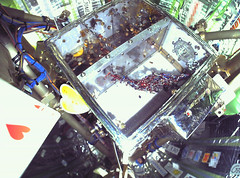
You can also look inside Genesis and see what’s already gone up (besides NASA’s GeneBox, that is). The picture above, by the way, is a box of Mexican jumping beans sent up in Genesis I by Bigelow Aerospace employees.

For $295 a pop, you can send up anything you want as long as it’s:

  • smaller than a golf ball;
  • less than 1 oz. in weight;
  • doesn’t contain any magnets;
  • doesn’t contain power-operated devices, liquid, or powder.

I’m not sure what options that leaves or whether the price beats a similar program from Masten Enterprises, but at least there’s now another way to send more junk into space.