Dancing With The Satellites
Tuesday, May 25th, 2010
Typically well-done rendering by AGI of how SES and Intelsat plan to mitigate interference between Galaxy-15 and AMC-11.
Typically well-done rendering by AGI of how SES and Intelsat plan to mitigate interference between Galaxy-15 and AMC-11.

This weekend, at the San Mateo County Event Center, it’s Maker Faire 2010, the world’s largest DIY festival. A brilliant idea from the publishers of Make: — one of the very few successful new media properties in the new millennium.
Just check out this preview for what to expect.
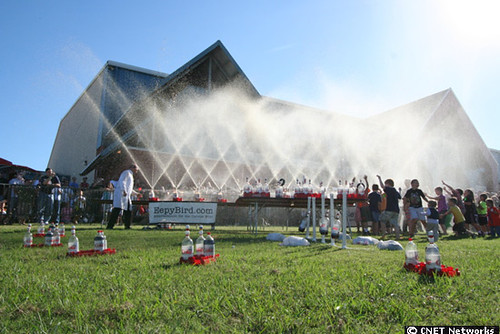
The big fun event ought to be the EepyBird.com guys, originators of the Diet Coke/Mentos phenomenon a few years back.

They’ve refined their "science entertainment" to produce Bellagio-style fountain art. Check out these videos…
Can’t make it out to California? Maker Faire is coming to Michigan (Detroit and Ann Arbor) and New York.

The University of Tokyo’s Intelligent Space Systems Laboratory (Nakasuka) built and launched a cubesat, 4-in/10-cm square, in 2005. The low-earth orbit spacecraft is now sending out updates via Twitter, all by itself.

The tweets, in Japanese, even feature little twitpics and have assembled over 2,600 followers. Some detail, via Asiajin:
Nakasuga Lab., the University of Tokyo, introduced a bot account tweeting the real-time state of a satellite which is located in the earth low orbit. The tweet(@XI-V) keeps us update with parameters like the satellite’s surface temperature, battery voltage and where it is located over of the planet and also shows us still images shooting the planet from the satellite in the space.
As we’ve blogged before, real-time tweets from space has had human intervention. This is automatic, and that’s kinda cool. This information is more than the poor boys at Intelsat have regarding the Galaxy-15 spacecraft. They get no telemetry data at all, but they do have some ranging info and ephemeris data.
As for CubeSat XI-V, a job well done by the rocket scientists at Nakasuka!
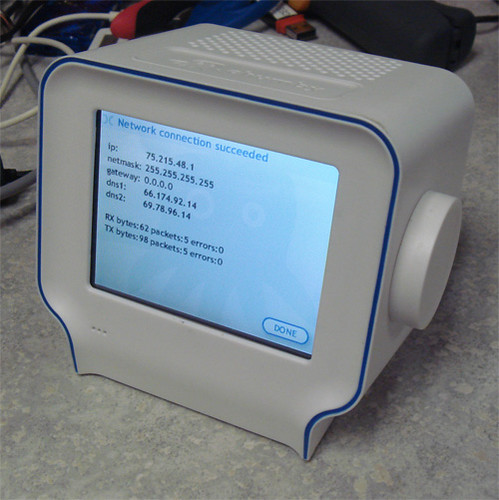
Bunnie’s blog has the coolest 3G router you can make yourself with a Chumby…
There’s an Easter Egg inside the chumby One (which is now on sale at Costco online for $99, cheaper than chumby.com’s $119 price!) that enables it to work with certain 3G USB modems and function as a 3G router (similar to a MiFi). Use of the Easter Egg is documented on the chumby wiki, but it can be quite simple:
- Plug in your 3G card.
- Go to the Network Config screen by pressing the top button, going to Settings, then tapping on Network.
- Select "create a new connection", press OK, and wait for the scan to time out.
- Select "Other"
- Enter 3G as the name of the access point. It must have a capital G for it to work.
- Wait for the subsequent scan to time out.
- Select "Manual".
- Tap "OK" to select None as the encryption type.
- Tap "OK" to select Automatic IP allocation.
- Tap "OK" to confirm settings and connect to the network
To activate local wifi sharing, ssh into the device (or plug in a USB keyboard to activate the drop-down console) and use the command "touch /psp/start_ap" to flag the network setup scripts to configure your chumby One as an access point. Note that AP mode also works with other network sources, such as Ethernet-over-USB.
Cute.
The "This Too Shall Pass" music video by the band OK Go is impressive. It features a Rube Goldberg Machine produced with the help of MIT students and alumni, it was put up on YouTube in March and has since garnered more than 11 million views. Sure, that’s nowhere near the new record set by Lady Gaga’s "Bad Romance" video (187 million and counting). Posting music videos helps sell records. EMI had a problem with that, so OK Go is on its now. Good for them.
OK Go’s Web site has a wonderful interactive floor map to keep you busy.
Very cool. Watch this video of how to build one with kids. Check out Argonne National Laboratory’s contest for high schools, and, of course, Purdue’s Rube Goldberg Contest is one of the best for college students.
Need ideas? Poke around the Instructables site.
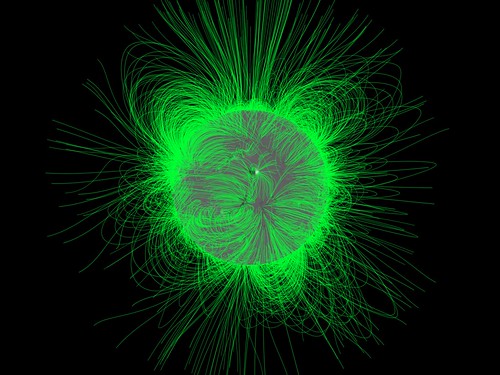
Yes, it’s Earth Day. So we’ll follow the Sun instead. NASA’s Solar Dynamics Observatory released it’s first images and video. The spacecraft’s three instruments will likely revolutionize the study of heliophysics, much as Hubble did for astronomy.

The Helioseismic and Magnetic Imager (HMI) will study the motions and magnetic fields at the Sun’s surface to figure out what’s happening inside.
The Atmospheric Imaging Assembly (AIA) is a bunch of four telescopes will check out the corona, the outer layer of the Sun’s atmosphere. The AIA filters will observe across ten wavelength and provide 725 km resolution.
And the Extreme Ultraviolet Variability Experiment (EVE) will gauge the Sun’s energy in extreme-ultraviolet wavelengths.
Check out this short video…
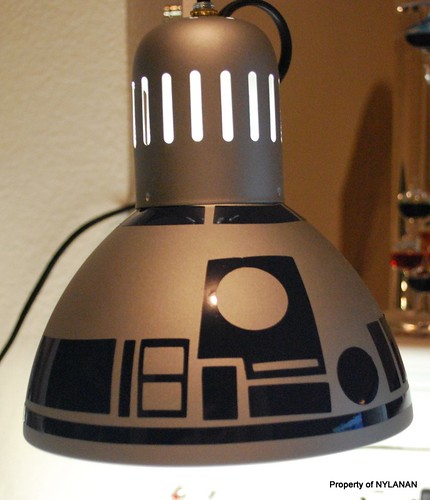
This is a cool project for Star Wars fans: a metal desk lamp decorated to look like R2-D2, via Instructables…
I am building a full size R2D2 from scratch, when you are scratch building everything begins look like a potential part, well this lamp I just got from IKEA really reminded me of the little domed one so I got bored and with a little bit of tweaking I got him looking pretty good.
Can’t make the decals yourself? Buy them on Etsy! Kids love R2-D2.
How did the volcanic eruption in Iceland get to ground air traffic in northern Europe? Check out this illustration from the ESA…
The information has been derived by a model using SO2 as particle tracer for the ash plume. This model has been developed at the Norwegian Institute for Air Research in the Department of Atmospheric and Climate Research.
This service was developed within the ESA Data User Element ‘Support to Aviation for Volcanic Ash Avoidance’ with the aim of generating accurate and timely satellite-based information to Volcanic Ash Advisory Centres (VAACs) to assist the aviation community.

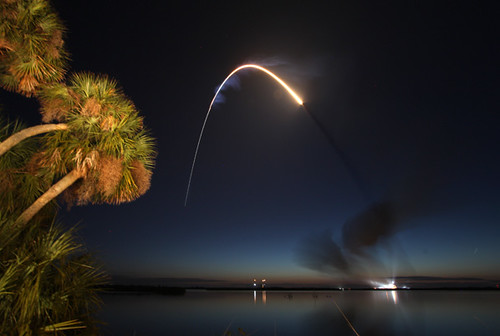
Nice launch this morning, and SpaceflightNow.com‘s photo selections (by Stephen Clark) are beautiful.
I know NASA was happy about it…
During a postlaunch news conference at NASA’s Kennedy Space Center in Florida, the 6:21 a.m. EDT liftoff of space shuttle Discovery was hailed as a great success.
Calling the launch, "a great start to a great mission," Bill Gerstenmaier, associate administrator for Space Operations, said the successful liftoff was a tribute to the team at Kennedy that got the vehicle ready to fly.
Mike Moses, chair of the Mission Management Team, said it was, "a spectacular launch and picture-perfect countdown." He outlined a few minor technical issues that were recorded, but that the spacecraft and crew were ready to start an action-packed mission.
Expressing his happiness that they were able to launch on the first attempt, Pete Nickolenko, STS-131 launch director, said he was proud of the teams that make such a difficult job look so easy.
Also on hand was Japan Aerospace Exploration Agency President Keiji Tachikawa, who noted that this will be the first time two Japanese astronauts will be in space at the same time, as Discovery’s Mission Specialist Naoko Yamazaki joins Expedition 23 crew member Soichi Noguchi for the STS-131 mission.
Discovery and crew will spend 13 days in space on their mission to the International Space Station.
Cool video, as always…

We’ve done featured quite a few DIY projects that recycle or re-use old satellite antennas. From using an old Primestar reflector to improve WiFi, to the wireless Internet cantenna, to more physical structures such as this BUD gazebo and the ever-popular solar cooker. Not mention one for the birds.
Today, you’re on your own with the steampunk satellite dish. We’re inspired by work commissioned by Telstra in Australia and created by Martin Dolan and the mArty Gallery, near Melbourne.
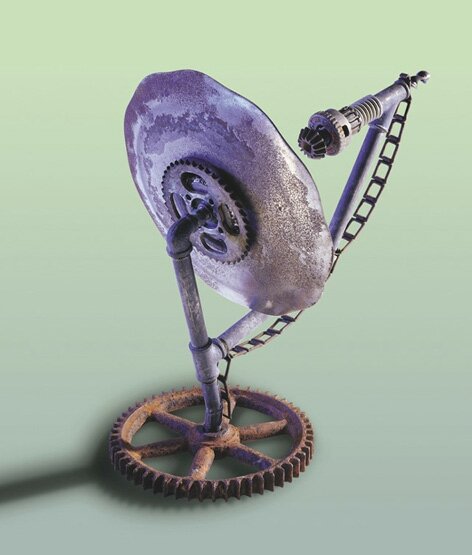
Look around your shop for old pipe and things parabolic, and have at it!
Australia. Steampunk. I’m thinking Mad Max, aren’t you?