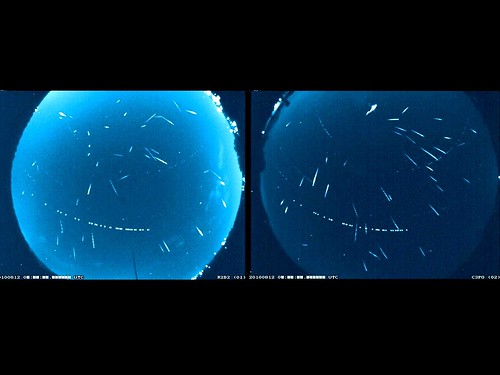
Composite Perseids view on the night of Aug. 11, 2010, combined from 39 single station events over Chickamauga, Ga. (NASA/MSFC/D. Moser, NASA’s Meteoroid Environment Office)
The Perseids have been observed for at least 2,000 years and are associated with the comet Swift-Tuttle, which orbits the sun once every 133 years. Each year in August, the Earth passes through a cloud of the comet’s debris. These bits of ice and dust — most over 1,000 years old — burn up in the Earth’s atmosphere to create one of the best meteor showers of the year. The Perseids can be seen all over the sky, but the best viewing opportunities will be across the northern hemisphere. Those with sharp eyes will see that the meteors radiate from the direction of the constellation Perseus.
This is a 24 hour observation of all of the large aircraft flights in the world, condensed down to 1:11. From space we look like a bee hive of activity. What you will see is a video showing air traffic around the world for 24 hours taken from a satellite. You won’t believe this! The yellow dots are airplanes in the sky during a 24 hour period. Stay with the picture. You will see the light of the day moving from the east to the west, as the Earth spins on it’s axis. Also you will see the aircraft flow of traffic leaving the North American continent and traveling at night to arrive in the UK in the morning. Then you will see the flow changing leaving the UK in the morning and flying to the American continent in daylight. You can tell it was spring time in the north by the sun’s foot print over the planet. You could see that it didn’t set for long in the extreme north, and it didn’t quite rise in the extreme south. I have never seen this before. We are taught about the earth’s tilt and how it causes summer and winter, and we have had to imagine just what is going on. With this 24 hour observation of aircraft travel on the earth’s surface we get to see the daylight pattern move as well. Remember watch the day to night. Day is over in Australia when it starts.
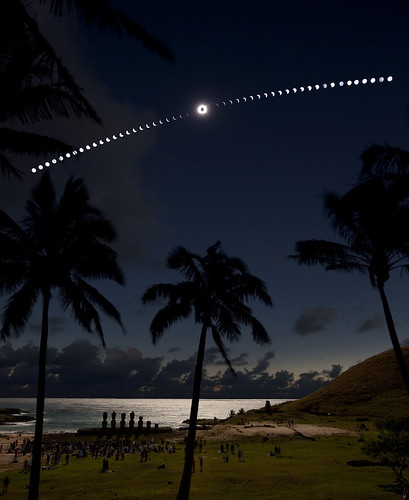
Has it been a month since the last post? I reckon it has. Spent three weeks sleeping in a tent in North Collins, N.Y. During that time, when we didn’t get a chance to read a newspaper, there was a total solar eclipse. Thanks to today’s Astronomy Picture of the Day (APOD), we see what it was like from Easter Island…
As theNew Moon’s shadow slidacross the southern Pacific on July 11, people gathered along the white, sandyAnakena Beachon the north side of Easter Island to watch atotal solar eclipse. The experience was captured in this tantalizing composite image, constructed from a sequence of 50 consecutive exposures. At their center is the totally eclipsed Sun surrounded by ashimmering solar corona. From the well chosen viewpoint, palm trees appear in silhouette against a darkened sky and the faint light reflected in the water. Of course,towering abovethe onlookers, at the boundaries of land, ocean,and skyare Moai, the island’smysterious monolithic statues.
Holding the new iPhone 4 can cause interference between the GSM and WiFi antennae, so naturally the Net is abuzz with this "problem." Hey, it doesn’t take a rocket scientist to figure this one out.
Get about an inch of scotch tape off the reel (that’s Sellotape if you’re in the U.K.).
Cut it carefully so that you make a rectangle something over a half-inch long and just tall enough to exceed the iPhone 4’s height (about 0.4 inches should do it).
Align the piece of tape so that it’s covering a section of the lower left metal side of the iPhone 4, some below the thin black plastic line and some above.
Stick it around the phone’s metal edge, making sure that all of the back of the edge’s metal strip is covered–you may even be able to leave the front uncovered, as it’s the back where your hand will rest. The main thing is to ensure that it’s unlikely that your palm will touch the metal on both sides of the black plastic line.
Result: Your iPhone 4’s twin antennas are now insulated against skin short-circuiting in the "problem corner". You don’t even have to use scotch tape–make a statement and do it in bright red electrician’s tape, if you feel better for it.
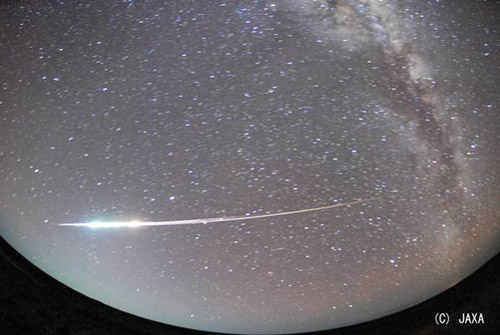
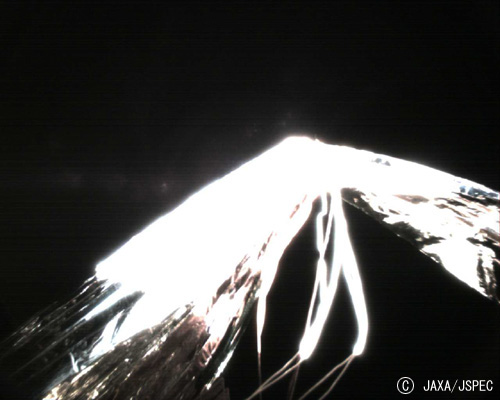
Hayabusa separated the capsule at 7:51 p.m. and reentered the atmosphere at 10:51 p.m. on June 13th, 2010 (JST). Hayabusa was launched on May 9th, 2003 by M-V rocket and operated for approximately seven years. During its operation, JAXA was able to achieve the difficult mission including Hayabusa’s sample capture attempt after its touchdown on the asteroid named Itokawa, and Hayabusa’s return to the earth overcoming many hardships. JAXA would like to appreciate every support to JAXA leading this mission to a great success.
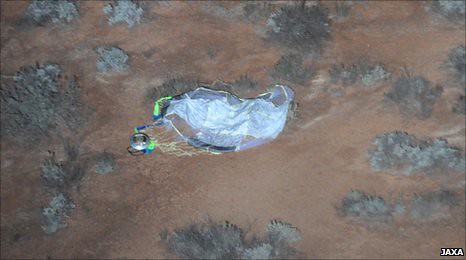
The Hayabusa capsule has just returned to Woomera, Australia. As the next step, JAXA will move forward to the capsule recovery.
Very cool technology being developed by Ad Astra Rocket Company: using plasma engines to reach Mars in 39 days. Hammer-down: space truckin at 110,000 MPH.
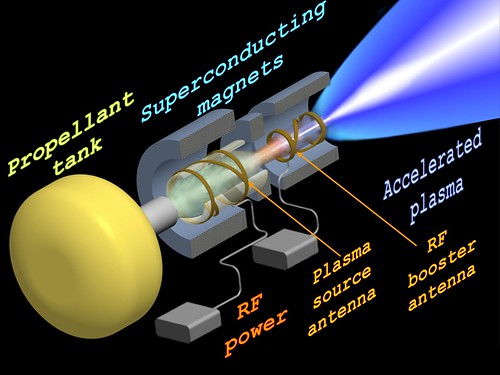
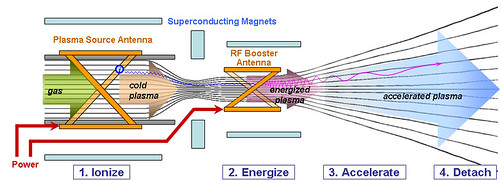
The company’s main project is the Variable Specific Impulse Magnetoplasma Rocket, or VASIMR, a highly-efficient space engine running on electricity and argon gas instead of conventional solid or liquid propellants.
Franklin Chang-Diaz, the project’s chief architect, says the VASIMR engine is the most flight-ready high-power electric propulsion system anywhere in the world.
"It is transformational technology that we are developing," Chang-Diaz said. "It always has been my view that chemical approach to space transportation really was not going to get us very far."
Chemical rocket engines require spacecraft to carry all of its propellant during its mission. The VASIMR engine burns small amounts of argon gas, one of the most stable elements on the periodic table. But one of the most revolutionary features of the VASIMR design is its reliance on electricity, a renewable resource in space.
"It’s very robust, but in order to get beyond the moon, and move on to Mars and beyond, we really need completely new transportation technology," Chang-Diaz said. "We view the VASIMR as the workhorse for that transportation infrastructure."
Electrically-powered plasma rockets could cut travel times for missions across the solar system. One concept championed by Chang-Diaz involves a 39-day mission to Mars, but it assumes leaps in nuclear energy production in space.