Intelsat, SES, Eutelsat, Telesat — all big satellite operators who continually try to get their stories out and reported on by the general business media, and, if they’re lucky, some broader medium. Doesn’t happen much, unless there’s a catastrophic failure during launch or in-orbit.
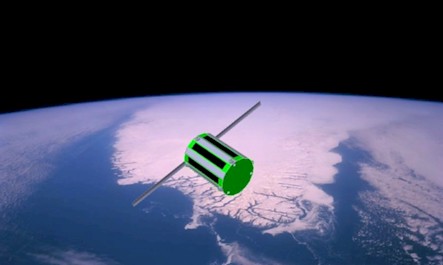
Along comes Kosta Grammatis with an idea to buy the Terrestar-1 spacecraft and move it from 111 West to a location assigned to Papua New Guinea, possibly 31.5 West over West Africa or something closer to home. So guess what happens. They put up a Web site to raise $150,000 to get it started.
Futurismic’s Paul Raven posts something on it yesterday, Boing Boing picks it up, then Gizmodo. Expect this to go viral in a way the major satcoms can only dream of.
But seriously, I doubt secured debtors such as EchoStar will let this baby go to another location. It’s in a good spot for broadcasting in the S-band. Free Internet? Good luck building modems for the masses. And each modem needs electricity, so get busy with power generation, too.
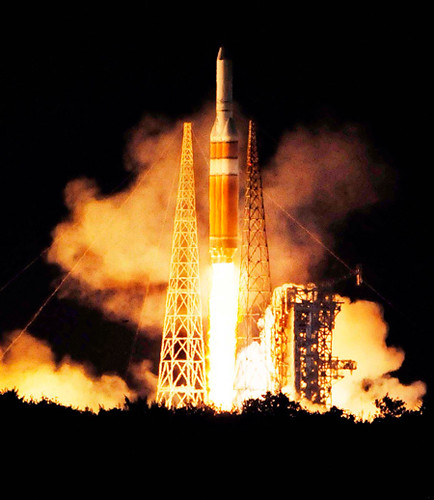
Undoubtedly, the Delta-IV Heavy is my favorite launch vehicle. ULA just popped an NRO payload into orbit the other day, via Aviation Week…
United Launch Alliance (ULA) racked up its fourth successful flight of a Delta IV Heavy, which blasted off Nov. 21 from Cape Canaveral Air Force Station, Fla., carrying a classified satellite for the U.S. National Reconnaissance Office.
The launch occurred at 5:58 p.m. EST. ULA halted commentary about seven minutes after liftoff. At the time, the vehicle was performing as expected.
The launch had been delayed from Nov. 18 to replace ground support equipment pyrotechnic ordnance lines, and on Nov. 19 due to anomalous temperature data signatures in the common core strap-on boosters. The problem was traced to faulty temperature sensors, which were replaced.
The Delta IV Heavy, currently the nation’s most powerful unmanned rocket, debuted on a demonstration flight six years ago, then flew two operational missions in November 2007 and January 2009.
The rocket, which was built by ULA in Decatur, Ala., is comprised of a common booster core with two strap-on common booster cores. Each is powered by an RS-68 cryogenic engine and an RL10B-2 cryogenic engine powers the second stage. Pratt & Whitney Rocketdyne builds both engines.
The payload was encased by a 5-meter diameter aluminum, tri-sector payload fairing.
The launch was the eighth and final flight this year for ULA. The company’s next launch is with another Delta IV Heavy for the NRO, scheduled for Jan. 11, 2011, from Space Launch Complex 6 at Vandenberg AFB, Calif.
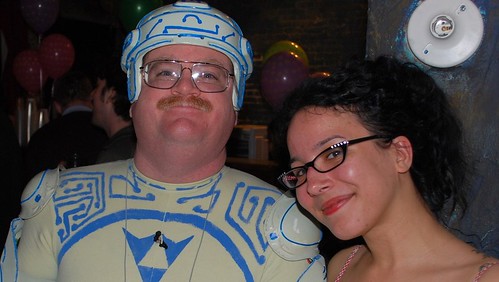
Sure, I remember the Disney movie TRON . Loved it — thought it was one of the coolest movies around. Yes, it stars one of the girls who appeared in Caddyshack (heh). With the new TRON Legacy movie getting good reactions to the preview making the rounds, maybe this Halloween is a good time to make your own TRON costume using electroluminescent wire?
Sonja Thompson posted a "how to" on TechRepublic in August, so I’d start there. Pretty good step-by-step report. Yes, it features "Tron Guy" Jay Maynard, who has gained a fair amount of notoriety in geekdom.
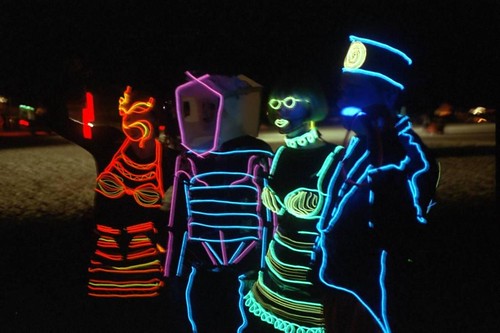
“Electroluminescent (EL) wires are really the best option. When you use the LEDs, you have to put them in one at a time, and it takes a while. You can make them react to sound, or make different patterns with them,” said Diana Eng, a fashion designer and author of “Fashion Geek: Clothes, Accessories, Tech” (North Light Books, 2009).
“It’s pretty easy to use. All you need is some AA batteries,” Eng said.
EL wire is regular copper wiring coated in a colored sheath that glows when current runs through the wire. Essentially a very long LED, you can weave it through your costume to add highlights, or give it a futuristic touch, Eng said. By soldering EL wire to a controller, users can program the wires to blink in rhythmic patterns, or respond to sensor input like motion or sound.
The two-day festival on the National Mall over the Oct. 22 weekend drew tens of thousands of participants, many of them students who were able to get hands-on experience with technologies ranging from alternative energy to aerospace. Elementary, middle and high school students asked and answered questions, participated in applied physics lessons, tore apart gadgets, raced to solve the Rubix Cube in record time and listened to interactive lectures by legendary scientists like Albert Einstein (portrayed by some very convincing impersonators).
The tech festival was organized by national science and engineering groups, U.S. technology and aerospace companies like festival host Lockheed Martin Corp. and media organizations, including EE Times. This publication sponsored a training effort called “Innovation Generation,” in which groups of student reporters fanned out during the festival to cover a broad range of technology subjects.
Virgin Galactic’s Spaceport in New Mexico is open and ready to make good on the $50 million in deposits it’s taken in from prospective space tourists after a runway dedication on Friday…
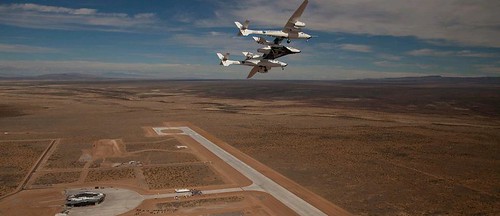
The New Mexico Spaceport Authority (NMSA) today dedicated the nearly two-mile long “Governor Bill RIchardson Spaceway” at Spaceport America, representing significant progress toward launching commercial customers into space from the desert of New Mexico. Governor Bill Richardson, Sir Richard Branson and approximately 30 of more than 380 Virgin Galactic future astronauts attended the event along with guests from around the world and watched a flyover and landing by Virgin Galactic’s WhiteKnightTwo, in a captive carry with SpaceShipTwo.
“We are celebrating the world’s first spaceway at the world’s first purpose-built, commercial spaceport,” said Governor Richardson. “New Mexico is not only helping to launch the commercial spaceflight industry, but we are launching new jobs and opportunities for the people of southern New Mexico. Today marks a significant milestone on our historic and exciting journey.”
The nearly two-mile long runway was officially named the “Governor Bill Richardson Spaceway” at the event, and Governor Richardson joined Sir Richard in placing their handprints in clay as a permanent commemoration of the historic day. NMSA Chairman Ben Woods said the board of the NMSA had met early today to formally and unanimously approve the name of the spaceway.
Sir Richard Branson commented, “It is incredible to be here today with Governor Richardson and be part of the runway dedication at Spaceport America. To see for myself how far the construction has come from when I last visited New Mexico is truly inspiring – I for one can’t wait for the grand opening – today has brought it one step closer to reality for me. The last few weeks have been some of the most exciting in Virgin Galactic’s development. Our spaceship is flying beautifully and will soon be making powered flights, propelled by our new hybrid rocket motor, which is also making excellent progress in its own test program. The investment deal with our new partners Aabar has successfully closed, securing funding for the remainder of the development program and we are seeing unprecedented numbers of people coming forward to secure their own reservations for this incredible experience. To be here in New Mexico to witness this historic moment is the perfect end to a great month.”
They’ve got 380 "future astronauts?" Not too shabby.
Going into Friday, an unanswered question lingered in the air at Spaceport America: Would Virgin Galactic’s carrier plane and spaceship actually touch down on their inaugural visit to – dare we say – a "virgin" runway?
Since March, officials had advertised that the vehicles, WhiteKnightTwo and SpaceshipTwo, would participate in a "flyover" at Friday’s runway dedication ceremony.
And sure enough, soon after arriving in spaceport air space, the vehicles were piloted over the runway and nearby 600-person crowd several times.
After catering plenty to the spectators and their cameras, the plane disappeared out of sight, presumably to start the 800-mile trip back to Mojave, Calif., its home base.
Meanwhile, spaceport officials and Virgin Group head Richard Branson continued the event with a press conference. And about 10 minutes into it, Branson interrupted with some unsolicited remarks:
"I rang the pilot of the spaceship and said, ‘Look, we’ve got a runway here. Why are you going back to Mojave? Why can’t you come and sort of show it off?"
Branson then encouraged the audience to put their own "vibes" into the sky, in an attempt to persuade the pilots to turn back and get them to land.
The audience obliged, seemingly eagerly, with cheers and squinching finger motions to send out their "vibes." A few people busted out in a jig.
About 10 minutes later, Branson again told the audience to send out vibes and clap until the aircraft returned. And, after a couple minutes of clapping, the plane and spaceship were back in sight. Not long after, the duo had landed.
A plan was in the works all along for WhiteKnightTwo to touch down on the runway, said an official with Scaled Composites, the company partnering with Virgin Galactic to build the airplane.
WhiteKnightTwo, carrying SpaceshipTwo, wasn’t the first aircraft to land on the new, 10,000-foot runway. Earlier in the day, Branson, New Mexico Gov. Bill Richardson and other dignitaries arrived at the ceremony in Branson’s plane, "Galactic Girl." And a spaceport official said another smaller aircraft has landed previously.
Your "alpha" varies throughout the universe and that means physical laws are different. Just when you thought you’ve got this physics thing worked out, POW: right in the kisser.
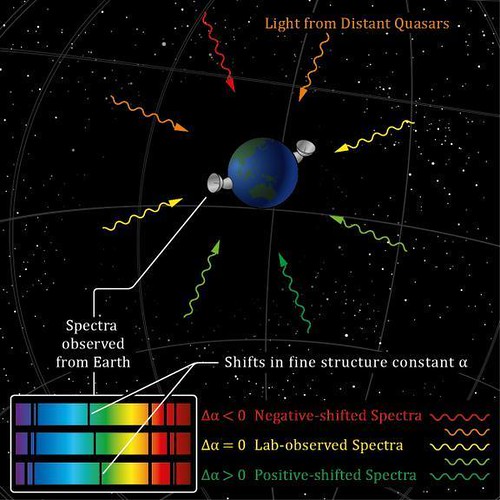
The report describes how one of the supposed fundamental constants of Nature appears not to be constant after all. Instead, this ‘magic number’ known as the fine-structure constant — ‘alpha’ for short — appears to vary throughout the universe.
"After measuring alpha in around 300 distant galaxies, a consistency emerged: this magic number, which tells us the strength of electromagnetism, is not the same everywhere as it is here on Earth, and seems to vary continuously along a preferred axis through the universe," Professor John Webb from the University of New South Wales said.
"The implications for our current understanding of science are profound. If the laws of physics turn out to be merely ‘local by-laws’, it might be that whilst our observable part of the universe favours the existence of life and human beings, other far more distant regions may exist where different laws preclude the formation of life, at least as we know it."
"If our results are correct, clearly we shall need new physical theories to satisfactorily describe them."
We previously reported observations of quasar spectra from the Keck telescope suggesting a smaller value of the fine structure constant, alpha, at high redshift. A new sample of 153 measurements from the ESO Very Large Telescope (VLT), probing a different direction in the universe, also depends on redshift, but in the opposite sense, that is, alpha appears on average to be larger in the past. The combined dataset is well represented by a spatial dipole, significant at the 4.1 sigma level, in the direction right ascension 17.3 +/- 0.6 hours, declination -61 +/- 9 degrees. A detailed analysis for systematics, using observations duplicated at both telescopes, reveals none which are likely to emulate this result.
"We think our self-cleaning panels used in areas of high dust and particulate pollutant concentrations will highly benefit the systems’ solar energy output," study leader Malay K. Mazumder, Ph.D. said. "Our technology can be used in both small- and large-scale photovoltaic systems. To our knowledge, this is the only technology for automatic dust cleaning that doesn’t require water or mechanical movement."
Mazumder, who is with Boston University, said the need for that technology is growing with the popularity of solar energy. Use of solar, or photovoltaic, panels increased by 50 percent from 2003 to 2008, and forecasts suggest a growth rate of at least 25 percent annually into the future. Fostering the growth, he said, is emphasis on alternative energy sources and society-wide concerns about sustainability (using resources today in ways that do not jeopardize the ability of future generations to meet their needs).
A dust layer of 4 grams per square meter can decrease solar power conversion by 40 percent, says Malay Mazumder, a research professor in Boston University’s Department of Electrical and Computer Engineering. To put this in perspective, dust deposition in Arizona is about 17 grams per square meter per month, and the situation is worse in many other solar-friendly sites, including the Middle East, Australia and India. Mazumder, who led the study, presented the results Sunday at the 240th National Meeting of the American Chemical Society (ACS).
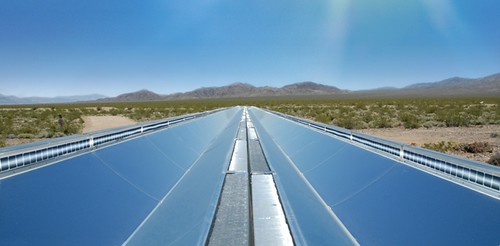
The electrodynamic transparent screen developed by Mazumder and his colleagues is made by depositing a transparent, electrically sensitive material—indium tin oxide (ITO)—on glass or a clear plastic sheet covering the solar panels. When energized, the electrodes produce a traveling wave of electrostatic and dielectrophoretic forces that lift dust particles from the surface and transport them to the screen’s edges. The researchers found that 90 percent of deposited dust can be removed by the transparent screen in fewer than 60 seconds.
This works in part because many solar panels are positioned at an angle—the raised dust would simply fall off. Whereas solar panels are generally placed in dry, open spaces, the researchers are hoping to make their technique and technology also work to keep raindrops and mud from adhering to solar panel surfaces as well.
Now, if we can only apply this technique to dusting our desks…
Yes, friends, you too can be a rocket scientist and orbit your own satellite. All thanks to Tubesat. The $8,000 price includes launch into LEO. The low-down, via Discovery News…
The program, called TubeSat, is the brainchild of Randa and Roderick Milliron, a Mojave, Calif.-based couple who’ve been developing a bare-bones, low-cost rocket system for the past 14 years. Selling flights as a package deal with satellite-building kits is proving to be a winning combination, with more than a dozen customers signed up to fly on the debut launch early next year.
The first of four suborbital test flights is scheduled for August and there are customers for those as well.
"The acceptance and enthusiasm has been overwhelming," Randa Milliron, chief executive of Interorbital Systems, told Discovery News.
The customers include hobbyists like Alex Antunes, who is customizing his TubeSat into a device that can detect changes in the ionosphere in a digital format for musicians’ use.
"You can listen to the ionosphere and get a sense of what space is like. Space is a very interesting place and sound is one way we can display it," Antunes said.
He ordered a kit late last year. It contains the shell components for a satellite including a printed circuit board, solar cells, batteries, a combination transmitter-receiver, microcomputer, electronic components, blueprints and a structural shell that’s about the size of a one-liter bottle.
Antunes found a company in Canada that has sensors he wants, thermal and magnetic detectors that will be able to convert the dance of the ionosphere into a blueprint for music. The data will be transmitted real-time via ham radio and recorded for distribution via the Internet at no charge.
"This is a solo project," Antunes said. "It’s not as hard as it looks. It’s very much a hobbyist kind of thing."
In addition to those already signed on, 20 additional experimental teams have reserved payload space with sales pending (satellites are added to the manifest only after full payment is made). The NEPTUNE 30 was originally designed to launch a 32-TubeSat payload, or 15 CubeSats, but the customer base began to demand CubeSat launches and double or triple TubeSat placement. To keep the costs at affordable, academically accessible levels, no more than four Cubesats will be flown on the specially priced academic launches, leaving space for 26 TubeSats to launch at the original $8,000 rate. The base price per standard TubeSat Kit, including launch, is $8,000. The cost per Cubesat launch (no kit) on a mixed manifest flight is $12,500. The price per satellite aboard an all-CubeSat NEPTUNE 30 launch will be $18,000.
Four low-altitude (15km/10mi) suborbital test launches of the NEPTUNE 30 components are scheduled throughout 2010 prior to the first orbital launch. The first three pre-orbital testflights will evaluate the performance of a single CPM and related launch systems. The last testflight will be conducted with an all-up 5-CPM NEPTUNE 30. Payload space is still available for all suborbital flights on the NEPTUNE CPM launches. Prices start at a minimum of $500/kg.
Two technologies make Interorbital Systems’ low-cost space program possible: the TubeSat and the NEPTUNE 30 Modular Rocket, both developed in-house. After studying the small satellite market for the last two years, and seeing the need for low-cost alternatives to existing small sat sources and launch options, IOS invented the TubeSat Personal Satellite (PS) Kit and offered it to the space community with a launch to orbit on the IOS NEPTUNE 30 rocket at the combined price of $8,000. Interorbital’s co-founder and CEO Randa Milliron commented, “Starting now, private ownership of a piece of space real estate is possible — and at an irresistibly affordable cost. Planet Earth has just entered the age of the Personal Satellite.”
With its low cost and flexibility of use, the TubeSat Personal Satellite Kit offers endless possibilities. What exactly can one do with one’s own spacecraft? For the general public, it’s an opportunity to send a loved-one’s ashes or mementos to orbit in a tiny private mausoleum. For tekkies, artists, scientists, or hobbyists, this is a chance to broadcast personal messages from space, track migrating animals, photograph and chronicle climate change, conduct sustained zero-G science, send private email, play a new musical release from orbit, study cosmic ray activity, space-qualify hardware, or advertise a product, company, or cause — all from one’s own orbiting platform that is tearing through space at over 17,500 miles-per-hour.
Check out the "news" video…
It may cost more than most DIY projects, but think of the possibilities. Think big.
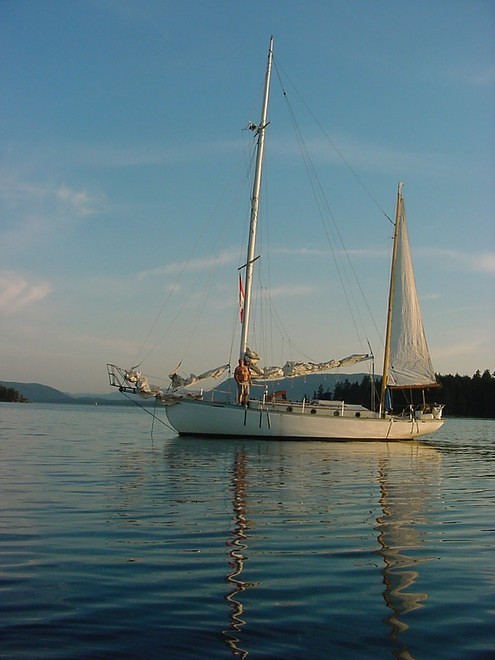
Ahoy, rocket scientists. Got your boat out on the water? You’ll appreciate this project from Jim Harrington, via Sail World…
A sailor and inventor who just eighteen months ago won a prestigious Premier’s Award from Loyalist College in Ontario Canada for his work in inventing a hydrogen assisted sailing boat, has come up with an idea for a set of do-it-yourself navigation lights for the bow.
While Sail-World couldn’t recommend these for crossing oceans, and we don’t know if they comply with rules for visibility from a distance, but for Jim’s use they have proved ideal.
With his previous record of achievement, one has to listen to this astro- and geo-physics and oceanographic design engineer, who, like many of us, likes ‘mucking about in boats’.
Here Jim describes how he was inspired to get creative about navigation lights, and then, below, the video describes in graphic detail just how to create these navigation lights for yourself.
The process is super-simple, using solar powered ‘garden lights’ that can be purchased from most hardware stores.
Jim describes:
‘Using solar powered LED garden lights, I have modified them for use on my sailboat as navigation lights. I found myself out on the water a few times at dusk with failing batteries or looking for my clamp on running lights and asked is there a simpler way.
The modification is very simple and easy to do by changing to ultra bright LEDs of the appropriate colour. What is nice is it is low cost, reliable, no special wiring of the boat system required and they come on by themselves as dusk deepens.
It costs about $25 or less to do your self. I liked what I did so much that I acquired a US provisional patent but individuals can copy it, no problem.