Archive for the ‘Front Page’ Category

Mach 23 Will Set You Free

Tuesday, October 3rd, 2006

The U.S. Air Force Office of Scientific Research thinks it’s possible, and a company in California wants to prove it: a large electromagnetic ring will be able to launch small satellites into space. Discovery Channel Canada gives us the scoop:
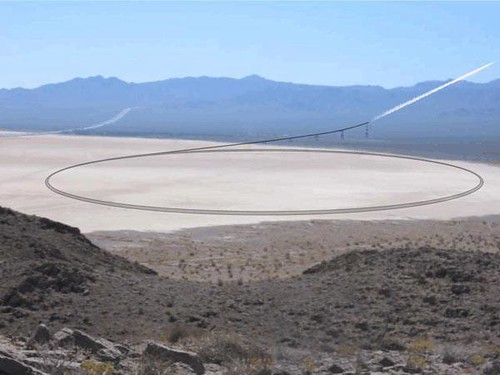
A large circular metal track could accelerate objects to supersonic speed using electromagnets and spit them out into space, says a report from the U.S. air force’s Office of Scientific research.

Tagged as the Launch Ring by its inventing company, Launch Point Technologies, the track would be several kilometers in diameter. Similar to trains that hover on electromagnetic tracks, a sled would hover over the ring and be propelled forward using powerful magnets.

According to the company, a satellite protected by an eggshell-like capsule could sit atop the sled and slowly accelerate over a matter of hours to a supersonic 10 km/sec. Then a small explosion could detach the capsule from the sled and it would hurtle into a side tunnel.

From there, it would shoot up a ramp and through the atmosphere into outer space. Traveling at a 23 times the speed of sound, the capsule would experience forces 2,000 times that of normal gravity on Earth.

A rocket strapped on the capsule would correct the trajectory so that it correctly aligned itself in orbit.

The Goleta California company has received funding to begin a two-year study within several weeks. Boosters of the ring hope to one day use it for thousands of launches a year, at a fraction of today’s cost of putting things in space.

Humans could never withstand the forces exerted during the ring’s launch process. Under existing technological limitations, it could only be used to propel supplies to be used by humans on a long-term mission in outer space, or to put satellites into orbit.

The Air Force also suggests it could be used for military purposes, quickly launching weapons around the world.

For more details, try NewScientist.com.


DIY Friday: Dude, Where’s My Droid?

Friday, September 29th, 2006

If you’re like some of us here at Really Rocket Science, you look back upon 1977 as a watershed year — a year when, for the first time, you realized what you wanted more than anything else in the world.

And what you wanted, of course, was to be Luke Skywalker. Or maybe Han Solo. At the very least, you wanted to have your own droid — a faithful mechanical friend like R2-D2.

Fast forward nearly thirty years. Dude, where’s my droid? Technology and industry haven’t exactly delivered the type of personal-pal robot that we saw in Star Wars.

But there’s no need to wait any longer. Want a droid? Do it yourself at Astromech.net

Astromech has a complete tutorial page that will help you build your droid — with instructions and real-world experiences on every part, from the dome to the feet to the lights and and cute little R2-D2-like sounds. 

For inspiration, be sure to check out the photogalleries of droids built by other fans. There’s even a video section showing close-ups of completed droids beeping and blinking in action, and (as an added bonus) this video of droid bloopers taken from the original filming of Star Wars.

The articles section of the Astromech site is a fine place to idle a few hours away before you get to work on your droid (you are going to get to work, aren’t you?);  we recommend taking a quick gander at this review of the original R2-D2 robot from the December, 1977 Electronics Today.

Throw Out Them Bunny Ears

Wednesday, September 27th, 2006

We’ve written before about how dramatically the intersection of television and computers — particularly through IPTV and satcom– will transform the media marketplace and the media consumption habits of ordinary people.

That transformation is several steps closer to reality, if news of new gadgets today is any indication.

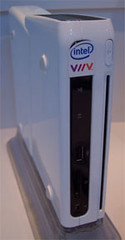
First up is the DirecTV Plus HD DVR — the result of a partnership between DirecTV and Intel:

[I]n other news to come out of the Intel Developers Forum, DirecTV and Intel are joining forces to produce the DirecTV Plus HD DVR — which we first heard about all the way back at CES — allowing viewers to check out content via the interweb when connected to a Viiv PC. In addition, there will be a new software update for DirecTV subscribers by the end of the year that turns subscribers’ set-top-boxes into digital media adapters, the companies said in a press release earlier today. The new DVR, to be released later this fall, will capture 200 hours of standard definition programming or 50 hours of HD, or whatever combination of the two your little heart desires.

CNET also reports that Apple’s iTV wireless router — connecting TV to PC or Mac — will be coming out soon:

 Apple Computer’s take on the living room became a little clearer… with its preview of a new networking product….

CEO Steve Jobs announced that Apple is working on a product code-named iTV that will allow both Mac and PC users to watch movies or television shows purchased from the iTunes store in their living rooms….

The iTV box won’t be available until the first quarter of 2007, but Jobs said it will cost $299 and walked attendees at Apple’s press event in San Francisco through a brief demonstration of its capabilities.

The iTV unit is basically a wireless router with ports for video connections to televisions, including an HDMI port for high-definition digital televisions. The idea is to hook it up to a television or set-top box as another video input device, and access video content stored on a Mac or PC through a special Apple remote control, Jobs said.

And if neither Apple nor DirecTV whet your whistle in anticipation of the coming transformation in consumer media choice, AT&T’s U-Verse fiber-based television service is set to offer some cool options, according to Engadget

 U-verse users, meet HDTV. We just got word that AT&T’s IPTV service is going to be blessed with numerous upgrades within the next few weeks that will include HDTV support, more channels, more VOD, games, personal photos and other unannounced features. This rollout seems to be within the same speculated time frame of October 25th to coincide with the launch of those brand spanking new Motorola DVR’s; whenever it does happen, though, these features will be implemented during the slow viewing times between 11 PM and 5 AM with the hope of minimizing service interruption. On a similar note, AT&T is upgrading DVRs to prep for this rollout, with customers seeing all previously recorded programs erased and all scheduled recordings canceled after October 5th. But keep in mind this is for high-def along with more content, so hopefully the ends will justify the means — you can deal with a few Adult Swim-free nights for the greater good, right?

 The times, they certainly are a-changin’.


TV on Wheels

Monday, September 25th, 2006

We’ve written recently about DIY techniques for getting satellite reception on your RV. But doing it yourself, we readily admit, requires actually doing something yourself, which can be a drag (especially on Mondays!) .

Sometimes, after all, you just want to lean back and have the sort of unbridled fun that the guys in the photo to the right are clearly having.

Luckily for the want-it-now crowd, there are several consumer options already on the market that will bring you (or, more precisely and safely, your passengers) satellite television reception in your minivan or SUV while you barrel down the interstate.

One such system is RaySat’s T5 low-profile in-motion satellite antenna,  which "can work across multiple Ku-Band frequencies (factory option) in either linear or circular polarization (field option) and operate over many geographical regions, multiple satellites and any DTH (dedicated) infrastructure." Another system — the TracVision A7 mobile satellite system — is now being offered by DIRECTV, which also offers a mobile programming option:

Recognizing the growing interest among American motorists who want the same DIRECTV entertainment experience in their cars that they have in their homes, DIRECTV is now delivering to car video screens live local news, weather, traffic, sports and other local entertainment programming.

Local broadcast channels via DIRECTV are now available to mobile customers on the open road within the continental United States to vehicles that have been equipped with a TracVision A7 mobile satellite TV system, launched today by KVH Industries, Inc. DIRECTV will provide mobile customers their local broadcast channels within the designated market areas where it already offers them to home viewers. Local channels availability may vary by market. DIRECTV delivers local programming in 142 markets, representing 94 percent of U.S. television households.

DIRECTV’s TOTAL CHOICE(R) Mobile with local channels package, created exclusively for mobile customers with a low-profile automotive TracVision system, is available for $44.99, and offers more than 185 channels. To receive local channels in their car, DIRECTV customers must purchase a new TracVision A7 satellite TV system, which includes an integrated GPS unit and new 12-volt receiver jointly developed by DIRECTV and KVH.

The mobile local channels offering is part of a larger strategy by DIRECTV to target the more than 20 million U.S. vehicles expected to have in-vehicle passenger video systems by 2011, according to the leading analyst firm Frost & Sullivan.

Delivering uninterrupted satellite reception while an antenna moves at nearly 70 miles per hour is no simple engineering feat, which helps explain why the KVH system is loaded with patents.

It also helps explain why the system will currently set you back about 3,000 clams. (To keep a low wind profile, it looks like a clam, too.)

Just remember, though, that 20 million vehicles are expected to have such a system in place by 2011. So keep your eyes on the road.
 

DIY Friday: Build a Backyard Observatory on the Cheap

Friday, September 22nd, 2006

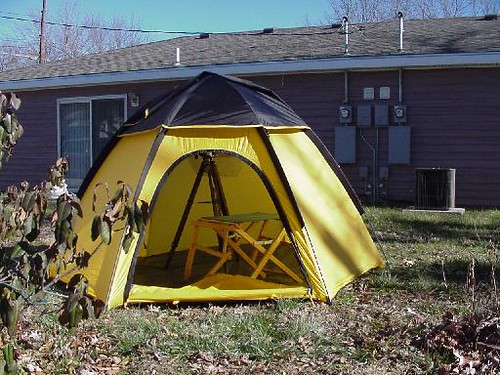
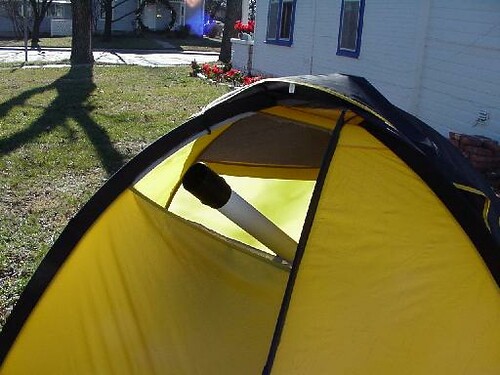
Ever wanted to have your own Observatory? Stargazing enthusiast Thomas Campbell did, so he created one and put it up in his own backyard, as seen below. Sure, it looks like a simple 2-3 man dome tent, but it’s actually has all of the features amateur astronomer might want and for under $40.


Backyard Observatory


Campbell reports that two main reasons prompted him to build his observatory:

"Several years ago, I (not knowing any better) purchased a 60mm refractor (a Kmart Focus model) at a yard sale. The main tube has pretty good optics and the 20mm eyepiece (35x magnification) isn’t too bad, but the other eyepieces are only fair at best, and the wooden mount is pretty wobbly in even the slightest of breezes.

The most important reason, however, was light pollution in my backyard. I live in a small town, but live on a highway (with a lot of streetlights) and across the street from a county hospital (lots of light pollution there!). Even so, by cupping my hands around my eyes, on good nights of seeing, I can still make out the Milky Way, so the skies are still fairly dark.

I had found an article on the internet about how to make a light blocker out of PVC pipe and heavy-ply trash bags, but with the light coming from all around me, I would need about a dozen of them, and the amount of time needed putting all of those up would seriously cut into my observing time."

Not surprisingly, considering the tents ability to block light and wind, the $40 observatory seems to be working out for Campbell pretty well, saying it has,

"…allowed me to view things with my scope that I didn’t think was possible before. For instance, on nights of good seeing, I can now make out all four of the main stars of the Trapezium in the Orion Nebula. Before, I was only able to make out the three brightest stars at best. Overall, I believe I can now see objects about a half-magnitude fainter than I was able to before using the observatory."

Not bad for $30! Check out Campbell’s DIY observatory site for more information and maybe even check out some of the other projects he’s done ranging from building an astronomical red-dot finder out of a BB-gun site to constructing a ply-wood tripod & mount. Awesome stuff!


FiOS TV

Friday, September 22nd, 2006

From Skyreport 

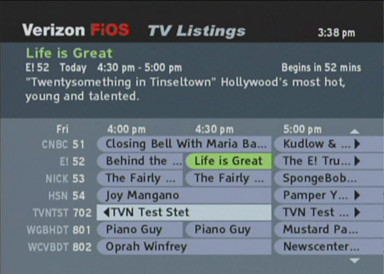
TELCO-TV — One year ago today, Verizon launched its fiber-optic FiOS TV service in Keller, Texas. Since that time, the telco’s TV product serves more than 80 communities in the Lone Star state with additional territories in California, Florida, Virginia, Maryland, Massachusetts and New York. The company said it expects to begin service in Pennsylvania, Delaware and New Jersey within the coming months – and in Fort Wayne, Ind. next year.


Ricochet Laser

Wednesday, September 20th, 2006

The USAF Research Lab does some interesting work, and this one is certainly no exception: the Aerospace Relay Mirror System (ARMS). A unit of Boeing’s Integrated Defense Systems is working on the project and they had a very successful test last month:

The demonstration, conducted recently at U.S. Air Force Research Laboratory facilities at Kirtland Air Force Base, N.M., used a half-scale version of a strategic relay mirror payload that ultimately could be packaged and carried to high altitudes on airships, long-endurance aircraft or spacecraft. The payload could be used with airborne, ground-based or sea-based high-energy lasers to destroy ballistic missiles and other targets. Relay mirror systems will greatly enhance laser weapon system performance by reducing the atmosphere’s effects on laser beams and extending their range beyond line of sight.


Reminds me of an old Hanna-Barbera character called "Ricochet Rabbit," who would ping-ping-ping around the Old Southwest, where he was a sheriff — backed up by deputy Droop-a-long, who was not nearly as fast.



But this is the real deal, as described by defensetech.org last winter:

Lasers can only zap as far as the eye can see. The beams don’t curve, so ray guns can’t reach over the horizon. The Defense Department’s Office of Force Transformation wants to change that, however, with a world-wide ring of giant mirrors, that would bounce laser light to wherever the Pentagon saw fit.

This test advances their development, hopefully toward eventual adaptation to communications targets, as opposed to the other kind.

Intel Builds the World’s Most Remote Digital City in Amazon

Wednesday, September 20th, 2006

Intel, working in conjunction with Brazilian schools and companies, has brought easily accessible broadband to Parintins, an isolated city of 114,000 on an island in the Amazon Basin, CNET News reports.

A tower for WiMax, a long-range wireless technology, was set up on the island and connects two schools, a hospital, a community center and a university to a broadband network…. The new WiMax network could help eliminate some of the problems that come with living deep in Brazil’s interior. The hospital, for instance, will use the link for telemedicine and remote diagnostics. The city only has one hospital and 32 doctors. "Most likely, if you need a specialist you need to go to Manaus (a 15-hour boat ride away) or Sao Paolo," said Carreon. Intel estimates that the new network will serve about 1,500 students and 10,000 community members.

Computing News in Minsk provides additional details on Intel’s movement into Brazil:

Intel aims to extend wireless PC access to millions of citizens in Latin America and train more than a million teachers about the effective use of technology in the classroom. In Parintins, Intel has already trained 24 teachers through its education initiatives. The Intel Teach Program teaches teachers how to use technology to improve the way students learn. The Intel Learn Program provides job-readiness skills to underprivileged students between the ages of 10 and 18.


The Intel press release describes the deployment of WiMax in Parintins as part of a "global movement to bring technology to the next billion people." Video and an audio interview with Intel Chairman Craig Barrett is also available on the Intel site.

 Brazil isn’t the only emerging market entering the WiMax era: DataWeek reports that Saab Grintek is preparing a WiMax roll-out in South Africa. Given the ability of WiMax to "leapfrog" into areas with under-developed infrastructures, it may well be that WiMax will arrive in emerging markets long before it’s seen widely in European, North American and Asian markets.


Second Team Added to Rocket Racing League Roster

Tuesday, September 19th, 2006

Alan Boyle over at the CosmicLog reports that a second team has joined the Rocket Racing League, the relatively new association charged with organizing and promoting the emerging sport of rocket racing, and, thus may soon be ready for actual competition. Yesteraday, the Bridenstine Rocket Racing Team, which is named after its leader Navy Lt. James Bridenstine, announced that it would be challenging the world first (and, previously, only) rocket racing team, the Leading Edge.

RRL President and CEO Granger Whitelaw thinks that the new teams might have some natural competition.

"Given the air force credentials of our first team, Leading Edge, and the navy aviation experience of this second team under Jim Bridenstine, we expect a good-natured competition as the Rocket Racing League prepares for its official launch in late 2007."

So when can we expect the RRL to ramp up to full gear? While the official word (as we see above) is late 2007, some are saying it could be even earlier. Boyle reports that the Mark1 X-Racers that are going to be used in the competition are still in development, early, usable, and expensive (the final crafts will cost about $1.2 million) prototypes could be hitting the scene within the next four five months. Those looking for an even earlier preview might keep an eye on the X Prize Cup, where the league is planning to show some of their wares next month.

NASA Play-by-Play

Thursday, September 14th, 2006

Great piece on NPR yesterday:

All Things Considered, September 13, 2006 · Astronauts working on the International Space Station lost another screw today — but they made it through a seven-hour spacewalk. NASA provided coverage, with commentary, of the entire event. That got producer Jeremy Hobson thinking what it would be like to have a "color guy" to spice up NASA’s coverage.

You’ve got to listen to the podcast yourself.

Complete STS-115 and ISS coverage is on NASA TV.