Archive for the ‘Front Page’ Category

Hubble Decision

Monday, October 30th, 2006

 

The unusual variable star V838 Monocerotis (V838 Mon) continues to puzzle astronomers. This previously inconspicuous star underwent an outburst early in 2002, during which it temporarily increased in brightness to become 600,000 times more luminous than our Sun. Light from this sudden eruption is illuminating the interstellar dust surrounding the star, producing the most spectacular "light echo" in the history of astronomy.

The image above was recently captured by the Hubble Space Telescope, which is in need of repair, according to this (among others)  CBC report:

NASA officials met Friday to decide whether to risk a space shuttle flight on a mission to repair the Hubble space telescope.

Michael Griffin, the agency administrator, is scheduled to announce Tuesday at Goddard Space Flight Center in Greenbelt, Md., whether the mission will take place.

NASA says a mission to repair the Hubble telescope carries a higher risk.
(NASA/Associated Press) Although the space agency hasn’t said anything officially, University of Wisconsin-Madison astronomer Jay Gallagher, a member of a science team responsible for a camera in the Hubble telescope, says the signs are promising.

The 16-year-old telescope has been repaired four times since its launch in 1990. A fifth repair mission was cancelled after the 2003 space shuttle Columbia tragedy that killed seven astronauts.

NASA officials decided to cancel any future repairs of Hubble, saying it was a matter of shuttle safety. If a spacecraft heading to the telescope encountered a problem, there would be no safety net, since the astronauts would not be able to reach the International Space Station from Hubble’s orbit.

If Tuesday’s announcement gives the go-ahead for the mission, it could prolong Hubble’s ability to capture some of the most spectacular images of the universe well into the next decade. If the repair doesn’t take place, the telescope will deteriorate by 2009 or 2010.

Satellite-Linked Heineken?

Monday, October 30th, 2006

Well, it looks like the party might soon be over for the generations of euro-tripping backpackers who’ve snuck a few bottles of French wine into Germany or bottle of the illicit green stuff from central europe into Ole’ Blighty… shucks!

Our good friends at vnunet are reporting that Heineken Brewery (makers of Dutch delight drunk around the world), in association with IBM, international shipping company Safmarine, Vrije Universiteit Amsterdam (University of Amsterdam), and customs agencies in the US, UK, and the Netherlands, are beginning a program to track cargo container shipments of Heineken beer from Europe to the United States using satellite and cellular technology.

Called the "Beer Living Lab," the main goal of the project is to create a paperless documentation trail using IBM technology to provide real-time visibility of the product and interoperability through wireless sensors linked to its WebSphere platform.

According to IBM project Manager, Steffan Reidy, the results of this research effort could be used to improve customs processes around the world:

"[It’s] the first step in building the ‘Intranet of Trade’, which will help to substantially improve efficiency and security in the global supply chain."

Or, as Vnunet reported:

"Once accepted and implemented widely, paperless trade will support initiatives that will eliminate most inspections on arrival, thus significantly speeding up ocean freight shipments and improving the profit margins for shippers."

While this might mean it might be a little harder to sneak some booze across the border (especially if and when the technology is combined with RFID tagging of shipped spirits), the potential savings that could be passed down to consumers and improved port security probably evens things out a bit.

Want even more information about the Beer Living Lab? Think about taking a brief sojourn to Amsterdam in the next few days… the lab seems to be having a workshop on the technology on Thursday.

XM-4 Ready to Join Rock and Roll Satellites

Thursday, October 26th, 2006


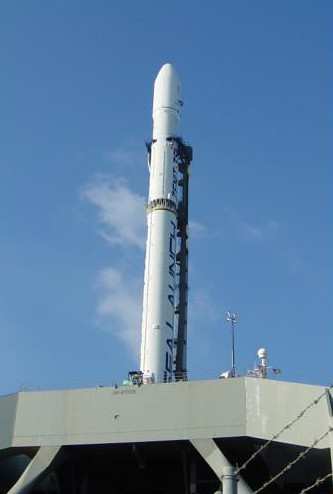
Sea Launch is now preparing for the launch of the XM-4 satellite on 26 October 2006, at 23:49 GMT. Here’s the feed from their webcam:

Live broadcast of the launch will be available in North America via the AMC-3 satellite’s Ku-band payload, transponder 18. The satellite is located at 87 degrees West Longitude. Here are the particulars:
          
Downlink Frequency:   12064  Mhz Vertical
DIGITAL PARAMETERS:      4:2:0      FEC:  3 / 4      Symbol Rate: 6.1113
Audios:    Audio channel 1 / Audio channel 2 = Program Mix ( English)
Standard:    525 NTSC

Transmission test begins at 23:00 GMT, with the live transmission beginning at 23:35. Launch window opens at 23:49 and closes 00:57 on 27 October 2006.

Or you can watch the webcast.

Cargo for ISS

Tuesday, October 24th, 2006

Via MosNews.com

An unmanned Russian cargo ship carrying 2.76 U.S. tons of supplies, equipment and gifts blasted off Monday en route to the international space station, a space official quoted by AP said.

The Progress M-58 mounted atop a Soyuz-U booster rocket lifted off at 5:41 p.m. from the Baikonur cosmodrome in Kazakhstan and entered orbit about 10 minutes later, Federal Space Agency spokesman Valery Lyndin said.

The ship was scheduled to reach the orbiting station Thursday evening, delivering fresh fruit and vegetables, compact discs and DVDs and other gifts to the station’s current crew — cosmonaut
Mikhail Tyurin, U.S. astronaut Michael Lopez-Alegria and German astronaut Thomas Reiter.

Also included in the shipment, according to Itar-Tass, will be equipment for repairing a Russian-built Elektron oxygen generator, which overheated last month, spreading burnt-rubber smell and leaking potassium hydroxide.

While the incident forced the crew to don masks and gloves in the first emergency ever declared aboard the 8-year-old orbiting outpost, Russian and U.S. space officials downplayed it, saying crew members’ lives were never in any danger.

“The Perfect Thing” Turns 5

Monday, October 23rd, 2006

Longtime Really Rocket Science readers will recall our intrepid reporting on the "Ipod From Space" rumor that went around the Internets back in March.
As it turned out, there was no grand marketing plan to unveil an Ipod that was viewable from space. But since then, at least one Ipod has gone into space: Anousheh Ansari brought her Ipod with her when she became the first female space tourist (and first female Muslimin in space) when she travelled to the International Space Station last month. (Ansari blogged about her cosmic music selection here.)

Hey, who doesn’t like a little electronic diversion on a long commercial flight? 

All of this is to say that sometimes a technological and design break through isn’t really rocket science — but it can change the world nonetheless. 

And today, on the Ipod’s fifth birthday, we doff our hats to the beautiful design and transformative power of what is — let’s face it — not much more than a portable hard drive with an occassionally buggy OS.

But our Ipods are something we just can’t imagine living without. And that, ultimately, is the most meaningful testament  to any technology.

But we’re not alone in singing the Ipod’s praises today: it’s been hailed as "The Perfect Thing" and "The Poster Child for the 21st Century."

Everyone from Queen Elizabeth to the janitor in our building has one. It’s been to space. Thousands of them have entertained our troops abroad. And they’ve changed the way we purchase and listen to music — transforming the entire music industry in the process.

Not bad for a cute little piece of plastic.

Lunar Lander XPrize

Monday, October 23rd, 2006


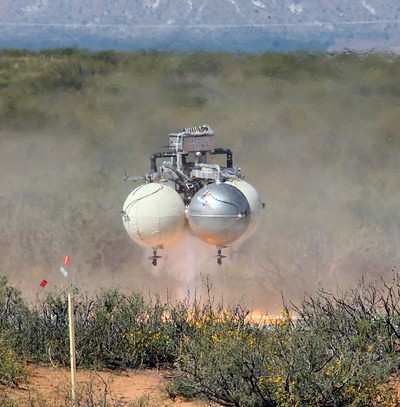
Armadillo Aerospace’s  lunar lander impressed quite a few people at the XPrize Cup in Las Cruces this weekend. Aero-News Net gives this account:

 …the final flight on Saturday, the one that would have earned Armadillo the first tier prize, was frustrated when minor damage done in the previous landing caused a series of events that initiated an inflight abort when the vehicle banked too aggressively shortly after liftoff, and the vehicle went down, damaging itself beyond the ability to fly again.


RRL Announces Winner of Naming Contest; First X-Racer Unveiled

Friday, October 20th, 2006

Following up on Spektor’s post on Wednesday about the Wirefly X-Prize Cup (which begins today in Las Cruces, New Mexico), Space.com reports that the first first Mark-1 X-Racer will be known as the Thunderhawk:


 Unveiling the Thunderhawk [image] today at the Wirefly X Prize Cup, RRL officials said that the moniker beat out names like Banshee and Sky Warrior in an online contest that generated more than 2,000 submissions from fans around the planet.

The world headquarters of the Rocket Racing League is based here. The RRL aims to debut its first NASCAR-style races in late Fall 2007 – a first-of-its-kind aerospace sports and entertainment league formed by X Prize founder Peter Diamandis and Granger Whitelaw, a two-time Indy 500 champion team partner….

The fan submitting the winning name is Michael Higgins of New Market, Maryland. He’s an engineer and manager working in the composite pressure vessel industry serving life-support and aerospace/defense applications.

Higgins outlined today how he came up with the Thunderhawk moniker.

“The aircraft, with its rocket propulsion, combines thunderous sound with brilliant flame and light. So I worked up several names focused on thunder and light, and tried to connect those with a bird of prey,” he explained. 

Higgins said he expected the RRL races will put rocket propulsion technology in front of thousands of people through thrilling events. 

“They should generate public interest in rockets and space, much like the famous air races of the 1920s and 1930s did during the golden era of aviation,” Higgins said.

The contest began January 30 and attracted over 2,000 submissions. The top 1,000 names were whittled down to ten semi-finalists by a panel of RRL judges. Fans then were able to vote for their favorite name from the top ten on AOL. 

Nearly 20,000 votes were cast via AOL, selecting Thunderhawk the most popular name.

The live webcast from events at the Wirefly X-Prize Cup is now up; Really Rocket Scientists like us (who couldn’t attend in person) will be glued to the webcast and news coming out of Las Cruces today and tomorrow. (On-demand video from the event can be found here.)

X-Prize Cup Tournament This Friday & Saturday in New Mexico

Wednesday, October 18th, 2006

For readers that haven’t established weekend plans just yet, you might want to consider a quick jaunt out to La Cruces, NM where the Wirefly X-Prize Cup will be taking place this coming Friday and Saturday (Oct. 20 & 21).

The main event of the weekend will, of course, be the $2.5 million in Prize competitions that will being going on throughout the exposition.

The Northrop Grumman Lunar Lander and Vertical Lander Challenge will probably be on of the most watched events, but the Spaceward Foundation‘s Space Elevator Challenge may be among its most technically interesting. In the Space Elevator Games, teams will be competing for two, separate $200,000 prizes, one for who builds the best climber (a machine capable of traveling up and down a tether ribbon, with powering being beamed to a transmitter on the device) and the team that builds the strongest tether (first competing against other teams and then by proving that its tether is 50% stronger than the off-the-shelf variety.

While we’ve written about the space elevator competition in the past, Really Rocket Science readers will also have a leg-up on other attendees in terms of other events going on at the space exposition. Also taking place during the fair will be the unveiling of the Rocket Racing League’s X-Racer (written about at RRS here) and meet and greet with the world’s first space tourist, Anousheh Ansari (written about on RRS just a few weeks ago).

Stay tuned to Really Rocket Science for all the information coming out of New Mexico in the next few days. While we won’t be there, we’re going to stick to this story in the days ahead.

Set Your Watches: New Break Through in Atomic Clocks

Monday, October 16th, 2006

"Most technical systems that employ satellites, including GPS technology, make use of atomic clocks; these technologies can now operate much more accurately," thanks to a recent breakthrough in understanding errors in atomic clock technology, ScienceDaily reports:

Andrei Derevianko, Kyle Beloy, and Ulyana Safronova [of the University of Nevada, Reno] sat down six months ago and began work on a calculation that will help the world keep better time….

Associate physics professor Andrei Derevianko and his team isolated and explained a significant portion of the error in atomic clock output….

In its research, the University team was able to isolate and explain a significant portion of the error in atomic clock output. The portion of error that the team studied has now been cut to one-fiftieth of its original size. The team’s research was based solely on calculations, many of which were conducted on high performance computers…

In 2004, an Italian research team found some convincing evidence that suggested that atomic clocks were less accurate then previously thought. This evidence concerned the scientific community and gave the theory behind atomic clocks renewed international attention….

Atomic clock technology is based on the fact that atoms emit a fixed frequency. Lasers, which also have operating frequencies, can be calibrated so that their frequencies match that of a given atom. Since atomic frequencies are constant, syncing a laser with an atom and counting the laser’s oscillations will always provide a steady measurement of time….

The new findings are also paving the way for all kinds of new scientific experimentation. Extremely accurate measurements are required to make estimations about the behaviors of the universe. The extra time-keeping precision will allow scientists to explore hypotheses about the big-bang theory. The improved technology might even be accurate enough to provide evidence related to the controversial theory that universal constants, as in the amount of charge in an electron, are changing.

So how does one tune in to the more accurate atomic clock? Why, with an atomic clock receiver, of course:

A radio system is available in North America set up and operated by NIST – the National Institute of Standards and Technology, located in Fort Collins, Colorado. NIST operates radio station WWVB, which is the station that transmits the time codes. WWVB has high transmitter power (50,000 watts), a very efficient antenna and an extremely low frequency (60,000 Hz). For comparison, a typical AM radio station broadcasts at a frequency of 1,000,000 Hz. The combination of high power and low frequency gives the radio waves from WWVB a lot of bounce, and this single station can therefore cover the entire continental United States plus much of Canada and Central America. The time codes are sent from WWVB using one of the simplest systems possible, and at a very low data rate of one bit per second. The 60,000 Hz signal is always transmitted, but every second it is significantly reduced in power for a period of 0.2, 0.5 or 0.8 seconds: • 0.2 seconds of reduced power means a binary zero • 0.5 seconds of reduced power is a binary one. • 0.8 seconds of reduced power is a separator. The time code is sent in BCD (Binary Coded Decimal) and indicates minutes, hours, day of the year and year, along with information about daylight savings time and leap years. The time is transmitted using 53 bits and 7 separators, and therefore takes 60 seconds to transmit. A clock or watch can contain an extremely small and relatively simple antenna and receiver to decode the information in the signal and set the clock’s time accurately. All that you have to do is set the time zone, and the atomic clock will display the correct time.


Remember The Schwartz!

Wednesday, October 4th, 2006

We recently heard about a new venture between Brooksfilms Ltd. and MGM Studios to produce and distribute a new animated TV series based on the 1987 Mel Brooks feature film "Spaceballs." The G4 cable network and Berliner Film Companie are also in on the development and production.

The show is set to debut on G4 in the fall of 2007. Owned by Comcast, the G4 channel is distributed to nearly 60 million households in the U.S. via satellite and cable systems. G4 has exclusive U.S. distribution rights.