Archive for the ‘Front Page’ Category

When the Moon Hits Your Eye and you… ask who is “Tye”?

Monday, December 4th, 2006

It seems like satellites with room for names of supporters is the new UGG boots of the space agencies — everyone’s gotta have them. But, as a savvy consumer, you know you’re better off shopping around. I mean, sure you could have your name on MIT & GeorgiaTech satellite, as we suggested a couple of weeks ago, or you could get your name on Japan’s new lunar orbiter, SELENE.

Here’s the whole story, in only the slightest "All your bases are belong to us" english:

"The Japan Aerospace Exploration Agency (JAXA) plans to launch the lunar orbiter ‘SELENE’ on a H-IIA Launch Vehicle from Tanegashima Space Center in the summer of 2007.

The SELENE is an artificial satellite that aims to collect closely featured scientific data on “The formation of the moon and its transitional history up to today,” which is the biggest lunar exploration project since the Apollo Project.

JAXA will accept from the public names and messages to deliver to the moon aboard the SELENE. Please send us your wishful messages."

The real question: If getting your name blasted into space on a satellite is the new in thing, which one is Brangelina going to choose?


RRS Reads: Please, Mr. Einstein

Tuesday, November 28th, 2006

While you may not normally turn to Really Rocket Science for book recommendations, we’ve always believed that even the best engineers (and enthusiasts) could use a little literature in their life.  Still, if you’re going to indulge in the good stuff, its always a good idea to start with some work that has some applicability to your every day life, which is why we’re recommending a work written by a French playwright chronicle the afterlife of the 20th century’s most preeminent scientist… errr… ummm… Well, now that I think about it, it probably isn’t even close to applicable to your everyday life, but it does sound pretty cool, right?
While the review NYT Science Editor Dennis Overbye gave Jean-Claude Carrière’s Please, Mr. Einstein (Amazon, Powells) was a little ho-hum, the topic of the book, the musings and travails of Albert Einstein from beyond the grave, was interesting enough that it might be worth a look. Written as a play, it appears a little heavy on the monologue, but seems to work, overall, as a novel that "isn’t so much[…] about physics as it is[…] about how people feel about physics."

Sure, we may be more inclined to cosy up to a copy of Surely You’re Joking, Mr. Feynman! (Amazon, Powells) but, come on, how often do you find a play/novel that work in discussions of spacetime between the cameos of Picasso, Newton, and Elvis?

What SpaceTime is It?

Tuesday, November 28th, 2006

The New York Times Review of Books takes a look at Jean-Claude Carrière’s new novel, Please Mr. Einstein:

In its uncounted hours of conversation, “Please, Mr. Einstein” touches down lightly and charmingly on some of the thorniest philosophical consequences of Einstein’s genius and, by extension, the scientific preoccupations of the 20th century — the nature of reality, the fate of causality, the comprehensibility of nature, the limits of the mind — while scrolling through Einstein’s life. It’s easy to see this novel as the germ of a future playlet or movie along the lines of Steve Martin’s “Picasso at the Lapin Agile” or the play and movie “Insignificance,” which featured a mythical Einstein in a hotel room with Marilyn Monroe.

I like Carrière’s Einstein. He’s frank, down to earth and not prone to cosmic mustiness. He’s actually worn an Einstein T-shirt and admits he’s happy to be talking to a woman, especially a woman from the 21st century, because that means his godchild, the atomic bomb, hasn’t destroyed civilization — yet. “I think better when eyes like yours are looking at me,” he tells her, “and when I’m talking to them.”…

Among the features of Einstein’s unusual office are doors he seems able to open on any time and place. At one point, discussing his years in Germany, he and his visitor step out into a Nazi book-burning. Another excursion provides the surprising climax to an amusing side plot about Newton, who just doesn’t get relativity and quantum theory and keeps pestering Einstein to explain what was so wrong with the clockwork world he described in the 17th century. Finally, exasperated, Einstein calls Newton over and opens a door on the atomic blast that destroyed Hiroshima. Newton’s wig flutters in the wind from the shock wave. He stares, aghast, then slowly turns transparent and disappears. Newton’s universe is truly, undeniably dead, and so his sojourn in this intellectual aerie is over.

Carrière’s novel relies upon spacetime as a literary device. But what is spacetime? This "Spacetime 101" page explains the history of spacetime from Pythagoras to Einstein. 

What Dish? That Antenna Looks Like a Turkey

Wednesday, November 22nd, 2006

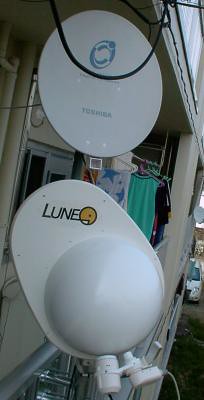
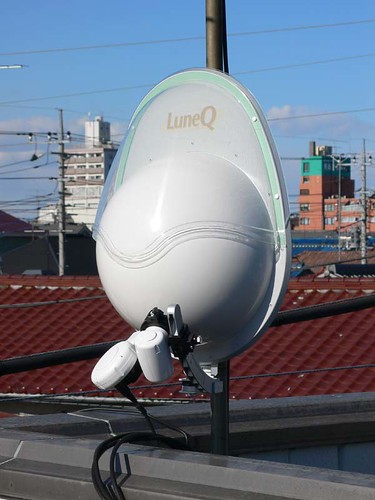
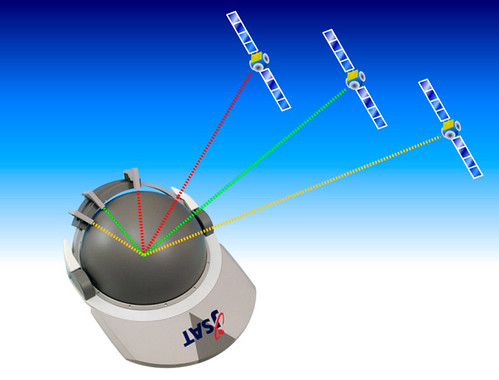
There’s a revolutionary satellite antenna being sold in Japan, based on the Luneberg Lens, capable of receiving signals from multiple satcoms. JSAT’s press release in 2001 announced this breakthrough, and a joint release with Sumitomo Electric introduced it to the marketplace in 2003. This photo journal demonstrates assembly, which looks simple enough.


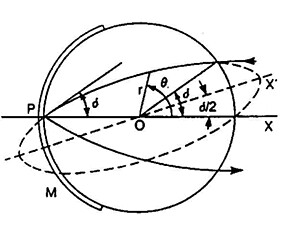
But was it really a “breakthrough?” I think it was – at least from a marketing perspective.  R. K. Luneberg proposed the principle of this lens for electromagnetic waves in 1944, where a sphere made of materials with relative dielectric constants varying in square distribution from 1 at the surface to 2 at the center becomes a dielectric lens with countless foci on its surface. A dielectric constant is a measurement of a material’s capacity to modify electromagnetic waves. This suggests a single lens antenna is capable of receiving and transmitting waves to and from multiple directions simultaneously – without moving the sphere. Brilliant!


What we have here is a high-gain, low-cost antenna that may have substantial market potential in the U.S and Europe, too.  Presently, antennae based on the Luneberg Lens have been used in mobile military applications, especially on aircraft where a low profile is required. Datron makes and sells a Luneberg Lens Array (LLA). Lun’tech of France is selling one today, and Raven in the U.K. has been talking about one for some time.


Pretty cool how this 60-year-old technology may have an impact in today’s most advanced satellite communications systems. Want to learn more? This comprehensive overview from Stevens Tech in Hoboken is very useful. And if you want to start selling them, the folks at Rozendal Associates can help you make them.


DIY Friday: Build Your Own GPS Navigation System

Friday, November 17th, 2006

Well, I know I’m a horrible driver, but my friends tell me I’m pretty decent with directions, so on long road-trips I’m usually the "navigator." In addition to my excellent map reading skills, knowledge of the compass rose, and keen sense of direction, I’m also pretty good at announcing where we should be turning, staying straight, or getting off the highway — oh my god, you just missed that exit. How could you have missed it? — just a few seconds before the necessary maneuver.


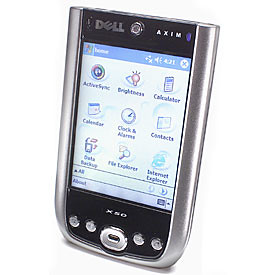
Still, while I may be pretty good at my shotgun role, I’m probably not nearly as a good as a device dedicated solely to the task. That’s why, even if you can’t afford one of those fancier devices or always have that navigating, right-hand man at your stead, you could always assemble a GPS navigating system yourself. Although the task isn’t too difficult, we found instructions over a navigadget for turning your Dell X50 palm PC into a lean, mean navigating machine with the help of a wireless bluetooth GPS a receiver and a little know-how.

And, although this might not be the most off the wall DIY Friday, just remember to thank us when you cut the time to Grandma’s house next Thursday with a little help from RRS, we’re smaller that that navigating buddy of yours and certainly require far less pit stops.

Leonid Meteor Shower Forecast

Friday, November 17th, 2006


A prediction of when to watch for the Leonids this year, from the Planetary Society:

Viewers along the northeastern coast of the United States and Canada, as well as people in Europe and western Africa might get to see a possible "outburst" of as many as 100-600 meteors per hour. This spike in activity is predicted for 11:45 p.m. – 1:33 a.m. EST on November 18-19 (4:45 – 6:33 UT on November 19).

DIY Friday: Death Ray Dogs and Other Potential Uses for your Old Satellite Dish

Friday, November 10th, 2006

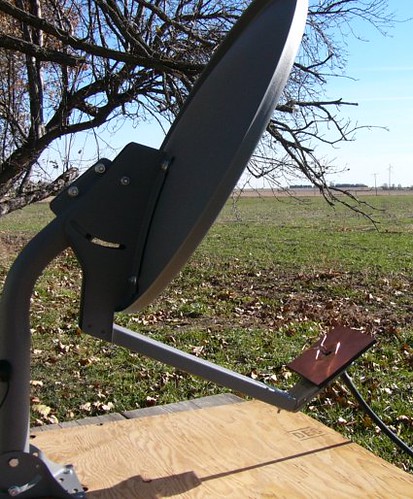
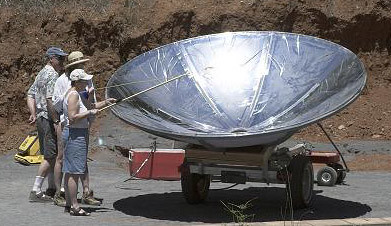
If you’re like most RRS readers you probably have an old satellite dish (or seven) sitting around your place and loathe the idea of parting with perfectly good electronics. This being the case, here are some ideas…

  1. Solar Death Ray Hot Dogs

    It’s probably not the most efficient way to cook a dog, but for a brat in the desert its hard to beat.
  2. Redneck Deer Stand

    Sure, you could just make stand completely out of wood, but, come on, where’s the sport in that. Now if only we could figure out a way to use the ’82 Gremlin on cement blocks on the front lawn…
  3. WiFi Antenna

    Certainly the most useful idea even if its not the most exciting.

Anyone have any other suggestions?


Space-based Narcissism

Thursday, November 9th, 2006

Ok, honestly, what could be cooler than having your name — yes, YOUR name — on a future piece of space junk? Well, I can probably think of a few things (a free donut, a good massage, etc.), but having your name blasted in to space does seem pretty cool.

If you agree, you should check out MIT and Georgia Tech’s Your Name In Space project, which aims to put "America’s most ambitious student spacecraft" up in the sky with the "tax-deductible" support of people looking for their "space in space". The Boson Globe had the story yesterday, but the project website gets a little more specific:

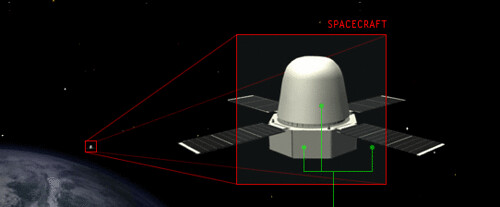
"In 2010, a small unmanned research spacecraft designed by students will launch into Earth’s orbit. The science on board will help pave the way for humankind to explore our solar system. We invite you to participate in this landmark mission by uploading content to be printed on our spacecraft…

Choose a location on the outside of the spacecraft and get pictures of your content photographed in space. Choose a location inside the return vehicle, and after five weeks in orbit we’ll return to you the actual piece of spacecraft hardware which carried your image into orbit."

The best part? Even if you can’t pony up the cold hard cash (a donation as small as $35 gets you a picture of your name or image on the craft before the flight, $250 gets you piece after reentry), you can still send your name up into the heavens. While financial supporters get a photograph of their name/logo/etc. in space or even a piece of the spacecraft following the mission, anyone can provide their name and information and have it encoded on to a DVD that will hitch a ride on the craft during its journey. Sure, it might not be a trip aboard the ISS, but, for now, its the next closest (and far cheaper) alternative.

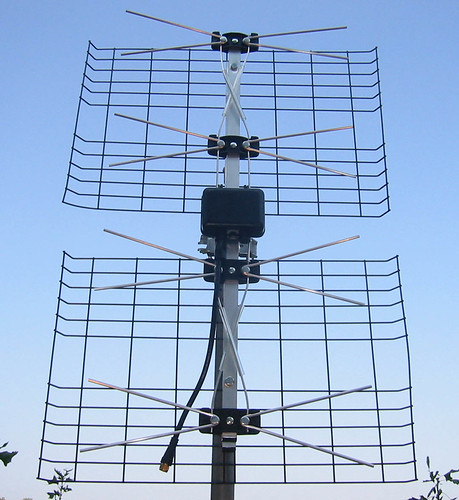
DIY Friday: Build Your Own HDTV Antenna

Friday, November 3rd, 2006

Sure, you just spent $10,000 on a sweet Plasma HDTV Monitor and another $400 on a kick a$$ receiver, but that doesn’t mean you have to break the bank buying a super-expensive HDTV antenna, does it?

Not at all, according to pitman2 over in the Lumenlab 2.1 ("Saving the World from Bad TV") forums, who posted instructions on how to build your very own HD antenna using cardboard, a few hangers, and something called a UHF Matching Transformer. While its not entirely a MacGyver-esque construction (no saliva and papertowel tubes required), it seems to do the job.

"In my un-scientific tests this antenna seems to hold it’s own against the DB2 as an indoor antenna . In outdoor tests it performed almost as well as the DB2. Although I wouldn’t use this one outdoors, being card board and having a solid reflector. One good gust of wind and it’ll fly away. But there is no reason why you can’t build one with higher quality materials to be used outside. Like a cooling rack for a reflector so that it doesn’t catch the wind."

What’s that you say? You haven’t shelled out yet for a new HDTV monitor and receiver yet? You’re waiting for the price of your next generation television to drop below the price of the house your grandparents bought in 1956? Oh, well, have no fear, we hear at RRS have you covered too. Actually, Popular Mechanics has the information, but we’ll link to their how-to on turning your PC into a lean, mean HDTV viewing machine and you can thank us later.

One word of warning on the last bit though: While turning your PC into an HDTV and building your own antenna maybe cheap, explaining to your significant other why you have to watch television under the phosphorescent glow of your computer monitor while coaxial cable from the antenna on the roof dangle overhead… well, that’s priceless.


WirelessHD Could Clip Cords in 2007

Tuesday, October 31st, 2006

For all the advances in cool consumer gadgetry in the last decade — from Ipods to High Definition Television to the proliferation of satellite radio and television — there is one thing that keeps contemporary gadgets tethered to the past: their wires.

That may begin to change in the next year. CNET reports today that "several leading consumer electronics companies are expected to announce… that they are working together to develop a new standard for transmitting high-definition audio and video signals wirelessly."

The new standard is to be known as WirelessHD, "with the stated goal of enabling wireless connectivity for streaming HD content between source devices and high-definition displays."

From the CNET report: 

 Televisions are the "natural" application for [WirelessHD], said John Marshall, president of WirelessHD. Eventually the technology will make its way into adapters for source devices like notebook PCs, digital video recorders, HD disc players, digital audio players and digital cameras. Because it does not compress the digital video, the experience will be the same as using a high-definition multimedia interface (HDMI) or digital video interface (DVI) cable, he said.

The specification will maintain high-quality video, ensure the interoperability of CE devices, protect from signal interference and use existing content protection techniques, Marshall said.

WirelessHD will use the unlicensed 60GHz radio frequency band to send uncompressed HD video and audio at 5 gigabits per second at distances of up to 30 feet, or within one room of a house. While most other wireless audio and video transmissions occur in the 2.4GHz-to-5GHz range, WirelessHD says neither will allow the fast transmition speeds required for high-definition content.

WirlessHD will rely upon the new 802.11n WLAN system, which is supported by… well, just about everybody. (Check out the Enhanced Wireless Consortium  for a list of companies that are working together to accelerate the development process of 802.11n.)

Among consumer electronics companies that are already releasing products capable of interoperability with the draft specifications is Apple, new line of Intel Core 2 Duo-based iMacs sport AirPort cards capable of supporting 802.11n, "which supports connection speeds of up to 540Mbps, or a 10-fold increase compared to existing 802.11g networks," according to Think Secret.

Speaking of Apple — rumors persist that the company is set to unveil both a 50 inch monitor and the new iPhone in January. 

But will we need to connect them with cords?