Archive for the ‘Front Page’ Category

DIY Friday: WiFi Signal Amplifier

Friday, January 5th, 2007
This rocket scientist has recently discovered the joys of a Verizon Aircard while traveling. No more dropping $10 extra bucks in a $200 a night hotel just to get online, or wrestling with the credit card at the airport to check your email between flights. It’s liberating, and wonderful, and somewhat akin to magic.

That said,  my personal plan is $50+ per month, and whenever I use the wireless broadband these days, it seems there’s a freely availably wifi service just out of reach. If only my wifi receiver were better, I might be able to save even that dough.

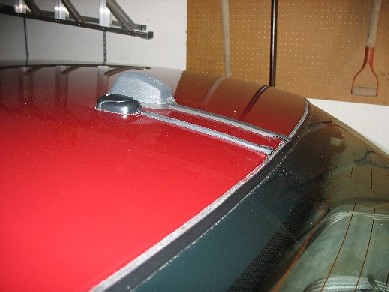
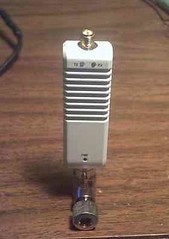
Which brings us to today’s edition of DIY Friday, and that rugged little gizmo to the left, which looks like a cross between a Glade Plugin and the valve on my gas grill:


Most laptops nowadays have a mini PCI Wi-Fi card hooked to an antenna which is located inside a screen plastic cover on the laptop. I was browsing eBay recently and noticed that there were some Wi-Fi amplifiers available that promoted themselves as improving the reception of the signal. Sadly most of those amplifiers are designed to be hooked to a PCMCIA type card or a router! None of them seemed to be specifically made for a mini PCI card.

I decided to buy a Wi-Fi amplifier and hook it to my laptop. I have an ASUS A2H laptop with a Dell 1470 a/b/g Wi-Fi mini PCI card inside, I bought the card for $20 off of eBay. I bought the amplifier for $118, it is a 500 mw bi-directional amplifier called "turbo tenna", the amplifier was shipped from Hong Kong and I received it shortly after ordering on eBay.


 A nip and tuck of a wire here and there, and the author of the piece found "a dramatic increase in signal strength! More than -80dBm, and the speed of the connection is 24Mbps with signal strength 34% as compared to the same connection at 1% previously tested. You can also see more Wi-Fi connections around you, though of course they’re all password protected."

 But hey — it’s not $50 a month, either.
FCC Authorizes New NGSO Satellite System

Friday, January 5th, 2007


Several years ago, there were several companies who wanted to use the Ku-band in operating non-geosynchronous satellites (NGSO’s), causing an uproar among established GEO operators at the time.  As proposed, they’d interfere with high-value satellite services around the world. That wasn’t gonna happen.

Most of those interference issues were resolved via an agreement at the ITU. Now, via Doug Lung’s RF Report, we see the FCC authorizing one of those original applicants:

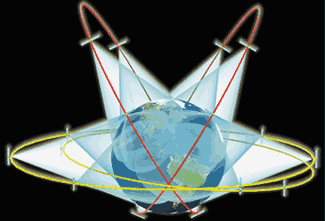
The commission allowed Virtual Geosatellite LLC to begin building a non-geostationary satellite system that will use a network of satellites with highly elliptical orbits. The system is composed of three sub-constellations, each with five satellites. Two of the sub-constellations track the Earth’s northern hemisphere and the third tracks the southern hemisphere. Each sub-constellation will have one spare satellite. To eliminate interference with satellites in geostationary orbits and terrestrial microwave systems using the same frequency band, Virtual Geo terminals and gateway stations will communicate with the satellites only when the satellites are above a certain elevation angle and the satellites in each sub-constellation will actively communicate with earth stations only when they are at an orbital position that is at a latitude greater than 45 degrees away from the equator in their respective operating hemisphere.

Virtual Geo was allowed to use 5925-6725 MHz, 12.75-13.25 GHz and 13.8-14.5 GHz for uplinks and 3700-4200 MHz and 10.7-12.7 GHz for downlinks. User-to-satellite links will use the 14.0-14.5 GHz band and satellite-to-user links will use 11.2-11.7 GHz.

Is this what’s left of Teledesic?

Meteor Crashes in New Jersey

Thursday, January 4th, 2007


One of my Brooklyn buds sent me this from the Asbury Park Press:

It fell from the sky! Mystery object hits Freehold Township house

Posted by the Asbury Park Press on 01/3/07
BY JAMES A. QUIRK

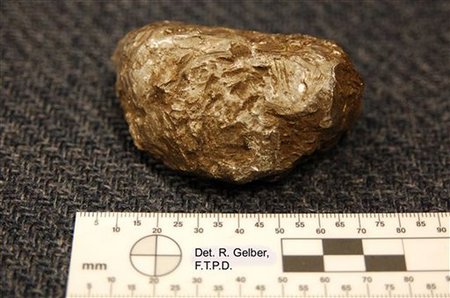
FREEHOLD TOWNSHIP — The Federal Aviation Administration is currently investigating the origin of what appears to be a lump of metal that fell from the sky and through the roof of a home on Kentucky Way last night.

The metal object is about the size of a golf ball and weighs nearly as much as a can of soup, authorities said. Nobody was injured when the oblong object, weighing more than 13 ounces, crashed into the home.

Police received a call Wednesday morning that the metal object had punched a hole in the roof of a single-family home and damaged tiles on a bathroom floor below.

The object was heavier than a usual metal object of that size, said police Lt. Robert Brightman. He added that investigators with the Monmouth County Office of Emergency Management this morning brought in Geiger counters to determine if the object posed any radiological hazard to the homeowners or responders, and the object was found not to be radioactive.

Brightman would not immediately disclose the address or the names of the people who lived at the home, other than to say that a couple and their adult son live there. He said a man who lived at the home found the object at about 9 p.m. Tuesday after returning from work and hearing from his mother that something had crashed through the roof a few hours before.

The Federal Aviation Administration sent a team to the home this afternoon to check whether the object came from an airplane, said spokeswoman Arlene Murray.

"We won’t know what it is until our inspectors have a chance to look at it,” she said. If the investigators cannot identify the object on sight, it may be sent for testing, she said.


Meanwhile, over Colorado, there was a spectacular meteor shower. Fox31 has the video.

DIY Satellite Radio Merger

Wednesday, January 3rd, 2007

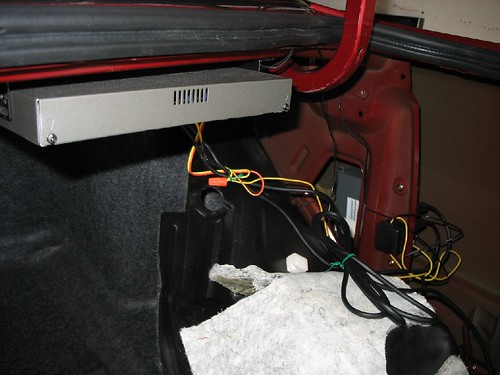
While the NYTimes confirmed rumors that the two were headed towards mergers-ville Monday, some hackers over in the XM fan forums have been discussing a joining of Sirius and XM that even the FTC can’t shut down. As with most two headed consumer electronic beats, the rig requires ignoring manufacturer claims that the doing so is impossible and leaving a mess of cables and random boxes in your trunk.


Hey, who said you needed to put groceries in there anyway.

[Adding XM to Sirrus]

RRS Over The Holidays: See You in ’07

Friday, December 22nd, 2006

ReallyRocketScience is going to be taking a bit of a break over the Holidays, but we’ll see you all back here bright and early on Tuesday, January 2nd, nursing our lingering hangovers, and still wondering what happened the evening before last.

 In all seriousness, whatever you celebrate (and even if you’re celebrating nothing in particular), best wishes to you and yours for a happy and safe holiday season.  See you in 2007!

DIY Friday: Car Laptop Desk and a Flash Diffuser (Holiday Edition)

Friday, December 22nd, 2006

With just three shopping days left before the big day, many of us are trying to frantically figure out how we’re going to get all our work done before the end of 2006, while simultaneously hitting the malls getting gifts of all 27 nieces and nephews that we all of the sudden have.


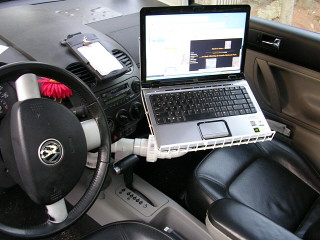
While you’re probably better off not turning to ReallyRocketScience for gift giving suggestions (Hint: Your girlfriend really isn’t going to love that "Build Your Own" Rocketry Kit as much as you think she is), we will direct you to site that will show you how to "build your own", cup-holder-based laptop desk for your car. Sure, checking your email while you’re hunting for that great parking space might lead to one or two fender benders or incidences of road rage, but, hey, at least you’ll be able to make sure your boss thinks you’re still at your desk.


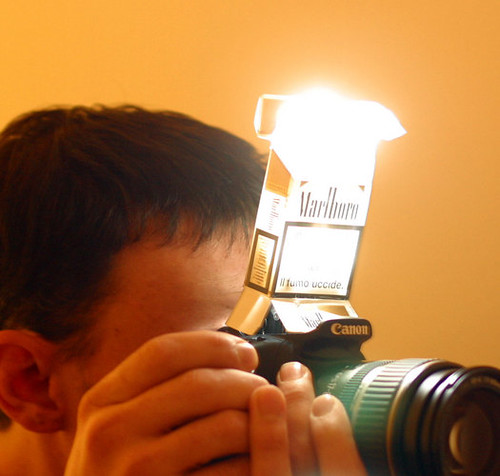
For those of you that have the shopping done, but are planning to photograph the christmas morning festivities only to find out that you didn’t get the flash diffuser you wanted from Santa, here’s a site where you can figure out how to make your own. Just one word of caution: While the resulting diffuser may be good for your evening photos, the cigarettes it takes to make it are bad for your health and, in the long term, far more expensive than the priciest diffuser you can buy.

Yoga? In Space?

Monday, December 18th, 2006

Let it never be said that you don’t get all the angles on space travel and rocketry here on the Really Rocket Science blog. Oh sure, I could tell you about Japan’s launch this afternoon of the country’s largest satellite ever, but you’d much rather know about Yoga’s history in space, right? I thought so.

In any event, I came across this interesting story on the history of Yoga in America published in a recent issue of the Columbia Journalism Review from one of my favorite news/article blog, Arts & Letters Daily. While most of the article, obviously didn’t have much to do with what we talk about here on RRS, it turns out that Yoga has interesting relationship with space travel. For example, at the height of the Cold War Space Race, there was a fair amount of concern about India’s ties to the Soviet Union’s space program. In the 1950s,

"Prime Minister Jawaharlal Nehru of India, obviously prompted by cold-war worries, denied reports that his nation would supply the Soviet Union with yogis to help cosmonauts breathe easier in outer space."

While yogi’s might have never made it to Mother Russia, Yoga did make it into outer-space (and on a Russian mission, no less) when Rakesh Sharma, who some have recently rumored is being considered for a second trip into space, became the first Indian in space in 1984. During the spring flight aboard the Soviet Soyuz T-11, Sharma often did a somewhat elaborate series of zero-gravity Yoga exercises, marking the first extraterrestrial practice of the asanas (postures). Ever since, there has been great interest in the potential benefits in stress relief, breathing, and circulation Yoga could bring to space travel in the future.

Moral of the story? If you’re thinking about hoping a trip on the Virgin Galactic-1 or one of the other opportunities for space travel that might come afterwards, maybe you should start thinking about picking up a matt and heading off to your your local Yoga center while you wait.

Frisbee in Space

Monday, December 18th, 2006


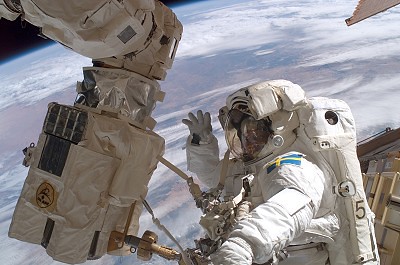
The Swedish astronaut on STS-116, Christer Fuglesang,  is a former Frisbee champion back home.  Philly.com reports he set a new world record for maximum speed aloft last Friday.

DIY Friday: Build an Air Laser

Friday, December 15th, 2006


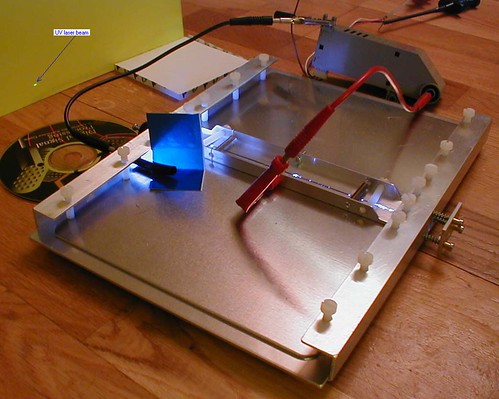
Ever dream of blasting your friends (or your enemies) with really freakin’ cool laser gun when you were kid? Well, it might not be the gun, but the MAKE blog points to a really cool how-two guide for building your own Air Laser. That’s right, "Laser" (insert Dr. Evil air quotes) technology for $10 and none of the crazy stuff that requires a government license and HAZMAT signage.

We describe a very simple laser: no special gas, no chemical products, no vacuum and no glass work! This Nitrogen laser uses normal air at atmospheric pressure. All you need is some metal parts and an about 10 kV 1 mA adjustable High tension DC source.

Dig it! Oh, and if you dig our DIY feature and haven’t checked out the MAKE blog or the quarterly magazine of the same name, do yourself a favor and take a look. You won’t regret it.


Moon Base Alpha

Monday, December 4th, 2006


NASA unveiled plans for building a base on the Moon today:

NASA Deputy Administrator Shana Dale, who is guiding the long-term strategy development effort among 14 of the world’s space agencies, said, "This strategy will enable interested nations to leverage their capabilities and financial and technical contributions, making optimum use of globally available knowledge and resources to help energize a coordinated effort that will propel us into this new age of discovery and exploration."

The Global Exploration Strategy focuses on two overarching issues: Why we are returning to the moon and what we plan to do when we get there. The strategy includes a comprehensive set of the reasons for embarking upon human and robotic exploration of the moon. NASA’s proposed lunar architecture focuses on a third issue: How humans might accomplish the mission of exploring the moon.

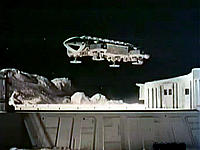
I can’t help it: every time somebody mentions going to the Moon, I think of the British sci-fi show from the 70’s, SPACE:1999. You can still buy the videos on Amazon.

It begins with the Lunar Reconnaissance Orbiter in 2008. This is going to be a pretty cool mission.