Archive for the ‘NASA’ Category

Big Bang Monday: Seen From Mangaia

Monday, September 26th, 2011


In Upstate New York on Saturday (Columbia County), the clouds went away to show a beautiful view of the stars. Light pollution was at a minimum and one of my friends, who spent some time skiing in New Zealand, commented on how the view from the Southern Hemisphere is completely different.

How appropriate that the Astronomy Picture of the Day (APOD) on 24 September 2011 was from Mangaia, one of the Cook Islands…

Explanation: From Sagittarius to Carina, the Milky Way Galaxy shines in this dark night sky above planet Earth’s lush island paradise of Mangaia. Familiar to denizens of the southern hemisphere, the gorgeous skyscape includes the bulging galactic center at the upper left and bright stars Alpha and Beta Centauri just right of center. About 10 kilometers wide, volcanic Mangaia the southernmost of the Cook Islands. Geologists estimate that at 18 million years old it is the oldest island in the Pacific Ocean. Of course, the Milky Way is somewhat older, with the galaxy’s oldest stars estimated to be over 13 billion years old. (Editor’s note: This image holds the distinction of being selected as winner in the Royal Observatory, Greenwich, Astronomy Photographer of the Year competition in the Earth and Space category.)

I simply must visit New Zealand some day, but I’ll settle for watching USA vs. Italy today in the Rugby World Cup — in New Zealand.

WBMSAT Satellite Industry News Bits 09/23/2011

Friday, September 23rd, 2011

First global map of salinity of ocean surface produced from data  collected by NASA’s Aquarius, aboard the Aquarius/SAC-D  satellite/observatory.
[SatNews  – 09/23/2011]

RRsat expands backup and disaster recovery with Spacecom, acting as  Spacecom’s remote and mirror Earth station for telemetry monitoring, tracking,  and commanding (TT&C) and In-Orbit Testing (IOT).
[SatNews –  09/23/2011]

U.S. Department of Defense tracks NASA’s Upper Atmosphere Research Satellite as its orbit decays, expecting to predict when – and possibly where – it will  re-enter the atmosphere.
[SatNews –  09/22/2011]

SES-2 satellite built by Orbital, with CHIRP hosted payload, successfully launched from French Guiana.
[Market Watch – 09/22/2011]

Japan launches new military Information Gathering Satellite known as  Optical-4, with primary mission to provide early warning of impending hostile  launches (prompted by 1998 North Korean missile launch).
[SatNewqs –  09/22/2011]

Two vessels receive Inmarsat-sponsored award recognizing extraordinary  courage and seamanship for their rescue of a party of 64 students from sinking  Canadian tall ship Concordia.
[SatNews –  09/22/2011]

Eutelsat’s ATLANTIC BIRD 7 satellite set for September 24 launch.
[Market Watch – 09/22/2011]

Defense Department’s 1000 lb., $150M 10-channel high power UHF satellite set  to launch September 27 from Kodiak, Alaska – expected to free troops in the  field from carrying heavy radio equipment and fiddling with antennas.
[Stars and Stripes – 09/22/2011]

Sea Launch, now 95% owned by Russian aerospace giant Rocket & Space Corp.  Energia and headquartered in Switzerland, set to launch its first rocket Friday  in over two years – ATLANTIC BIRD(TM) 7 for Eutelsat.
[LA Times – 09/22/2011]

Virgin Galactic unveils new $8M Final Assembly, Integration and Test Hangar  (FAITH) at Mojave Air and Space Port for final stages of production of  WhiteKnightTwo and SpaceShipTwo.
[SatNews –  09/22/2011]

Thrane & Thrane to manufacture broadband terminals for Inmarsat’s Global  Xpress network.
[Reuters – 09/22/2011]

India seeks to disable satellite phones at the border to fight terrorism.
[ars technica – 09/22/2011]

Ariane 5 lifts off from French Guiana with Arabsat 5C and SES-2 one day after  being delayed by local strike by French Guiana workers.
[xinhuanet  – 09/21/2011]

China receives first contract in Europe to build communications satellite for  Belarus and launch from Xichang Satellite Launch Center.
[Satellite Today – 09/21/2011]

South Africa’s one and only satellite, Sumbandila, out of contact with its  Mission Control and not downloading any images since being hit by blast of solar  radiation in July.
[SatNews –  09/21/2011]

LightSquared claims filter developed by high-precision GPS receiver  manufacturer Javad GNSS will fix problem of potential interference by  LightSquared planned LTE network, can be adapted for receivers already in the  market, and won’t make devices more expensive for consumers.
[Wireless Week – 09/21/2011]

Following successful trial on one of its LNG tankers, MOL LNG Transport Co.  Ltd. is adding the KVH TracPhone V7 satellite communications system and  mini-VSAT Broadband service to three of its LNG tankers.
[SatNews –  09/21/2011]

MTN Satellite Communications and Sensory International partner to deliver  global VSAT services and connectivity to superyachts.
[Market Watch – 09/21/2011]

Harris opens new and totally advanced center for manufacturing of tactical  radios and assured communication systems.
[SatNews –  09/21/2011]

General Dynamics receives FCC license for its Coms-on-the-Move terminals  enabling continuous access to private- and government-owned communications  satellites while on-the-move in vehicles.
[PR Newswire – 09/21/2011]

UtiliSat joins Satellite Industry Association as Associate Member.
[space ref –  09/21/2011]

Eutelsat and MultiChoice Africa Announce Winners of the First DStv Eutelsat  Star Awards in competition by over 800 students from across Africa.
[Sacramento Bee – 09/21/2011]

Gilat subsidiary Spacenet gets renewal contract valued at up to $27M from  U.S. retail giant for critical network solutions and potential store expansion.
[Market Watch – 09/21/2011]

NASA expects 26 of heaviest metal parts of a 20-year-old research satellite,  which should break into more than 100 pieces as it enters the atmosphere this  week, to reach Earth – but no one knows where.
[R&D Magazine – 09/20/2011]

Russia’s Proton-M carrier rocket successfully launched with a military  purpose spacecraft aboard.
[SatNews –  09/20/2011]

Satmex signs multi-year multi-transponder lease agreement with Telefonica  subsidiary Media Networks Latin America.
[SatNews –  09/20/2011]

Ratheon fields first AEHF satellite communications terminals to U.S. armed  forces tactical units.
[Space Daily – 09/20/2011]

NewSat Jabiru-1 contracts reach $279M with latest $40.2M contract with  Quicklink Communications.
[Satellite Today – 09/20/2011]

Marlink and Sea Tel team up to provide satellite communications for third  Kaisei expedition seeking viable solutions to problems associated with marine  debris in North Pacific Gyre.
[Maritime Executive – 09/20/2011]

Vizada and ARINC renew partnership to deliver mobile satellite services to  commercial, government aviation customers.
[Military & Aerospace – 09/20/2011]

Gilat to supply VSATs for e-Education program in Latin American country.
[Satellite Spotlight – 09/20/2011]

Zhongxing-1A satellite carried aloft by Long March-3B from Xichang Satellite  Launch Center in Sichuan Province, China.
[SatNews –  09/19/2011]

Senate Appropriations Committee approves $500M in funding for commercial  spaceflight as part of NASA’s 2012 budget.
[Satellite Today – 09/19/2011]

LightSquared CEO claims U.S. politicians using company as a pinata after  being denied opportunity to testify at U.S. House Armed Service Committee  hearing.
[Satellite Today – 09/19/2011]

Military communications satellite launched by China.
[Spaceflight Now  – 09/18/2011]

Component crunch slows delivery of Ka-band communications satellites as only  two companies manufacturing Ka-band TWTs, L-3 and Thales, are unable to keep up  with demand.
[Space News – 09/16/2011]

Low-cost Disaster Warning Dissemination System conceived by India Space  Research Organization can reach general public in local languages with early  warnings of potential weather dangers using satellite-based Direct-to-home  television broadcasts.
[Microwaves&RF – September 2011]

WBMSAT PS  satellite communications systems services


WBMSAT Satellite Industry News Bits 09/16/2011

Monday, September 19th, 2011

Satellite operators SES SA and Telesat Holdings may need to stick to  partnerships to expand in fast-growing emerging markets as acquisitions are  often blocked by politics.
[Bloomberg – 09/16/2011]

Avanti Communications announces contract win for UK rural broadband supply.
[Proactive Investors – 09/16/2011]

Space Systems/Loral’s Viasat-1 Ka-band satellite arrives at Kazakhstan’s  Baikonur Space Center launch base.
[Satellite Spotlight – 09/16/2011]

SES S.A. contracts with Osterreichischer Rundfunksender of Austria for a  fourth transponder at 19.2 degrees East to launch two new public broadcasting  channels in Austria.
[SatNews –  09/16/2011]

Space Weather research report states that solar superstorm could kill  majority of in-orbit weather, telecommunications, and military satellites in  less than a year.
[Satellite Today – 09/15/2011]

NASA selects designs of new heavy-lift rocket and crew capsule for ferrying  cargo, equipment, and science experiments to Earth’s orbit and beyond, as well  as serving as backup for transportation services to International Space Station.
[SatNews –  09/15/2011]

U.S. National Reconnaissance Office gets hit with budget cuts but preserves  science and technology funding used to develop unique capabilities including  advanced satellites, six of which have been launched in last seven months.
[Federal Times – 09/15/2011]

Weathernews Inc. of Tokyo, Japan sets date for launch of WNISAT-1 from the  Yasny Cosmodrome in Russia for next September – satellite will monitor ice  conditions in the Artic Sea.
[SatNews –  09/15/2011]

House Armed Services Committee hearing delves into LightSquared LTE plans and  potential interference with military GPS systems – FCC Chairman chooses not to  appear.
[Washington Post – 09/15/2011]

Eutelsat extends agreement with Russian Satellite Communications Company for  satellite control from Dubna.
[Market Watch – 09/15/2011]

European Space Agency and Arianespace sign contract for launch of BepiColombo  spacecraft, designed to explore planet Mercury.
[SatNews –  09/15/2011]

New Iridium personal services package includes capability to use Iridium  satellite communications device together with your smart phone in areas where  there is no wi-fi or cellular phone service.
[digital energy – 09/15/2011]

Globecomm Systems gets contract to host the enhanced and extended GSM  wireless network of Chariton Valley Wireless Services of Northeast Missouri.
[SatNews –  09/15/2011]

TCS does it again- $9.3M order from U.S. Army for SNAP deployable satellite  systems upgrades and spares equipment following earlier $20.7M in funding for  equipment and field services support of SNAP systems. .
[Market Watch – 09/15/2011] [Market Watch – 09/14/2011]

ViaSat receives delivery order valued at approximately $27.6M for  Multifunctional Information Distribution System – Low Volume Terminals from the  Space and Naval Warfare Systems Command.
[SatNews –  09/15/2011]

Gilat U.S. subsidiary Spacenet Integrated Government Solutions wins third  U.S. government contract to provide satellite communications services.
[Globes – 09/15/2011]

Northrop Grumman signs three-year agreement to become leased services  provider and network services distribution partner of Inmarsat’s satellite  services around the world.
[Emoney Daily – 09/15/2011]

Euroconsult 8th annual awards go to:  Global Satellite Operator of the  Year – Inmarsat; Strategic Transaction of the Year – EchoStar Corporation;  Regional Satellite Operator of the Year – AsiaSat; Broadband Satellite Operator  of the Year – Hughes Communications.
[SatNews –  09/14/2011]

European Space Agency shut down the second European Remote Sensing satellite  ERS-2 after 16 years of providing data for thousands of scientists and projects.
[SatNews –  09/14/2011]

FCC wants further tests of LightSquared’s proposed mobile broadband network  as concern mounts over possible interference with GPS.
[Mobiledia – 09/14/2011]

Sirius XM CEO expects significant revenue growth in 2012 after company raised  subscription fees for first time in about a decade.
[LA Times – 09/14/2011]

KVH to unveil new 1-meter TracVision(R) HD11 marine satellite TV system for  global HD with digitally programmable multi-beam Universal World LNB.
[Market Watch – 09/14/2011]

U.S. Navy announces plans to launch September 27 the Tactical Microsatellite  (TacSat)-4, funded by Office of Naval Research and developed by Naval Research  Laboratory to allow service members around the world to use handheld radio for  mobile communications in the field without having to set up a satellite antenna.
[Stars & Stripes – 09/13/2011]

Worries about Russian rocket reliability delay launches of U.S. and French  satellites and crew rotation for International Space Station.
[The Hindu –  09/13/2011]

Graduate students at Purdue designing and building rocket engine that could  land a vehicle on the moon.
[R&D Magazine – 09/13/2011]

Farstaed Shipping signs 5-year satellite communications contract with Harris  CapRock Communications for 53 offshore supply vessels.
[Market Watch – 09/13/2011]

Comtech receives $12.1M in orders for broadband high-power amplifiers to  un-named U.S. contractor.
[Bloomberg  Business Week – 09/13/2011]

Eutelsat aims to improve quality assurance standards for satellite TV ahead  of the 2012 Olympic Games in London.
[Cable – 09/12/2011]

Hughes is awarded extension contract for U.S. Air Force study of commercial  communications satellite systems capabilities.
[Market Watch – 09/12/2011]

LightSquared forges ahead with another wholesale agreement, with VoX  Communications.
[Market Watch – 09/12/2011]

Arabsat announces that all necessary technical and logistics requirements for  global distribution of Saudi League matches in Europe and the U.S. have been  finalized.
[SatNews –  09/11/2011]

Thuraya IP, world’s smallest satellite high throughput solution, attracts  praised from British and French Ministries of Defence, will be showcased at  upcoming DSEi exhibition in London.
[Teletechwire – 09/11/2011]

LightSquared says it can avert interference problems with GPS systems by  limiting power levels and adjusting height and tilt of antennae.
[Kansas City Star – 09/10/2011]

WBMSAT PS satellite communications systems services


WBMSAT Satellite Industry News Bits 09/09/2011

Friday, September 9th, 2011

SES S.A. presents new brand identity and logo as operating units merge into single entity, with independent subsidiary SES Government Solutions to market to U.S. government.
[SatNews – 09/09/2011]

New unified approach and identity of merged entities forming SES S.A. outlined by CEO of SES Government Solutions.
[SatNews – 09/09/2011]

Iridium adds new services to “personal mobile satellite communications” product, including extending beyond satellite phones to include enabling a Wi-Fi hotspot capability for connecting devices.
[Satellite Spotlight – 09/09/2011]

Launch of ViaSat-1, delayed in August due to Proton Breeze-M failure, is now scheduled for October.
[SatNews – 09/09/2011]

MIT led NASA GRAIL moon mission, twin spacecraft set to precisely map moon’s gravitational field, suffered launch delay yesterday due to high winds.  Re-scheduled to launch today, Friday September 9,
[R&D Magazine – 09/09/2011]
the launch is scrubbed a second time.
[SatNews – 09/09/2011]

Skyware Global debuts new Cielo Ka-band product range with world’s first truly integrated Ka-band VSAT transceiver.
[SatNews – 09/09/2011]

International Datacasting announces debut of IDC Systems & Solutions, offering comprehensive end-to-end systems integration for broadcasters.
[SatNews – 09/09/2011]

Satellite operators SES SA and Intelsat SA push services such as military drones in preparation for biggest increase in satellite capacity in at least 10 years (more than 200 commercial communication satellites to be launched by 2020).
[Bloomberg – 09/08/2011]

Orbit of NASA’s Upper Atmosphere Research Satellite decays, with re-entry into atmosphere expected by late September or early October.
[SatNews – 09/08/2011]

Satlink Communications’ live trial of Novelsat’s 3G-SAT NS3(TM) technology shows over 50% increase above DVB-S2 in bandwidth efficiency.
{MarketWatch – 09/08/2011]

TRACE selects Eutelsat’s EUROBIRD 9A satellite to broadcast its platform of HD channels across Europe and Middle East.
[PR Newswire – 09/08/2011]

Newtec signs contracts with Eutelsat’s Skylogic (for TOOWAY product), SES ASTRA (for ASTRA2Connect product), and African company SkyVine for the Newtec Sat3Play hub systems to provide two-way IP broadband services.
[SatNews – 09/08/2011]

Space Systems/Loral selected to provide two high-power satellites to Intelsat.
[Market Watch – 09/08/2011]

SES S.A. gets contract from GlobeCast for transponder on SES-4 as well as additional transponder on ASTRA-4A to launch two new broadcast platforms for sub-Saharan African region.
[MarketWatch – 09/08/2011]

TCS continues its successes with the U.S. military as the U.S. Marine Corp signs contract for integrated communications system that carries potential value of $139.8M.
[UPI – 09/08/2011]

Vizada expands Satcom portfolio to include new Iridium Extreme and Iridium AxcessPoint with location-based services like online tracking and emergency SOS notification.
[Market Watch – 09/08/2011]

Globecomm Systems is awarded two contracts from US Government customers valued at $12.8M, with options that could potentially increase value up to $66.6M for both contracts.
[Market Watch – 09/08/2011]

Emergency services professionals choose KVH TracPhone V3 Mini-VSAT for portable satellite communications.
[4-traders – 09/08/2011]

Marlink signs agreement with Wilson Ship Management to provide 80 of its ships with SCAP FleetBroadband on 36 month contract.
[SatNews – 09/08/2011]

C-COM debuts new 98cm iNetVue Ka-band antenna, tested by Gilat and fully integrated with Gilat’s SkyEdge II Ka-band terminals.
[SatNews – 09/08/2011]

ATCi tailors Simulsat transport system for European market.
[PR Newswire – 09/08/2011]

NASA’s Solar Dynamics Observatory provides scientists with new information that energy from some solar flares is stronger and lasts longer than previously thought.
[R&D Magazine – 09/08/2011]

Sea&Space of Belgium signs for capacity on Telesat’s Telstar 11N to bring advanced broadband services to remote African communities.
[SatNews – 09/08/2011]

DIRECTV Latin America signs with Intelsat for capacity on two new satellites to expand its DTH offerings and provide backup and restoration services.
[SatNews – 09/08/2011]

Advanta Technologies joins list of companies signing wholesale-only compacts with LightSquared.
[SatNews – 09/08/2011]

Optimal Satcom awarded multi-year contract by Asia Broadcast Satellite to provide enterprise satellite capacity system to help manage ABS’ growing commercial satellite business.
[SatNews – 09/08/2011]

Work Microwave announces new-generation DVB-S/S2 modulator.
[SatNews – 09/08/2011]

British scientists attempt to revive only satellite ever launched by the British (in 1971) – Prospero was only launched because it was finished; Ministers had already pulled the plug on the Black Arrow project.
[Daily Mail – 09/07/2011]

SES and Gazprom agreement boosts Russian satellite capacity with relocation of Astra 1F satellite.
[Digital TV Europe – 09/07/2011]

Eutelsat and Eser Telekom announce agreement to expand reach of Tooway(TM) satellite broadband into Turkey and neighbouring countries.
[Market Watch – 09/07/2011]

Hughes ships Ka-band broadband satellite solution to YAHSAT.
[Market Watch – 09/07/2011]

Hispasat selects Arianespace to launch its new Amazonas-3 telecommunications satellite.
[SatNews – 09/07/2011]

GlobeCast cuts ribbon on new Rome teleport.
[Satellite Today – 09/07/2011]

New Globalstar satellites now providing improved voice and data service for North American customers.
[GlobeNewswire – 09/06/2011]

ORBIT aims to expand tracking and telemetry/satellite earth observation business in the U.S.
[Market Watch – 09/06/2011]

ViaSat wins contracts from Boeing for ground based beam forming system for Mexican satellite.
[Market Watch – 09/06/2011]

KVH mini-VSAT broadband service now available in South America to all subscribers, completing original global coverage plan for the maritime satellite communications network.
[Market Watch – 09/06/2011]

Broadcom announces entry into Out Door Unit market with Full-Band Capture Satellite Channel Stacker solution supporting 24 independent channels, delivering more HD streams, multi-room DVR and IP services throughout the home.
[Market Watch – 09/06/2011]

Independent mobile and satellite networks likely to benefit from AT&T’s antitrust woes, and Justice Department sues to prevent AT&T merger with T-Mobile.
[Seeking Alpha –  09/05/2011]

Pakistan Chairman SUPARCO confident that recently launched PAKSAT-1R has capacity to bring revolution to national education programme.
[Pak Observer – 09/05/2011]

Croatia’s KLasik TV joins AMOS satellite system.
[News on News – 09/05/2011]

Hong Kong-based telco PCCW Global and Vizada Networks team up to expand international terrestrial and satellite services coverage of both companies.
[Trade Arabia – 09/04/2011]

Inmarsat launches a price War and goes direct – the risks and the possible rewards.
[SatMagazine – September issue]

WBMSAT PS satellite communications systems services

The Moon Needs Some Press

Tuesday, September 6th, 2011

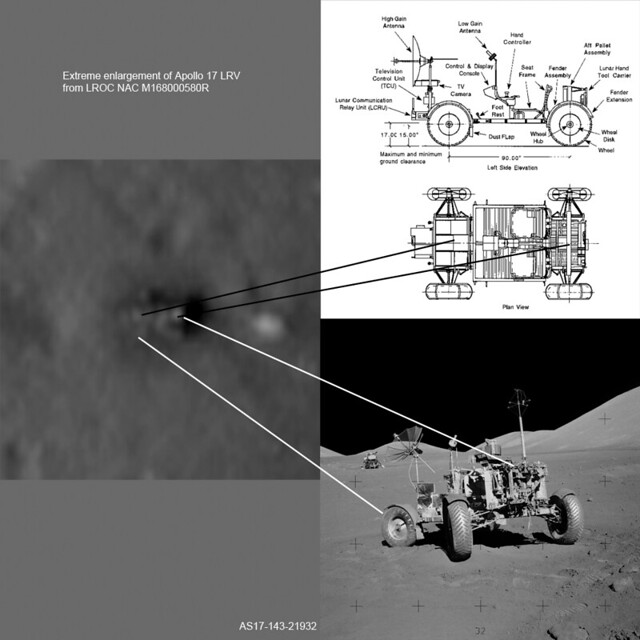
Just in time for the release of the movie Apollo 18, the folks who run the Lunar Reconnaissance Orbiter Camera at Arizona State decided to share some images of Apollo 17 remnants.

That’s good P.R., rocket scientists.

Here’s the horror film’s trailer…

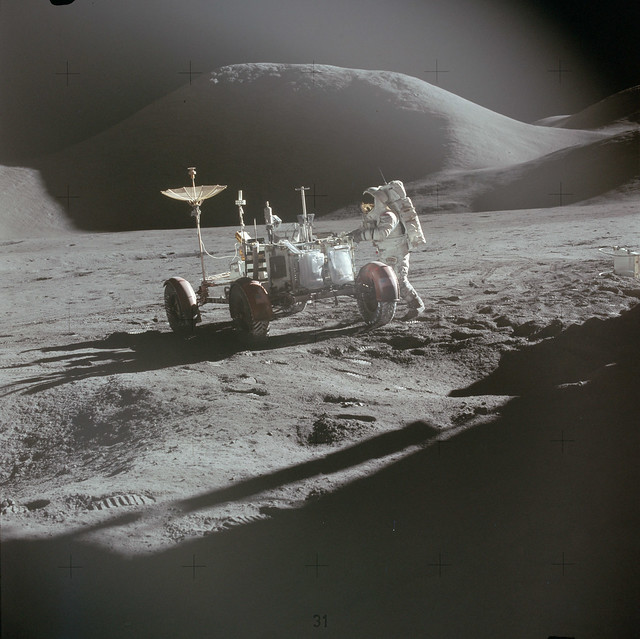
You know, that lunar roving vehicle is one sick set of wheels.

WBMSAT Satellite Industry News Bits September 2, 2011

Friday, September 2nd, 2011

Two-foot-wide model of world’s first geosynchronous commercial communications satellite, Syncom, shares the stage at Boeing celebration of 50 years in the satellite business.
[SatNews – 09/02/2011]

Stellar Group utilizes Newtec’s Flex ACM and three transponders on inclined orbit satellite to provide reliable high speed satellite link to camp of 40,000 in Afghanistan.
[SatNews – 09/02/2011]

Indian Space Research Organization (ISRO) pre3pares for launch of Megha-Tropiques advanced weather and climate satellite later this month aboard Polar Satellite Launch Vehicle.
[SatNews – 09/02/2011]

Orbital Sciences receives Commercial Space Transportation License from Federal Aviation Administration to conduct Commercial Orbital Transportation Services program demonstration mission in 2012.
[SatNews – 09/02/2011]

National Polar-orbiting Operational Environment Satellite System Preparatory Project satellite,. first of new generation of satellites to observe many facets of our changing Earth, arrives at Vandenberg for October launch.
[SatNews – 09/02/2011]

Aljazeera invests in several Multimedia Exchange Network over Satellite TV interactive terminals from Newtec.
[SatNews – 09/02/2011]

Comtech EF Data’s new LPOD to get deployed by U.S. Government under $1.2M satellite earth station equipment order from leading solutions provider.
[SatNews – 09/02/2011]

iPONT International and SES Astra to demonstrate glasses-free 3DTV on SES stand at IBC 2011.
[SatNews – 09/02/2011]

Orbital awarded $135M contract by NASA for Icesat-2 earth science satellite program.
[Reuters – 09/01/2011]

Inmarsat GX and Rockwell Collins team up to expand airborne connectivity for aeronautical industry.
[Satellite Spotlight – 09/01/2011]

Gaps in smart grid network communications technologies lead many utility companies to consider two-way satellite IP networks.
[Electric Light & Power – 09/01/2011]

Worried National Research Council committee urges NASA to place greater focus on space junk.
[Science Magazine – 09/01/2011]

Repaired Amos 5 satellite to be launched in December 2011.
[Globes – 09/01/2011]

Three men responsible for damaging Waihopai Valley intelligence gathering satellite dome in 2008 found liable for damages by High Court at Wellington, NZ
[NZ Herald – 09/01/2011]

New Euroconsult report says growth continues but slows as challenges emerge for the satellite communications sector.
[Broadcast Engineering – 08/31/2011]

Roscosmos considers returning the federal space program to the framework of the state defense order to ensure steady financing and reduce the number of accidents with space launches.
[SatNews – 08/31/2011]

Launch of China’s Tiangong satellite will be delayed due to failure of experimental orbiter SJ-11-04 to enter orbit following its launch last weerk.
[SatNews – 08/31/2011]

Hughes wins two orbital slots in Brazilian auction.
[PR Newswire – 08/31/2011]

Thuraya partners with SRT Wireless to redefine the future of satellite data transmission.
[MarketWatch – 08/31/2011]

LightSquared and Inmarsat join forces to support hurricane Irene emergency responders.
[Satellite Spotlight – 08/31/2011]

Expand Networks offers satellite optimization for reliable communications in disaster events.
[Satellite Spotlight – 08/31/2011]

American Family Radio chooses Ka You Communications and VSAT Systems to connect 156 of their transmitter sites to the Internet to comply with new Common Alerting Protocol for the Emergency Alert System.
[PR Newswire – 08/31/2011]

Gilat is selected to provide multi-million dollar SkyEdsge II broadband network and services for security communications in Latin America.
[MarketWatch – 08/31/2011]

Russia lifts suspension on launches of main Proton-M rockets, pointing to problem with Briz-M booster stage as cause of August 18 failed launch.
[Reuters – 08/30/2011]

Kratos wins $6M in contracts to provide critical SATCOM situational awareness products and value added services to the military, government and intelligence communities.
[MarketWatch – 08/30/2011]

Eutelsat Communications announces six-year distribution agreement between Skylogic subsidiary and Egyptsat, bringing satellite broadband to Egyptians.
[Broadband TV News – 08/30/2011]

RRsat signs with Spacecom for Amos-5 satellite remote and mirror earth station for telemetry monitoring, tracking, and commanding, and In-Orbit Testing of the satellite following its December launch.
[PR Newswire – 08/30/2011]

KVH and ViaSat enhance KVH’s Mini-VSAT Broadband network, doubling uplink speeds and implementing adaptive return-link technology.
[SatNews – 08/30/2011]

Vizada launches SkyFile C Store & Push to offer customers highly-reliable data reporting and polling services, enabling shipping companies to adhere strictly to international maritime law.
[SatNews – 08/30/2011]

Arianespace places hold on launch of Arabsat 5X and SES-2 in order to carry out supplementary checks on the ESC-A upper-stage cryogenic engine.
[SatNews – 08/30/2011]

One-day International satellite-industry forum organized by Global VSAT Forum and Satellite Interference Reduction Group will be held in Netherlands September 8 to target satellite interference.
[SatNews – 08/30/2011]

TSF lands in Tripoli, and establishes satellite links to benefit medical establishments and organizations charged with treating injured that have been evacuated.
[SatNews – 08/30/2011]

Dish Network unveils portable satellite TV antenna for tailgaters, campers, and customer engaging in other outdoor activities.
[Satellite Today – 08/30/2011]

Pakistan telco awards $134M satellite contract to NewSat.
[The Express Tribune – 08/30/2011]

As 6,500 cell sites in four states are knocked out by Irene, Army North coordinates with FEMA and dispatches defense coordinating officer teams equipped with Chevrolet Suburban Emergency Response vehicles with satellite communication systems.
[NextGov – 08/29/2011]

ViaSat completes Yonder mobile high-speed Internet coverage over South America.
[MarketWatch – 08/29/2011]

X Class solar flare of August 9, 2011 and subsequent disruption to Japan’s Kodama communications satellite illustrate the vulnerability of Earth’s communication systems to astronomical events – underscores need to prepare.
[PR Web – 08/29/2011]

Globalstar completes French authorization of new satellite constellation.
[MarketWatch – 08/29/2011]

Raytheon ground system passes launch test for critical Polar orbiting satellite.
[Ottawa Citizen – 08/29/2011]

Dish Network and DirecTV take opposite tacks, as Dish embraces diversification including launch of new LTE network, while DirecTV is “well-advanced on a debt-fueled share buyback.”
[DSL Reports – 08/29/2011]

T-Mobile rolls out new satellite backhaul-supported emergency voice service.
[Satellite Today – 08/29/2011]

Research satellite set for launch from Kodiak Launch Complex in Alaska on September 27.
[Chron – 08/28/2011]

ISRO issues request for proposal seeking available satellite capacity to lease.
[SatNews – 08/28/2011]

Dish Network seeks FCC approval of TerreStar-DBSD merger.
[Space News – 08/26/2011]

Nigerian satellite launched August 17 returns first pictures.
[BBC News – 08/26/2011]

Russian cargo rocket bound for International Space Station with food and fuel fails and lands in Siberian forest.
[The New York Times – 08/24/2011]

Dish Network wants FCC to let it use Terrestar’s satellite spectrum to roll out LTE-Advanced, although the new standard is not yet ready.
[Wireless Week – 08/23/2011]


Juno LEGO

Monday, August 8th, 2011

Besides an over-the-top Flash site, the Juno mission to Jupiter is pretty fascinating. It began years ago, culminating in a spectacular launch the other day. Since it’s got a long way to go, strap-on solid rocket boosters were called in to help make really move on up…

Now all we need to do is wait five years to get there.

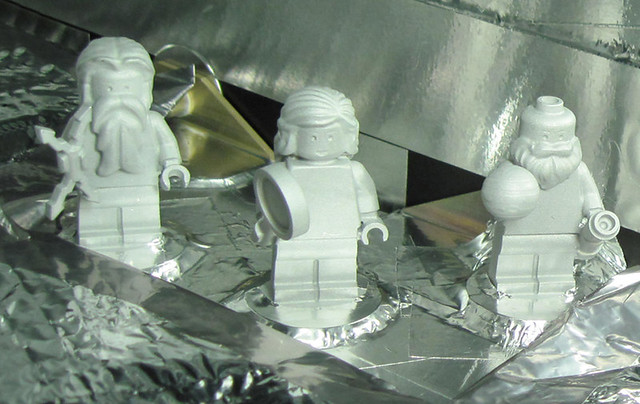
Besides a very interesting payload system, it carries three LEGO figurines

NASA’s Jupiter-bound Juno spacecraft will carry the 1.5-inch likeness of Galileo Galilei, the Roman god Jupiter and his wife Juno to Jupiter when the spacecraft launches this Friday, Aug. 5. The inclusion of the three mini-statues, or figurines, is part of a joint outreach and educational program developed as part of the partnership between NASA and the LEGO Group to inspire children to explore science, technology, engineering and mathematics.

In Greek and Roman mythology, Jupiter drew a veil of clouds around himself to hide his mischief. From Mount Olympus, Juno was able to peer through the clouds and reveal Jupiter’s true nature. Juno holds a magnifying glass to signify her search for the truth, while her husband holds a lightning bolt. The third LEGO crew member is Galileo Galilei, who made several important discoveries about Jupiter, including the four largest satellites of Jupiter (named the Galilean moons in his honor). Of course, the miniature Galileo has his telescope with him on the journey.


LEGO is cool.

The Moonwalk of 1969

Thursday, July 21st, 2011

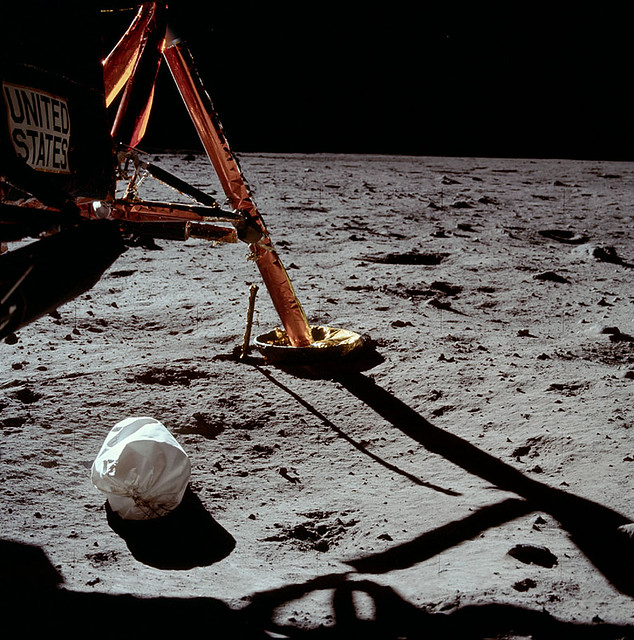
I remember watching the first human steps on the Moon on 20 July 1969, along with a couple of hundred people at a hotel in the Catskills. It was the only TV set around.


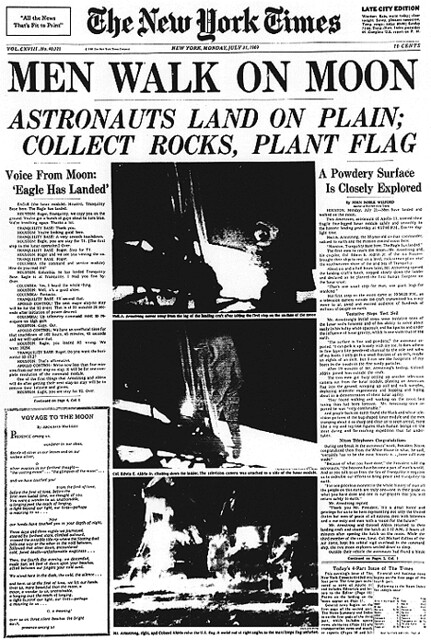
42 years later, it’s worth revisiting the article in The New York Times from that day. Check out the lead…

Men have landed and walked on the moon.

Two Americans, astronauts of Apollo 11, steered their fragile four-legged lunar module safely and smoothly to the historic landing yesterday at 4:17:40 P.M., Eastern daylight time.

Neil A. Armstrong, the 38-year-old civilian commander, radioed to earth and the mission control room here:

“Houston, Tranquility Base here. The Eagle has landed.”

The first men to reach the moon–Mr. Armstrong and his co-pilot, Col. Edwin E. Aldrin, Jr. of the Air Force–brought their ship to rest on a level, rock-strewn plain near the southwestern shore of the arid Sea of Tranquility.

About six and a half hours later, Mr. Armstrong opened the landing craft’s hatch, stepped slowly down the ladder and declared as he planted the first human footprint on the lunar crust:

“That’s one small step for man, one giant leap for mankind.”

His first step on the moon came at 10:56:20 P.M., as a television camera outside the craft transmitted his every move to an awed and excited audience of hundreds of millions of people on earth.

Tentative Steps Test Soil

Mr. Armstrong’s initial steps were tentative tests of the lunar soil’s firmness and of his ability to move about easily in his bulky white spacesuit and backpacks and under the influence of lunar gravity, which is one-sixth that of the earth.

“The surface is fine and powdery,” the astronaut reported. “I can pick it up loosely with my toe. It does adhere in fine layers like powdered charcoal to the sole and sides of my boots. I only go in a small fraction of an inch, maybe an eighth of an inch. But I can see the footprints of my boots in the treads in the fine sandy particles.

After 19 minutes of Mr. Armstrong’s testing, Colonel Aldrin joined him outside the craft.

The two men got busy setting up another television camera out from the lunar module, planting an American flag into the ground, scooping up soil and rock samples, deploying scientific experiments and hopping and loping about in a demonstration of their lunar agility.

They found walking and working on the moon less taxing than had been forecast. Mr. Armstrong once reported he was “very comfortable.”

And people back on earth found the black-and-white television pictures of the bug- shaped lunar module and the men tramping about it so sharp and clear as to seem unreal, more like a toy and toy-like figures than human beings on the most daring and far- reaching expedition thus far undertaken.

Nixon Telephones Congratulations

During one break in the astronauts’ work, President Nixon congratulated them from the White House in what, he said, “certainly has to be the most historic telephone call ever made.”

“Because of what you have done,” the President told the astronauts, “the heavens have become a part of man’s world. And as you talk to us from the Sea of Tranquility it required us to redouble our efforts to bring peace and tranquility to earth.

“For one priceless moment in the whole history of man all the people on this earth are truly one–one in their pride in what you have done and one in our prayers that you will return safely to earth.”

Mr. Armstrong replied:

“Thank you Mr. President. It’s a great honor and privilege for us to be here representing not only the United States but men of peace of all nations, men with interests and a curiosity and men with a vision for the future.”

Mr. Armstrong and Colonel Aldrin returned to their landing craft and closed the hatch at 1:12 A.M., 2 hours 21 minutes after opening the hatch on the moon. While the third member of the crew, Lieut. Col. Michael Collins of the Air Force, kept his orbital vigil overhead in the command ship, the two moon explorers settled down to sleep.

Outside their vehicle the astronauts had found a bleak world. It was just before dawn, with the sun low over the eastern horizon behind them and the chill of the long lunar nights still clinging to the boulders, small craters and hills before them.

Colonel Aldrin said that he could see “literally thousands of small craters” and a low hill out in the distance. But most of all he was impressed initially by the “variety of shapes, angularities, granularities” of the rocks and soil where the landing craft, code-named Eagle had set down.

The landing was made four miles west of the aiming point, but well within the designated area. An apparent error in some data fed into the craft’s guidance computer from the earth was said to have accounted for the discrepancy.

Suddenly the astronauts were startled to see that the computer was guiding them toward a possibly disastrous touchdown in a boulder-filled crater about the size of a football field.

Mr. Armstrong grabbed manual control of the vehicle and guided it safely over the crater to a smoother spot, the rocket engine stirring a cloud of moon dust during the final seconds of descent.

Soon after the landing, upon checking and finding the spacecraft in good condition, Mr. Armstrong and Colonel Aldrin made their decision to open the hatch and get out earlier than originally scheduled. The flight plan had called for the moon walk to begin at 2:12 A.M.

Flight controllers here said that the early moon walk would not mean that the astronauts would also leave the moon earlier. The lift-off is scheduled to come at about 1:55 P.M. today.

Their departure from the landing craft out onto the surface was delayed for a time when they had trouble depressurizing the cabin so that they could open the hatch. All the oxygen in the cabin had to be vented.

Once the pressure gauge finally dropped to zero, they opened the hatch and Mr. Armstrong stepped out on the small porch at the top of the nine-step ladder.

“O.K., Houston, I’m on the porch,” he reported, as he descended.

On the second step from the top, he pulled a lanyard that released a fold-down equipment compartment on the side of the lunar module. This deployed the television camera that transmitted the dramatic pictures of man’s first steps on the moon.

Ancient Dream Fulfilled

It was man’s first landing on another world, the realization of centuries of dreams, the fulfillment of a decade of striving, a triumph of modern technology and personal courage, the most dramatic demonstration of what man can do if he applies his mind and resources with single-minded determination.

The moon, long the symbol of the impossible and the inaccessible, was now within man’s reach, the first port of call in this new age of spacefaring.

Immediately after the landing, Dr. Thomas O. Paine, administrator of the National Aeronautics and Space Administration, telephoned President Nixon in Washington to report:

“Mr. President, it is my honor on behalf of the entire NASA team to report to you that the Eagle has landed on the Sea of Tranquility and our astronauts are safe and looking forward to starting the exploration of the moon.”

The landing craft from the Apollo 11 spaceship was scheduled to remain on the moon about 22 hours, while Colonel Collins of the Air Force, the third member of the Apollo 11 crew, piloted the command ship, Columbia, in orbit overhead.

“You’re looking good in every respect,” Mission Control told the two men of Eagle after examining data indicating that the module should be able to remain on the moon the full 22 hours.

Mr. Armstrong and Colonel Aldrin planned to sleep after the moon walk and then make their preparations for the lift-off for the return to a rendezvous with Colonel Collins in the command ship.

Apollo 11’s journey into history began last Wednesday from launching pad 39-A at Cape Kennedy, Fla. After an almost flawless three-day flight, the joined command ship and lunar module swept into an orbit of the moon yesterday afternoon.

The three men were awake for their big day at 7 A.M. when their spacecraft emerged from behind the moon on its 10th revolution, moving from east to west across the face of the moon along its equator.

Their orbit was 73.6 miles by 64 miles in altitude, their speed 3,660 miles an hour. At that altitude and speed, it took about two hours to complete a full orbit of the moon.

The sun was rising over their landing site on the Sea of Tranquility.

“We can pick out almost all of the features we’ve identified previously,” Mr. Armstrong reported.

After breakfast, on their 11th revolution Colonel Aldrin and then Mr. Armstrong, both dressed in their white pressurized suits, crawled through the connecting tunnel into the lunar module.

They turned on the electrical power, checked all the switch settings on the cockpit panel and checked communications with the command ship and the ground controllers. Everything was “nominal,” as the spacemen say.

LM Ready for Descent

The lunar module was ready. Its four legs with yard-wide footpads were extended so that the height of the 16-ton vehicle now measured 22 feet and 11 inches and its width 31 feet.

Mr. Armstrong stood at the left side of the cockpit, and Colonel Aldrin at the right. Both were loosely restrained by harnesses. They had closed the hatch to the connecting tunnel.

The walls of their craft were finely milled aluminum foil. If anything happened so that it could not return to the command ship, the lunar module would be too delicate to withstand a plunge through earth’s atmosphere, even if it had the rocket power.

Nearly three-fourths of the vehicle’s weight was in propellants for the descent and ascent rockets–Aerozine 50 and nitrogen oxide, which substituted for the oxygen, making combustion possible.

It was an ungainly craft that creaked and groaned in flight. But years of development and testing had determined that it was the lightest and most practical way to get two men to the moon’s surface.

Before Apollo 11 disappeared behind the moon near the end of its 12th orbit, mission control gave the astronauts their “go” for undocking–the separation of Eagle from Columbia.

Colonel Collins had already released 12 of the latches holding the two ships together at the connecting tunnel. He did this when he closed the hatch at the command ship’s nose. While behind the moon, he was to flip a switch on the control panel to release the three remaining latches by a spring action.

At 1:50 P.M., when communications signals were reacquired, Mission Control asked: “How does it look?”

“Eagle has wings,” Mr. Armstrong replied.

The two ships were then only a few feet apart. But at 2:12 P.M., Colonel Collins fired the command ship’s maneuvering rockets to move about two miles away and in a slightly different orbit from the lunar module.

“It looks like you’ve got a fine-looking flying machine there, Eagle, despite the fact you’re upside down,” Colonel Collins commented, watching the spidery lunar module receding in the distance.

“Somebody’s upside down,” Mr. Armstrong replied.

What is “up” and what is “down” is never quite clear in the absence of landmarks and the sensation of gravity’s pull.

As Mr. Armstrong and Colonel Aldrin rode the lunar module back around to the moon’s far side, the rocket engine in the vehicle’s lower stage was pointed toward the line of flight. The two pilots were leaning toward the cockpit controls, riding backwards and facing downward.

“Everything is ‘go,'” they were assured by Mission Control.

Their on-board guidance and navigation computer was instructed to trigger a 29.8-second firing of the descent rocket, the 9,870-pound-thrust throttable engine that would slow down the lunar module and send it toward the moon on a long, curving trajectory.

The firing was set to take place at 3:08 P.M., when the craft would be behind the moon and once again out of touch with the ground.

Suspense built up in the control room here. Flight controllers stood silently at their consoles. Among those waiting for word of the rocket firing were Dr. Thomas O. Paine, the space agency’s administrator, most of the Apollo project officials and several astronauts.

At 3:46 P.M., contact was established with the command ship.

Colonel Collins reported, “Listen, baby, things are going just swimmingly, just beautiful.”

There was still no word from the lunar module for two minutes. Then came a weak signal, some static and whistling, and finally the calm voice of Mr. Armstrong.

“The burn was on time,” the Apollo 11 commander declared.

When he read out data on the beginning of the descent, Mission Control concluded that it “look great.” The lunar module had already descended from an altitude of 65.5 miles to 21 miles and was coasting steadily downward.

Eugene F. Kranz, the flight director, turned to his associates and said, “We’re off to a good start. Play it cool.”

Colonel Aldrin reported some oscillations in the vehicle’s antenna, but nothing serious. Several times the astronauts were told to turn the vehicle slightly to move the antenna into a better position for communications over the 230,000 miles.

“You’re ‘go’ for PDI,” radioed Mission Control, referring to the powered descent initiation–the beginning of the nearly 13-minute final blast of the rocket to the soft touchdown.

When the two men reached an altitude of 50,000 feet, which was approximately the lowest point reached by Apollo 10 in May, green lights on the computer display keyboard in the cockpit blinked the number 99.

This signaled Mr. Armstrong that he had five seconds to decide whether to go ahead for the landing or continue on its orbital path back to the command ship. He pressed the “proceed” button.

The throttleable engine built up thrust gradually, firing continuously as the lunar module descended along the steadily steepening trajectory to the landing site about 250 miles away:

“Looking good,” Mission Control radioed the men.

Four minutes after the firing the lunar module was down to 40,000 feet. After five and a half minutes, it was 33,500 feet. At six minutes, 27,000 feet.

“Better than the simulator,” said Colonel Aldrin, referring to their practice landings at the spacecraft center.

Seven minutes after the firing, the men were 21,000 feet above the surface and still moving forward toward the landing site. The guidance computer was driving the rocket engine.

The lunar module was slowing down. At an altitude of about 7,200 feet, with the landing site still about five miles ahead, the computer commanded control jets to fire and tilt the bug-shaped craft almost upright so that its triangular windows pointed forward.

Mr. Armstrong and Colonel Aldrin then got their first close-up view of the plain they were aiming for. It was then about three and a half minutes to touchdown.

The brownish-gray panorama rushed below them–myriad craters hills and ridges, deep cracks and ancient rubble on the moon, which Dr. Robert Jastrow, the space agency scientist, called the “Rosetta Stone of life.”

“You’re ‘go’ for landing,” Mission Control informed the two men.

The Eagle closed in, dropping about 20 feet a second, until it was hovering almost directly over the landing area at an altitude of 500 feet.

Its floor was littered with boulders.

It was when the craft reached an altitude of 300 feet that Mr. Armstrong took over semimanual control for the rest of the way. The computer continued to have control of the rocket firing, but the astronaut could adjust the craft’s hovering position.

He was expected to take over such control anyway, but the sight of a crater looming ahead at the touchdown point made it imperative.

As Mr. Armstrong said later, “The auto-targeting was taking us right into a football field- sized crater, with a large number of big boulders and rocks.”

For about 90 seconds, he peered through the window in search of a clear touchdown point. Using the lever at his right hand, he tilted the vehicle forward to redirect the firing of the maneuvering jets and thus shift its hovering position.

Finally, Mr. Armstrong found the spot he liked, and the blue light on the cockpit flashed to indicate that five-foot-long probes, like curb feelers, on three of the four legs had touched the surface.

“Contact light,” Mr. Armstrong radioed.

He pressed a button marked “Stop” and reported, “okay, engine stop.”

There were a few more cryptic messages of functions performed.

Then Maj. Charles M. Duke, the capsule communicator in the control room, radioed to the two astronauts:

“We copy you down, Eagle.”

“Houston, Tranquility Base here. The Eagle has landed.”

“Roger, Tranquility,” Major Duke replied. “We copy you on the ground. You got a bunch of guys about to turn blue. We are breathing again. Thanks a lot.”

Colonel Aldrin assured Mission Control it was a “very smooth touchdown.”

The Eagle came to rest at an angle of only about four and a half degrees. The angle could have been more than 30 degrees without threatening to tip the vehicle over.

The landing site, about 120 miles southwest of the crater Maskelyne, is on the right side of the moon as seen from earth. The position: Lat. 0.799 degrees N., Long. 23.46 degrees E.

Although Mr. Armstrong is known as a man of few words, his heartbeats told of his excitement upon leading man’s first landing on the moon.

At the time of the descent rocket ignition, his heartbeat rate registered 110 a minute–77 is normal for him–and it shot up to 156 at touchdown.

At the time of the landing, Colonel Collins was riding the command ship Columbia about 65 miles overhead.

Mission control informed the colonel, “Eagle is at Tranquility.

“Yea, I heard the whole thing,” Colonel Collins, the man who went so far but not all the way, replied. “Fantastic.”

When the Apollo astronauts landed on the Sea of Tranquility, the temperature at their touchdown site was about zero degrees Fahrenheit in the sunlight, even colder in the shade.

During a lunar night, which lasts 14 earth days, temperatures plunge as low as 280 degrees below zero. Unlike earth, the moon, having no atmosphere to act as a blanket, is unable to retain any of the day’s warmth during the night.

During the equally long lunar day, temperatures rise as high as 280 degrees. By the time of Eagle’s departure from the moon, with the sun higher in the sky, the temperatures there will have risen to about 90 degrees.

This particular landing site was one of five selected by Apollo project officials after analysis of pictures returned by the five Lunar Orbiter unmanned spacecraft.

All five sites are situated across the lunar equator on the side of the moon always facing earth. Being on the equator reduces the maneuvering for the astronauts to get there. Being on the near side of the moon, of course, makes it possible to communicate with the explorers.


Bye-Bye Space Shuttle

Wednesday, July 13th, 2011

STS-135 launch video — the last one.

WBMSAT News Bits – post July 4th catchup issue

Friday, July 8th, 2011

WBMSAT Satellite Industry News Bits July 8, 2011

Thales Alenia Space selects EMS Technologies to supply hardware for  French-Italian Ka band and EHF satellite to support armed forces and civil  security agencies.
[Market Watch – 07/07/2011]

Arianespace will launch THOR 7 satellite for Telenor.
{Space Travel – 07/07/2011]

NOAA deputy administrator tells local leaders that satellite programs are key to saving lives and lessening economic impact of severe weather.
[Market Watch – 07/07/2011]

Freeing up some government broadband spectrum for commercial use could take more than 10 years.
[Government Video – 07/07/2011]

LightSquared creates rural initiative to drum up popular support for its wireless network plans while arguing that installing filters on GPS systems would address possible interference problems.
[Connected Planet Online – 07/07/2011]

Vizada looks to Expand Networks to enhance its existing Inmarsat BGAN, Swift  Broadband, and Fleet Broadband offerings with WAN optimization features for the  satellite networks.
[TMCnet – 07/07/2011]

Thuraya introduces specialised suite of solutions aimed at offering all the functionality of satellite communication indoors.
[Al Bawaba – 07/06/2011]

‘Remote Cueing’ capabilities of the Space Tracking and Surveillance System demonstration satellites built by Northrop Grumman demonstrated during Aegis test.
[Market Watch – 07/06/2011]

General Dynamics Information Technology gets task order from Defense  Intelligence Agency for enterprise communication services including satellite  communications support on coalition networks.
[PR Newswire – 07/06/2011]

India set to launch GSAT-12 communications satellite onboard a Polar  Satellite Launch Vehicle on July 15.
[Satellite Spotlight – 07/06/2011]

Hughes to connect 1,500 broadband satellite sites for India’s Restructured Accelerated Power Development & Reforms Programme.
[TMCnet – 07/05/2011]

Lockheed Martin’s BSAT-3c/JCSAT-110R satellite ready for launch aboard Ariane  5-ECA launch vehicle.
[Satellite Spotlight – 07/05/2011]

Comtech announces receipt of a SATCOM equipment contract from India-based  Bharti Airtel.
[TMCnet – 07/05/2011]

Spanish Ministry of Defence awards Indra maintenance contract for its  satellite communications terminals worth C17 million.
[Defence Professionals – 07/05/2011]

European Space Agency saves a four-satellite Cluster mission from near loss  by using “an unorthodox, dirty hack.”
[Satellite Today – 07/04/2011]

Italian Space Agency to cooperate with Eutelsat and Skylogic on broadband  connectivity in Italy.
[PR Newswire – 07/04/2011]

Consilium partners with Orange to market maritime VSAT service.
[Satellite Today – 07/04/2011]

Space rock passes through satellite belt within 12,000 kilometres of  Australia.
[University World News – 07/03/2011]

Dual launch of ASTRA 1N and BSAT-3c/JCSAT-110R scrubbed due to LH2 valve  fault on vulcain core stage of Ariance 5 ECA vehicle.
[NASA Spaceflight – 07/01/2011]

LiightSquared offers three-part solution to interference to GPS by its  proposed network, saying it remains committed to a robust GPS system and GPS  manufacturers could have avoided the problem with filters as cheap as 5 cents  each..
[SatNews  – 06/30/2011]

HISPASAT selects Gilat for broadband VSAT network in Spain.
[MarketWatch – 06/30/2011]

Pentagon’s ORS-1 imaging satellite carried to orbit aboard Orbital Sciences  Corp. Minotaur 1 rocket.
[Space News  – 06/30/2011]

Dish Network wins bid for TerreStar for $1.375 billion.
[Multichannel – 06/28/2011]

Raytheon triples bandwidth on National Weather Services’ satellite broadcast  network.
[PR Newswire – 06/28/2011]

Airport Authority of India says GAGAN {GPS-Aided Geo Augmented Navigation)  satellite is in position and certification is underway.
[Inside GNSS – 06/26/2011]


WBMSAT PS  satellite communications systems services