There it was, a punch in the nose to fans of IPTV in the U.S. back in December when SES announced it was shutting down IP-PRIME:
“In line with its plan, IP-PRIME has contracted IPTV signal delivery agreements with 70 small telecom operators, of which 37 have so far reached commercial stage. However, with a subscriber base of less than ten thousand at the end of November and after more than 2 years of service, the consumer uptake is insufficient to justify continuing operations,” said Rob Bednarek, President and CEO of SES AMERICOM-NEW SKIES.
The IP-PRIME service will continue to operate until July 31, 2009. This will offer telecom operators an opportunity to orderly transfer their services and SES AMERICOM, in collaboration with third parties involved in the service, to seek the best option to transition the business.
Sure, it was costing lots in resources (people and money) to keep the C-band based service running. It was ahead of all competitors in the U.S., but it was tough to convince SES management it was worth the continuing effort. Inside Americom, people thought the way out of this was to sell the service and related assets to EchoStar, who had their own Ku-band based service, ViP-TV. Ironically, using the AMC-16 satellite they were leasing.
EchoStar Satellite Services, a division of EchoStar Corporation (NASDAQ: SATS), announced today the company’s IP-Prime Conversion Program, designed to provide continued delivery of video transport services for telco IP headend facilities across the United States. Commercial transport provider IP-Prime has previously announced it will discontinue its video transport service to headend facilities by July 31, 2009. EchoStar’s IP-Prime Conversion Program provides qualified customers with EchoStar’s ViP-TV(TM) transport service, replacement IDC satellite receivers and a standard professional installation, including compatible LNBs, a satellite dish re-point, cabling and connectors.
Not surprisingly, Western Europe is still the leading IPTV region in the world, but regions such as North America continue to show their own strong growth paces. That’s the word from research firm Point-Topic and the Broadband Forum, who announced their fourth-quarter 2008 numbers at the IPTV World Forum in London this week.
Western Europe had more than 10.3 million IPTV subscribers at the end of 2008. North America, despite the U.S. being Ground Zero for the recession, saw its IPTV subscriber numbers grow a whopping 113 percent to more than 3.8 million from the end of 2007 to the end of 2008. Worldwide, IPTV subscribers totaled 21.7 million at the end of 2008, representing growth of 63 percent from the previous year.
Thank you, Japanese taxpayers, for subsidizing the development of what we’ll expect to see in about ten years. 16 times better than today’s HDTV.
NHK’s Super Hi-Vision provides 7,680 x 4,320 pixel (32 million pixels) images at 60 progressive frames a second, with 22.2 channel immersive audio. By contrast, today’s HDTV offers 2 million pixels in 1,920 x 1,080 scanning system.
They had a live feed from London to the IBC show in Amsterdam earlier this week. What was the reaction? "Dude, I need a bigger wall!" The Hollywood Reporter used the word "agog" in their headline:
NHK’s developing Super Hi-Vision system was the subject of a stunning demonstration Monday at the IBC. SHV offers 8K resolution — 16 times that of HDTV — with a 22.2 channel surround sound system.
Delegates waited in long lines for a glimpse at the scenic images, which were broadcast to Amsterdam’s RAI Convention Center in two ways: From a live camera in London over a fiber connection and from a server in Torino, Italy, via satellite.
What kind of set-up/config are we talking here? Big broadband, accoriding to EE Times:
In London, the camera and audio mixing is operated by SIS Live (formerly BBC Outside Broadcasts). Siemens IT Solutions and Services, the BBC’s technology partner, has built a control room that includes a bank of 16 MPEG-2 encoder channels which compress the native 24Gb/s of Super Hi-Vision to 600 Mb/s.
Siemens carries this, without any modulation, together with data, communications and reverse video and audio feeds, to Cable&Wireless, which is providing a gigabit Ethernet fiber connection from London to Amsterdam.
Besides the output of a live camera and microphone array in London transmitted over fiber optics connection, the BTF group is also showing content from a local server located in Torino, delivered to Amsterdam live over satellite.
RAI and Eutelsat provided Super Hi-Vision material live, using DVB-S2 modulation with "a channel efficiency that approaches closely theoretical limits," according to the group.
The Super Hi-Vision video and the 22.2 multichannel audio are coded using H.264 and AAC respectively. The 140 Mbits per second coded signal is then carried over two satellite transponders, using 8PSK 5/6 modulation.
Two transponders? Cool. Maybe they’ll start using the Kizuna satellite for these broadcasts.
Japan Inc. magazine gives a unique perspective, noting HD in Japan is nothing new:
“The public and private sector cooperation has been such that ordinary Japanese people don’t necessarily think of HDTV as anything special,” says NHK engineer Kenji Terada, noting that 93% of Japanese households already receive HDTV broadcast signals, thanks mainly to the country’s BS satellite service (BS-hi), which came online in 2000. The One-Seg system for mobile receivers (cell phones and car navigation systems, and so on) has been up since 2006.
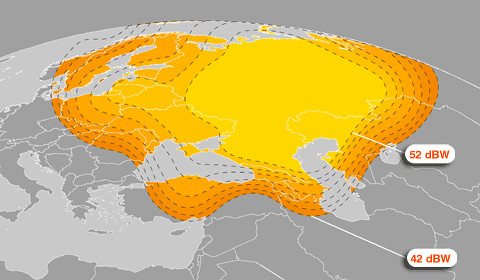
Platforma HD, the new Russian all-HDTV platform has selected the EUROBIRD(TM) 9 satellite operated by Eutelsat Communications (Euronext Paris: ETL) to deliver new HD content across western parts of Russia to the Urals. The new platform was launched in August in order to offer Platforma HD’s first subscribers the Beijing Olympics in HD with the Eurosport HD channel.
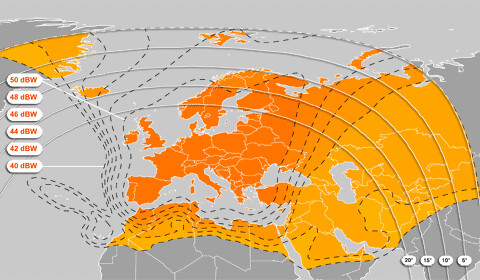
They’re using Eurobird 9, formerly Hotbird 2, in the 9 degrees East position, which doesn’t provide optimal coverage (as shown above). Hungarian HDTV, Hello HD, is also on the Eurobird 9, as we blogged a few months ago. But Platforma HD says they’ll be moving it to the 36 degrees East location in 2009. (Incase you read Russian, check it out here…)
This is bad news for people adding an LNB to their dishes in order to receive hundreds of Free-to-Air (FTA) channels from adjacent HOT BIRD at 13 degrees East.
We’re guessing this was all timed to coincide with the IBC show in Amsterdam, considered to be THE NAB show of Europe.
Speaking of Russian programming, Disney just announced that it is making its first Russian film. The movie will be based on some of Russia’s most famous fairy tales and is expected to be released next fall.
Now that we have the two satellite radio companies combined, are we that far off from the two major satellite TV companies trying to merge again? Good question.
Considering DISH Network’s recent subscriber loss, Robert Holmes at TheStreet.com are asking just that:
Dish-DirecTV Deal Won’t Fool Feds
Prompted by the first subscriber losses at a major U.S. satellite-TV provider, Dish NetworkDISH could revive a merger attempt with rival DirecTVDTV, but industry observers say a potential deal will once again be found to be anticompetitive.
Six years removed from failing at a $16 billion tie-up, Dish Network Chairman and CEO Charles Ergen has said market conditions are more welcoming to a deal, according to a report in The Wall Street Journal. Ergen has reportedly calculated the potential savings of a merger at up to $2 billion a year, and he also harbors hopes of a potent broadband offering from a combined satellite company — something neither has been done individually.
However, a renewed bid to combine Dish and DirecTV would revisit the same problems that plagued the 2002 attempt — and would once again fail to pass muster with the Federal Communications Commission and the Justice Department, the government bodies that would again examine the merger.
In its October 2002 decision, the FCC said a combination of Dish Network, then under the umbrella of parent EchoStarSATS, and DirecTV, which was then owned by Hughes Electronics, would likely harm consumers by eliminating a viable competitor in every market, creating the potential for higher prices and lower service quality, and hurting future innovation.
Three weeks later, the Justice Department agreed that a merger would reduce competition in markets served by cable, and eliminate it in areas served only by direct broadcast satellite.
"That merger was the first in recent memory that the FCC turned down," says Adam Candeub, an associate assistant professor of law at Michigan State University College of Law, who was an attorney-adviser for the FCC and worked on the 2002 deal between Dish and DirecTV. "That’s something [Dish and DirecTV] would like to correct and would give it another go-round."
The recently approved deal between Sirius Satellite RadioSIRI and XM Satellite Radio has given Dish’s Ergen hope, though, that consolidation among satellite companies would be better received by government officials, especially if both Dish and DirecTV can argue they compete not only against each other but cable and telecom companies, such as ComcastCMCSA, AT&TT and VerizonVZ, which have started bundling television, Internet, and phone services.
However, when going strictly by FCC and Justice comments about both Dish and DirecTV – and about XM and Sirius — Candeub argues that the government bodies would not likely bend to concessions, even if Ergen wants to use the XM-Sirius deal as a blueprint.
"From a market-definition perspective, it’s not clear that the satellite radio market has much to do with the video market," Candeub says. "They’re very different. There are so many various ways to get audio, like AppleAAPL iPods. Arguably, one analysis would not work for the other."
The Journal reported that Ergen, attempting to assuage fears over what a Dish-DirecTV merger would do to the competitive landscape, is willing to peg monthly charges to the lowest fees paid by subscribers in rural regions, where satellite antennas are currently the only way for customers to receive pay-TV options. A cap on prices would be similar to Sirius and XM’s pledge to hold off on price increases for three years after their merger was completed.
Craig Moffett, senior analyst for U.S. cable and satellite broadcasting with Sanford Bernstein, says that a commitment to national pricing is one way to ameliorate the potential for monopoly pricing power in rural markets, although such a move would still not prevent a deal from being labeled anticompetitive.
"These kinds of concessions are commonplace in the FCC … but the test in the [Justice Department] is an objective ‘rule of law’ test," he writes in a research note. "Voluntary a priori commitments such as national pricing plans are therefore generally not considered as relevant when considering whether a merger does or doesn’t meet the letter of the law."
Moffett adds that under the precedent set by Sirius and XM, the two satellite-TV providers would have to prove there was an alternative distribution model for television in rural areas, one that would be a suitable substitute for Dish and DirecTV’s service. One approach would be to wait until TV-over-the-Internet connections are more available to rural customers, although Moffett finds that to be a Catch-22.
"This itself is problematic, inasmuch as TV-over-the-Internet requires a high quality broadband connection, which generally means either cable modem or telco fiber," Moffett says. "The very definition of ‘rural’ to be applied by the [Justice Department] in 2002 presumes that connections of this kind are not available."
Of course, a few variables have changed that arguably could make a deal more palatable for regulators. "When the Dish/DirecTV merger was out there in 2002, there was a Republican majority in the Senate," Candeub says. "Many of those Senate seats were held by Republicans who represent people from big rural states who rely on satellite and who would see higher rates."
In the last six years, though, there has been a shift of political power. While then-FCC Chairman Michael Powell, a Republican, argued that a Dish and DirecTV combination would replace competition with "a regulated monopoly," a Democratic majority in Washington might be more open to regulation of satellite television.
Despite this shift, though, analysts say those pesky laws cannot simply be circumnavigated. "In rural America, a merger would still be two [companies in the field]-to-one. Two-to-one mergers are unlawful under U.S. antitrust law," Moffett asserts. "Nothing in six years has changed."
As Dish Network copes with the first quarterly subscriber losses reported by a major U.S. satellite-TV provider, the company is considering another attempt to merge with DirecTV Group, The Wall Street Journal reported citing unnamed sources.
Dish Network’s chairman and chief executive, Charles Ergen, is considering the first run at a satellite-TV merger since 2001. That attempt was shut down by opposition from federal and state regulators, but Mr. Ergen has been emboldened by the drawn-out but successful union of satellite radio companies Sirius and XM Satellite, the Journal said.
Efforts to reach another deal, such as a sale to AT&T, may be hamstrung by Dish Network’s loss of 25,000 subscribers in the past quarter. Concerns about that shrinking customer base offset news about Dish Network’s 50 percent increase in net income, to $335.9 million, or 73 cents a share.
Excellent obituary by Adam Bernstein in the Washington Post:
Clay T. "Tom" Whitehead, 69, who helped the cable industry flourish by bringing competition to the domestic satellite market in the early 1970s, died July 23 at Georgetown University Hospital. He had prostate cancer.
During the Nixon administration, Mr. Whitehead became the country’s first telecommunications policy adviser and championed free markets in the satellite business. He later revolutionized the way communications satellites were sold — outright to cable providers instead of leasing them to those companies.
Starting in the mid-1980s, he challenged Europe’s state-owned television systems by spearheading the first private Pan-European television satellite system, Luxembourg-based SES Astra. It became one of the continent’s most popular and profitable private satellite systems.
Dr. Whitehead had degrees in engineering and management but little knowledge of communications when in 1970 he was appointed the first director of the old White House Office of Telecommunications Policy. Considered bright and able, he said his chief concern was trying to get the federal government to become "more anticipatory" in addressing rapid technological changes.
During his four years overseeing the office, he sough to demolish the monopoly model that had given tremendous power to large international corporations such as Comsat and Intelsat. He set in motion policies that allowed domestic satellite competitors to succeed, and far more cheaply.
His work had an enormous impact on the cable industry, which because of his efforts could get its own programming channels via satellites to a national audience. Before, that reach was impossible unless a cable channel wanted to lease land lines from the monopoly provider AT&T.
HBO, the Turner cable networks and C-Span were among the key beneficiaries of Dr. Whitehead’s decisions.
Henry Geller, a Washington telecommunications lawyer and Federal Communications Commission general counsel, said Dr. Whitehead "changed the entire landscape of television in the United States and throughout the world" by advocating an "open skies" policy toward domestic satellites.
Geller said Dr. Whitehead "stopped the FCC cold, which was still promoting Comsat as a domestic monopoly. Satellite service became more competitive, allowing such companies as RCA and Hughes to achieve greater innovations more cheaply."
Dr. Whitehead was credited with formulating policies that gave more autonomy to local stations in the public broadcasting system, which was seen by some PBS executives as an attack on the service in large part because of Dr. Whitehead’s early reputation for antagonizing the press.
He called network television news a haven for "ideological plugola" and "elitist gossip." His criticisms extended to the public broadcasting system, which he called a "fourth network" for alleged liberal biases.
He apologized before a Senate committee, saying his own comments "did not serve a very useful purpose."
Clay Thomas Whitehead, was born Nov. 13, 1938, in Neodesha, Kan., and raised in Columbus, Kan.
An early interest in astronomy led him to the Massachusetts Institute of Technology, where he received a bachelor’s degree in electrical engineering in 1960 and doctorate in management in 1967.
He was a Rand Corp. economist before joining the Nixon team in 1968 as an expert on budget policies. He also helped create the Office Telecommunications Policy, which was folded into the Commerce Department’s National Telecommunications and Information Administration during the Carter administration.
In 1979, Dr. Whitehead became the founding president of Los Angeles-based Hughes Communications, a satellite-manufacturing subsidiary of Hughes Aircraft Co. His greatest achievement was the Galaxy program of commercial communications satellites, which addressed the needs of a rapidly growing cable television market.
He likened the Galaxy program to a mall with an "anchor tenant," such as HBO. Each subsequent company would buy a piece of the satellite. This approach made enormous profits for Hughes, reportedly $200 million for the 24 transponders on the Galaxy I that launched in 1983.
"I suppose the thing I like to do most is set things up and make them run," Dr. Whitehead had once told the New York Times. He left Hughes in 1983 because he said he tired of working for a big company.
He spent the next two years laying the financial, technical and political groundwork for a $180 million enterprise that became SES Astra.
Some European politicians criticized the proposed system as "Coca-Cola satellite" and dismissed it as cultural imperialism, all to protect their government-run television channels.
"I think we’re seeing wounded national pride," Dr. Whitehead told Forbes magazine in 1985. "There would be more European programming if a large commercial marketplace already existed there."
SES Astra, in which Luxembourg is a major stakeholder, grew tremendously. Its programming is beamed into more than 65 million homes, and its worth was estimated to be more than $1 billion.
A contractual dispute led Dr. Whitehead to sue SES Astra and the Luxembourg government for $600 million. He was consumed by the lawsuit for a decade, until prevailing in 2003. The final agreement was confidential.
Rapid TV News did provide a settlement figure in its write-up:
Unfortunately he spent some 10 years of his life in a legal squabble with SES Astra (and the Luxembourg government) claiming a total of $1.8bn and receiving some €30m as dividend payments in a Court-ordered settlement in June 2002.
And as far as the extent of ASTRA’s reach in Europe*, the number are greater today than they’ve ever been:
At year end 2007, 117.2 million homes receive audiovisual broadcast and broadband services via ASTRA at 19.2º, 23.5°, 28.2º East or SIRIUS at 5.0º East.
The ASTRA Group** consolidated its position as the top European satellite fleet for DTH reception.
By end of 2007, 50.3 million homes receive ASTRA or SIRIUS services directly via satellite. A further 66.9 million homes receive services via ASTRA Group satellites in cable.
More than 4 out of 10 of all TV homes within the ASTRA Group footprint are now receiving digital services.
Satellite continues to be the most popular digital reception mode, with a 58% share of the total digital market.
81% of all ASTRA satellite homes are digital.
* 35 countries within the ASTRA Group footprint ** ASTRA Group reach includes ASTRA at 19.2°E, 23.5°E, 28.2°E and SIRIUS at 5.0°E
The 2008 Olympics in Beijing is right around the corner and, despite the political controversy, one thing is clear: this year’s games will be easier to watch than ever before.
NBCU is providing DIRECTV with 10 VOD titles each week, including athlete features, Beijing previews, and more. The service will be available through the end of the Olympics in both standard-definition and HD. NBCU will produce more than 500 titles now through the end of the 2008 Beijing Olympic Games.
For those who prefer to watch online, NBCU’s website will give fans access to approximately 2,200 total hours of live streaming and video coverage of 25 different sports. The site will also feature blogs, live chat, athlete profiles and, of course, the latest results.
If you want to psych yourself up for some amazing sports action in Beijing, search YouTube for some great moments in Olympics history. Take, for example, the 1968 Olympics in Mexico City where Bob Beamon set a new world record in the long jump that stood for 23 years.
Long Beach, Calif., July 14, 2008 – The Sea Launch team arrived at the launch site in the Equatorial Pacific over the weekend and initiated a 72-hour countdown, in preparation for the launch of the EchoStar XI satellite on Tuesday, July 15. Liftoff is planned at 10:21pm PDT, July 15 (5:21 GMT, July 16), at the opening of a two-hour launch window.
Upon arrival at the launch site, at 154 degrees West Longitude, the team ballasted the Odyssey Launch Platform to launch depth. A final series of tests on all systems is now underway. Prior to fueling operations, the platform will be evacuated, with all personnel safely positioned on the ship, about four miles from the platform. One hour after liftoff, a Zenit-3SL vehicle will insert the 5,511 kg (12,150 lb) EchoStar XI satellite into geosynchronous transfer orbit, on its way to a final orbital location of 110 degrees West Longitude.
Built by Space Systems/Loral (SS/L), the powerful 20-kW spacecraft, carries a Ku-band payload that will support DISH Network’s direct broadcast television service for its customers throughout the United States. This spacecraft is designed for a 15-year service life on orbit. This is the 3rd mission Sea Launch is executing for DISH Network and the 8th mission with a spacecraft built by SS/L.
Check out a live still webcam from the platform here and here. If you’re going to stay up late, you can watch live coverage of the launch here. And Sea Launch has extensive coverage of the mission and satellite here.
With DISH Network promising 130 HD channels by the end of 2008, this satellite launch is, like all of them, very important. And this launch couldn’t be mre timely, as DISH just surpassed 100 channels just a few days ago. And this means that DISH may have just surpassed DirecTV.
Bèibei, Jīngjing, Huānhuan, Yíngying, Nīni — the Fuwa, official mascots of the Beijing 2008 Olympiad. Each represents one of the five Chinese elements: Water, Wood, Fire, Earth, Air, respectively. Colored for the five Olympic rings, we can expect a lot of them over the course of this summer, with the Beijing 2008 opening ceremony on Friday, 8 August 2008.
The swirling stories around the 3.5 hour show are getting interesting — from a giant winking panda to fantastic fireworks. According to one of the producers, "The world can expect, of course, to be gobsmacked…"
Imagine a 100-m-wide red flower opening up its petals; picture 10,000 bicycles circling the Olympic stadium and transforming into hi-tech robots; then envisage Peking Opera performers morphing into hip-hop dancers and singing in English.
Finally, picture a 50-m-tall giant inflatable panda, which turns its head and winks at the world.
These powerful images of rapid change and spectacular icons are the possible eye-candy in the Middle Kingdom’s biggest ever ceremony.
China’s record-breaking social and economic changes over the past 20 years will become one of the major themes of the Olympic opening ceremony, according to one of the key members of the team.
Although opening ceremony organizers are sworn to secrecy, Games ceremonies guru Ric Birch has hinted that China’s great changes will be a dominant theme.
"The fact China has achieved so much in one generation is so extraordinary, we can’t compute it," he told China Daily.
"There has never been an equivalent, so we don’t have benchmarks.
"All these issues will come together for me in Beijing for the opening ceremony."
Australian Birch is a key adviser to Zhang Yimou, who wields full creative control over the ceremonies.
The Olympics are an immense undertaking and China will be under an intense global media spotlight. TV news crews from all over the world will need to coordinate their RF transmit-receive equipment like never before.
What we might expect to see unveiled is which mobile TV standard will be selected as the national standard in China. EE Times did a piece on this a month ago:
"We used to joke that there are as many standards in China as there are universities, but it looks like CMMB is pulling ahead," said Azzedine Boubguira, vice president of business development for DiBcom, which designs demodulators.
DiBcom, Siano and Beijing-based Innofidei Inc. will all have CMMB silicon ready by the end of this year or early next. Innofidei already has a chip out, having released a first-generation demodulator in March, and hopes to have a smaller, lower-power version by October. Around that time, two satellites will be launched in preparation for network trials in the spring and modest commercial services targeted at the Olympics.
At least, that’s the plan. "It will be a rush job for sure. I don’t see it happening by then," said Duncan Clark, managing director of telecom consultancy BDA China. Others are also doubtful, including the chip makers themselves.
It has become increasingly clear that CMMB’s benefactor, the State Administration for Radio, Film and Television (Sarft), is willing to use its power over frequency allocation and content licensing to see that CMMB wins out over competing standards, including established international formats such as Europe’s DVB-H and South Korea’s T-DMB. But the CMMB effort’s estimated $3 billion price tag may not fly with government bean counters. And China’s track record for implementing homegrown technologies is spotty. Its highest-profile case thus far is a 3G technology, TD-SCDMA, whose ascendancy has easily set back the rollout of 3G services for at least a year as engineers rush to make it reliable.
Sarft introduced CMMB last October. The spec is based on a homegrown transport technology known as STiMi (short for "satellite and terrestrial interactive multiservice infrastructure"). The service operates in the 2.6-GHz frequency, using 25 MHz of bandwidth to offer 25 video and 30 radio channels, plus some data channels. STiMi supports the S- and UHF/VHF bands and will use both satellites and terrestrial relays to implement coverage. The technology bears some resemblance to Europe’s DVB-SH (for satellite service to handheld devices).
Competitive and regulatory challenges could impede CMMB’s progress. A chip maker associated with the development of China’s free-to-air transmission standard, DMB-T, is trying to field a low-power chip set for portable media players (PMPs), automotive displays and notebook PCs (via USB dongles). The company, Legend Silicon, believes those uses will trump handsets as the early market for mobile TV in China.
"There’s enough money to be made in USB and PMPs, plus we have the larger market of set-top boxes and TVs," said Hong Dong, a co-founder of Legend.
Interestingly, the USB and PMP market is also the initial target of CMMB backer Innofidei. By sidestepping the handset, at least for now, these companies are waiting to see the outcome of a potential showdown among CMMB, DMB-T and another, little-known standard that has been floated by a rival bureaucracy, the Ministry of Information Industry (MII).
The spec, T-MMB (Terrestrial-Mobile Multimedia Broadcasting), is a T-DMB derivative developed by Beijing software firm Nufrontsoft in conjunction with two local universities. The MII-backed format supports frequencies from 30 MHz to 3 GHz. Like T-DMB, which is based on the Digital Audio Broadcasting spec, it uses bandwidth of 1.536 MHz and can support four to seven video channels and two audio channels.
At the moment, it’s uncertain how committed MII is to backing T-MMB and instigating a turf battle. Insiders said T-MMB seems to have the least support.
The minutiae of bureaucratic maneuvers may have a profound impact on the way the mobile-TV industry develops in China. If CMMB is to be successful, it needs the backing of telecom regular MII, which approves handsets for distribution to operators. On the other hand, if MII wants to push T-MMB, it would have to get Sarft to approve frequencies and content licenses.
"They need each other to be successful, but they need telecom convergence to see this happen. So they are kind of stuck," said BDA’s Clark.
All this uncertainty greatly influenced EchoStars decision (10-Q Statement) to suspend their S-band payload plans:
We are suspending construction of the CMBStar satellite and may record an impairment charge. During April 2008, we notified the State Administration of Radio, Film and Television of China that we were suspending construction of the CMBStar satellite pending, among other things, further analysis relating to efforts to meet the satellite performance criteria and/or confirmation that alternative performance criteria would be acceptable. We are also currently evaluating potential alternative uses for the CMBStar satellite. Therefore, we could be required to record an impairment charge relating to the CMBStar satellite. We currently estimate that this potential charge could be as much as $100 million, which would have a material adverse effect on our results of operations and financial position.
Good of EE Times to pick up on that one, too, and concluding no satellite capacity exists to launch a new national standard in China:
When the Beijing Olympic Games start in August, China’s much-touted mobile TV broadcast service will have to crawl before it can walk–because it’s missing one leg.
The homegrown Chinese system has been designed to operate by picking up two signals: a 2.6-GHz satellite signal and a 700-MHz terrestrial signal. (see: Satellite mobile-TV spec gains influential backers in China)
However, no satellite will be operating in time to realize the full promise of the China Multimedia Mobile Broadcasting (CMMB) standard — technology also known as STiMi (satellite and terrestrial interactive multiservice infrastructure).
EchoStar, the primary provider of S-band satellite capacity for China’s mobile video project, quietly revealed in its 10-Q form filed with the U.S. Securities and Exchange Commission in late May that it is suspending construction of the CMBStar satellite.
China Satellite Mobile Broadcast (CSM), a company overseen by the Wireless Bureau of China’s State Administration of Radio, Film and TV (Sarft), last year selected China Mobile Broadcasting Satellite (CMBSat), a Hong Kong-based affiliate of EchoStar, as its partner.
EchoStar claimed that it already notified the Sarft of its intentions in April. But the U.S. firm has not explained why it suspended activities in China, other than saying that its decision is "pending, among other things, further analysis relating to efforts to meet the satellite performance criteria and/or confirmation that alternative performance criteria would be acceptable."
It remains unclear if any technical problems have surfaced, or if the delay is purely a negotiating ploy by EchoStar or CSM.
Although EchoStar remains a viable candidate to deliver a satellite to China, a growing likelihood is that China will turn to its own satellite companies to launch a satellite in the first quarter of 2009.
Yes, the number of free-to-air channels featuring "adult content" in Europe is astounding — over 70 in France via Eutelsat alone. And France’s CSA (Le Conseil supérieur de l’audiovisuel) wants to know more about, ahem, these channels. With names like "Happy Hour Girls," "Babecast" and "The Basement," it’s market segmentation at its best. The news item, via Broadband TV News:
The French media authority CSA says it has written a letter to satellite operator Eutelsat demanding all necessary information about the seventy porn and adult channels that transmit over one of their satellites. The regulator wants to identify all these broadcasters and their place of origin, apparently in a move to better control the channels.
The CSA wants to identify all such broadcasters and see if they operate with a proper broadcasting licence. Lately, in some European countries there has been some uproar about the large number of adult channels available free to air on satellite.
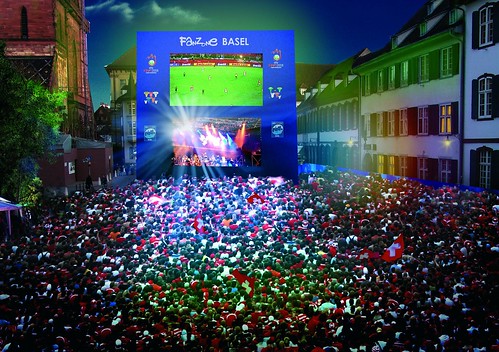
Are you kidding me? During a LIVE broadcast, ESPN’s feed from Switzerland goes dark? That’s right, rocket scientists, they lost the signal during the Euro 2008 semi-final match between Turkey and Germany. I missed one of the goals! And it wasn’t only ESPN that lost the feed — everybody lost it. Germans, Turks — all the live broadcasts were depending on that pool feed from Basel, Switzerland (live webcam image above).
Why? Has the world gone mad? Where’s my Swiss dependability? Perhaps I shouldn’t trust those aerial trams and cable cars at ski resorts like I used to, owing to "Swiss dependability." Well, it’s got nothing to do with "the Swiss." This was all UEFA: they decided to handle all the technical stuff themselves by forming UEFA Media Technologies SA, who was in charge of the International Broadcast Centre in Vienna, Austria. The operation is run by Alexandre Fourtoy, who used to run their Web site, uefa.com.
Apparently lightning struck the power source and knocked out the feed several times, via Canadian Press:
A violent thunderstorm swept across Austria and knocked out power at the International Broadcast Center in Vienna, from where television images of the match were beamed around the world.
With the match delicately poised at 1-1 in the second half at St. Jakob Park in the Swiss city of Basel, screens around the world flickered and went blank. Internet coverage also was hit by the blackout.
"Tonight the television signal in the International Broadcast Centre for the Germany-Turkey game has been interrupted several times in the second half due to technical reasons which are currently being investigated, in particular to evaluate the impact of the violent electrical storm over Vienna at that time," UEFA said in a statement.
As the thunderstorm raged over Vienna, the images came and went several times in the closing minutes.
In between the blackouts, Miroslav Klose gave Germany a 2-1 lead in the 79th minute off a cross from Philipp Lahm. But screens were blank when Semih Senturk pulled off what looked like another Turkey escape act with an 86th-minute equalizer, beating goalkeeper Jens Lehmann at the near post.
Images returned in time for viewers to watch Lahm eliminate Turkey with a goal in the last minute of regulation time.
The only broadcasters whose signal escaped the interruption were Swiss public TV company SRG in Zurich and Al-Jazeera, said UEFA, which couldn’t immediately explain why those feeds were unaffected by the Vienna broadcast centre blackout.
However, SRG spokesman Daniel Steiner, said the broadcaster has access to an official feed in all Swiss stadiums, and they were able to tap into that when the connection went down. The Swiss broadcaster provided the feed to German TV station ZDF for 15 minutes, during which time the two goals were scored.
The heavy rain, high winds and lightning also sparked the evacuation of a fan zone in downtown Vienna and two people were injured after being trampled in the rush to leave the area, police said.
Authorities said they gave the order to close the fan zone at 10:15 p.m. local time after the storm unleashed winds exceeding 100 kilometers per hour.
While the disruptive storm hit Vienna, spectators watching the game at the ground in Basel remained dry and unperturbed throughout.
Look, this isn’t some minor league game from Ukraine — this is the European Championships, aruguably the second most important soccer (football) tournament after the World Cup. You’re providing the satellite feed for hundreds of television networks. Where’s your redundancy?
When Fox does an NFL game from the Los Angeles, for example, they buy three fiber and two satellite paths, and probably a couple of power generators (properly grounded) standing by. Nobody wants to break the news to Rupert they saved some money by not having an extra back-up on Monday.
So they switched to a feed showing the "fanzone" in the Muensterplatz. Actually, the match ended while we were watching that feed. I’m sure I was not the only one outraged by this. Al-Jazeera’s feed was not affected? Dude…
GOAL! Germany 2-1 Turkey (Klose 78): Goal! And I didn’t see it! Rustu comes for a cross, makes a right pig’s ear of it, and Klose heads home. So I’m told.