Archive for the ‘NASA’ Category

A Hard Knock Life for Satellites

Friday, March 31st, 2006

I’m probably giving away my age when I say this, but I remember when our television had a "rabbit ear" antenna, and adjusting the picture just meant moving the "ears" around. Later we had an antenna on the roof. Adjusting the picture meant someone had to climb a ladder to the roof, while someone else yelled out of a window until the picture was clear. Then there was cable. If we lost the signal, we called the cable company and waited.

Now we have satellite TV, and we rarely lose a the signal — except for occasionally during a storm, when it flickers on and off briefly before returning. If we have snow, it can interrupt the signal if it piles up on the dish, but that just means a quick trip to the back yard to brush it off. The dish in the back yard, however, is just a receiver; pointing at at a satellite so high up that a ladder on the roof doesn’t begin to do the trick. So, what happens if a satellite gets bonked by an asteroid or other random space junk?

Well, you lose the signal, which is what happened to a lot of Russians this week when a telecom satellite failed after a "sudden impact" shut down its thermal control, causing it to end up in space disposal orbit.  (Yeah. I didn’t know what that meant either. Apparently there’s a whole part of space where satellites go to die. Who knew?)  New Zealand had an outage too, due to loss of pointing control.  (Another hard knock?) A European satellite got bonked in 1993 when the earth passed through a trail of comet dust. 

So, what to do? Some people are trying to predict problems, and others are working on better materials. (What can withstand getting smacked by an asteroid?) And some are focusing on better monitoring and forecasting of sunspots and space weather (space weather?), which apparently can also cause problems for satellites. 

I can’t say how it all works. I just hope it keeps working. I don’t want to miss any of my favorite shows, and I don’t want to have to climb any higher than the roof.

Making MobTV Work

Friday, March 24th, 2006

I’ve decided to try my hand at coining a new phrase: mobTV. I figure if mobile blogging can become "moblogging", then mobile television can become "mobTV." Besides, as I’m learning more about it and writing more about it I’m going to need a more efficient way to refer to it if I want to keep up, given the way its spreading and the number of terms I have to learn. 

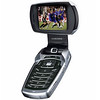
Since my last post on the mobTV taking off in Korea, it looks like mobTV is coming to China next, if Radioscope has its way.  And on a pretty cool looking phone, if you ask me.

Samsung MobTV PhoneRadioscape has won contracts to supply five more Digital Multimedia Broadcast (DMB) and Enhanced Packet Mode (EPM) transmission systems for mobile TV operators in China, bringing the total to nine in the past few months.

 The company says the contracts are the fruits of at least two years of courting Chinese authorities about its DAB-based mobile TV technology and helping them evaluate the most appropriate technologies for the service, and choosing between DMB, DVB-H and DMB-T.

From there it gets interesting. Qualcomm announced last year that it was bringing mobTV to the states via a  technology called MediaFLO, which Verzion also adopted late last year. For the curious, Mobile Content News has video of MediaFLO in action. (Found via Engadget, and I believe that’s Shrek on the small screen.)  The question is, can it work? The experts aren’t  exactly in agreement. Depending on who you ask, MediaFLO and another technology called DVB-H are doomed because EV-DO already gets the job done and new networks are too expensive to build and support, or DVB-H will be the de facto standard once spectrum allocation problems are solved.

Got all that? Good, because I’m about to add some French to the mix. Alcatel just announced that it’s overcome the spectrum allocation issue by using a satellite frequency.

With the help of satellites, Alcatel aims to overcome a key hurdle in rolling out broadcast television services over mobile phones: the lack of available spectrum. 

The French telecommunications-equipment manufacturer proposes using the widely available S-Band frequency reserved for satellites to transmit broadcast signals both terrestrially and via satellite to mobile phones based on the DVB-H (digital video broadcasting – handheld) standard, instead of the UHF band. 

… The Alcatel proposal calls for equipping base stations with S-Band repeaters and, in addition, using satellites capable of transmitting in the S-Band to deliver content to 3G (third-generation) phones enabled with DVB-H technology in three different ways: base-station streaming, base-station broadcasting and satellite broadcasting.

The article also does a good job of explaining the drawbacks of the three delivery systems. Streaming offers unlimited channels and great indoor coverage, but only for a limited number of users on a network. Broadcast matches it on indoor coverage, and supports unlimited users, but only 27 channels. Satellite matches them on channels and user support, but falls short on indoor coverage. Alcatel claims the answer is an "intelligent content-management system" that seamlessly chooses the right delivery system. 

Leave it to the French to come up with an elegant solution. I just hope it works well enough to eventually get picked up in the U.S. It would be great to catch up on Desperate Housewives reruns on the subway, and get all the way up the street to my office without losing the signal.

EchoStar, DirecTV Possible Partners

Thursday, March 16th, 2006

Joyzelle Davis reports in the Rocky Mountain News:

EchoStar Communications’ Chief Executive Charlie Ergen gave the strongest indication yet that the satellite-television provider would team with larger rival DirecTV to establish a broadband service.

DirecTV, whose controlling shareholder is Rupert Murdoch’s News Corp., is working on technology that could allow it to offer services including phone and wireless high-speed Internet to homes and mobile devices. That would give satellite-TV providers a way to counter cable companies’ bundle of video, high-speed Internet and phone service….

A partnership would allow EchoStar to split the "excessive" costs of building the network and help craft standards for the industry, Ergen said…

If such a partnership were to occur, it would mark the first strategic alliance between the companies that sought to merge four years ago.

 Read more about the plan here.

TV: To-Go vs. Terrestrial

Wednesday, March 15th, 2006

Imagine for minute that you want to watch, say, the Super Bowl or some other big television event. But it’s only available on your phone.  That’s right. None of the "terrestrial" networks are carrying it. Hard to imagine?  It happened in South Korea

Cable TV and other media that are considered as "non-mainstream" are threatening the realm of conventional terrestrial TV.

The latest case was a challenge made by a one-year-old sports channel Xports, which is buying up broadcasting rights for matches of the South Korean national team.

On Wednesday night, Xports exclusively aired the national team’s match with Syria. It was the first time a national team match was not shown on the three terrestrial TV channels _ KBS, SBS and MBC. Adding insult to injury was the fact that the Korea-Syria match was also viewed on versatile mobile phones with satellite DMB functions, another emerging medium of entertainment.

Satellite TV on a cell phone? Evidently, it’s spread so widely in other parts of the world that it’s starting to rival traditional — "terrestrial" — TV. Well, it’s here. And though you may not find it’s your only option for some television events, it’s set to offer more options. It’s expanding into Europe and other countries, through companies like Pantech and Samsung. It’s also coming to Canada and Latin America. Now, I find out that my wireless carrier launched its own video service a week ago, along with two new phones to go with it. 

Boy, am I behind. I haven’t even gotten a video iPod yet.  Now my phone is outdated, and have to choose which new phone to get; never mind deciding what to watch once I get it.

Space Archaeology?

Thursday, February 16th, 2006

Who knew that NASA did archaeology? Unless someone’s sifting through the sands of some distant planet for signs of ancient intelligent life, I’ve always thought of archeology as the earthbound realm of the Discovery Channel and maybe Indiana Jones. That is, at least until I read that NASA helped uncover lost Maya ruins in the Central American jungle. 

Remains of the ancient Maya culture, mysteriously destroyed at the height of its reign in the ninth century, have been hidden in the rainforests of Central America for more than 1,000 years. Now, NASA and University of New Hampshire scientists are using space- and aircraft-based “remote-sensing” technology to uncover those ruins, using the chemical signature of the civilization’s ancient building materials.

NASA archaeologist Tom Sever and scientist Dan Irwin, both from NASA’s Marshall Space Flight Center in Huntsville, Ala., are teaming with William Saturno, an archaeologist at the University of New Hampshire, to locate the ruins of the ancient culture. Saturno discovered the oldest known intact Maya mural at the site in 2001.

… Sever has explored the capacity of remote sensing technology and the science of collecting information about the Earth’s surface using aerial or space-based photography to serve archeology. He and Irwin provided Saturno with high-resolution commercial satellite images of the rainforest, and collected data from NASA’s Airborne Synthetic Aperture Radar, an instrument flown aboard a high-altitude weather plane, capable of penetrating clouds, snow and forest canopies.

These resulting Earth observations have helped the team survey an uncharted region around San Bartolo, Guatemala. They discovered a correlation between the color and reflectivity of the vegetation seen in the images – their “signature,” which is captured by instruments measuring light in the visible and near-infrared spectrums – and the location of known archaeological sites.

My first thought was that if it’s possible to be an archaeologist without having to tromp around deserts and rain forests, I might start considering a new line of work. (Those mummy-related specials on Discovery and TLC inspire me.) I did a little searching online and found a bit more information about the research team and their research in Petén, Guatemala. Turns out, it’s still archaeology, so they still had to hack through the jungle — using satellite images to guide them — to “ground test” the data. They uncovered a series of ancient sites, right where the data and images predicted they’d be. 

So much for doing archaeology from a nice, air conditioned, indoor space — which I’m guessing were the conditions at the National Space Science and Technology Center, where Sever and Irwin conducted their space-based research before heading out into the field. Sever and Irwin can use satellites to lead them to ancient ruins, and I’ll wait for the same to beam their findings down to my living room.

Scandal via Satellite

Wednesday, February 8th, 2006


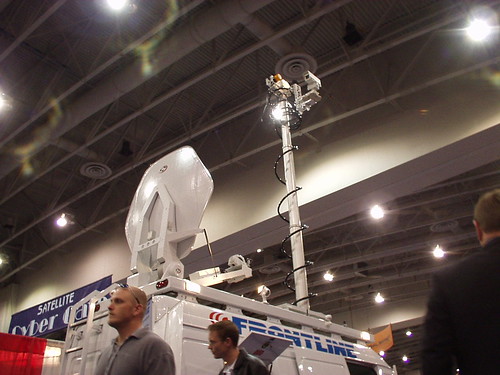
Satellite2006 News Truck
Being a relative “newbie” to the space/satellite beat, I was surprised to see something I actually recognized as I continued my sojourn across the exhibit floor at Satellite2006. As a denizen of D.C., living and working downtown for about 10 years, I’m often alerted to breaking scandals by spotting satellite news vans parked outside of various buildings on my way to or from work. That was my cue to check the news once I arrived at my destination, to see who’d just been indicted, etc.


Microwave Arm
So, it was pretty cool to turn a corner and saw the Frontline news truck parked on the exhibit hall floor, even tho’ there wasn’t an actual indictment. (At least not at the conference. We are in D.C., after all.) I know enough to recognize a satellite dish when I see one, but it wasn’t until I talked to the Frontline rep. that I learned there’s also microwave involved. I admit, I did peek inside to see if there was a microwave in there. But apparently it’s that long skinny pole across from the dish, and the rep explained that it’s used mostly for short haul uplinks to station antennas, which explains why I see poles up and the dishes down on the news vans I spot as I wander around D.C.

There wasn’t anything actually in the van at Satellite2006. I guess the buyers put in the guts. But I still bet that at least some of the vans I see have microwaves inside. After all, news crews gotta eat too.

Satellite2006: Touching Down

Monday, February 6th, 2006

I spent most of Monday afternoon hanging out at the Sattelite2006 conference. Actually, I spent most of it wandering around the exhibit hall while setup was in full swing. Even that was an education for me, a guy whose knowledge of satellites doesn’t extend much beyond the satellite TV dish outside my house. As I wandered around, dodging forklifts and ducking around big wooden crates, I saw a few things that caught my eye. 


The banner statement at the Internet Solutions booth — Communications Convergence from Africa for Africa — caught my eye. In fact, it stopped me in my tracks because it reminded me of my previous post about wireless networking in the developing world. OK, it’s vaguely related, but close enough to make me take a closer look. Based on their news page, it looks like they’ve been busy in Ghana most recently, and mostly with corporate work. There wasn’t anyone at the IS booth when I stopped by, but I look forward to coming back tomorrow and learning more about their work to “enable people and businesses to share information and interact with one another – anywhere, at any time, over any protocol.”