Archive for the ‘NASA’ Category

Google Watching You Watch TV?

Monday, August 7th, 2006

Sebadoh posted on Friday about Google getting into the satellite radio business. Well, it looks like Google is also making forays into television. Not producing, mind you, but monitoring what you watch and producing related internet content.

In a research paper presented last week at interactive television conference Euro ITV in Athens, Greece, Google researchers Michele Covell and Shumeet Baluja propose using ambient-audio identification technology to capture TV sound with a laptop PC to identify the show that is the source of the sound and to use that information to immediately return personalized Internet content to the PC.

"We showed how to sample the ambient sound emitted from a TV and automatically determine what is being watched from a small signature of the sound—all with complete privacy and minuscule effort," Covell and Baluja write on the Google Research Blog. "The system could keep up with users while they channel surf, presenting them with a real-time forum about a live political debate one minute and an ad-hoc chat room for a sporting event in the next."

… According to Boralv, the system wouldn’t be that intrusive. She writes, "If you were watching the news and wanted to delve deeper, this type of system could allow you to do that easily by automatically collecting related material and Web links for you. The beauty of the system that Michele and Shumeet describe is that it wouldn’t be a distraction. If you don’t want it you can ignore it and the PC browser will quietly update pages without bothering anyone—no input required and no audible output to form a distraction."

Those appalled by the prospect of Google tapping your television take heart: The proposal suggests user privacy would be respected. "[O]ur approach will not ‘overhear’ conversations," the paper says. "Furthermore, no one receiving (or intercepting) these statistics is able to eavesdrop, on such conversations, since the original audio does not leave the viewer’s computer." Perhaps there’s a lesson here for the National Security Agency.

Creepy? Or just the next step in increased synergy between new media and old? I can’t decide, but the Interactive TV Today blog describes in a bit more detail how Google might "overhear" what you’re watching.

[The system] would use a PC microphone to sample the ambient sound emitted by a television set and automatically determine what is being watched on that set from a small signature of that sound. The system would then use the data thus gathered to automatically present the viewer–in real time on his or her Web browser–with contextually relevant information, and with ad-hoc services that would enable social interaction around programming: thus, if the viewer were watching a sporting event, the system might present him or her with an ad-hoc fan forum; and if the viewer were to switch to a movie, it might present him or her with maps of the locales featured in the movie or with a bio of the actor currently appearing on the TV screen.

The system is composed of three distinct components: "a client-side interface, an audio-database server (with mass-media audio statistics), and a social-application Web server," the three scientists write in the paper’s introduction. "The client-side interface samples and irreversibly compresses the viewer’s ambient audio to summary statistics. [Note: the authors note that this irreversible mapping would serve to protect the viewer’s privacy.] These statistics are streamed from the viewer’s personal computer to the audio-database server for identification of the background audio (e.g., ‘Seinfeld’ episode 6101, minute 3:03). The audio database transmits this information to the social-application server, which provides personalized and interactive content back to the viewer."

One more question. How does this relate to Google partnering with Viacom to test sharing ad revenues from web videos? Is there a possible tie-in here? Maybe Google monitors what you’re watching and turns up related web videos? Clips from other shows you might be interested in, from Google’s ad partners?

Blast from the Past: Titan IV

Tuesday, August 1st, 2006

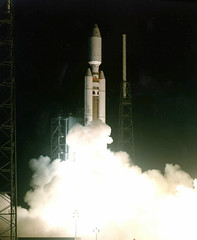
Titan IV

We reached into our video archives and pulled out two rocket launches to show you. Titan IV is the largest unmanned space booster used by the U.S. Air Force to carry payloads as big as the ones the space shuttle carries.

On September 8, 2003, Communications Concepts, Inc. broadcast the launch of the massive Titan IV as it blasted off the launch pad at Cape Canaveral Launch Complex 40. The day’s payload was a satellite for the National Reconnaissance Office. The model rocket was the Titan IV-B, the final model of the now retired Titan program, which was the largest, most powerful, heavy-lift expendable launch vehicle in the United States at the time. This mammoth rocket was as tall as a 20-story building and, with the solid rocket boosters and fuel, weighed about 940,000 kilograms (2 million pounds). In the video, you can see the sheer power of the Titan as the shot, captured from a remote camera less than 500 feet from the launch pad, fills with white just after liftoff.


The Missing Moonwalks

Monday, July 31st, 2006

A couple of weeks ago, I posted about the dual anniversaries of the Viking I landing on Mars and the first humans (Neil Armstrong and Buzz Aldrin) to walk on the moon. Well, NPR has video footage of Armstrong’s and Aldrin’s lunar jaunts. The only problem is that they’re pretty shoddy copies. So NPR is looking looking for the original footage.

LandingAlmost everyone on the planet who had access to television watched the first moon landing, back on the night of July 20, 1969. What the TV viewers didn’t know is that they weren’t seeing the best images.

The astronauts actually beamed higher-quality footage back to Earth, but it was only seen by a small number of people at three tracking stations.

Those original images were recorded and put into storage — somewhere. Now, a small crew of retirees, space enthusiasts, and NASA employees are searching for a moon landing that the world has never seen.

The NPR piece goes on to describe how the images most Americans saw on their televisions sets back in 1969 were so degraded — compared to what the folks in Houston’s mission-control saw — and incompatible with television broadcasts that they had to be converted to the right format. Afterwards, the original footage was recorded onto 14-inch reels, which disappeared into the National Records Center in Maryland before NASA brought them to Goddard for "permanent retention." They haven’t been seen since.

The folks from the Apollo team would like very much to see the footage again. Actually, so would I. For the first time, of course.


DIY Friday: Disguise Your Dish

Friday, July 21st, 2006

Let’s face it: no matter how cool it may be to have a satellite dish, they make terrible lawn ornaments. Only the most hardy space nut finds the local neighborhood array a thing of beauty– and many homeowners associations have introduced covenants prohibiting the use of large dishes.
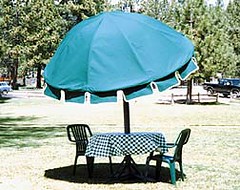
But for $900 bucks or so, Clearsat has a DIY solution that will please those who don’t like looking at your dish:

Most Home Owners Associations (HOA’s) have agreed that if the dish is adequately disguised, they will allow it. The ClearSat Umbrella Style Dish Cover will comply with most reasonable HOA’s by covering both the front and back, and when coupled with a set of chairs and table, can actually function as a patio set.

One or two persons can install the umbrella cover in about 15 minutes. It does not require any drilling or modification to the dish whatsoever. Once the fiberglass rods are inserted between the hub and end socket, the cover springs into shape. You simply rest the end sockets on the edge of the dish and zip up the back panels.

The shade provided is not to be overlooked as an added benefit — especially this week, when most of North America is blistering under a scorching heat wave. 


Looking for the Killer WiMAX App

Friday, July 21st, 2006

Rumors have been going on for months about the two big U.S. satellite TV providers (DirecTV and EchoStar) merging. The buzz grew louder earlier this week after the Los Angeles Times quoted EchoStar CEO Charlie Ergen at the Allen & Company annual media-mogul-fest in Sun Valley, Idaho saying that combining the two largest satellite TV providers could save $3 billion in expenses.

The comment set off a renewed flurry of press speculation of a potential merger. The Rocky Mountain News (EchoStar is based in Englewood, CO) reported yesterday:

EchoStar Communications Corp. shares were raised to "buy" from "sell" at Citigroup Inc. because of an increased chance that the No. 2 satellite television provider may combine with rival DirecTV Group Inc….

"It reflects our belief that there is a greater chance that EchoStar and DirecTV may attempt to merge," Bazinet said
of his rating change.

A merger is more likely since EchoStar and DirecTV formed a joint venture to bid for wireless spectrum in an auction next month, Bazinet said in the note. Satellite TV companies are also facing rising competition from cable companies such as Comcast Corp. as well as from telephone companies such as Verizon Communications Inc. that are starting TV services.

Propelling the talk is the growing awareness that IPTV will fundamentally change the media landscape and the balance of power between satcom- and telco-delivered content, as well as growing evidence that Rubert Murdoch’s News Corp is set to receive approval for a project that could create a national WiMAX network. As The Hollywood Reporter writes:

Approval is imminent for the project that could take at least two years and $2 billion, providing News Corp. and DirecTV a valuable wireless interactive broadband loop with consumers to directly sell content, advertising, goods and services. WiMax is a wireless a broadband technology often referred to as "WiFi on steroids" with a much wider 30-mile range than the more limited access offered by WiFi services. WiMax, which is short for World Interoperability for Microwave Access, also promises to provide more security and speed than traditional wireless connections.

"If we can pull something off … there is no reason why that shouldn’t link in with everything," News Corp. chairman and CEO Rupert Murdoch said in a recent interview….

High-level sources say the unprecedented undertaking will involve strategic equity partners that bring WiMax spectrum, equipment and other expertise to the mix. In one of the most likely scenarios, News Corp. and DirecTV have been in advanced talks with Clearwire Corp., a WiMax venture of Craig McCaw, in which chipmaker Intel Corp. and equipment manufacturer Motorola Inc. recently invested $900 million.
McCaw has been amassing one of the largest stables of licensed radio spectrum to build his own national wireless WiMax network. Intel, which has a vested interest in the commercial success of WiMax, particularly for PC users, has been one of Clearwire’s partners from the start….

Some sources say that EchoStar could join DirecTV in providing a united domestic satellite-backed WiMax alternative to cable and to telephone competitors such as Verizon, Cingular and Sprint Nextel. Sprint Nextel is working with a consortium of cable operators including Comcast and Time Warner to assist them with a much-needed wireless out-of-home extension.

Still, not everyone is convinced that the coming WiMAX wars will lead to consolidation on the SatCom side. Al Lewis in the Denver Post says that "anybody who believes EchoStar and DirecTV are about to merge should remember the forgotten tome "The Essential Guide to the Echo- Star/DirecTV Deal:"

Australian media mogul Rupert Murdoch had his team of lobbyists canvass Washington with this 123-page diatribe in 2002.

It argued, in exhaustive detail, why Douglas County-based EchoStar should not be allowed to acquire DirecTV from Hughes Electronics….

In October 2002, the Federal Communications Commission [sic– it was the FTC] blocked Ergen’s deal. The Justice Department blocked it too.

Then Murdoch’s News Corp. acquired a controlling stake in DirecTV for $6.6 billion…

And now – four years later – there are continuing rumors that DirecTV, the nation’s No. 1 satellite-TV provider, will acquire EchoStar, No. 2.

EchoStar and DirecTV are working on several joint projects that involve the two-way transmission of voice, video and data. But if Murdoch were to bid on EchoStar, he’d have to argue against his previous arguments. Or he’d have to argue that the satellite-TV business has changed significantly over the past four years.

The results of the August auctions for additional WiFi spectrum will give observers a clue as to who is coming out ahead in the inevitable rush to bring WiMAX to market. And whether the DirecTV and EchoStar rumors are just rumors or not, we’d expect to hear more talk of consolidation on both sides as emerging technology further alters the old divisions between cable, satcom and telcos.


Pirates of the World Cup

Thursday, July 20th, 2006


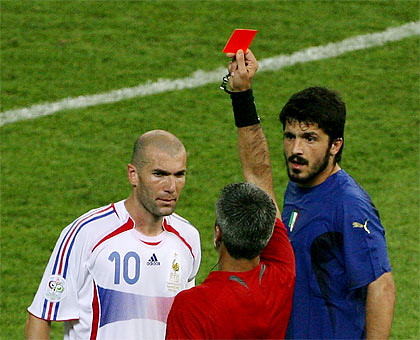
The recently completed FIFA World Cup had many memorable moments. Some teams advanced further than expected, while some just fell to pieces. Win or lose, most people agree it was an achievement for a national team to make the trip to Germany to begin with – especially if you consider two years elapse before the qualifying rounds are completed.Zidane gets carded  

Some might remember how entire countries became “interupted” during teams’ matches. The people at eBay will never forget how online traffic and transactions slowed down when a match began, then resumed afterwards. Others will remember hearing rumors of less-developed countries’ plumbing systems losing all water pressure once a match’s first half ended.

Apparently, some bars in Hong Kong forgot it was against the law to broadcast matches without paying for them — and the folks at CASBAA are giving notice and are out to teach these pirates a lesson:  


“Although the industry reached out to the Hong Kong food and beverage industry in the run up to the World Cup, stating that pay-TV signal theft is not to be tolerated by government or industry, many bars blatantly screened unlicensed pay-TV broadcasts. We have had no choice but to take the matter to the courts,” said Simon Twiston Davies, Chief Executive Officer of CASBAA.

As an indication of the pay-TV industry’s commitment to the Hong Kong sporting community, Mr Twiston Davies noted that the plaintiffs and CASBAA would donate any proceeds received from the defendants after costs to local sports charities. CASBAA believes it is important to return the funds to where they belong – the support of sports development.

“The issue of intellectual property rights protection requires concerted efforts on all fronts between the government, industry, bar and club owners and the general public, especially as we run up to other global events such as the Beijing Olympics in 2008 and recurring high value events such as the English Premier League,” continued Mr. Twiston Davies. “The sports leagues who stage major events need a fair return on their investment.”


Only licensed pay-TV operators such as Hong Kong Cable, now Television and TVB Pay Vision are authorized to provide such programming. These pirate bars were receiving signals from satellites providing service to other countries.

Spammers and other nasties were at it during the World Cup, too. Hopefully, they’ll soon be forgotten or busted (preferred).

New Satellite Service By 2012?

Monday, June 26th, 2006

The FCC has proposed allowing new satellite service in the 17 and 24 gigahertz band spectrum — a proposal which, if passed, could add new competition to satellite radio and other emerging broadcast industries, Billboard Radio Monitor reports:

 In an email exchange with Billboard Radio Monitor, one high-level engineering source wrote that “the ‘Ka-Band’ frequencies (18 GHZ to 40 GHZ) usually suffer from extreme susceptibility to rain-out and fog failure conditions. On the plus side, the satellite antennas (up in orbit) can send more spot-area signals to different parts of the [continental U.S.], potentially creating individual market coverage signals, which can’t effectively be done at 2.3 GHZ.”

Radio Monitor sources and industry observers estimate that the shortest possible timetable for a new satellite service to make its way through the FCC, onto the launch pad and into space would be five or six years.

The FCC’s Notice of Proposed Rule Making (NPRM) for establishing a new satellite service was originally going to be part of the commission’s Open Meeting agenda but it was deleted at the last minute. Instead, the FCC’s commissioners handled the vote later in the day, with all five commissioners approving the NPRM.

An FCC press release about the Notice says the service “holds the potential of bringing a new generation of innovative satellite services to American consumers—providing a mix of video, audio, data and multimedia services to residential and business subscribers.”


Enhanced by MobTV Technology

Thursday, May 11th, 2006

In writing about the whole mobTV phenomenon, I’ve been wondering about something that I haven’t asked about until now. Just how does one enjoy watching video on such a tiny screen? I mean, I haven’t measured them, but the screens on even the best phones seem rather small for any serious or enjoyable viewing; definitely not for watching full length programs.

As usual, I should have known someone would be way ahead of me on this. Enter video glasses for mobile TV

Kowon Technology, a South Korean venture start-up, Wednesday announced it plans to introduce an eye-glass type display _ dubbed MSP-209 – in the local market next week at 199,000 won.

The product is equipped with a pair of liquid crystal display (LCD) screens, roughly the size of a human pupil _ 4.2 millimeters by 4.8 millimeters _ in both lenses.

“Weighing just 2 grams each, this micro LCD would be the world’s smallest and lightest screen available. The weight of the video glasses would be also fine at 58 grams,” Kowon vice president Park Hong-tae said.

Park continued Kowon did not compromise the all-important visual quality to minimize the display size because the miniature screen features programs at 320X240 pixels resolution, similar to that of digital multimedia broadcasting (DMB).

They’re also being called "anti-glance" glasses, because you can watch your video without worrying about your fellow commuters or other neighbors peeking over your shoulder. And it’s supposed to be like watching a 32 in. television screen about two yards away. So, it’s like watching television in your living room, but from anywhere. And you also get to look as though you’ve been "enhanced by Borg technology." Not bad for the equivalent cost of $216 in U.S. dollar. 

Via MobileMentalism.Com.

mobTV Happens in Vegas

Monday, April 24th, 2006

Here’s an interesting tidbit from behind the Wall Street Journal’s subscription wall. MobTV is getting another foothold stateside.

Satellite operator SES Global S.A., seeking to find a place in the burgeoning wireless-entertainment arena, today is expected to announce it is joining with a start-up company that controls a big swath of mobile broadcast spectrum across the U.S.

The anticipated technical and marketing alliance between SES Americom, the U.S. unit of Luxembourg’s SES Global, and closely held Aloha Partners LP of Providence, R.I., is intended to demonstrate the business case and consumer appeal of beaming digital music and high-resolution video to cellphones and other consumer hand-held devices. But the initiative also illustrates broader efforts by satellite-services companies to participate in the fast-changing media landscape, particularly at the convergence of television and

… A yearlong test is planned to begin this fall in Las Vegas, though negotiations with programmers and leading cellular providers still have to be worked out.

The plan is the most ambitious yet to test such a system using fewer transmitters, or towers, to simultaneously distribute as many as 40 higher-resolution video channels directly to handsets. Implementing the concept would end up costing a small fraction of the estimated billions of dollars necessary to build out rival networks relying on less-powerful broadcast signals and thus requiring towers spaced closer together.

Multichannel News has a bit more, no subscription required. 

It’s encouraging news, after my previous post on mobTV spreading in Korea, across Europe, and into Canada and North America. It’s also encouraging that, after re-reading my post on how mobTV works, I think I get how the Las Vegas project is gonna work out.  I’m guessing the involvement of a satellite company means using a satellite signal to cut down on spectrum issues like the ones covered in my previous post. 

So, this sounds like a wish fulfilled. I just hope that the tag line from those edgy and ubiquitous Las Vegas tourism commercials doesn’t hold true for  this latest stateside foray into mobTV.

Atlas V Rocket to Launch ASTRA 1KR Today

Thursday, April 20th, 2006

ASTRA’s newest satellite will be launched into geosynchronous orbit and will become part of a system that provides television reception to 107 million households in Europe. Launch window opens at 4:27 p.m. EDT (20:27 GMT), and remains opens until 7:16 p.m. (23:16 GMT). Watch the launch live via webcast from launch complex 41 at the Cape Canaveral Air Force Station in Florida. Broadcast begins at 4:05 p.m. (20:05 GMT). Here’s how you can receive it directly via satellite:
 
In North America, AMC-4, transponder 17, C-band analog, 101 degrees West, downlink frequency 4040 MHz (vertical).

In Europe, on ASTRA, transponder 116 on ASTRA 1G at 19.2E with following reception parameters: downlink frequency: 12669.50 MHz / downlink polarization: vertical / transponder transmission rate: 22 MB/s QPSK FEC 5/6; Service name: ASTRA VISION 3

Test signals begin about 3:45 p.m. EDT (19:45 GMT).

If you are not able to watch it, then you can follow it via live text updates.