Archive for the ‘Satellite TV’ Category

Maps in Greater Detail

Monday, March 20th, 2006

Wired has a good article out today on how the next-generation of commercial imaging satellites is going to change, er, the way we view the world– or at least the details of our view:

Critics of overhead imagery services like Google Earth and Microsoft Virtual Earth generally fall into two categories: government agencies who say the services show too much, and users who lament they can’t see more.

As the next generation of commercial imaging satellites moves closer to launch, the first camp may be out of luck.

Forthcoming features such as enhanced zoom capabilities, higher-resolution views and faster updates of stock imagery will reveal far more detail of Earth’s surface than anything visible on a computer screen today. While satellite imagery won’t be real-time, or capable of distinguishing individuals, it will be good enough to pinpoint ground-level details too blurry to identify using today’s technology.

"We’re just starting," said Matthew M. O’Connell, CEO of GeoEye (formerly Orbimage), which plans to launch a satellite in early 2007 that can show images of objects as small as 1.3 feet across. "At that resolution, we can literally count the manhole covers in Manhattan."

Just a few years ago, the idea of zooming in from a PC screen to any point on Earth would have seemed like the stuff of fantasy. Now that it’s reality, satellite and aerial mapping applications are drawing millions of addicted users. Hardly a week goes by without news of some strange or scandalous finding: Last week amateur astronomer Emilio González of Spain used Google Earth to find what might be a previously unknown impact crater in Chad.


Read the whole story here


Blackstar System Shelved?

Tuesday, March 7th, 2006

Aviation Week and Space Technology reports on the recently-shelved Blackstar system, a two-stage-to-orbit system designed to place a small military spaceplane in orbit:


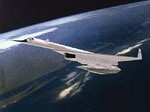
This two-vehicle "Blackstar" carrier/orbiter system may have been declared operational during the 1990s.

A large "mothership," closely resembling the U.S. Air Force’s historic XB-70 supersonic bomber, carries the orbital component conformally under its fuselage, accelerating to supersonic speeds at high altitude before dropping the spaceplane. The orbiter’s engines fire and boost the vehicle into space. If mission requirements dictate, the spaceplane can either reach low Earth orbit or remain suborbital.

The manned orbiter’s primary military advantage would be surprise overflight. There would be no forewarning of its presence, prior to the first orbit, allowing ground targets to be imaged before they could be hidden. In contrast, satellite orbits are predictable enough that activities having intelligence value can be scheduled to avoid overflights.

Exactly what missions the Blackstar system may have been designed for and built to accomplish are as yet unconfirmed, but U.S. Air Force Space Command (AFSPC) officers and contractors have been toying with similar spaceplane-operational concepts for years. Besides reconnaissance, they call for inserting small satellites into orbit, and either retrieving or servicing other spacecraft. Conceivably, such a vehicle could serve as an anti-satellite or space-to-ground weapons-delivery platform, as well.


Read the full story here

Satellites Track Climate Change

Thursday, March 2nd, 2006

Back in March of 2002, twin satellites launched called GRACE (short for Gravity Recovery and Climate Experiment) were launched by NASA to make detailed measurements of Earth’s gravity field and to the Earth’s natural systems.

Today, MSNBC reports that new data from the satellites reveal that global warming is causing ice loss in Antartica: 


 Joining the growing list of places on this planet that are melting, Antarctica is losing about 36 cubic miles (150 cubic kilometers) of ice every year, scientists reported Thursday.

For comparison, Los Angeles consumes roughly 1 cubic mile of fresh water a year.

The south polar region holds 90 percent of Earth’s ice and 70 percent of the total fresh water on the planet, so any significant pace of melting there is important and could contribute to an already rising sea….

"This is the first study to indicate the total mass balance of the Antarctic ice sheet is in significant decline," said Isabella Velicogna of the University of Colorado at Boulder.

More information on GRACE can be found here


Space Archaeology?

Thursday, February 16th, 2006

Who knew that NASA did archaeology? Unless someone’s sifting through the sands of some distant planet for signs of ancient intelligent life, I’ve always thought of archeology as the earthbound realm of the Discovery Channel and maybe Indiana Jones. That is, at least until I read that NASA helped uncover lost Maya ruins in the Central American jungle. 

Remains of the ancient Maya culture, mysteriously destroyed at the height of its reign in the ninth century, have been hidden in the rainforests of Central America for more than 1,000 years. Now, NASA and University of New Hampshire scientists are using space- and aircraft-based “remote-sensing” technology to uncover those ruins, using the chemical signature of the civilization’s ancient building materials.

NASA archaeologist Tom Sever and scientist Dan Irwin, both from NASA’s Marshall Space Flight Center in Huntsville, Ala., are teaming with William Saturno, an archaeologist at the University of New Hampshire, to locate the ruins of the ancient culture. Saturno discovered the oldest known intact Maya mural at the site in 2001.

… Sever has explored the capacity of remote sensing technology and the science of collecting information about the Earth’s surface using aerial or space-based photography to serve archeology. He and Irwin provided Saturno with high-resolution commercial satellite images of the rainforest, and collected data from NASA’s Airborne Synthetic Aperture Radar, an instrument flown aboard a high-altitude weather plane, capable of penetrating clouds, snow and forest canopies.

These resulting Earth observations have helped the team survey an uncharted region around San Bartolo, Guatemala. They discovered a correlation between the color and reflectivity of the vegetation seen in the images – their “signature,” which is captured by instruments measuring light in the visible and near-infrared spectrums – and the location of known archaeological sites.

My first thought was that if it’s possible to be an archaeologist without having to tromp around deserts and rain forests, I might start considering a new line of work. (Those mummy-related specials on Discovery and TLC inspire me.) I did a little searching online and found a bit more information about the research team and their research in Petén, Guatemala. Turns out, it’s still archaeology, so they still had to hack through the jungle — using satellite images to guide them — to “ground test” the data. They uncovered a series of ancient sites, right where the data and images predicted they’d be. 

So much for doing archaeology from a nice, air conditioned, indoor space — which I’m guessing were the conditions at the National Space Science and Technology Center, where Sever and Irwin conducted their space-based research before heading out into the field. Sever and Irwin can use satellites to lead them to ancient ruins, and I’ll wait for the same to beam their findings down to my living room.

Satellite Used to Study Effects of General Relativity

Tuesday, February 14th, 2006

The Tartan Online, Carnegie-Mellon’s student newspaper, chooses Gravity Probe B as its "Experiment of the Week":

Gravity Probe B, a well-endowed NASA/Stanford satellite, is at this moment orbiting the Earth. The satellite’s main feature is its four perfectly spherical, shiny balls. These balls serve as the world’s most perfect gyroscopes, used in an extraordinarily complex and expensive experiment to observe the effects of general relativity…. Einstein’s theory predicts that a rotating massive body should slowly “frame-drag” space and time around with it. Over time, this dragging effect should push the gyroscope’s axis of rotation about 40 milliarc-seconds out of alignment. That’s the width of a human hair as seen from 10 miles. The probe intends to measure this to an accuracy of one percent.

Stanford University, which is working with NASA on the mission, has a mission status webpage that is worth checking out. Also be sure to check out the vehicle tour and the image gallery, featuring schematics of the satellite and pictures of the launch. What other satellite mission websites have you found? Post a link in the comment, or post your own blog entry, and we may promote your link to the homepage.

Star Kicked Out of Magellan Cloud

Tuesday, January 31st, 2006

No, we’re not talking about a petulant singer and a rock band (though we’re familiar with the type); we’re talking about an unusual astronomic event captured by the European Southern Observatory:

Using ESO’s Very Large Telescope, astronomers [1] have recorded a massive star moving at more than 2.6 million kilometres per hour. Stars are not born with such large velocities. Its position in the sky leads to the suggestion that the star was kicked out from the Large Magellanic Cloud, providing indirect evidence for a massive black hole in the Milky Way’s closest neighbour. These results will soon be published in the Astrophysical Journal Letters [2].

“At such a speed, the star would go around the Earth in less than a minute!”, says Uli Heber, one of the scientists at the Dr. Remeis-Sternwarte (University of Erlangen-Nürnberg, Germany) and the Centre for Astrophysics Research (University of Hertfordshire, UK) who conducted the study.

The hot massive star was discovered in the framework of the Hamburg/ESO sky survey far out in the halo of the Milky Way, towards the Doradus Constellation (“the Swordfish”).

“This is a rather unusual place for such a star: massive stars are ordinarily found in the disc of the Milky Way”, explains Ralf Napiwotzki, another member of the team. “Our data obtained with the UVES instrument on the Very Large Telescope, at Paranal (Chile), confirm the star to be rather young and to have a chemical composition similar to our Sun.”

The data also revealed the high speed of the star, solving the riddle of its present location: the star did not form in the Milky Way halo, but happens to be there while on its interstellar – or intergalactic – travel.

“But when we calculated how long it would take for the star to travel from the centre of our Galaxy to its present location, we found this to be more than three times its age”, says Heber. “Either the star is older than it appears or it was born and accelerated elsewhere”, he adds.

Be sure to check out an artist’s rendering of the star here.