Archive for the ‘Observation’ Category

Paglen’s Spy Satellites

Tuesday, June 24th, 2008

It’s a bird…it’s a plane…it’s a super secret spy satellite?!

This is the stuff of Ian Fleming, mixed with a bit of high art.

Trevor Paglen has spent years photographing things in the night sky that supposedly don’t exist. Using time-lapse photography, he has captured 1,500 images of mysterious objects.

A small selection of these photos are now on view at the Berkeley Art Museum.

And these photos don’t skimp on political symbolism:

In taking these photos, Paglen is trying to draw a metaphorical connection between modern government secrecy and the doctrine of the Catholic Church in Galileo’s time.

“What would it mean to find these secret moons in orbit around the earth in the same way that Galileo found these moons that shouldn’t exist in orbit around Jupiter?” Paglen says.

Satellites are just the latest in Paglen’s photography of supposedly nonexistent subjects. To date, he’s snapped haunting images of various military sites in the Nevada deserts, “torture taxis” (private planes that whisk people off to secret prisons without judicial oversight) and uniform patches from various top-secret military programs.

…well, at the very least they’re pretty cool. And we’ve been interested in this subject for a while, ever since we learned about the “MISTY” satellite program.

I’m guessing the “powers that be” won’t be too pleased with Paglen’s exhibit, judging by the steps they take to ensure that their programs stay secret. Remember when the DoD shot down the spy satellite to keep information from getting into the wrong hands?

And this exhibit isn’t the first time Paglen has given the world a glimpse into the intriguing world of secret military programs. His book, “I Could Tell You but Then You Would Have to Be Destroyed by Me” offers a rare look inside the Pentagon’s Black Budget, through images of the patches worn by the nation’s stealthy, high-tech warriors.

Keep it comin’ Paglen. With stuff like this, who needs science fiction?

Shake, Shake, Shake

Wednesday, June 11th, 2008

Mobile Satellite Ventures is proposing a system to help predict earthquakes in the U.S. Naturally, it’s a satellite-based system:

Mobile Satellite Ventures (MSV) today announced that it has joined with the Central United States Earthquake Consortium (CUSEC) to form a new satellite mutual aid radio talkgroup (SMART) dedicated to the preparation for and response to earthquakes throughout the central United States.

CUSEC is a partnership of the federal government and eight states most affected by earthquakes in the central U.S. including Alabama, Arkansas, Illinois, Indiana, Kentucky, Mississippi, Missouri and Tennessee. The organization serves as the coordinating hub for the multi-state region and as a partnership of organizations to mediate disasters and save lives caused by earthquakes in the central U.S.

MSV is expected to shake things up with their new satellite, MSV-1, expected to launch in 2009 and based on Boeing’s GeoMobile platform (like Thuraya, but bigger). Wait a minute: where’s California? They have their own earthquake people. But central U.S.? There was an earthquake measuring 5.2 on the Richter Scale in the Wabash Valley on 18 April 2008, via The Southern Illinoisan:

An earthquake centered in southern Illinois rocked people awake across the Midwest early Friday, surprising residents unaccustomed to such seismic activity.

The quake just before 4:37 a.m. was centered 6 miles from West Salem, Ill., and 66 miles west of Evansville, Ind.

Initially pegged as a 5.4 earthquake, the U.S. Geological Survey revised its estimate to give it a value of 5.2.

West Salem is in Edwards County, and dispatcher Lucas Griswold says the sheriff’s department received several calls about the earthquake but only reports of minor damage and no injuries.

“Oh, yeah, I felt it. It was interesting,” Griswold said. “A lot of shaking.”
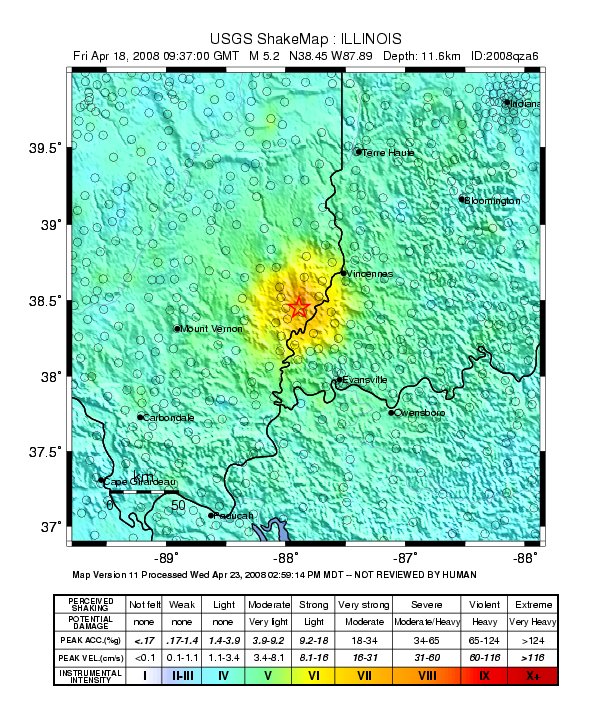
Meanwhile, on the other side of the world, Australian Broadcasting is reporting a new satellite system for predicting earthquakes using ionospheric dimpling:

The theory suggests that much of earth’s rock has soaked up water, which has later been exposed to extreme heat and pressure inside the earth. Those conditions break apart the water and create the electrically conductive crystals that exist inside most rocks, as well as byproducts such as oxygen.

As pressure builds before an earthquake, the oxygen molecules inside the rocks undergo chemical reactions, creating a positive electrical charge that radiates out toward the earth’s surface.

"It’s similar to how an electrical charge radiates through a battery," says Freund.

The charge creates a subtle fluorescent, infrared glow and a magnetic field one to two weeks before a major earthquake.

That light shines into space, the theory goes, where satellites can register the change.

Low-resolution thermal cameras aboard the proposed satellites would scan the earth to detect earthquake precursors, says Eves.

The positively charged magnet creates a dimple, up to 20 kilometres deep, in the earth’s atmosphere by attracting negatively charged ions from as far away as 600 kilometres above the surface of the Earth.

To detect this ionospheric dimpling, the satellites would monitor the existing Global Positioning Satellite System with three small GPS antennas on its side. As each GPS satellite comes up over the horizon, its signal would pass through the ionosphere. Any dimpling would change that signal.

The theory is not without skeptics.

"As far as I know, there is no published research to suggest that this will work," says Dr Mike Blanpied, who is with the United States Geologic Survey’s Earthquake Hazards Program.

This early-warning system was reported by the Wall Street Journal last month:

Early in May, NASA earth scientists monitoring infrared images of the earth noticed unusual patterns in southwestern China. One sent an email to colleagues, noting: Something is happening in Sichuan province.

For Friedemann Freund, a chemist-turned-NASA geophysics researcher, it was more support for his simple, though hotly contested theory: Earthquakes are the culmination of drawn-out physical processes that can be tracked sometimes more than a week ahead of the main event.
 
The main idea: Rocks put under enough pressure — for example, when tectonic plates shift — turn into batteries. The resulting electrical currents can travel miles into the earth, Dr. Freund says. The infrared images observed by NASA, for example, were concentrated several hundred miles from the epicenter of the roughly 8.0 magnitude earthquake that struck on May 12, killing at least 34,000 people.

Dr. Freund describes his discovery as simple, made at 2 p.m. on a Friday afternoon in early 2005 just before he and his graduate students finished packing up a temporary laboratory they had been using. For experiment No. 167, one for the road, they decided to use a copper contact to test whether a squeezed rock emitted a current. It did.

"This is something that should have been discovered 50 years ago," he said.

Certainly, people have tried. For more than a century, researchers have debated the pursuit of the "holy grail" of earthquake prediction. There is still no widespread support for linking electromagnetic signals, infrared emissions or atmospheric changes to an approaching quake.

Satellites are used to communicate seismic data, and transmitting videos, of course. The prospect of being able to predict such events many days in advance seems like a real possibility. Count on the Smithsonian to present it, probably based on a published piece by Dr. Ouzounov of George Mason University.

Alaskan Business

Wednesday, June 4th, 2008


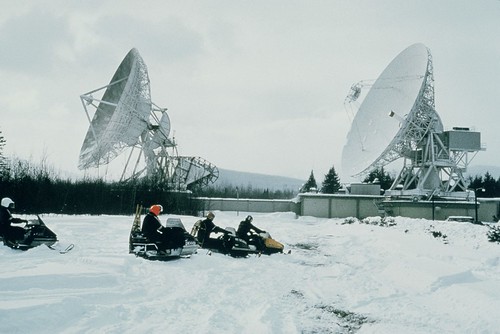
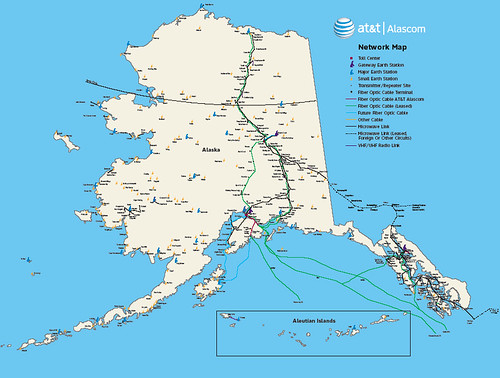
Out in the bush, you need an airplane to get around effectively. You can get by with a snowmoble in the winter, but how much can you cover in a day? Alaska is a big state, spanning 663,267 square miles (that’s 367 million acres, cowboy). Since the early 1970s, Alaska’s telephone system has been using satellite, primary using AT&T Alascom’s Aurora satellites (currently Aurora III; co-named AMC-8). Pretty extensive network, highlighted by the Alyeska Pipeline:


When Galaxy 18 launched in May, we didn’t think they’d be cutting over some of the services from the Galaxy 10R spacecraft so quickly.  End-of-life for G10R was originally projected to be 2015, but after a XIPS problem, it was cut short. One of the big customers on that bird, GCI, moved nine transponders of traffic yesterday:

GCI announced today that it successfully transitioned all of its rural telecommunication services last night to the Galaxy 18 satellite. This satellite will provide long-distance, Internet, distance education and telehealth services throughout rural Alaska for the next 14 years.

“The success of last night means rural Alaskans will stay connected to the most advanced network in Alaska,” said Ron Duncan, GCI president and CEO. “It also provides major businesses in Alaska and carriers in the lower 48 states the ability to directly touch customers virtually anywhere in Alaska.”

GCI owns nine transponders on Galaxy 18 and will take possession of a tenth transponder in approximately two weeks. GCI will lease the transponder capacity from Intelsat. However, GCI will be required to account for this arrangement as a capital lease. This will result in a capital lease obligation, and corresponding long-term asset, in the approximate amount of $98 million.

Hmm. At that price, it seems to work out to approximately $58,000 per month per transponder, and that ain’t a bad price. I suppose if the oil keeps pumping, there will always be money to pay for satcom services. Keep us rocket scientists busy for years.

Here’s where the oil ends up, in Valdez:


Blogging at 300 KM/H

Monday, June 2nd, 2008

No, the title of this post isn’t a reference to the velocity of our Kerouacian prose — it’s what you could be doing if you took a train between Paris, Brussels, Amsterdam and Cologne:


 The first commercial application of the European Space Agency (ESA) “Broadband on Trains” initiative officially launched May 14 on six high-speed Thalys trains… Passengers on the trains equipped with “Thalysnet” have continuous Internet connectivity while traveling at 300 km/h via a satellite 36,000 km above the trains.

The satellite link uses a low profile tracking antenna on the train to provide a two-way connection to the Ku-band satellite system and a hub station connected to the Internet backbone. Terrestrial wireless is used to maintain a connection when the train is traveling through tunnels. The total bandwidth from the satellite shared among users on the train is 2 Mbps down and 512 Kbps up. Bandwidth across all trains in the fleet is allocated on demand according to the usage level.

The tracking antenna truly is low-profile. If a train passes you at high speed, you’d be hard pressed to see the little nub whizzing by you:


The ESA initiative to bring broadband to trains started nearly two and a half years ago; as of May of this year, Thalysnet is officially and commercially available to train passengers

Thalysnet… was developed by a consortium lead by Nokia Siemens Networks, which combines satellite communications with conventional wireless data technologies to provide a continuous Internet connection on board trains travelling across national borders at 300 km/h. One of the companies in the consortium is the UK-based 21Net, which carried out a pilot project in 2005 under the European Space Agency’s Broadband to Trains initiative.

21Net worked with leading railway operators such as RENFE (Spain) and SNCF (France), along with Thalys, to develop a solution combining bi-directional satellite communications with terrestrial wireless technologies.

With soaring gas prices leading to an increase in public transport usage here in the US, could an American equivalent of Thalysnet be far behind? 

Chinese Interference

Wednesday, May 28th, 2008

If you’ve been in the satcom business for a while, you remember Loral’s problems with selling satellite technology to China about 10 years ago. The story made the front page of the New York Times 10 years ago:

The documents paint a fascinating portrait of the intense struggles surrounding Mr. Clinton last February as he weighed whether to allow the satellite launching and ignore the pleas of prosecutors and the probable outrage from some in Congress.

A top State Department official had warned White House staff members that the satellite company, Loral Space and Communications, engaged in ”unlawful” and ”criminal” activity by providing valuable help to the Chinese rocket program.

And the chairman of the company, Bernard L. Schwartz, combed a White House dinner on Feb. 5, looking for Samuel R. Berger, the national security adviser, to plead for a decision on the satellite launching, a decision worth tens of millions of dollars to the company.

As it all played out, with the company arguing it needed an immediate decision, the senior White House staff were concluding that the President’s broader strategy of engaging China should not be endangered by blocking the launching.


The impact of that scandal was far-reaching and still affects how satellite technology is exported — or not.  The spacecraft in question, Chinasat 8, was never delivered. What ever became of it? Space Systems/Loral sold it to Bermuda-based ProtoStar, modified it and just shipped it to Kourou for launch next month:

"Space Systems/Loral has been able to deliver a satellite customized to our requirements in a timely and professional manner," said Philip Father, chief executive officer of ProtoStar. "We have worked closely with SS/L throughout this project and are very impressed with the passion and commitment of all the engineers and technicians who have been involved."

The satellite, which was designed to meet the needs of both emerging and existing direct-to-home (DTH) operators in the Asian market as well as other broadband communication needs in the region, was completed for ProtoStar less than 17 months after the contract was signed. It is the first in a fleet of multiple satellites ProtoStar plans to launch that will enable its in-country partners to offer advanced satellite television services and powerful two-way broadband Internet access.
 
"ProtoStar I is the third satellite that SS/L has shipped for launch this year," said John Celli, president and chief operating officer of Space Systems/Loral. "It is rewarding to see the tangible evidence of our ability to deliver within commercial schedule constraints and to help our customers meet business plan requirements."

Space Systems/Loral was able to deliver the satellite in just over a year because the project involved modifications to an existing satellite, which ProtoStar purchased from its previous owner. SS/L then tailored the spacecraft to meet the defined power and footprint/coverage requirements of ProtoStar’s customers.

Now we read of the Protostar-1 satellite is not fully coordinated in Asia, causing quite a bit of friction, via Satellite Finance (subscription):

Confusion has broken out in the Asian satellite industry as Protostar-1 nears its launch at the end of June. Other Asian operators have expressed fears that Protostar-1 has not been properly configured to avoid interfering with the signals of other satellites close to its orbital slot at 98.5° East.

Speaking to SatelliteFinance, Peter Jackson, CEO of AsiaSat, said: "The Ku band is an issue, but it’s the C-Band on the Protostar satellite that’s going to be the real problem, it is going to interfere with a number of satellites. I know that the Chinese national operator has a problem because they are only a half a degree away with Chinasat 22, and Thuraya has a problem because they have a satellite right at 98.5°. New Skies will have issues as well."

Protostar is understood to be launching the satellite to the orbital slot belonging to Singapore. The Chinese Radio Regulatory Department has written to the Infocomm Development Authority in Singapore to express its concerns.

Jackson said that AsiaSat has had contact with Protostar over the issue, but that they have not been able to come to any definitive understanding on the matter. "When AsiaSat 4 launched we had to make changes to accommodate Thaicom, it’s just the way it works," he said. "I’d be very surprised if Singapore allows them launch as it stands. I know that if it were Hong Kong that was in the same position it would definitely not allow it."

Protostar could not be reached for comment on the issue. Protostar-1 is an SS/L built satellite with 16 Ku band transponders and 36 C-Band transponders, and its primary purpose is to provide capacity for DTH platforms in Asia.

This should be interesting. The co-passenger for next month’s launch is expected to be BADR-6 for Arabsat.

Unfurling a Big Antenna in Space

Wednesday, May 28th, 2008

The ICO G1, launched last month, is referred to as the "world’s largest" by manufacturer Space Systems/Loral:

ICO G1 is a Loral-designed spacecraft that incorporates a 12-meter antenna reflector designed and built by Harris Corporation. The reflector utilizes a gold-plated mesh reflective surface and a unique new Harris design that allows a very large antenna reflector to stow safely and easily on the Loral 1300 satellite platform. The reflector size enables the increased performance typically required for mobile interactive media services.

ICO G1 is the largest commercial satellite launched to date, weighing nearly 15,000 pounds at liftoff, and measuring more than 27 feet high and over 100 feet wide, following solar array deployment.

Here’s the animation simulating deployment:


A Billion More Satellite Internet Users

Thursday, May 15th, 2008

Q: How do you connect 1 billion more Africans to the Internet by 2012?

A: By Satellite, of course.


According to a story by Efem Nkanga in This Day (Nigeria), that will call for launching 20 satellites to do the job:

One billion Africans located in under-served rural and urban areas across the continent are set to benefit from an initiative powered by a non profit association of the international satellite industry called Global VSAT Forum to double the number of earth station terminals operating in Africa by 2012.

The worldwide Global body of firms involved in the business of delivering advanced digital fixed satellite unveiled these plans to newsmen at the ongoing Telecoms Africa forum in Cairo. Mr. Jeremy Rose, Chairman, International Development Initiatives, Global VSAT Forum,  who disclosed this initiative said that more than 20 satellites will be brought into service to connect Africa during the next five years to support this initiative. Rose added that to facilitate the industry’s offering, complimentary capacity building will be delivered to governments in Africa by the GVF. These initiatives according to him are being unveiled to support ongoing plans by the International Telecoms Federation to meet Africa’s  connectivity goals set during Connect Africa Summit held in Kigali, Rwanda in October, 2007.

The GSM Association had announced that its industry members planned to invest $50 billion between 2008 and 2012 in networks in Africa, covering 90 per cent of the population.

The Association announced today that the number of mobile connections in Africa has risen 70 million in the past 12 months to 282 million.

Mobile operators have ramped up investment in the region, extending GSM coverage to reach an additional 550,000 square kilometers occupied by 46 million people.

This broadening  coverage along with the falling cost of mobile communications has enabled millions of Africans to get connected.He added that the company’s goal was to provide enhanced opportunities in connecting the next billion people.Earlier, stakeholders had made calls for Africa to have Broadband connectivity at affordable prices that would drive growth in the continent.One of the ways of driving this uptake of broadband was the call for optic fiber deployment across the length and breadth of the continent.A highlight of the formal opening was the Press launch of ITU’s regional report, "African Telecommunication/ICT Indicators 2008: At a Crossroads". Following booming growth in the mobile telephony sector – which saw 65 million new subscribers in 2007- and an encouraging investment climate spurring economic development in the region, Africa is a continent on the move: the theme for ITU TELECOM AFRICA 2008.

That’s quite a challenge from the GVF. If I’m still around in 2012, I’ll do a follow-up post.

Look, I remember a forecast in June of 2001, by a market research company, that an addtional 500 geosynchronous satellites will be needed to satisfy demand.  Nearly 7 years later, I don’t see expansion of that magnitude.

Panasonic to Pursue Broadband at 35,000 Feet

Thursday, May 8th, 2008

We’ve long been fans of inflight broadband, ever since Ed blogged two years ago about his experience watching TV at 35,000 feet while  reflecting on the use of Connexion by Boeing.


Way back in September of 2006, when Boeing shut down Connexion, we reported that Panasonic was looking to get onboard with inflight broadband. It took them longer than we expected to book their flight, as it were, but now Panasonic and Intelsat have announced that they are teaming up to bring broadband to air travelers:

Panasonic, known for delivering state-of-the-art in-flight entertainment technology, is introducing an advanced satellite transmission platform that will allow airline passengers the ability to access Internetbased information and entertainment. The service, Panasonic eXConnect, provides passengers Internet connectivity.

The platform will leverage Intelsat’s existing GlobalConnexSM Broadband service that is available on Intelsat’s global fleet of 53 in-orbit satellites, and regional teleport facilities. By utilizing Intelsat’s existing infrastructure, Panasonic will be able to introduce eXConnect in key regions around the world, providing an efficient and cost-effective means to scale the network capacity as demand grows.

Panasonic eXConnect enables two-way broadband connectivity that provides a wide range of applications useful to both the passengers and crew such as VPN, live TV, shopping, streaming media, tele-medicine, operational applications and personal devices integrated to the airline’s in-flight entertainment systems. With data rates comparable to ground public WIFI hotspots, eXConnect offers airlines the opportunity to further differentiate their in-flight product with a valuable service to their passengers.

ARINC is also working to put a wifi cloud up there with the regular puffy whites. They introduced their own inflight broadband service in Germany back in March

ARINC’s Oi connectivity enables passengers to surf the Internet (by the hour, day, or flight leg), access e-mail during flight, chat over Instant Messenger, watch real-time news and sports flashes, hear bulletins—all on their own personal laptops. They can even watch and download the latest Podcasts. ARINC’s Oi technology makes optimum use of Inmarsat Swift satellite communication services.

Passengers merely switch on their PCs and can connect instantly via a wired or wireless cabin backbone to the Oi Web Portal. The Portal is fully customized to each airline’s requirements, supporting a combination of free view or paid applications. Oi will feature a range of price points to suit most budgets, and ARINC expects webmail prices will be under US$10 a flight, with larger attachments requiring an extra charge.

$10 bucks really isn’t that bad for email access per flight leg, considering Sebadoh recently shelled out $3 for a mere half ounce of peanuts that lasted about 2 minutes. 

What about the other services we’ve blogged about in the past, like the Row 44 platform being pursued by Alaska Airlines? We hear Row 44 is moving up, but it’s not yet full.

Smiles via Satellite

Monday, May 5th, 2008

We spend a lot of time here on Really Rocket Science looking at new technology, telling jokes, and covering rocket launches. The human interest stories are rare – but incredibly important:

U.S. soldier Joseph Chavez couldn’t wipe the smile from his face at seeing his daughter Lilliana for the very first time on a video call via satellite uplink from Iraq.

“Oh wow, she’s so pretty,” a beaming Chavez said over and over from Baghdad as his wife Naomi held his sleeping one-day-old daughter up to the camera for him to see.

The video conference, organized by the American non-profit foundation Freedom Calls, was held in the basement of Vancouver’s St. Paul’s Hospital and attended by throngs of media, at least for the first few minutes. Chavez was projected on a large screen, fuzzy but clearly elated.

“Look at her, she’s beautiful,” he said. “She looks happy to be alive right now.”

Naomi, who lives in Vancouver, had talked to her husband after Lilliana’s birth and sent pictures from her computer, but he was still beside himself to see his new wife and even newer daughter live onscreen.

“I saw all the pictures of everyone else getting to hold her,” said Chavez. “I’m very jealous.”

Freedom Calls is the charity behind the very slick effort:

Freedom Calls Foundation uses high technology to keep U.S. soldiers abroad connected with their families.

The signal from Iraq is bounced off a satellite and picked up in Germany, where it is sent by fibre-optic cable to Atlanta, Ga., and then by high-speed Internet to families in the United States — and this time to Canada. The service is slick, with only a 600-millisecond lag, which is noticeable but not enough to scramble conversation.

“We can connect anywhere in the world via satellite, but this is our first-ever call to Canada,” said Freedom Calls spokeswoman Kathryn Hudacek.

“When soldiers go to Iraq they have a habit of leaving a lot of pregnant wives behind,” said Hudacek. “It’s a real deployment phenomenon.”

Freedom Calls organizes 2,000 video conferences a month and at least 200 are dads meeting new babies, she said.

One of these video conferences not only allowed a soldier to see his newborn, but to watch the actual birth. And this isn’t Freedom Call’s only schtick:

Satellite junkies with a conscience and some disposable income may have just found their perfect charity. You can donate here.

Atlas Launches ICO G1 Satellite

Tuesday, April 15th, 2008

Yesterday at 4:12 pm at Cape Canaveral, an Atlas 5 rocket successfully lifted ICO Global Communications‘ ICO G1 North American geosynchronous satellite, "a mobile communications satellite to assist and entertain Americans on the go."

The launch marked the first commercial flight in two years of an Atlast 5, and the carrying of its heaviest payload ever

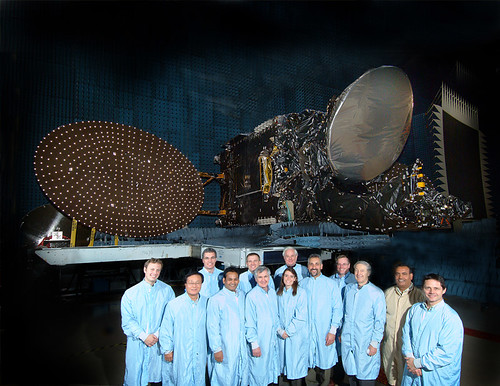
 Weighing 14,625 pounds, the ICO G1 spacecraft was the heftiest payload ever launched by an Atlas rocket. Built by Space Systems/Loral, the craft stands over 27 feet tall, features a 39-foot-diameter mesh reflector antenna that will be unfurled in space and a pair of power-generating solar wings to span over 100 feet tip-to-tip once extended in orbit.

It’s a pretty bird, the G1:


 The ICO G 1 satellite belongs to the 2-GHz mobile systems, which are driving a growing segment of today’s satellite manufacturing industry.

ICO’s G 1 satellite is based on SS/L’s space-proven LS-1300 platform, which has an excellent record of reliable operation. Its high efficiency solar arrays and lightweight batteries are designed to provide uninterrupted electrical power. In all, SS/L satellites have amassed almost 1,200 years of reliable on-orbit service.

ICO G1 is a next-generation satellite designed to deliver a wide variety of interactive services to mobile and portable devices using ICO’s Mobile Interactive Media (ICO mim™).

The launch marks the first deployment of DVB-SH service in North America. DVB-SH is short for Digital Video Broadcasting – Satellite services to Handhelds; it’s "a physical layer standard for delivering IP based media content and data to handheld terminals such as mobile phones or PDAs, based on a hybrid satellite/terrestrial downlink."

ICO mim addresses a wide variety of consumers’ entertainment, information and two-way communication needs, including live and stored mobile TV in vehicles, interactive navigation, and roadside assistance, all with nationwide coverage.

ICO mim will also initially provide 10-15 channels of premium television content to portable, larger-screen (4.5- to 10-inch) user devices. Initial partners for the trial phase of ICO mim include Alcatel-Lucent.

For a demo video of ICO mim click here. To see the current state of DVB-H reployments, click here.

Here’s the launch video…