Archive for the ‘Observation’ Category

Submarine Cable Cut Mystery Solved

Monday, April 14th, 2008

Earlier this year we discussed undersea fiber cables being cut in the Mediterranean. The event led to disruptions in 70% of Egypt’s Internet service (and lots of busy SES NEW SKIES sales offices). Now, thanks to satellite imagery, comes the swift hand of telecommunications justice:

Dubai authorities have impounded two ships suspected of damaging undersea telecom cables in the Middle East earlier this year. One of the ships has reportedly been released after paying for the damage. The cable cuts, which disrupted Internet traffic in much of the Middle East, India and Pakistan, sparked a flurry of conspiracy theories that the series of outages in the region were not a coincidence.

Reliance Globalcom, whose FLAG Telecom unit maintains the cables, contacted authorities after studying the satellite images of the ship movements around the area of undersea cable damage. The Hindu reports that Dubai Port Trust officials believe the two ships, MV Hounslow and MT Ann, improperly dropped anchor in the area. The cables then were damaged by "jerks and force of the ship(s)" the port said.

The action was taken after Reliance Globalcom provided details of its analysis of satellite images documenting the ship movements around the area of undersea cable damage. "The matter has been brought to the notice of appropriate authorities which are taking necessary action," the Reliance Globalcom official told The Hindu.

The National Terror Alert reports that a Korean ship was released after an official admitted that the vessel was in the area and made a payment of $60,000 to compensate FLAG Telecom for repairs. The second ship, which belongs to an Iraqi company, is still being held in Dubai, the report said, quoting Dubai police officials.

The news may put to rest a number of conspiracy theories, including the ever-popular Godzilla explanation.

Britain – a space power?

Monday, March 3rd, 2008

Well, sort of. With a little investment, the Brits could be an important player in space exploration and business:

Britain can play an important role in space exploration by exploiting its skills in the satellite sector rather than joining the competition in manned space flights, according to David Williams, head of Avanti, a satellite communications company. "There aren’t unlimited resources – we have to prioritise in areas where we have an economic advantage," he said.

Britain should be creating the communications infrastructure that will be needed as exploration expands deeper into space, he said. Countries such as the US, China, India and Russia, as well as the European Space Agency, are working on deep-space exploration. "If mankind is going to exploit the resources of the solar system, you are going to have to travel over very long distances and you are going to have to communicate over very long distances and you will need a network of data-relay satellites. The UK has a big advantage. We have the opportunity to control the space internet, which is going to be this network of data-relay satellites."

As The Guardian explains, these hopes are part of the government’s space strategy, drawn up by the British National Space Centre, which aims to double the number of British companies involved in the space business by 2012. Unfortunately, a trip to the moon is NOT part of the plan:

However, many space enthusiasts will be disappointed to learn that the plan has little to say about long-held aspirations for a British astronaut, though officials are to launch a review of the costs and possible benefits of human spaceflight.

In the 1960s ministers opted out of all crewed space missions, a stance governments have maintained since, but last year several key groups of experts, including the Commons science committee and a panel commissioned by the BNSC, warned that Britain risked being left behind if it did not end its long-standing opposition.

The failure to back a British astronaut dismayed some experts who believe Britain has missed any chance of being involved in European and Nasa plans to send humans back to the moon.

"There’s no commitment at all from this strategy. We’re the only developed nation that doesn’t have an astronaut, despite the fact that we’re the fifth largest economy," said Nick Spall of the British Interplanetary Society, who has been leading a campaign for a British astronaut.

"The government has missed a huge trick in terms of being able to offer inspiration to young people. In particular the chances of the UK contributing to a return to the moon, from a human spaceflight point of view, are very limited now. If we don’t have an astronaut with spaceflight experience we won’t get a look in on either of those missions."

Instead of "catching up" with other national manned space programs, Britain is going to try to conquer what it beleives to be an emerging focus of space research – climate change and disaster warning/relief:

The threat of climate change to planet Earth is to become the cornerstone of Britain’s role in the heavens, following an extensive review of space policy. British experts will develop satellites and other sophisticated technology capable of gazing back at Earth and taking the pulse of the planet from orbit, by monitoring melting ice sheets, dying rainforests and violent storms, under plans to be published by the government today.

The satellites will help create an early warning system for natural disasters, including hurricanes and tsunamis, and help to police international carbon-cutting agreements, such as pledges to avoid deforestation in some of the world’s environmental hotspots.

The move is at the heart of the government’s space strategy, drawn up by the British National Space Centre, which aims to double the number of British companies involved in the space business by 2012.

Under the plans Britain will become home to a major new European Space Agency facility based at Harwell in Oxfordshire. It will be dedicated to understanding climate change from space and developing robotics for space exploration. Britain is the only major contributor to the ESA that does not yet have its own facility.

According to BNSC officials, Earth observation from space is prioritised to help Britain become a hub for expertise in environmental science and disaster relief. During the 1990s natural disasters killed half a million people and caused £380bn of damage. Some 80% of those disasters were weather related, the report states.

It says: "Global satellite-based monitoring systems underpin our understanding of the health of the planet, alert us to dangers and speed up our responses. Satellites have a significant role in accurately assessing changes in sea [level] and temperature, the melting ice caps, and the effects of solar activity on the Earth and its environment."

Kizuna: The Big Kahuna in Satcom Bandwidth

Sunday, March 2nd, 2008


JAXA‘s new spacecraft, launched via an H-IIA rocket last week, promises 155-Mbps downlink and 6-Mbps uplink speeds:

It is expected that this information and telecommunications network’s speed and capacity will be much higher than anything achieved previously. KIZUNA satellite communication system aims for a maximum speed of 155Mbps (receiving) / 6Mbps (transmitting) for households with 45-centimetre aperture antennas (the same size as existing Communications Satellite antennas), and ultra-high speed 1.2 Gbps communication for offices with five-meter antennas.

In addition to establishing a domestic ultra high speed Internet network, the project also aims to construct ultra high speed international Internet access, especially with Asian Pacific countries and regions that are more closely related to Japan.

KIZUNA project is responsible for the demonstration of the validity and usefulness of technologies related to large-capacity data communications in our space infrastructure project, "i-Space," the purpose of which is to promote the use of satellites in such fields as Internet communications, education, medicine, disaster measures and Intelligent Transport Systems.

JAXA’s been working on this "i-space project" for a while now:

The Japanese Government announced in January 2001 that Japan becomes one of the most advanced countries in the world in the field of Information Technology (IT). They also set a ambitious target to launch an ultra-high speed Internet satellite (i.e. WINDS) by 2005 and completes verification testing of its function.

Recognizing the importance of this commitment toward an advanced information society and in response to a growing social demand to realize broadband communications environment and advanced mobile communications, JAXA proposes a new space project named "i-Space Project". The i-Space Project intends to make contribution to a revolutionized information society, and is accomplished by developing new space-based communication capabilities effectively integrated with ground communication infrastructure. It is also promoted by demonstrating an experiment(s) to prove its effectiveness in as many space-based application areas as possible.

Here’s the launch video:


Fractionated Spacecraft

Thursday, February 28th, 2008

Orbital was awarded a contract for the initial development of an advanced space technology for the Department of Defense:

Orbital Sciences Corporation (NYSE: ORB), a world leader in smaller-sized civil government and national security satellites, announced today that it has been selected by the Defense Advanced Research Projects Agency (DARPA), Arlington, VA, to develop a Phase 1 concept for System F6 (Future Fast, Flexible, Fractionated, Free-Flying Spacecraft united by Information eXchange). DARPA is the central research and development organization for the Department of Defense (DoD).

They could only come up with six "F’s"? Come on.

To simplify (sort-of), the concept is called "fractionated spacecraft," which is described in this 2006 paper (pdf):

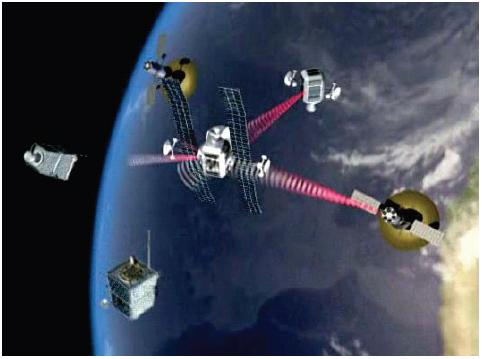
We note that the everlarger monolithic spacecraft of today are notoriously unresponsive. We then suggest a novel architectural paradigm, which we call fractionated spacecraft, whereby a satellite is decomposed into a set of similar or dissimilar component modules which interact wirelessly while in cluster orbits.

How is fractionated spacecraft more responsive than their larger, monolithic mainstays? (link)

According to DARPA such a virtual satellite effectively constitutes a "bus in the sky" – wherein customers need only provide and deploy a payload module suited to their immediate mission need, with the supporting features supplied by a global network of infrastructure modules already resident on-orbit and at critical ground locations. In addition, there can be sharing of resources between various "spacecraft" that are within sufficient range for communication.DARPA said the within the F6 network all subsystems and payloads can be treated like a uniquely addressable computing peripheral or network device.

Orbital is pretty excited:

“F6 has the potential to be a game-changing event in the history of military space systems in the same way that the internet revolutionized data communications,” stated Mr. Gregg Burgess, Orbital’s Vice President for National Security Systems in the Advanced Programs Group. “DARPA and Orbital have had a long and productive partnership leading to major innovations such as the Pegasus launch vehicle and numerous advanced small satellites. System F6 could transform today’s military space architecture to create a truly networked system of systems in space.”

Host My Payload

Wednesday, February 27th, 2008


Very interesting news from California this morning about Space Systems/Loral and Northrop Grumman’s Space Technology division getting together to go after U.S. government business. Building spacecraft for fully-funded government projects can be more profitable than going after commercial projects. Sounds like a simple agreement:

"The agreement with Northrop Grumman will allow SS/L to cost-effectively add capacity to address increased near-term commercial satellite opportunities," said Pat DeWitt, chief executive officer, Space Systems/Loral. "The agreement will also streamline the process for our companies to collaborate on providing the world’s best satellites for both civil and defense applications."

"The resulting strategic agreement will be important to increasing our competitiveness. These initiatives will present win-win opportunities for both companies and our U.S. government customers," said Alexis Livanos, corporate vice president and president of the company’s Space Technology sector. "For some of our mission areas, we believe that assured access to SS/L’s 1300 bus and bus subsystems would improve our cost and delivery schedule competitiveness. In addition, hosted payloads hold the promise of providing us greater ability and flexibility to rapidly respond to our government customers’ evolving needs."

Some of these new opportunities included "hosted payloads" where specialized instruments or entire subsystems can be added on to a satellite bus whose primary mission is paying most of the build cost. Given the importance of the role space plays in today’s C4ISR systems (Command, Control, Communications, Computers, Intelligence, Surveillance and Reconnaissance), and the expected ends-of-life of the spacecraft currently in orbit, we’ll need a bunch of new launches in the short term. Factor in programs being behind schedule — with some going way over budget —  and you might conclude we have a problem, Houston. Intelsat General is going after this market, too.

Northrop Grumman is involved in a new moon mission for NASA, the LCROSS (Lunar CRater Observation and Sensing Satellite):


Ready, Aim

Tuesday, February 19th, 2008

usa-193_notam_plot

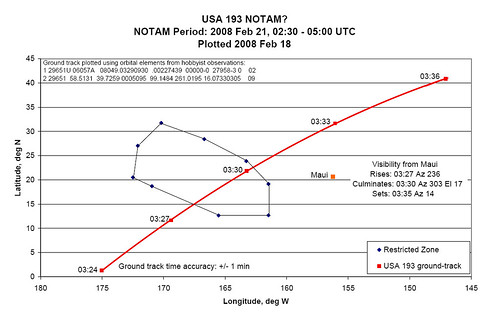
We’ve been following this story for a few weeks now, and it is astounding how much attention has been paid to it. A top-secret U.S. observation satellite that’s out of control is set to be shot out of the sky precisely so it brings no harm to the public. Over the Pacific Ocean, for example, would be a good location. Now the U.S. Navy has issued a "notice to airmen," signaling just that:

02/062 (A0038/08) – AIRSPACE CARF NR. 90 ON EVELYN STATIONARY RESERVATION WITHIN AN AREA BNDD BY 3145N 17012W 2824N 16642W 2352N 16317W 1909N 16129W 1241N 16129W 1239N 16532W 1842N 17057W 2031N 17230W 2703N 17206W SFC-UNL. 21 FEB 02:30 2008 UNTIL 21 FEB 05:00 2008. CREATED: 18 FEB 12:51 2008

The Register explains what this means:

A "CARF" (Central Altitude Reservation Function) designation indicates a NOTAM intended to keep commercial and private flights clear of military operations, and SFC-UNL means the height band of this warning zone reaches from the surface to "unlimited" altitude – in other words all the way into space. The UTC time referred to is the same as UK time, so the zone exists from 0230 to 0500 on Thursday morning for British readers.

As will be evident, the barred area is a cool 1,400 miles long and nearly 700 miles wide at the surface, giving the US Navy plenty of elbow room to fire their interceptor missiles up into the descending spacecraft’s path.

Reports have it that three US Aegis air-defence warships, the cruiser Lake Erie and the destroyers Decatur and Russell, will be waiting for the satellite west of Hawaii. Each ship carries a specially modified Standard SM-3 interceptor, originally intended for defence against lower-flying ballistic missile warheads. The three interceptors are on separate ships in case of a technical issue with the Aegis radar and fire-control system.

As it passes over the firing area, the satellite will be approximately 3,000 miles and ten minutes out from the western coast of Canada, the next land it will pass over. The satellite has much more mass than the soaring "exo-atmospheric kill vehicle" it will smack into, so this gives some idea of the onward track the wreckage might follow in the event of a hit.

Google Earth kmz file by Alan Clegg is worth a look.

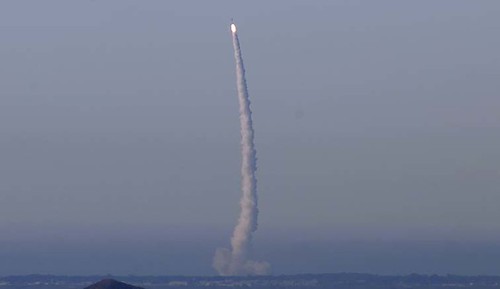
What can we expect on Thursday? Take a look at this Japanese test from last December:


Mediterranean Submarine Cable Cut

Wednesday, January 30th, 2008


Wow, big fiber cut yesterday, about a year after the one near Taiwan. If you’re in the Middle East, you know: Internet service is disrupted in Egypt, the Gulf Region and to India, too:

Egypt’s Telecommunications Ministry said a communications cable in the Mediterranean was cut, disrupting 70 percent of the country’s Internet network.

The ministry said in a statement it was not known how the cable was cut but that services would probably take several days to return to normal.

India reported serious disruptions to its services and one Indian Internet service provider linked the problem to the Egyptian outage.

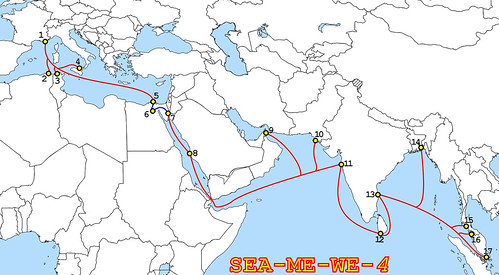
Seems the cut was somewhere between Palermo, Sicily, and Alexandria, Egypt. That sounds like the South East Asia-Middle East-West Europe 4 (SEA-ME-WE 4) cable, which has 17 landing points connected:

    1. Marseilles, France
    2. Annaba, Algeria
    3. Bizerte, Tunisia
    4. Palermo, Italy
    5. Alexandria, Egypt
    6. Cairo, Egypt (overland)
    7. Suez, Egypt (overland/return to submarine)
    8. Jeddah, Saudi Arabia
    9. Fujairah, United Arab Emirates
    10. Karachi, Pakistan
    11. Mumbai, India
    12. Colombo, Sri Lanka
    13. Chennai, India
    14. Cox’s Bazar, Bangladesh
    15. Satun, Thailand
    16. Melaka/Malacca, Malaysia
    17. Tuas, Singapore

Our friends at SES NEW SKIES probably had their phones ringing off the hook yesterday. Best remedy for fiber cuts is a satcom backup. That’s the "secret sauce" in a well-run network.


Credit Crisis Threatening Intelsat Deal?

Tuesday, January 29th, 2008

The current credit crisis isn’t just hitting the housing market. Last June, BC Partners agreed to buy satellite operator Intelsat. Now, BC Partners is requesting an "unusual" exception, asking "existing lenders to finance the purchase instead of selling a new financing in the open market." The current credit conditions make it very difficult to sell loans.

If Credit Suisse’s proposal is accepted, it would be relieved of the task of refinancing the bank loans for Intelsat and PanAmSat. New financing would still be required to finance the purchase, but the amount needed would be much smaller than the $5.1 billion commitment, as lenders would have agreed to roll the existing credit agreement into the new company.

The terms of Credit Suisse’s proposal are unusual in that the bank is asking lenders to loosen the definition of a "change of control" clause in the existing credit agreement. Usually, this clause will trigger a repayment of bank debt, but under the current proposal, a change of control would not be triggered.

For some background on Intelsat:

Intelsat, a global satellite network set up in 1965 by the national telecom operators of several Western countries, is being sold by a group of four buyout funds. Apax Partners, Permira, Apollo Management and Madison Dearborn Partners bought the company for about $3.1 billion in 2004. They added PanAmSat, a rival operator, for $3.2 billion in 2005.

Intelsat, based in Washington, operates 51 satellites used by cable companies, broadcast networks and governments for distributing video programming. It leases capacity to television companies rather than providing content itself.

The company has about 35 per cent global market share and last year reported $1.7 billion in revenues and adjusted earnings of $1.3 billion. Just under half its business is in North America, with 15 per cent of profits driven by Europe and 17 per cent from the Middle East and Africa.

Despite the credit conditions and the uncertainty surrounding the Intelsat transaction , BC Partners remains upbeat:

BC Partners, the international private equity group have today said they are anticipating returns in excess of 20% on the group’s sub-prime linked investment portfolio, despite the ongoing unrest in the global credit marketplace, according to a top executive today.

Stefan Zuschke of the group’s German operation said that the group was still looking forward to returns of as much as a fifth from its portfolio, despite the collapse of the sub-prime sector which left many banks and investment firms heavily out of pocket and forced to take severe writedowns against their balance sheets.

Whilst it was said that the credit crunch made for difficult times for investment firms, given increasing reluctance from banks to put up the cash for acquisitions and buy-outs at the same rate as before, he added that 2008 would see a return to the previous levels of spending and somewhere in the region of the same level of market confidence and optimism.

Uncontrolled Re-entry by Spy Satellite

Sunday, January 27th, 2008

Apparently, a spy satellite is no longer in control and could crash to earth very soon. Today’s New York Times has some detail:

Specialists who follow spy satellite operations suspect it is an experimental imagery satellite built by Lockheed Martin and launched from Vandenberg Air Force Base in California in December 2006 aboard a Delta II rocket. Shortly after the satellite reached orbit, ground controllers lost the ability to control it and were never able to regain communication.

Of course, somebody has to think of the worst. This report from Canadian TV picks up on the hydrazine threat:

Gordon Johndroe, a spokesman for the U.S. National Security Council, said appropriate government agencies are monitoring the situation.

"Numerous satellites over the years have come out of orbit and fallen harmlessly," he said. "We are looking at potential options to mitigate any possible damage this satellite may cause."

It’s unknown whether the U.S. may attempt to destroy the spy satellite before it re-enters the atmosphere.

"It’s not all that easy," said Atwood. "You’re not going to shoot it down, you’re just going to explode it into a million pieces that are ultimately going to fall on the Earth."

An anonymous government source told AP that the satellite contains a rocket fuel called hydrazine, which is a toxic chemical and can be harmful to anyone exposed to it.


One of the news "sources" cited a launch out of Vandenburgh AFB on a Delta II rocket. Probably the NROL-21, a classified NRO spacecraft. Judging from its orbit (353 km x 380 km, 58.5°), it’s probably an experimental radar, according to Gunther:

NROL 21 is the cover-name for one-off classified satellite. Although nothing is known about the mission, the orbit hints for an experimental radar reconnaisance satellite.

A few weeks after launch reports emerged, that grond stations were unable to communicate with an expensive experimental U.S. spy satellite launched last year by the U.S. National Reconnaissance Office (NRO). Efforts were said to be continuing to reestablish communication with the classified satellite, which cost hundreds of millions of dollars, but "the prognosis is not great at this point," said the defense official, who asked not to be identified.The official said the problems were substantial and involved multiple systems, adding that U.S. officials were working to reestablish contact with the satellite because of the importance of the new technology it was meant to test and demonstrate. An other source said the satellite had been described to him as "a comprehensive failure."

In August 2007 the satellite has been declared a complete loss and will be allowed to decay from orbit.

I doubt the re-entry will be as pretty as the launch was…

It certainly will not have an on-board camera like the launch did (fast forward to 2:35 — that’s when the action begins):


The Sky is Failling!!!….well, part of it anyways….

Saturday, January 26th, 2008

AP report

Disabled spy satellite threatens Earth

By EILEEN SULLIVAN, Associated Press Writer

WASHINGTON – A large U.S. spy satellite has lost power and could hit the Earth in late February or March, government officials said Saturday. 

The satellite, which no longer can be controlled, could contain hazardous materials, and it is unknown where on the planet it might come down, they said. The officials spoke on condition of anonymity because the information is classified as secret.

"Appropriate government agencies are monitoring the situation," said Gordon Johndroe, a spokesman for the National Security Council, when asked about the situation after it was disclosed by other officials. "Numerous satellites over the years have come out of orbit and fallen harmlessly. We are looking at potential options to mitigate any possible damage this satellite may cause."

He would not comment on whether it is possible for the satellite to be perhaps shot down by a missile. He said it would be inappropriate to discuss any specifics at this time.

A senior government official said that lawmakers and other nations are being kept apprised of the situation.

Such an uncontrolled re-entry could risk exposure of U.S. secrets, said John Pike, a defense and intelligence expert. Spy satellites typically are disposed of through a controlled re-entry into the ocean so that no one else can access the spacecraft, he said.

Pike also said it’s not likely the threat from the satellite could be eliminated by shooting it down with a missile, because that would create debris that would then re-enter the atmosphere and burn up or hit the ground.

Pike, director of the defense research group GlobalSecurity.org, estimated that the spacecraft weighs about 20,000 pounds and is the size of a small bus. He said the satellite would create 10 times less debris than the Columbia space shuttle crash in 2003.

As for possible hazardous material in the spacecraft, Pike said it might contain beryllium, a light metal with a high melting point that is used in the defense and aerospace industries. Breathing beryllium can lead to chronic, incurable respiratory problems.

Jeffrey Richelson, a senior fellow with the National Security Archive, said the spacecraft likely is a photo reconnaissance satellite. Such eyes in the sky are used to gather visual information from space about adversarial governments and terror groups, including construction at suspected nuclear sites or militant training camps. The satellites also can be used to survey damage from hurricanes, fires and other natural disasters.

The largest uncontrolled re-entry by a NASA spacecraft was Skylab, the 78-ton abandoned space station that fell from orbit in 1979. Its debris dropped harmlessly into the Indian Ocean and across a remote section of western Australia.

In 2000, NASA engineers successfully directed a safe de-orbit of the 17-ton Compton Gamma Ray Observatory, using rockets aboard the satellite to bring it down in a remote part of the Pacific Ocean.

In 2002, officials believe debris from a 7,000-pound science satellite smacked into the Earth’s atmosphere and rained down over the Persian Gulf, a few thousand miles from where they first predicted it would plummet.