Archive for the ‘Observation’ Category

Dish Network & DirecTV Team Up with Google, Intel, Skype and Yahoo!

Tuesday, March 6th, 2007

Very interesting twist to the upcoming spectrum auctions. Breaking story via Multichannel News:

DirecTV and EchoStar Communications formed an alliance with Google, Intel, Yahoo and Skype in support of a national licensing plan for a pending federal spectrum auction expected to take in at least $10 billion, according to draft of the plan obtained by Multichannel News Tuesday. The formation of the alliance doesn’t mean that the companies are going to bid together in the auction, which, by law, has to begin by Jan. 28, 2008. Instead, each alliance member has an interest in seeing that the Federal Communications Commission permits bidders to aggregate enough licenses to cover substantially all of the United States. The 60 megahertz of spectrum up for auction is returning to the FCC as a result of TV broadcasters’ transition to digital-only transmission. Broadcasters won’t require the same amount of bandwidth in total because digital signals are spectrally more efficient than analog airwaves.

Every full-power TV station is required to terminate analog TV service no later than Feb. 17, 2009. The analog cutoff would also allow public-safety entities to obtain 24 MHz of former analog-TV spectrum.


Space Weather Forecast Sees (STEREO) Gain

Tuesday, March 6th, 2007

To the left: An image of a February 25 eclipse taken from NASA’s STEREO-B satellite.

Back in October, we wrote about the successful launch of of NASA’s STEREO mission. (Click here for video of the Delta II launch.)

The STEREO (Solar TErrestrial RElations Observatory) Mission uses stereoscopic 3D vision to construct a complete picture of the sun and the nature of solar flares. Among the uses of such knowledge: protecting future astronauts from the dangerous effects of solar flares and providing better space forecasting.

The Washington Post now gives us an update on STEREO’s progress

The effort to improve space weather capabilities took a major step forward last week with the transmission of never-before-seen images of a solar eruption traveling the 93 million miles from the sun to Earth.

Sent back by the twin satellites of NASA’s newly launched Solar Terrestrial Relations Observatory (STEREO), the video is part of an ambitious new effort to learn more about massive electromagnetic storms on the sun, and the dynamics and characteristics of their eruptions. The sun is a huge furnace of nuclear fusion, in constant turmoil with flares, eruptions, convections and the release of lower-energy solar winds.

The "fronts" produced by coronal mass ejections, as the biggest eruptions are called, are the prime movers of space weather in Earth’s neighborhood, and understanding them better is essential to space weather forecasting.

"With STEREO, we can track the front from the sun all the way to Earth and forecast its arrival within a couple hours," said Russell Howard, principal investigator for STEREO’s most cutting-edge instrument, which will allow researchers to observe the movements of solar eruptions in three dimensions. "The new views from STEREO are like having a curtain lift from our eyes — they are extraordinarily instructive."

They are also pretty amazing, as this video animation taken from STEREO images shows. 

The Washington Post continues: 

STEREO cost NASA and its European partners about $600 million to build and is expected to operate for at least two years. It has already detected somewhat surprising characteristics of the solar eruptions. Researchers have, for instance, located "hot spots" within a solar eruption as it speeds from the sun, and they have seen loops and arcs formed from the hot plasma. They have also begun to measure the velocity of the eruptions, which gradually slow as they collide with other solar matter moving far more slowly in the solar winds.

Like most researchers, STEREO team members say they are looking for solar surprises as much as confirmation of existing hypotheses. The detailed study of space weather is in its infancy, they said, and the opportunity for discovery is vast.

We’ll keep you updated on STEREO’s discoveries as they are reported; in the interem, be sure to check out the STEREO mission homepage for the latest developments. 

Satellite Distributed Movies Set to Emerge in 2007

Monday, March 5th, 2007

While the technology has been talked about for years, many experts are positioning 2007 as the year that digital movies and satellite distribution of box-office blockbusters take flight. Working in conjunction with Warner Bros. Entertainment and Universal Pictures, Digital Cinema Implementation Partners (made up of big name theater companies AMC, Cinemark and Regal) is working to "use satellite and broadband delivery systems to beam digital films directly to theaters, rather than have them copied onto hard drives and delivered by hand, as they usually are now."

While the theater chains and studios are looking at the technology as a great way to decrease the likelihood of piracy (the theory being that encrypted satellite transmissions would mean fewer hands are on the prints), it could also mean improved access to popular films and big screen showings of smaller films that struggle for an audience large enough to usually get them. As the AP article about the technology notes that satelite distribution,

"would give U.S. theater operators the flexibility to put a popular movie on an extra screen as quickly as the demand arises… At the same time, theater operators could stop showing a surprisingly unpopular film and even book an art-house film with a small but devoted audience for a day or two."

While Variety and Hollywood are explicitly concerned with the digital cinema’s implications for the US market, the Hindustan Times points out that the technology may be even more welcome throughout the developing world where, although movie theaters are plentiful (with over 12,500 movie houses throughout India alone), the relatively small number of "prints" (sometimes only 500) available of any given film arbitrarily limits distribution.

Wok TV System

Thursday, March 1st, 2007

Love this story about Kiwi ingenuity from the New Zealand Herald:

$10 wok keeps TV station on air

Why pay $20,000 for a commercial link to run your television station when a $10 kitchen wok from the Warehouse is just as effective?

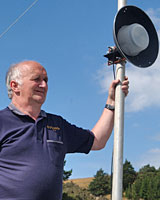
This is exactly how North Otago’s newest television station 45 South is transmitting its signal from its studio to the top of Cape Wanbrow, in a bid to keep costs down.

45 South volunteer Ken Jones designed the wok transmitter in his spare time last year when he wanted to provide wireless broadband to his Ardgowan home.

"A group of us wanted to connect our computers to each other and then we worked out a way to get of getting the signal between two points," he said.

He discovered satellite dishes were between $100 to $400 retail and that smaller dishes, the same size as a wok, were $80.

Mr Jones thought he could do better.

Along with friend Murray Bobbette they worked out mathematical equations to prove the curved metal face of a wok would have the same effect as a small satellite dish.

"We have spent a lot of time getting it right — the first time we installed one we had it up a pole with the handle still on the end of the wok," he said.

"We had it connected to the woolshed and initially you couldn’t get a signal the width of the paddock and now it can reach up to 20km."

When the television station 45 South (UHF channel 41) started up in September last year, Mr Jones thought the same technique could be applied.

"The $20,000 for a commercial link was just money we didn’t have, so we bought several woks from The Warehouse instead which was convenient and cheap," he said.

Pre-recorded clips at the studio are fed through a computer and beamed to Cape Wanbrow where they are relayed off to television sets around North Otago.

The classic case of Kiwi ingenuity has made its way onto the internet and the technique has been posted by an American website, Mr Jones said.

"People wanted to know all the details about how to make their own, so it is now all publicly documented," he said.

One of the issues they had to deal with was making the pole that the wok sits on high enough to clear the Kingsgate Brydone Hotel.

Of course, this story found it’s way to Make a day after it was published.

Anti-Jamming Technology Goes Commercial

Tuesday, February 27th, 2007

The Times reported yesterday that Boeing is looking to put anti-jamming technology previously reserved only for the military on commercial satellites used by business and the communications industry. According to the article,

"Anti-jamming technology is already used by military and spy satellites, but proposals to install similar protection in the 250 large satellites in commercial operation have been prompted by the threat of disruption.

The successful jamming of video, data, or voice signals by individuals or groups could jeopardise the millions of dollars spent on just a handful of satellites, operators fear.

Such jamming of government navigation satellites has already occurred, according to Lieutenant General Robert Kehler of the US Air Force, ‘as has jamming of commercial telecommunications satellites.’"

Space.com has a great background report on Spy Satellites for those who want to know a little bit more about the technology and the American Military and Intelligence communities uses of the technology. While Spy Satellites have been used for quite a long time, even the latest anti-jamming technologies are unable to prevent detection, the spy satellite holy grail. While satellite project, such as MISTY, have been able to avoid detection by laser and microwave radar, none has been able to completely avoid visible detection, a limitation which has prompted the emergence of a small, but strong spy satellite monitoring enthusiast community.

Oh, and for those of you who might be worried about the commercial anti-jamming technologies making it into the wrong hands, it looks like your not alone. While Boeing seems confident that they’ll win it, the U.S. government does have to approve the use of the "top secret" anti-jamming technology on commercial satellites before the company can start introducing it on products sold to foreign customers.

Boring Press Releases

Sunday, February 25th, 2007

I’m so glad we have journalists around to make the news interesting. Imagine if we only had press releases.  B-O-R-I-N-G !

Just look at all these releases surrounding the Satellite 2007 show in Washington last week. Open your eyes wide and read these exciting excerpts:

"…released two new software options to their industry leading product lines that extend their already unique ability to…"

"This flexibility makes the product line more accessible to the networking requirements of government, military, and commercial customers who increasingly value high uplink and downlink speeds at a node and desire to blend terrestrial solutions with their satellite backhaul."

"The company’s DVB-RCS/S2 solutions are the only multiple-access satellite solutions capable of delivering data transfer rates of up to 80 Mbps for downloads and up to 8 Mbps for uploads at each remote terminal, or enough bandwidth to support a variety of users such as a small business or battalion unit to an entire community/military base from a single remote terminal."

And this quote is typical from apparently happy customers:

“We are looking forward to working with X on the development of this next generation intelligent network. Significant improvements can be made to future VSAT systems with the addition of artificial intelligence to the network. These capabilities offer the promise of enhanced performance and economic gains which will allow us to offer new and more cost effective services to our customers.”

I think it’s time we put some excitement in our "realeases" and start making some real news. I’ve noticed NASA’s public affairs people are putting some fun into their work and coming up with some very creative angles over the past year or so — just take a look at this "Camping on the Moon" release. Brilliant!

Japan Launches Spy Satellites

Saturday, February 24th, 2007


Japan Times reports a Japanese H-IIA rocket carrying two satellites blasted off from the Tanegashima Space Center (see web cam) in Kagoshima Prefecture:

JAXA used an H-IIA rocket Saturday to successfully place a radar satellite in orbit to complete Japan’s spy system for full global coverage.

The rocket also carried an experimental optical satellite.

Both satellites were placed in orbit about 20 minutes after the 1:40 p.m. launch from the Tanegashima Space Center in Kagoshima Prefecture, the Japan Aerospace Exploration Agency said.

They began functioning and their solar-battery panels are open, JAXA said.

If the radar satellite continues to perform as planned, Japan’s compliment of four spy satellites will be able to photograph any point on Earth once a day for intelligence-gathering, the agency said.

The government decided to launch spy satellites after North Korea fired a Taepodong-1 ballistic missile in 1998, part of which flew over Japan into the Pacific Ocean. Pyongyang maintains it was for sending a satellite into orbit.

The launch of the radar satellite enhances a multibillion dollar, decade-old plan for Japan to have round-the-clock surveillance of the secretive North and other areas Japan wants to peer in on.

In the spy project, two optical satellites and one radar satellite have already been placed into orbit.

But weaknesses in the satellites’ capabilities have led to criticism that the program is a waste of money and, with better data available on the commercial market, that the government will continue to be dependent on Washington for its core intelligence.

The launch also comes just a month after China demonstrated its ability to shoot satellites out of orbit with ground-based missiles. Japan and other countries, including the United States, have strongly protested Beijing’s antisatellite test.

China has defended the test as peaceful, and said it presents no country with a threat.

JAXA officials say the satellites provide an important means for the country to independently collect intelligence, and say improvements in the satellites’ capabilities are in the works.

The experimental optical satellite launched Saturday features higher-resolution optics that can be used in the future to improve the quality of orbital photographs taken by Japanese satellites.

The two optical satellites already in orbit are reportedly capable of detecting objects about 1 meter in size. The plan is to work toward a satellite capable of detecting objects half that size.

JAXA had originally intended to launch the rocket Feb. 15 but postponed it three times due to thunder and poor weather conditions.

Who Owns That Satellite?

Thursday, February 22nd, 2007

According to Channel NewsAsia, things are heating up in Thailand, where concerns about spying may force the country to buy back satellites it sold to a Singapore investment firm, Temasek, last year. As you might expect, things get a little complicated when you viewed up closer:

"[The controversy]… centers around four satellites owned by ShinSat, which is a subsidiary of Shin Corp.

Shin Corp was founded by former [Thai] premier Thaksin Shinawatra, whose family sold a 49 percent stake in the company to Singapore investment firm Temasek in January 2006.

General Sonthi [Boonyaratglin, who led last September’s coup d’état] said the government should buy back these satellites, which transmit encrypted military communications, in the interest of national security.

The estimated price tag is US$294 million."

Most Thai’s on the street believe that the Thailand should reclaim ownership of the old satellite’s for reasons of national security, although many don’t think the country should have to pay for the reacquisition. As one Thai citizen said in an interview:

"Thaksin sold it, so he should buy it back for Thailand. Thai people are already paying taxes to the government, so we shouldn’t use the country’s money to buy it from Singapore."

The problem for Thailand is, however, that such an oddball move with a foreign company would probably inhibit the future foreign direct investment so crucial to their development.

Opening General Session at Satellite 2007

Wednesday, February 21st, 2007

Here’s the write up of Tuesday’s Opening General Session by Mark Holmes in the Satellite 2007 Daily:

FSS operators Seek Ways To Capitalize on Growth Patterns

The satellite industry finds itself in a strong position, top executives said at the SATELLITE 2007 opening session, but there was an undercurrent of caution in their comments.
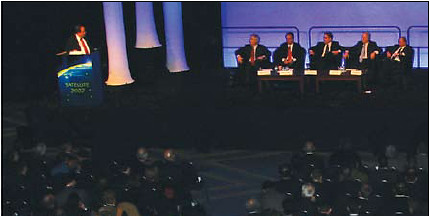
Overall, the panel was increasingly optimistic about the growth prospects for the satellite industry. “I think we see an industry that is healthier every day,” said Intelsat CEO David McGlade.. We see economies improving around the world. It is a great time to be in the industry. In 2004, the industry was not as healthy as it was today. It is improving even in areas like Asia.”

There was also a sense of renewed optimism in traditional market segments such as broadcasting with new direct-to-home (DTH) operators springing up throughout the world as well the move to high definition (HD) which is increasing capacity demands.
 
“People are going back to basics,” said Giuliano Berretta, CEO of Eutelsat. “TV is picking up very strongly. There is a resurgence in the TV business. For example, I think SES is becoming more traditional when you look at their recent divestments. In our most recent results, 70 percent mof revenues were derived from broadcasting. There are new countries which want pay TV.”

The optimism also extended to new market opportunities and the opportunities for satellites to play an increased role in areas such as mobilebroadcasting, broadband and other areas. McGlade spoke of the need of making “small, smart, bets” when going into new areas. “When you see a take-up you grow with it. You have to seed some new activities. I feel there is the right kind of climate for responsible growth. Huge bets have been taken before, but we won’t be doing that again.”

Romain Bausch, CEO of SES Global, said there are strong growth opportunities for satellite manufacturers and launch providers, but admitted the industry “could be in trouble” if companies do not move quickly when attacking new markets and consolidating positions in existing markets.

Bausch admitted he was concerned of the impact players such as Deutsche Telekom (DT) could have on satellite players. “We need to make sure the satellite solution is developed further to compete with terrestrial solutions,” he said. “You look at someone like DT who is going into the video business, this may be dangerous for us, because of the vertical integration of such players.”

Changing landscape

The satellite landscape has changed since these CEOs gathered at SATELLITE 2006. In recent weeks, Eutelsat has announced new shareholders, SES has done a deal with GE to divest certain assets and repurchase stock, Loral and Telesat have hooked up. Unsurprisingly, all the executives painted a bright picture of these moves.

Bausch made the point that divesting certain assets was almost as important as acquiring new assets. “When we bought New Skies, we got new assets in Asia and Latin America. It allowed us to divest in minority of assets such as AsiaSat and StarOne,” he said. “Divestiture is also a key trend. It is removing the overhang and having a currency to use in the future. It is a rationalization of assets. It is clear with overlapping footprints you have to rationalize. From a strategic perspective, we are now built on three 100 percent-owned companies. This will allow us to be more aggressive and in control of our developments.”

McGlade said Intelsat believed in a different approach. “I do not believe as much as the regional entities standing alone,” he said. “We have put more people out into the field. I think the integration process has transformed us and been a tool to bring us forward. There are many areas of growth. I think broadband will continue to grow. We have an investment in WildBlue and that has done well. When I look at video, HDTV has reached an inflexion point. Once that trend starts to accelerate you will see many programmers go to HD both for offensive and defensive reasons. There are new DTH platforms being launched. As we see liberalization of regulatory regimes there are growth opportunities in every sector.”

Michael Targoff, CEO of Loral Space & Communications, said his company’s acquisition of Telesat was vital for the operator to be a long-term player in the market and would help Loral compete more effectively with the big guns in the industry.

“You need to offer the customer a sense of capability,” Targoff said. “It was clear to Loral when we sold assets to Intelsat we did not have a sustainable position in the long term. By buying Telesat, we believe we can compete. We are comfortable it provides us with the mass to compete. I don’t just see it as a step along the way.”

In terms of how he views new opportunities for Loral and other operators, “We will be using satellites to deliver video to handheld nphones,” Targoff said. “We will use satellites to deliver broadband where there is not broadband infrastructure. There will be a role of satellites. While there is clear strength in the traditional services, it is also clear the future the role of satellites is how we participate in the way people access content now.”

Besides competing with the other satellite players, Berretta called for more cooperation within the satellite industry as they look to compete against other infrastructures and operators.

His views were shared by McGlade. “I think an association together could make a lot of sense and add a lot of value,” he said. “… “We are such a small fish in the media and telecoms pond. We need to look at how we can spur growth. We can do more. When we look overall, we have to look at what is happening with customers as well as our competitors. We are moving the industry forward, but we could do more. We are not doing enough.”

Mobile satellite services

Andy Sukawaty, CEO of Inmarsat and the lone Mobile Satellite Services (MSS) representative, told the session that some of the plans being offered by the low-Earth orbit (LEO) operators are “deeply flawed”.

Sukawaty warned that the investment community may not have learned from its previous efforts in funding LEO constellations if investors believe there was so much money to be made from the MSS industry. “In the 1990s, $15 billion was lost by investors that invested in this business,” he said. “We have instilled a capital discipline. It is capital intensive business. I think that is where investors need to focus. If you look at the fund raising at the MSS sector people are looking to raise $12 billion over the next five years. I don’t think there is $12 billion of business out there.”

Sukawaty saved his strongest comments for some of the LEO operators. He said in a blistering attack on some of the players, “To spend $2 billion on a LEO constellation will not work. They have a distinct competitive disadvantage. That thinking is deeply flawed. That cannot compete against GEO systems.”

However, Sukawaty was optimistic about his own company’s growth prospects. While price erosion on the voice side means revenue growth is difficult despite volume growth, data applications could be the key to a successful future for the operator. “Historically, we have had targeted a 3 percent growth rate, but now we want to accelerate that to 6 [percent] to 8 percent growth,” he said. “That will be driven by data applications. Data applications will provide double digit growth. The question is who captures that double-digit growth."


Satellite Broadband Gets to Europe

Wednesday, February 21st, 2007

Looking to go check out the Northern Lights in Europe, but afraid the lack of a solid connection to the net will prevent you from convincing the boss you can work in the Arctic Circle? Well, have no fear, according to CNET UK, it looks like even the farthest reaches of Europe will be wired just in time for a summer roll-out in June and in place in time for next year’s show.

The expansion will, employing Eutelsat’s birds, use ViaSat’s Surfbeam system (the same one SES-Americom started using with enterprise customers a couple of years ago) to bring two-way broadband Internet connections to EU citizens in Germany, Switzerland, Spain & Portugal who live in areas that don’t generally have access to wire and wireless-based broadband.  The hub will be run by Skylogic from the SkyPark teleport in Turin, Italy, home of the 2006 Winter Olympics. The full story can be found in a surprisingly informative press release on ViaSat’s site.

The even better news for those in Europe looking to connect via satellite is that you may not have to pay an arm-and-a-leg or necessarily suffer with dial-up technology for uploads. Wildblue, the company utilizing the two-way satellite broadband technology in the states, has been around for around two years and seems to be charging rates that are comparable to wired-broadband rates in some of the country’s more expensive markets (between $50-80/month) with upload speeds starting at 128Kbps. While equipment fees might eat away at some of the initial savings, the possibility of being able to do your work and watch nature’s greatest light show at the top of the world? Well, that’s priceless.